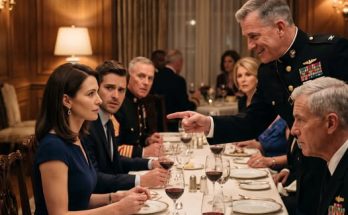
Three days later, the facts began moving faster than the rumors.
Nolan was charged first with obstruction-related offenses while investigators built the corruption case around the older conduct.
Additional financial charges were expected.
Mercer entered a formal cooperation agreement and was placed on administrative leave pending review.
Rourke retained counsel and gave a full statement about transmitting the advisory.
Ellison remained hospitalized but stable.
No one called any of that closure.
It was process.
Process mattered.
So did patience.
William came to my apartment the first evening Bell released it from evidence processing.
He stood inside the doorway and looked at the open drawers, dusted surfaces, and little numbered adhesive markers investigators had missed removing.
Margaret stood behind him.
She had insisted on coming.
“I leave you men unsupervised for one birthday,” she said, “and apparently everyone begins uncovering federal crimes.”
William looked at her.
“I was not the federal crime.”
“That is the minimum standard for marriage.”
Ethan laughed for the first time in days.
The sound loosened something in the room.
Natalie arrived twenty minutes later carrying food.
No one had asked her.
She announced that nobody involved in an investigation should be trusted to remember dinner.
She was probably right.
For an hour, we behaved like a family trying very hard not to discuss why federal agents had dusted my cabinets.
Then Margaret asked the obvious question.
“So William was cleared?”
William winced.
“Margaret.”
“What?”
“That is not how investigations work.”
She pointed her fork at him.
“You were not involved in the delay.”
“The recording indicates that.”
“The dead admiral explicitly said keep Brooks out.”
“Yes.”
“Nolan is arrested.”
“Yes.”
“Then allow me one uncomplicated sentence.”
William surrendered.
“Yes. The evidence currently clears me of involvement in the delay.”
Margaret smiled.
“See?”
Natalie leaned toward me.
“Imagine growing up with this.”
“I’m beginning to.”
Ethan looked at me when I said it.
The glance lasted slightly too long.
I knew the conversation was still waiting.
Later, after everyone left, we stood in the kitchen.
The apartment looked almost normal again.
The metal case sat on the table.
Returned.
Inventoried.
Sealed evidence copies removed.
My original notebook inside.
Ethan looked at it.
“Are you keeping it?”
“Yes.”
“Thought so.”
He leaned against the counter.
I waited.
He did too.
This was how we had become lately.
Two people learning that silence could either create space or hide things.
Finally he said, “I’m angry at you.”
I nodded.
“I know.”
“Don’t do that.”
“What?”
“Say ‘I know’ before I’ve told you why.”
Fair.
“All right.”
He folded his arms.
“I’m angry because you were willing to let me build a life with you while keeping an entire room in yourself locked.”
I did not answer immediately.
He continued.
“Not because I needed every operational detail. Not because you owed me classified information. Not because I wanted Meridian as a story.”
I looked at him.
“Then what?”
“Because it shaped you.”
That landed.
He moved away from the counter.
“The way you handle fear. The way you hate being questioned. The way you disappear into silence when something matters too much. The way you treat asking for help like a design flaw.”
“That last part is unfair.”
“It is extremely fair.”
I almost argued.
Didn’t.
He continued.
“Meridian didn’t just happen to you professionally. It changed how you trust people.”
“Yes.”
“And you let me feel the consequences without letting me understand the cause.”
That hurt because it was true.
I looked toward the window.
The same city rain from William’s birthday had returned, light against the glass.
“I thought protecting the boundary protected us.”
Ethan shook his head.
“It protected you.”
I looked at him.
“Maybe.”
“No.”
His voice was not cruel.
“Definitely.”
I let the sentence sit.
Then I said, “You’re right.”
He exhaled.
Not victorious.
Tired.
“I don’t need you to tell me everything.”
“I know.”
He gave me a look.
I corrected.
“I understand.”
“Better.”
“What do you need?”
“That is the first useful question you’ve asked tonight.”
I deserved that.
He sat at the table.
I sat opposite.
He put one hand near the metal case but did not touch it.
“I need you to stop deciding for me which truths I can handle.”
That sentence reached farther back than Meridian.
Into every relationship I had managed by withholding discomfort until it became structurally important.
“I did that.”
“Yes.”
“I thought it was restraint.”
“Sometimes it was.”
“And sometimes?”
“Control.”
I looked down.
Pilots liked control.
We called it discipline.
Preparation.
Command presence.
But control could become arrogance when applied to other people’s emotional choices.
“I’m sorry.”
He watched me carefully.
The apology felt different from Coleman’s.
Not because mine was better.
Because I knew what I was apologizing for.
“I’m sorry I let you think the blank spaces were harmless when I knew they weren’t.”
Ethan’s shoulders lowered slightly.
“I can work with that.”
“Can you?”
“Yes.”
“Even after all this?”
He glanced around the apartment.
“I’m not thrilled that dating you apparently includes NCIS interviews.”
“That was not in the brochure.”
“Your brochure was extremely misleading.”
I smiled.
Then he asked, “Were you planning to tell me eventually?”
I considered lying beautifully.
Instead I told the ugly truth.
“I don’t know.”
His face changed.
“Thank you.”
“For the worst possible answer?”
“For the real one.”
We sat quietly.
Then he pointed at the notebook.
“Can I ask about something?”
“Yes.”
“You said fear came later.”
“In the shower.”
“Was that the only time?”
I understood what he meant.
“No.”
“When else?”
I looked at my hands.
“For months afterward, whenever weather got bad.”
“You kept flying.”
“Yes.”
“How?”
“Because weather is not a moral force.”
He waited.
“That sounds like something you tell students.”
“It is.”
“What did you tell yourself?”
The answer came from memory.
“Facts first.”
He waited.
“Altitude. Fuel. Distance. Wind. Aircraft state. Crew state. Mission need.”
“Not fear.”
“Fear came after facts.”
“Did that help?”
“Yes.”
“Does it still?”
“Usually.”
He nodded.
Then he surprised me.
“What did Lantern mean before Meridian?”
I laughed softly.
“Nothing heroic.”
“Good.”
“You sound relieved.”
“I’m tired of heroic explanations.”
“That makes two of us.”
I told him.
During training, I had once insisted a cockpit warning light was flickering when no one else saw it.
Maintenance found an intermittent electrical fault.
One instructor joked I could see lights in darkness before anyone else.
Lantern stuck.
Ethan smiled.
“That’s disappointingly wholesome.”
“It was mostly used sarcastically.”
“Better.”
The story felt lighter in his hands than I expected.
Maybe that was what I had feared.
Not that he would worship Meridian.
That he would make it ordinary.
Ordinary meant it could belong in our life without ruling it.
The next morning, William called.
“Nolan has begun cooperating.”
“What does that mean?”
“It means his lawyer believes arithmetic exists.”
“Financial arithmetic?”
“Sentencing arithmetic.”
That sounded like William.
“What did he admit?”
“Not everything.”
“What matters?”
“He confirmed Vale orchestrated the delay.”
I sat straighter.
“Nolan’s role?”
“He knew the purpose.”
“So he lied to Mercer.”
“Yes.”
“Repeatedly.”
“Yes.”
“And Vance?”
“Nolan says Vale ordered access to Vance’s files during the delay.”
“Did Nolan participate?”
“He claims he objected.”
I heard the skepticism in William’s silence.
“What does the evidence show?”
“Money ties him to the network.”
“That’s not the same as the file theft.”
“No.”
Good.
Even now, distinctions.
“What about Vale?”
“Dead. No prosecution.”
“Legacy findings?”
“Likely.”
“Rourke?”
“Cooperating fully.”
“Mercer?”
“Likely disciplinary consequences despite cooperation.”
“Ellison?”
“Recovering.”
“And the board appointment?”
“Canceled.”
I looked toward the kitchen where Ethan was making coffee.
“William.”
“Yes?”
“You signed the report.”
A pause.
“Yes.”
“You never told me.”
“No.”
“Why?”
His answer came quietly.
“Because I was ashamed that my signature appeared on something I had not questioned deeply enough.”
I understood that too well.
“You did not know the raw sequence.”
“No.”
“But you trusted the package.”
“Yes.”
“Because?”
“Because systems train senior people to assume someone beneath them verified what matters.”
“And people beneath them assume senior people know more.”
“Yes.”
There it was.
Meridian’s institutional lesson.
Not evil.
Not heroism.
A chain of assumptions.
Vale exploited them.
Nolan protected them.
Mercer hid inside them.
Rourke obeyed them.
William signed through them.
I nearly died flying through the space they created.
“I judged Coleman for assumptions,” I said.
William was quiet.
“So did I.”
“And yet?”
“And yet none of us are free of the habit.”
That conversation stayed with me.
Two days later, Coleman sent a letter.
Not an email.
Paper.
Handwritten.
I considered not opening it.
Then I did.
It was short.
He did not mention Meridian’s revelations.
Did not mention rank.
Did not praise me.
He wrote that at William’s birthday he had confused familiarity with expertise, confidence with credibility, and my refusal to satisfy him with evidence against me.
He wrote one line I read twice.
I did not doubt you because your answers were weak. I doubted you because they did not flatter my expectations.
That was better.
He ended without asking forgiveness.
I folded the letter.
Ethan asked what I thought.
“I think he finally apologized for the right thing.”
“Are you forgiving him?”
“That’s a different question.”
“Fair.”
I placed the letter in the metal case.
Not because it belonged with Meridian.
Because it belonged with the lesson.
A week later, the Navy scheduled a formal supplemental review.
Not disciplinary.
Historical and operational.
They wanted the timeline corrected.
They wanted the hold source documented.
They wanted the procurement interference separated from legitimate weather concerns.
And they wanted me to testify.
I agreed.
Before the hearing, Hayes pulled me aside.
“There may be press afterward.”
“No.”
“You can decline.”
“I am declining.”
“Good.”
She smiled slightly.
“I thought so.”
Inside, the panel asked familiar questions.
21:44.
21:47.
Weather.
Fuel.
Survivor state.
The recommendation.
My decision.
Then one admiral asked:
“Commander Bennett, knowing what you know now, would you make the same decision?”
I hated the question.
Not because it was difficult.
Because hindsight cheats.
“I would make the decision based on the information available at the time.”
He nodded.
“And was the decision to proceed correct?”
I looked at him.
“Sir, the survivors lived.”
“That isn’t exactly what I asked.”
“No.”
I took a breath.
“The decision was defensible. The crew executed it successfully. But survival does not transform risk into correctness after the fact.”
The admiral watched me.
“Then what is the lesson?”
I thought of Coleman.
Vale.
Mercer.
William.
Rourke.
Ethan.
All of us.
“Make distinctions before making conclusions.”
The room went quiet.
I continued.
“Recommendation versus order. Evidence versus assumption. authority versus expertise. Good outcome versus good decision. Secrecy versus integrity.”
The admiral nodded slowly.
“Anything else?”
“Yes.”
I looked around the table.
“If someone asks for five minutes, understand what those five minutes cost everyone else.”
Click here to continue reading: PART 16: At William’s Next Family Dinner, Nobody Asked Me to Prove Who I Was, and That Was How I Knew Meridian Was Finally Over
The Quiet Detail in Ethan’s Family Dinner Invitation That Told Me His Father Had Already Recognized Something I Never Discussed
Part 15 of 16