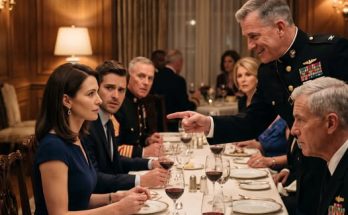
Rain gathered along the edge of the restaurant awning and spilled in a steady silver line onto the pavement. Ethan stood beside me with his hands buried in his coat pockets, watching traffic smear red taillights across the wet street. He had asked why I had never told him about Meridian, and I could not hide behind classification, privacy, or Colonel Coleman anymore.
“I didn’t know how,” I said.
Ethan looked at me.
It was the weakest answer I could have given, which was probably why it was the truest.
“You know how to explain complicated things,” he said quietly. “I’ve watched you explain flight systems to me using salt shakers.”
“That’s different.”
“Why?”
“Because engines don’t change how people look at you.”
His forehead creased.
I immediately regretted the sentence because it sounded like an accusation against him.
“That came out wrong.”
“Did it?”
A rideshare pulled to the curb. Someone behind us laughed while saying goodbye to another guest. The ordinary sounds of people ending an ordinary dinner made the space between Ethan and me feel even stranger.
I turned fully toward him.
“When people learn about Meridian, they stop hearing the rest.”
“What rest?”
“Everything before and after.”
He waited.
I struggled to put into words something I had never successfully explained even to myself.
“They hear storm, rescue, aircraft commander, and suddenly every quiet choice becomes courage. Every mistake becomes modesty. Every ordinary day gets rewritten as the life of somebody who did one extraordinary thing.”
Ethan watched my face.
“I don’t want to be somebody’s story about Meridian.”
“But you are still the person who did it.”
“Yes.”
“And you are also everything else.”
“That sounds obvious.”
“It is.”
“Most obvious things are much harder to live with than to say.”
He gave a tired breath that was almost a laugh.
Then he looked toward the restaurant windows.
“Did you think I’d become like Coleman?”
“No.”
The answer came too quickly.
He heard that.
“You thought I might become something.”
I pulled my coat tighter.
“I thought you might ask questions I wasn’t ready to answer.”
“That’s allowed.”
“I know.”
“Then why was that a reason not to tell me?”
Because questions from strangers were easy to refuse.
Questions from someone you loved stayed with you even after you said no.
I did not say that immediately.
The rain filled the pause.
Finally I said, “Because your questions matter.”
His expression changed.
Not softened exactly.
But the anger in it shifted.
I continued.
“If Coleman thinks I’m a liar, I sleep fine. If Reed thinks I made a bad decision at Meridian, I can live with that. If your father had decided I was reckless, I would disagree and continue with my life.”
“And me?”
I looked at him.
“If you asked whether I should have gone in, I would care what you thought.”
He stared at me for several seconds.
“That’s the reason?”
“Part of it.”
“What’s the rest?”
I looked down at the rainwater running along the curb.
“The officers we rescued weren’t the only people who almost died.”
He went completely still.
I had not intended to tell him that tonight.
The sentence had escaped because truth, once opened, had its own momentum.
“What do you mean?”
I heard myself answer in the same controlled voice I used when discussing accidents.
“Our aircraft took damage.”
“What kind?”
“Enough.”
“Claire.”
“I know.”
He stepped closer.
“You just told me the crew nearly died.”
“I said almost.”
“That distinction is not comforting.”
“It isn’t supposed to be.”
He studied my face as if searching for the part I still had not said.
“Were you injured?”
“No.”
That answer was technically accurate and emotionally evasive.
He saw it.
“What happened?”
I looked through the restaurant window.
William Brooks was visible near the table, saying goodbye to Reed. He glanced toward the glass and saw us.
He did not come outside.
Again, he gave me privacy.
I turned back to Ethan.
“The extraction did not end when we pulled them out.”
“What happened afterward?”
“We lost a system.”
“Which system?”
“One I am still not discussing on a sidewalk.”
“Fair.”
His patience hurt more than anger would have.
I continued.
“Then we lost another indication. The aircraft was flyable, but not comfortably. We were heavy. Visibility was still terrible. One of the rescued officers was barely responsive.”
Ethan’s face had gone pale.
“You flew back like that?”
“We didn’t have another option.”
“Was there anyone who could take the controls?”
“My copilot was capable.”
“Then why didn’t they?”
I hesitated.
Because that was where the story became complicated.
“It was my aircraft.”
“That’s not an answer.”
“Yes, it is.”
“No. That sounds like responsibility used as armor.”
I looked at him.
He did not look pleased with himself for saying it.
Good.
Neither was I.
“You’ve been waiting to use that sentence?”
“I came up with it three seconds ago.”
“It’s irritatingly good.”
“Thank you.”
Despite everything, I smiled.
Only briefly.
Then Ethan said, “Were you scared?”
There it was.
The question I hated most.
People preferred two answers.
Yes, because fear made bravery more meaningful.
No, because fearlessness made legends cleaner.
The truth was less satisfying.
“I didn’t have time to name it.”
He waited.
“I remember being aware of consequences. I remember thinking about fuel, altitude, distance, the injured officer, the weather. I remember wondering whether one vibration meant what I thought it meant. But fear?”
I shook my head.
“That came later.”
“When?”
“In the shower.”
He blinked.
“What?”
“Back on the ship.”
The memory returned with humiliating clarity.
Hot water striking my shoulders.
The smell of soap.
My hands suddenly shaking so badly I had dropped the bottle.
“I was fine until then.”
Ethan said nothing.
“I stood under the water for maybe ten minutes and couldn’t get my fingers to work properly.”
He looked away.
That was almost worse than watching him absorb it.
“The crew knew?”
“No.”
“Why not?”
“Because by the time I saw them again, my hands had stopped shaking.”
“Claire.”
“What?”
“That sounds deeply unhealthy.”
“I didn’t say it was ideal.”
He ran a hand through his hair, wetting it with rain blown under the awning.
“I wish you’d told me.”
“I know.”
“Not because I needed the impressive version.”
“I know.”
“Not because I wanted proof.”
“I know.”
“Then stop saying you know like it ends the conversation.”
That struck harder than I expected.
I went quiet.
He regretted the sharpness immediately.
“I’m sorry.”
“No. You’re right.”
He waited.
I forced myself not to retreat into silence.
“I didn’t tell you because I didn’t trust what the story would do between us.”
His face tightened.
“That’s not the same as not trusting me.”
“Maybe it is.”
There.
I had finally said the thing I had spent months avoiding.
Ethan looked down.
The rain kept falling.
“I don’t know what to do with that,” he said.
“You don’t have to do anything tonight.”
“That sounds like what you say when something is on fire and you’re pretending it isn’t.”
“It’s not on fire.”
“Claire.”
“Smoldering.”
He gave a tired, unwilling laugh.
Then his expression sobered.
“I love you.”
The words were not new between us.
The timing was.
I looked at him.
“And I love you.”
“That doesn’t solve this.”
“No.”
“But it means I’m not leaving because you didn’t tell me one story.”
Relief moved through me so sharply that it embarrassed me.
He saw it.
His eyes narrowed.
“Did you think I might?”
“No.”
He stared.
I sighed.
“Possibly.”
“Wonderful.”
“I’m working on honesty.”
“Please continue.”
I looked toward the street.
“I knew Coleman was wrong about me, so he didn’t scare me. Tonight you scared me.”
Ethan’s expression softened despite himself.
“Because?”
“Because I care whether you stay.”
The sentence hung between us.
He took his hands from his pockets.
Then, without rushing, he pulled me toward him.
I let him.
For several seconds, I rested my forehead against his chest and listened to rain strike the awning above us.
He did not ask anything else.
That restraint told me more than reassurance could have.
When we finally pulled apart, William had come outside.
He stood several yards away, deliberately looking toward the street as if he had not noticed us.
Ethan wiped rain from his face.
“Dad.”
William turned.
“Your mother has decided the cake must go home with someone.”
“Give it to Natalie.”
“Natalie has taken enough cake to feed a destroyer crew.”
He looked at me.
“You all right?”
The familiar question.
This time, I answered differently.
“Not entirely.”
William nodded.
“Usually a better answer.”
Ethan glanced between us.
“You really did know who she was.”
William looked toward me.
“I suspected.”
“From when?”
“The first dinner.”
“How?”
William hesitated.
I could have stopped him.
I did not.
“Her name.”
Ethan frowned.
“That’s it?”
“No.”
“What else?”
William studied me.
“Her reaction when Pensacola came up.”
I felt exposed in a way Coleman had never achieved.
Ethan looked at me.
“You reacted?”
“Apparently.”
“You didn’t notice?”
William asked.
Ethan gave him a look.
“I was trying not to panic because my girlfriend was meeting a retired admiral.”
William appeared deeply unimpressed.
“I was retired, not contagious.”
“You still organize place settings by seniority.”
“That happened once.”
“Three Thanksgivings.”
William ignored him.
His attention returned to me.
“There was another reason.”
I already knew what he would say.
“The name Bennett appeared in the Meridian review.”
I nodded.
Ethan looked at his father.
“You read it?”
“Parts.”
“Why?”
William’s face changed slightly.
“Because I was one of the officers who received the operational summary.”
I stared at him.
That I had not known.
He continued.
“The incident had training implications. Several commands received portions of the analysis.”
“Were you involved in judging the decision?” Ethan asked.
William considered the wording.
“No.”
“Did you agree with what she did?”
I looked sharply at Ethan.
He caught himself.
“Sorry.”
I understood why he had asked.
But I also felt old defenses rise instantly.
William saw them.
He answered with precision.
“My opinion was never the issue.”
Ethan nodded.
William turned to me.
“For what it’s worth, the final review did not characterize your decision as reckless.”
That word landed harder than it should have.
I folded my arms.
“What did it characterize it as?”
William’s eyes held mine.
“Necessary under deteriorating conditions, provided the crew possessed the training and judgment to execute the risk.”
I knew that language.
I had read it once.
Then never again.
Ethan watched me absorb it.
“You knew that?”
“Yes.”
“You never told me.”
I looked at him.
“Apparently tonight’s theme is things I never told you.”
William exhaled through his nose.
“An unfortunate choice for my seventieth.”
The restaurant door opened behind him.
Colonel Coleman stepped outside.
The three of us went quiet.
He saw us and stopped.
For one awkward second, none of us moved.
Then he looked at William.
“Margaret said you were out here.”
“She has remarkable observational abilities.”
Coleman gave a strained nod.
His attention shifted to me.
“I won’t keep you.”
He clearly wanted to say more.
I could see the apology waiting behind his teeth.
He remembered what I had told him inside and did not offer it.
That was, unexpectedly, the first thing he did all evening that made me believe he might have heard me.
Instead he said, “Good night, Claire.”
“Good night.”
He walked toward the parking area.
Ethan watched him leave.
“Was he always like that?”
William took his time answering.
“Not always.”
“That sounds ominous.”
“It means people become habits if nobody interrupts them.”
I looked toward Coleman’s retreating figure.
The sentence stayed with me.
Then William faced me.
“There is something else you should know.”
Ethan and I both looked at him.
William did not seem pleased.
“The Meridian review was circulated more broadly than you may realize.”
A cold sensation returned beneath my ribs.
“How broadly?”
“Joint aviation commands. Certain training groups. Some senior leadership.”
“That isn’t new.”
“No.”
“Then what is?”
William’s jaw tightened.
“A version of the report is being discussed again.”
I stared at him.
“Why?”
“I don’t know yet.”
“When did you hear that?”
“Last week.”
“You didn’t think to mention it?”
“I intended to.”
“When?”
“After my birthday.”
“That is an extremely admiral answer.”
Ethan looked between us.
“Why would an old mission be discussed now?”
William’s gaze remained on me.
“That is the question.”
I felt the evening shift once more.
Meridian had been years ago.
Reviewed.
Filed.
Reduced to lessons learned.
Nothing operational should have brought it back.
Unless something connected to it had changed.
“Who brought it up?” I asked.
William hesitated.
“A former Pentagon colleague.”
“What exactly did he say?”
“That people were asking about the decision chain.”
My stomach tightened.
“Which part?”
“The hold recommendation.”
The rain suddenly sounded much louder.
Ethan looked confused.
“What does that mean?”
I did.
If people were reexamining the recommendation to hold, they were no longer studying the rescue.
They were studying who had issued advice, who had authority, and why the aircraft had been permitted to continue.
That meant someone was looking upstream.
Not at me.
At command.
I looked at William.
“Did he say why?”
“No.”
“But you have a guess.”
“Yes.”
“What?”
William glanced toward Ethan, then back to me.
“I would rather not guess until I know.”
I almost argued.
Then I saw something in his face that stopped me.
Concern.
Real concern.
Not about his reputation.
Not about mine.
About something hidden inside the old operation.
Ethan said, “Dad, what aren’t you saying?”
William did not answer him.
His eyes stayed on me.
“Claire, if anyone contacts you about Meridian, do not answer informally.”
The words were so specific that my pulse quickened.
“Who would contact me?”
“I don’t know.”
“That isn’t reassuring.”
“It isn’t intended to be.”
I stepped closer.
“What happened?”
William’s expression closed.
“Nothing yet.”
“You’re doing exactly what I did to Ethan.”
A pause.
“Yes.”
“At least you admit it.”
“I am asking for twenty-four hours.”
“Why?”
“Because I want to verify something before I put a possibility into your head.”
I hated that.
But I understood it.
“Twenty-four.”
He nodded.
Ethan looked from his father to me.
“I feel like the only civilian in a language class I didn’t enroll in.”
I reached for his hand.
“You’re not the only one confused.”
William opened the restaurant door.
Before stepping inside, he looked back at me.
“One more thing.”
“What?”
“Do you still have your Meridian notes?”
The question hit harder than everything before it.
The private notebook.
Handwritten fuel calculations.
Crew observations.
A timeline I had built because the official sequence felt too clean compared with memory.
I had never shown it to anyone outside the inquiry.
“Yes.”
William’s expression tightened.
“Keep them somewhere secure.”
Then he went inside.
Ethan looked at me.
“What notes?”
I kept watching the door.
For years, Meridian had been a story other people remembered incorrectly.
Tonight, for the first time, I began to wonder whether someone had remembered it incorrectly on purpose.
Click here to continue reading: PART 6: The Old Notebook I Had Never Opened for Ethan Contained One Time Stamp That No Official Meridian Report Had Ever Explained
The Quiet Detail in Ethan’s Family Dinner Invitation That Told Me His Father Had Already Recognized Something I Never Discussed
Part 5 of 16