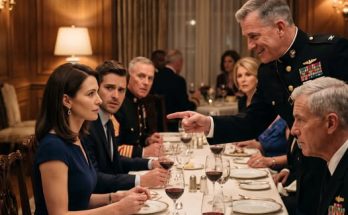
Six months after William’s seventieth birthday, Margaret invited everyone back to the same restaurant.
William objected immediately.
“Absolutely not.”
Margaret ignored him.
“It is not your birthday.”
“That room is cursed.”
“It is a private dining room.”
“Same thing.”
Natalie supported Margaret because Natalie supported anything likely to annoy her father.
Ethan remained neutral until Margaret promised the garlic potatoes.
Then principle collapsed.
I agreed last.
Not because of the room.
Because of what it represented.
The last time I entered that restaurant, I carried Meridian as a sealed compartment in my life.
I left with the door torn open.
Six months later, almost everything had changed.
The supplemental review officially corrected the operational timeline.
Vale was named as the senior officer who directed the informal delay.
Nolan admitted he knew Vale wanted time to access Vance’s procurement material and that he failed to report the misconduct.
Financial investigators documented money moving through entities connected to Vale’s family and Nolan’s network.
Mercer acknowledged suppressing operational context and later failing to report evidence promptly once corruption indicators became clear.
Rourke accepted responsibility for transmitting the advisory without forcing clearer accountability.
Ellison recovered from the crash and entered witness protection protocols while the wider contracting case proceeded.
Vance’s records became central evidence.
Daniel Shaw, the second officer rescued during Meridian, gave a statement confirming Vance had been deeply concerned about missing files immediately after recovery.
No hidden mastermind emerged after Nolan.
That mattered to me.
Reality was messy enough.
Vale had been greedy.
Nolan had been complicit.
Mercer had been weak where courage was required.
Rourke had obeyed too easily.
Others had missed pieces, trusted systems, or accepted explanations that arrived wearing enough authority.
That was the truth.
Not a conspiracy so perfect it required genius.
A sequence of human failures arranged around one deliberate crime.
William was formally cleared of involvement in the delay or suppression.
His “reviewed / no objection” signature remained part of the record.
He asked that it remain.
When I asked why, he said removing uncomfortable facts was how Meridian became distorted in the first place.
That answer sounded like him.
Coleman did not attend the dinner.
He and William were still friends, though apparently a more argumentative version of friendship had developed after the birthday.
Natalie claimed this was healthy.
Margaret called it exhausting.
I had not seen Coleman since.
His letter remained enough.
The private room looked almost identical.
Same long table.
Same city lights.
Different arrangement.
William insisted I sit nowhere near the seat I had occupied before.
“Superstitious?” I asked.
“Operational risk reduction.”
“You are retired.”
“Risk remains employed.”
Ethan whispered, “This is what I grew up with.”
Dinner began.
No one asked what I flew.
No one asked my rank.
No one asked flight hours, deployments, call sign, squadrons, or combat time.
At first I noticed the absence.
Then I stopped noticing.
That was better.
Captain Reed came.
He greeted me with a handshake.
“How’s the weather?”
“Exists.”
“Terrible.”
“Usually.”
He smiled.
Then asked if I had read a new aviation safety report.
We argued about two paragraphs for fifteen minutes.
It was the most normal pilot conversation I had enjoyed in months.
Later Natalie raised her glass.
“I would like to propose a toast.”
William immediately said, “No.”
“You don’t know what I’m saying.”
“I know you.”
Margaret smiled.
“Continue, darling.”
Natalie stood.
“To Dad.”
William looked suspicious.
“For reaching seventy and somehow turning his birthday dinner into an Inspector General matter.”
Laughter broke around the table.
William closed his eyes.
Natalie continued.
“To Claire, for surviving both naval aviation and our family.”
More laughter.
“And to Mom, who was right that none of us deserved dessert.”
Margaret lifted her glass.
“Finally, someone acknowledges leadership.”
We drank.
I looked around the room.
Months earlier, this table had felt like a courtroom because one man decided I needed to demonstrate legitimacy.
Now nobody needed proof.
Not because Meridian had made me more credible.
Because the people who mattered had learned that credibility was not something they could demand on command.
After dinner, William asked me to walk with him.
We stepped onto a small terrace outside the private room.
Cold air moved between the buildings.
He put both hands in his coat pockets.
“You all right?”
I laughed.
“What?”
“You have asked me that question approximately forty-seven times since we met.”
“Consistency is a virtue.”
“Not always.”
He nodded.
“Fair.”
We stood in silence.
Then he said, “I owe you an apology.”
My stomach tightened slightly.
“For what?”
“Recognizing you and saying nothing.”
I looked at him.
“That wasn’t wrong.”
“Maybe not.”
“Then why apologize?”
“Because part of my silence was respect.”
“And the rest?”
“Cowardice.”
That surprised me.
He continued.
“I suspected you were Lantern. I also suspected your discomfort around Meridian meant something remained unresolved.”
“You could not have known this.”
“No.”
“But?”
“I had seen the review.”
“Not the raw material.”
“No.”
He looked toward the city.
“I knew the report was unusually tidy.”
That phrase.
Too clean.
“What did you think?”
“That someone had done excellent staff work.”
I smiled faintly.
“And now?”
“Now I know excellent staff work can sometimes mean somebody removed everything inconvenient.”
We stood quietly.
He continued.
“When you appeared in my son’s life, I chose not to revisit any of it.”
“That was probably appropriate.”
“Professionally, yes.”
“And personally?”
He looked at me.
“I was relieved.”
“Why?”
“Because Meridian had bothered me for years.”
“You never told me.”
“No.”
“I’m noticing a family pattern.”
“That is unfair.”
“It is extremely fair.”
He gave me a reluctant smile.
Then his expression changed.
“I was relieved to meet you because you seemed fine.”
I understood.
“You wanted proof that the operation ended cleanly.”
“Yes.”
“It didn’t.”
“No.”
“Neither did I.”
“I know that now.”
I looked through the glass doors at Ethan.
He was helping Margaret pack leftovers.
Natalie was stealing one of them.
William followed my gaze.
“He loves you.”
“I know.”
He looked at me.
I corrected myself.
“I understand.”
“Good.”
He had learned that too.
When we went back inside, Ethan handed me my coat.
“Ready?”
“Yes.”
We walked home.
No rain this time.
The city was cold and clear.
For three blocks, neither of us mentioned Meridian.
That became increasingly meaningful.
At the apartment, Ethan set two glasses of water on the table.
The metal case was no longer there.
I had moved it.
Not hidden.
Stored.
There was a difference.
A week earlier, I had finally scanned the notebook, created secure copies, and placed the original in approved archival storage with the supplemental review record.
I kept one personal photocopy.
Not because I expected another conspiracy.
Because forgetting had almost been as dangerous as secrecy.
Ethan noticed the empty table.
“You miss the box?”
“No.”
“Really?”
“No.”
“That sounded convincing.”
“I’m practicing.”
He sat.
Then he reached into his jacket pocket.
“I have something.”
“If it is another federal subpoena, we are breaking up.”
“That seems harsh.”
“Reasonable boundary.”
He put a small object on the table.
A key.
I stared.
“What is that?”
“My apartment.”
“You already gave me one.”
“Old apartment.”
I looked at him.
He smiled.
“I signed the new lease.”
The apartment we had looked at two months earlier.
More space.
Two bedrooms.
A small balcony.
Neutral commute.
I had refused to discuss it while the investigation remained active.
“You signed it?”
“Yes.”
“Without me?”
“You approved the place.”
“That is not the same thing.”
“You said, and I quote, ‘I would live here.’”
“That is not contractual language.”
“It was emotionally binding.”
I picked up the key.
“You’re impossible.”
“Are you moving in?”
That was the real question.
Not the apartment.
Not logistics.
Not furniture.
Whether I would stop living as though closeness required controlled access.
I turned the key in my fingers.
“Yes.”
His face changed.
“Just yes?”
“Yes.”
“No operational conditions?”
“Several.”
“There it is.”
“We are not buying that couch you liked.”
“That couch was excellent.”
“It looked like furniture from a dentist’s waiting room.”
“It had lumbar support.”
“No.”
“Fine.”
He came around the table.
I stood.
He kissed me.
Nothing dramatic.
No orchestra.
No revelation.
Just two people in a kitchen after months of discovering that truth was not the same thing as complete disclosure and privacy was not the same thing as distance.
A month later, we moved.
William arrived at 0700 despite being told 0900.
Margaret arrived at 0830 with coffee.
Natalie arrived at 1030 and claimed she had been delayed by “strategic scheduling realities.”
Nobody believed her.
Captain Reed showed up unexpectedly with a hand truck.
Coleman did not.
That was fine.
By noon, boxes covered every room.
Ethan found my framed flight photograph.
The one cropped carefully enough that nobody could identify where it had been taken.
He held it up.
“Where does this go?”
I almost said office.
Instead I looked toward the living room wall.
“There.”
He raised his eyebrows.
“Public display?”
“It is a photograph.”
“Historic development.”
“Hang it before I change my mind.”
He did.
People seeing it would still not know the whole story.
That no longer bothered me.
They did not need to.
The photograph was not proof.
It was simply part of my life.
Weeks passed.
Then months.
The final Meridian report arrived on a Tuesday.
I opened it at the kitchen table.
Ethan sat across from me reading something on his laptop.
He did not ask to see the report.
That was why I handed it to him.
The document corrected the timeline.
Documented Vale’s direction.
Recorded Nolan’s involvement.
Clarified Mercer’s suppression of context.
Included Rourke’s testimony.
Referenced the recovered audio.
Preserved William’s review signature with explanation.
And described my crew’s decision in language close to the original finding:
Operationally justified under rapidly deteriorating conditions based on available information.
No hero language.
Good.
Then I reached the section on causation.
The review concluded that the unauthorized delay increased risk to the survivors and rescue crew.
Five minutes.
Written formally.
Measured cleanly.
Those five minutes had occupied seven years.
Ethan read the page.
Then looked at me.
“What are you thinking?”
“That paper makes everything look tidy.”
He nodded.
“Too tidy?”
“No.”
I considered.
“Tidier than life.”
He handed the report back.
“What will you do with it?”
“Archive it.”
“Not the metal box?”
“No.”
“Progress.”
I looked at him.
“Careful.”
He smiled.
The Navy eventually incorporated Meridian into training.
Not as a heroic case study.
At my request, the curriculum focused on ambiguous authority, communication provenance, decision-making under incomplete information, and the danger of allowing rank to replace verification.
I taught one session.
Only one.
A young lieutenant asked whether I had known proceeding would succeed.
“No.”
He looked surprised.
“Then how did you decide?”
“By identifying what I knew, what I did not know, and which risks changed if we waited.”
He frowned.
“So courage wasn’t part of it?”
I thought about the shower afterward.
My shaking hands.
Coleman at dinner.
William’s silence.
Ethan’s anger.
Rourke’s guilt.
Mercer’s avoidance.
“No,” I said.
“Courage is usually what people call decisions after they already know the ending.”
The lieutenant wrote that down.
I almost told him not to.
Then I let him.
On William’s seventy-first birthday, dinner was at home.
Margaret made the potatoes.
Natalie gave William a framed photograph of a dishwasher labeled GALLEY SUPPORT SYSTEM.
He threatened to disinherit her.
Ethan asked where I had put the candles.
Nobody asked about Meridian.
That was the first anniversary of the birthday dinner when I realized I had gone an entire day without thinking about the hold advisory.
Not forgotten.
Just not thinking about it.
There was a difference.
After dinner, William poured coffee.
Coleman’s name came up because he had sent a bottle of Scotch.
Margaret asked whether I had ever answered his letter.
“No.”
“Will you?”
“Probably not.”
William nodded.
“He understands.”
“How?”
“I told him silence is an answer.”
I smiled.
“Useful skill.”
William looked at me.
“Learned recently.”
Later, Ethan and I walked home.
He slipped his hand into mine.
“Do you ever wish Dad had never asked your call sign?”
I thought about it.
If William had stayed silent, Coleman might have continued.
Maybe I would have left angry.
Maybe Meridian would have resurfaced anyway through Vance’s records.
Maybe the notebook would still have been found.
Maybe not.
Counterfactuals were another kind of weather.
Interesting.
Impossible to fly.
“No.”
Ethan looked surprised.
“Really?”
“Really.”
“Why?”
“Because the question wasn’t the problem.”
“What was?”
“Who believed they were entitled to the answer.”
He nodded.
We kept walking.
Then he said, “For the record, I still think Lantern is a cool call sign.”
“It came from a warning light.”
“I know.”
“That is not cool.”
“It is to me.”
“You have terrible judgment.”
“I’m dating you.”
I looked at him.
He smiled.
I laughed.
And that was how Meridian finally ended for me.
Not when Nolan was arrested.
Not when the recording was recovered.
Not when William was cleared.
Not when the report was corrected.
Not even when the Navy formally closed the supplemental review.
It ended when the people closest to me no longer needed the story to understand me, and I no longer needed silence to protect myself from being misunderstood.
Years earlier, over black water, I had learned that waiting could be a decision.
Much later, I learned the opposite truth.
Speaking could be one too.
You did not owe every person your history.
You did not need to perform your credentials for strangers.
You did not have to answer every demand simply because someone framed it as curiosity.
But the people you chose to love were different.
Not because they were entitled to every secret.
Because trust required giving them enough truth to stand beside you without guessing where the ground ended.
On William’s birthday, Colonel Coleman had looked at me and seen a quiet woman who did not match the pilot in his imagination.
Then he heard one word.
Lantern.
Suddenly he believed.
For a while, I had thought that moment was the lesson.
It wasn’t.
The lesson was that I had been exactly the same person before he believed me.
The same pilot.
The same record.
The same choices.
The same woman.
Proof had changed Coleman.
It had never changed me.
Ethan understood that long before I did.
And once I understood it too, I stopped carrying Meridian like a credential I was refusing to show.
It became what it had always been.
Something that happened.
Something I survived.
Something I learned from.
One chapter in a life much larger than the storm.
The End
Read more original stories on Feel Every Story.
The Quiet Detail in Ethan’s Family Dinner Invitation That Told Me His Father Had Already Recognized Something I Never Discussed
Part 16 of 16