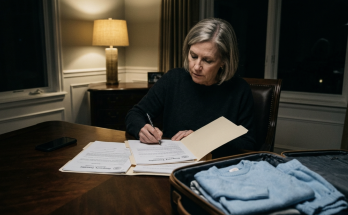
I read the message transcript later that afternoon.
Vanessa: I’m going to leave before I do something stupid.
Mom: Sit down. Don’t give Rachel the satisfaction.
Vanessa: I’m serious.
Mom: So am I.
Vanessa: Lily is upset.
Mom: She’ll be more upset if you teach her to surrender.
Vanessa: This is ridiculous.
Mom: Then end it.
Those were the messages exchanged while we were all in the same house.
While Emma and Lily played.
While Dad moved dishes.
While I sliced bread.
Vanessa had recognized that she was losing control.
Mom had told her to stay.
That did not make Mom’s hand close around the skillet.
It did something else.
It removed an exit Vanessa had identified herself.
I hated that distinction because it forced me to hold multiple truths at once.
Vanessa was responsible.
Mom had escalated her.
Dad had enabled both.
I had underestimated the seriousness because the conflict had always been framed as family annoyance.
And two children had been dragged into something none of them created.
Detective Morales asked whether I wanted a copy of the transcript through my attorney once the process allowed.
“I don’t have an attorney.”
“You may want one.”
The sentence made everything feel larger again.
“Criminal attorney?”
“No. Family or protective-order counsel, depending on what you want regarding contact and boundaries.”
“I don’t want Emma around Vanessa.”
“That’s clear.”
“And not around Mom.”
Morales nodded.
“That can be addressed.”
“What about Lily?”
“That’s a separate matter because she’s Vanessa’s child.”
“I know.”
I hated how powerless that made me feel.
Not because I believed Lily should be taken permanently from her mother.
Because I had seen how easily adult narratives could reshape a child’s sense of reality.
“What happens if Vanessa sees Lily?”
“Professionals will assess safe contact.”
“Supervised?”
“Possibly.”
“What if Mom is there?”
“That would depend on restrictions and the family arrangement.”
I looked at her.
“I don’t want Mom near Lily either.”
“I understand.”
“But I’m not her parent.”
“No.”
That was the edge of my control.
I could protect Emma.
Claire could advocate.
Dad could tell the truth.
Authorities could investigate.
But Lily’s future relationship with Vanessa and Mom would not be mine to decide.
That evening, Vanessa sent a message through the approved channel.
It was forwarded to me by a victim advocate because it concerned Emma.
I expected another apology.
Instead, Vanessa had written a statement.
I need Rachel to know I remember deciding to leave. I was standing near the hallway and had my keys in my hand. Mom told me if I left, Rachel would use it forever as proof I was unstable. I stayed because I wanted to prove I wasn’t. That makes no sense now. I am not saying Mom made me throw the skillet. She didn’t. I did that. I want that clear. But I was trying to leave before I did something terrible, and she told me to sit back down. I wish I hadn’t listened.
I read it three times.
The clearest sentence was the one I had been waiting for without realizing it.
She didn’t. I did that.
Vanessa was not trying to erase her responsibility.
At least not in that statement.
Maya sat across from me.
“What do you think?”
“I think I don’t know what to do with it.”
“You don’t have to do anything.”
“She’s admitting it.”
“Yes.”
“That matters.”
“Yes.”
“It doesn’t undo it.”
“No.”
I looked at the screen again.
“I hate that I’m relieved.”
“Why?”
“Because it would be easier to hate her if she blamed Mom for everything.”
Maya nodded.
“People are inconvenient.”
“That might be the theme of this week.”
“Strong theme.”
The next day, I met with an attorney referred by the victim advocate.
Her name was Leah Grant.
She asked fewer emotional questions than I expected.
Instead, she focused on boundaries.
Who had keys?
Changed.
Who knew Emma’s preschool?
Everyone.
Who was authorized for pickup?
Mom had been.
Not anymore.
Had I notified the school?
Not yet.
“Do it today.”
I wrote it down.
“Vanessa?”
“Never authorized.”
“Photographs?”
“What about them?”
“Does the school post publicly?”
“Sometimes.”
“Ask them not to include Emma for now.”
My chest tightened.
Another consequence.
Emma would have to be excluded from class photos online because adults had turned ordinary images into ammunition.
Leah saw my expression.
“It doesn’t have to be permanent.”
“I know.”
“Temporary privacy is not punishment.”
I wrote that down too.
We discussed protective orders.
Leah explained that legal options depended on evidence, jurisdiction, and what the court found appropriate.
She did not promise certainty.
I appreciated that.
When I returned to Maya’s, Emma and Lily were painting at the kitchen table.
Claire sat nearby.
Emma held up a piece of paper.
“Mommy, look.”
Two girls under a purple sky.
Both wore blue dresses.
My throat tightened.
“They look happy.”
“They’re at the beach.”
Lily corrected her.
“It’s a lake.”
Emma frowned.
“Beach.”
“Lake.”
“Beach.”
Claire looked at me.
I waited.
After a moment, Lily said, “Beach-lake.”
Emma nodded.
Problem solved.
I sat beside them.
“Can I ask something?”
They both looked at me.
“Not about Sunday.”
Claire relaxed.
“Would you two like different-color paint?”
“No,” Emma said.
“We’re sharing,” Lily added.
Simple.
I watched them dip brushes into the same blue cup.
The color had not become poisoned for them.
That mattered.
Later, Dad called.
“I spoke to Vanessa.”
My body tensed.
“You’re allowed?”
“She contacted me through the permitted channel about Lily.”
“What did she say?”
“She asked me to apologize to you.”
I laughed once.
“For what?”
“For staying silent at dinner.”
“That apology should come from you.”
“I know.”
“Not from her.”
“I know.”
Dad was quiet.
“Rachel, there’s something I need to tell you about your mother.”
My stomach tightened.
“What now?”
“She’s been doing this longer than eight months.”
“How long?”
“I found old family emails.”
“Dad.”
“I didn’t search after you told me not to. Police asked me to help identify an account.”
“Okay.”
“There are messages from when you were pregnant with Emma.”
I sat down.
“What kind?”
“Your mother telling Vanessa that she needed to protect Lily from being pushed aside once the new baby came.”
My eyes closed.
Before Emma was born.
The rivalry predated the child.
“She wrote that?”
“Yes.”
“What did Vanessa say?”
“At first, that babies don’t replace people.”
I almost laughed from grief.
“Of course.”
Dad continued.
“Then Mom kept bringing it up.”
“How?”
“She’d say things like, ‘Everyone will fuss over Rachel now.’ ‘Make sure Lily still gets attention.’ ‘Don’t let them forget who the first granddaughter was.’”
I put my hand over my mouth.
First granddaughter.
As if birth order created ownership.
“How long before Vanessa started agreeing?”
“Months.”
That was the worst answer possible.
Not because it excused Vanessa.
Because it showed how ideas became normal.
Repeat something often enough.
Attach it to fear.
Use love as justification.
Eventually a person could mistake insecurity for evidence.
“Dad, why didn’t you stop her?”
“I didn’t see all of it.”
“But you heard some.”
“Yes.”
“And?”
“I thought she was trying to reassure Vanessa.”
I closed my eyes.
“Reassurance would have been telling her Lily wasn’t being replaced.”
“I know.”
“Instead she confirmed the fear.”
“Yes.”
The pattern was older than Emma.
Maybe older than Lily.
Maybe older than either of us.
“Did Mom do this when we were children?”
Dad said nothing.
My heart sank.
“Dad.”
“I think so.”
The words were almost inaudible.
“What do you mean?”
“She used to tell Vanessa you got more attention because you were younger.”
I stared at the wall.
“Did I?”
“Babies need more attention.”
“That’s not what I asked.”
“You did for a while.”
“And then?”
“As you got older, things evened out.”
“Did Mom tell Vanessa that?”
“I don’t remember.”
“Did she tell me Vanessa deserved more because she was older?”
“Yes.”
Memories surfaced.
Vanessa choosing first.
Vanessa getting the front seat.
Vanessa receiving the larger bedroom.
All explained as fairness.
Mom had been balancing an invisible scale for decades.
Except the scale never reached level because she kept reminding Vanessa that one existed.
I heard Dad crying again.
“I failed both of you.”
“Yes.”
It hurt to say.
It was still true.
“I don’t know how to fix that.”
“You can’t fix childhood.”
“No.”
“You can stop repeating it.”
“I will.”
That evening, Emma asked when she could see Grandma.
I knew the question would come.
“Not for a while.”
“Is she sick?”
“No.”
“Is she mad?”
“Maybe.”
“At me?”
“No.”
“At you?”
I chose carefully.
“Grandma and I disagree about some important things.”
“Because of my dress?”
“Partly because Grandma made choices about the dress that were not okay.”
Emma twisted the edge of a blanket.
“Will she say sorry?”
“I don’t know.”
“Should she?”
“Yes.”
“What if she doesn’t?”
The question was so simple.
I thought about thirty-two years of waiting for people to become safe because I loved them.
“Then we still keep ourselves safe.”
Emma nodded.
“Can Biscuit protect us?”
Maya called from the kitchen, “Biscuit can barely protect himself from the vacuum.”
Emma laughed.
I did too.
That night, Morales called again.
“We completed another interview with your mother.”
My body tensed automatically.
“How did it go?”
“She maintains she never expected violence.”
“I believe that might be true.”
Morales paused.
“That’s consistent with some evidence.”
“Some?”
“She also admits she knew Vanessa was extremely angry.”
I waited.
“She admitted seeing Vanessa with her keys before dinner.”
My stomach tightened.
“She knew Vanessa was trying to leave.”
“Yes.”
“And told her to stay.”
“Yes.”
“Did she explain why?”
“She said she believed leaving would let you avoid accountability.”
I stared at the floor.
“Accountability for a dress.”
“She framed it as a longer pattern.”
“Of course.”
Morales continued.
“She also admitted the phrase ‘make sure she understands’ referred to forcing a confrontation.”
“Verbal?”
“That is what she says.”
I believed that too.
Mom wanted humiliation.
Submission.
A public victory.
Not necessarily injury.
That did not make it harmless.
“Anything else?”
Morales was silent for a second.
“Your mother said something we need you to confirm.”
“What?”
“She claims you knew she planned to confront you at dinner.”
“That’s false.”
“She says she warned you by text Saturday.”
“I never got that.”
“Check your blocked messages or deleted folder.”
I opened my phone while she waited.
Nothing.
Then I remembered Mom sometimes used the family group chat.
I searched.
There was a message from Saturday afternoon I had barely noticed.
Mom: Tomorrow I want everyone to clear the air. No walking away from difficult conversations.
At the time, it sounded like generic family-management nonsense.
“Found one.”
“Read it.”
I did.
Morales asked, “Did you understand that as a warning about Vanessa?”
“No.”
“Did she mention Emma’s dress?”
“No.”
“Did she tell you Vanessa was angry?”
“No.”
“Did she tell you she had sent Vanessa photographs?”
“No.”
“Then it does not support the claim that you knew the subject.”
I exhaled.
After we ended the call, another notification appeared.
From the victim advocate.
A new approved message from Vanessa.
I opened it.
Rachel, I remember something I haven’t told police yet. Mom didn’t just tell me to stay. When I stood up with my keys, she took them out of my hand and put them in her apron pocket. I didn’t ask for them back because I was embarrassed. I know I could have left anyway. I know this is still on me. But she physically took away the easiest exit.
I stared at the screen.
Then I forwarded it to Morales.
Thirty seconds later, my phone rang.
“What color was your mother’s apron?” she asked.
I frowned.
“Green.”
A pause.
“Why?”
“Because when we photographed the kitchen after the incident, your sister’s keys were found in the pocket.”
Click here to continue reading: PART 12: Vanessa’s Keys Were Still in My Mother’s Apron, and the Discovery Finally Forced Mom to Explain What She Thought She Was Doing
Two Little Girls Arrived in Matching Blue Dresses, and My Sister’s Expression Told Me Sunday Dinner Was Already in Trouble
Part 11 of 18