Dad called me before I could call him.
“I’m sorry.”
He had started using those words often enough that they were losing shape.
“Where exactly did you find the bow?”
“In the bottom drawer of her desk.”
“Were you searching it?”
“Yes.”
That surprised me.
“For what?”
“The tablet charger.”
“Why?”
“Police asked whether we knew where it was.”
I sat on Maya’s porch while Emma played inside.
“And the bow?”
“It was in a small envelope.”
“What kind of envelope?”
“Plain white. No label.”
“Anything else inside?”
Dad was quiet.
“Photos.”
My stomach tightened.
“Of Emma?”
“Yes.”
“How many?”
“Maybe twenty.”
“Prints?”
“Yes.”
Mom printed photographs constantly. That alone meant nothing.
“What kind of photos?”
“Mostly pictures where Emma and Lily had similar things.”
I closed my eyes.
“Of course.”
“There were notes.”
I stood.
“What notes?”
“Handwritten.”
“What did they say?”
Dad exhaled.
“One said, ‘Same doll—Christmas.’ Another said, ‘Red coat after Lily.’ Another said, ‘Braids.’”
My mouth went dry.
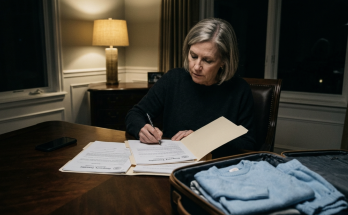
“She made a physical file.”
“It looks that way.”
“Did you touch anything?”
“Only the envelope.”
“Put it back.”
“I already called Detective Morales.”
“Good.”
Dad sounded ashamed.
“I didn’t know.”
I looked through the window.
Emma was kneeling beside Biscuit with a toy doctor kit.
“Did you really not know?”
“What does that mean?”
“You lived with her.”
“I knew she complained about you.”
“This is more than complaining.”
“I know.”
“Did she keep other files?”
“I don’t know.”
“Did she save things from Vanessa too?”
“I don’t know.”
Every answer returned us to the same problem.
Dad had spent years deliberately not knowing.
Avoidance had become his specialty.
“Don’t search anything else unless police ask.”
“I won’t.”
I paused.
“Dad.”
“Yes?”
“Why did Mom keep the bow?”
He swallowed.
“I have no idea.”
That was probably true.
Detective Morales called about an hour later.
The envelope had been collected with Mom’s consent after Dad disclosed it.
“Did she explain it?”
“She said she was documenting a family pattern.”
The phrase almost made me laugh.
“A pattern of what?”
“She says copying.”
“By a four-year-old.”
“She says by you, through your daughter.”
I leaned against the porch railing.
“That doesn’t even make sense.”
“People can interpret ordinary events through existing beliefs.”
I thought of every picture Mom had labeled as proof.
“Did she explain the bow?”
“She says she kept it because Vanessa threw it away after an argument.”
“Why would that matter?”
“She says it demonstrated Vanessa’s refusal to defend Lily.”
My stomach turned.
“So Vanessa refused to make matching bows a problem, and Mom turned that into evidence against her too.”
Morales did not speculate.
“That is one possible interpretation.”
“Did Vanessa confirm it?”
“She said your mother bought matching bows for the girls without telling either of you. Vanessa became angry and discarded Lily’s because she believed your mother was deliberately trying to provoke another comparison.”
I sat down.
That was almost impossible to process.
“Mom created the matching item?”
“According to Vanessa.”
“And then blamed me for similarities?”
“That is what we’re investigating.”
I rubbed my forehead.
“This is bigger than Sunday.”
“Yes.”
“How much bigger?”
“We’re still determining that.”
That afternoon, Claire brought Lily over.
The girls were supervised constantly now, not because they were unsafe with each other, but because every adult involved had become cautious about what the children might say and how those statements should be handled.
Emma immediately showed Lily Biscuit.
Lily knelt.
“He’s fat.”
Maya called from the kitchen, “He prefers substantial.”
Lily giggled.
The girls spent nearly an hour building a cardboard house.
I watched them argue over where the window should go.
Emma wanted the left side.
Lily wanted the right.
“No,” Emma said.
“Yes,” Lily said.
“No.”
“Yes.”
Then Lily said, “Two windows.”
Emma shrugged. “Okay.”
Conflict resolved.
No tears.
No adult intervention.
No hierarchy.
Claire watched too.
“Imagine that.”
“What?”
“They disagree without anybody throwing cookware.”
I almost smiled.
“Set the bar higher.”
“I’m trying.”
Later, while the girls colored, Claire and I sat nearby.
“Vanessa called me.”
I looked at her.
“From where?”
“She was released.”
My whole body tightened.
“When?”
“This morning.”
“What restrictions?”
Claire lowered her voice.
“She can’t contact you or Emma directly while everything is being sorted out.”
“Good.”
“She can communicate about Lily through approved channels.”
“Did she ask for Lily?”
“Yes.”
My stomach tightened for a different reason.
“Does Lily want to see her?”
Claire nodded slowly.
“She misses her mother.”
Of course she did.
Children did not stop loving parents because those parents did frightening things.
“What happens?”
“Professionals decide what contact is appropriate.”
I nodded.
Claire watched me.
“You look conflicted.”
“I am.”
“She threw a skillet toward Emma.”
“I know.”
“But?”
“But Lily loves her.”
“That doesn’t erase what happened.”
“No.”
“Then what?”
I struggled to explain.
“I don’t want consequences for Vanessa to become another thing Lily thinks Emma caused.”
Claire’s expression softened.
“That’s important.”
“Mom has spent months framing Emma as someone who steals from Lily. If Lily loses normal access to Vanessa now, I’m terrified she’ll eventually hear that story too.”
Claire looked toward Lily.
“So we make sure she hears the truth.”
“At six?”
“The age-appropriate truth.”
I nodded.
That was all we could do.
Near dinner, Dad came to Maya’s house.
I had agreed to see him outside.
He looked exhausted.
Gray stubble covered his jaw.
“I brought something.”
My body tensed.
“What?”
He held out a small notebook.
I did not take it.
“Where did that come from?”
“Mom’s desk.”
“Dad.”
“The police saw it.”
“Then why do you have it?”
“They photographed the relevant pages and returned it because it’s mostly household notes.”
I stared at the notebook.
“What’s relevant?”
He opened it.
Several pages contained grocery lists.
Appointment reminders.
Christmas gift ideas.
Then a page headed with our names.
Rachel / Emma.
Underneath were dates.
12/14 – same dolls.
1/09 – red coats.
2/03 – Lily braid / Emma braid.
3/18 – Emma dance shoes close to Lily’s.
4/02 – Claire praises Emma drawing.
4/09 – Dad posts Emma photo, not Lily.
I stopped reading.
“What is this?”
“I don’t know.”
“You keep saying that.”
“I truly don’t know.”
There were more entries.
5/11 – Emma asks for strawberry cake after Lily birthday.
5/28 – Rachel mentions preschool award.
6/06 – same sandals.
6/22 – Lily says Emma copied game.
That last one caught me.
“What game?”
Dad shook his head.
“I don’t remember.”
I did.
At a family picnic, Lily invented a game where the girls jumped between paving stones and pretended the grass was water.
Emma copied her because she was four.
That became evidence.
I flipped the page.
Vanessa / concerns.
Mom had listed comments from Vanessa.
Rachel always has to match.
Emma gets same praise.
Nobody notices what Lily does first.
But alongside those were other notes.
Vanessa says stop comparing.
Vanessa says dresses coincidence.
Vanessa angry Mom bought same bow.
Vanessa says Lily likes Emma.
I stared at Dad.
“She documented Vanessa resisting her.”
He nodded.
“Why?”
“I don’t know.”
The page continued.
Need to make V see pattern.
I stopped.
“What?”
Dad pointed.
There, in Mom’s handwriting.
Need to make V see pattern.
My hands went cold.
That sentence transformed the notebook.
Mom was not merely recording a belief.
She was trying to persuade Vanessa into it.
“Did police see this?”
“Yes.”
“What did they say?”
“They took pictures.”
I shut the notebook.
“Take it back.”
Dad did.
“I’m sorry.”
I looked at him.
“When did you stop asking what she was doing?”
He frowned.
“What?”
“Mom. When did you decide it was easier not to know?”
He stared at the grass.
“I don’t know.”
“Before Vanessa and I were adults?”
“Probably.”
“That was your choice.”
“Yes.”
“Every time she made one of us responsible for the other’s emotions, you looked away.”
“Yes.”
“Every time Vanessa exploded and I was told to compromise, you called it peace.”
Dad’s eyes filled.
“Yes.”
I wanted to comfort him.
I didn’t.
“You weren’t neutral.”
“I know.”
That answer mattered.
Maybe not enough.
But it mattered.
He sat on the porch step.
“I thought protecting the calmer person from conflict was the same as keeping the family stable.”
“You protected the person who caused the conflict.”
“I know.”
“And now Emma thinks she needs to change clothes so adults won’t become angry.”
Dad covered his face.
I let him.
After a while, he said, “What can I do?”
“Tell the truth.”
“I am.”
“Every time.”
“I will.”
“And stop asking me to forgive anybody.”
“I haven’t.”
“Good.”
He nodded.
“Anything else?”
“Get therapy.”
That surprised him.
“I’m serious.”
“I know.”
“Figure out why fear of Mom mattered more than protecting two children.”
He looked down.
“I will.”
Before leaving, he handed me a small plastic bag.
Inside was the blue bow.
“What are you doing?”
“Police said it wasn’t evidence they needed to retain.”
“I don’t want it.”
“I thought maybe Emma—”
“No.”
He stopped.
The bow had become contaminated by meaning.
Not physically.
Emotionally.
A piece of fabric should not carry that much weight.
“Give it to Claire,” I said. “Or throw it away.”
Dad looked at it.
“Okay.”
That night, Emma woke crying.
I found her sitting upright in bed.
“Mommy.”
“I’m here.”
“Aunt Vanessa threw it again.”
“A dream?”
She nodded.
I lay beside her.
She pressed against me.
“Did it hurt?”
“In the dream?”
She nodded.
“Yes.”
I did not tell her dreams weren’t real.
Fear was real whether the skillet existed in the room or not.
After several minutes, she whispered, “Grandma was there.”
My throat tightened.
“What happened?”
“She said change me.”
I kissed the top of her head.
“You don’t have to change.”
She held onto my shirt.
“Ever?”
“Sometimes you’ll change clothes because they’re dirty or too small or you want something different.”
She shook her head.
“No. For Grandma.”
“No.”
Her body relaxed slightly.
“Okay.”
The next morning, Morales called.
“We reviewed additional materials from the notebook and devices.”
I stepped onto the porch.
“What did you find?”
“Your mother appears to have been planning a conversation with you for weeks.”
“About what?”
“Keeping Emma from ‘mirroring’ Lily.”
I almost laughed.
“She’s four.”
“I understand.”
“What kind of conversation?”
“There are notes about family boundaries.”
“Boundaries?”
“Yes.”
“Her boundary was that my child couldn’t wear similar colors?”
“She appears to have wanted formal rules.”
I stared out at Maya’s yard.
“What rules?”
Morales read from the notes.
“No identical gifts. No same-color dresses at family events. Ask before purchasing matching toys. No copying activities Lily starts.”
For a moment, I could not speak.
“She wanted behavioral rules for preschoolers based on which child did something first.”
“Yes.”
“Did Vanessa know?”
“Not initially.”
“What happened when Mom told her?”
Morales paused.
“Vanessa replied, ‘That’s insane.’”
I closed my eyes.
Again.
Again, Vanessa had seen through it.
Until eventually she didn’t.
Morales continued.
“There’s one more entry.”
“What?”
“Your mother wrote, ‘If Vanessa won’t enforce boundaries, I may have to force the issue at dinner.’”
My heart pounded.
“What does force the issue mean?”
“She says she intended to confront you publicly.”
“Do you believe that?”
“We’re not at the stage where I can answer that.”
I looked through the window.
Emma slept on the couch with Biscuit curled near her feet.
“Was there anything about the skillet?”
“Not directly.”
“Anything about hurting Emma?”
“No.”
Relief and anger mixed strangely.
I wanted evidence that Mom had not intended violence.
I also wanted her manipulation named for what it was.
Morales added, “But there is another message relevant to Sunday.”
“To Vanessa?”
“Yes.”
“Before dinner?”
“Eleven minutes before the skillet was thrown.”
My mouth went dry.
“What did Mom say?”
“Vanessa wrote, ‘I’m going to leave before I do something stupid.’”
I gripped the porch railing.
“And Mom?”
“She replied, ‘Sit down. Don’t give Rachel the satisfaction.’”
Click here to continue reading: PART 11: Vanessa Tried to Walk Away Before the Skillet Flew, and My Mother’s Reply Became the Choice None of Us Could Ignore
Two Little Girls Arrived in Matching Blue Dresses, and My Sister’s Expression Told Me Sunday Dinner Was Already in Trouble
Part 10 of 18