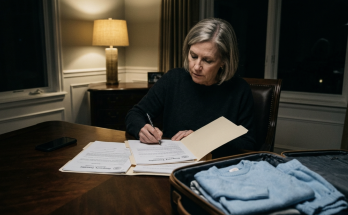
For two days after Mom’s second statement, I kept returning to the same sentence.
The children were never competing. I was.
It was the closest thing to clarity she had offered since the skillet hit the dining-room floor.
I wanted that sentence to feel like relief.
Instead, it felt late.
Late enough that Emma still woke some nights with her hands pressed against her neck. Late enough that Lily had started asking Claire whether grown-ups were allowed to keep someone from leaving a room. Late enough that every family photograph from the last several years had become suspect in my mind.
I found myself studying ordinary memories for hidden commentary.
Emma sitting on Dad’s shoulders at the county fair.
Lily blowing out candles at her birthday.
Both girls wearing paper crowns on Christmas morning.
Mom smiling beside them.
Had she already been keeping score then?
That question became dangerous because there was no answer that could help me.
Leah told me the same thing during our next call.
“You’re trying to reconstruct intent across years.”
“I know.”
“That may never be possible.”
“I know.”
“What matters now is behavior you can verify and boundaries you can control.”
The legal language was less satisfying than rage, but more useful.
I had already removed Mom from Emma’s preschool pickup list. Vanessa had never been authorized, and I added a note that no family member should receive information about Emma’s schedule without speaking directly with me.
The school director handled it without drama.
“We can do that.”
No questions.
No guilt.
No family history required.
I nearly cried in her office because the simplicity felt so foreign.
At home, Emma rediscovered the blue dress.
I had soaked it twice.
Most of the brown stain faded from the skirt, but a darker mark remained near the hem. The cardigan was worse and probably unsalvageable.
Emma examined the dress carefully.
“It still has dinner.”
“A little.”
“Can I wear it anyway?”
“Yes.”
She smiled.
That mattered more than removing every stain.
She wore it the next morning with yellow socks and no cardigan.
I waited for hesitation.
None came.
She spun once in the hallway.
“Sky dress.”
“Still sky dress.”
She went back to choosing hair clips.
I stood in the doorway and realized the stain no longer looked like damage alone.
It was also proof that Vanessa had failed to take something from her.
Not because Emma understood resilience.
Because she was four and still liked blue.
Claire brought Lily over that afternoon.
When Lily saw the dress, she stopped.
Emma looked down.
“What?”
“You wore it.”
“Yeah.”
Lily’s face brightened.
“I have mine.”
Emma looked at me.
“Can she wear hers next time?”
Claire and I exchanged a glance.
Then Claire said, “If Lily wants to.”
“I do.”
That simple agreement felt almost rebellious.
Two cousins choosing similar dresses because they liked each other.
No symbolism.
No hierarchy.
No permission from anyone keeping score.
While they played, Claire told me Vanessa had made another decision.
“She agreed to supervised visits.”
“With Lily?”
“Yes.”
“For how long?”
“As long as professionals recommend.”
I stared at her.
“She agreed?”
“Immediately.”
That surprised me.
I had expected resistance.
“What did she say?”
“That Lily’s safety matters more than her embarrassment.”
I sat back.
“That sounds unlike Sunday.”
“It does.”
Claire rubbed her hands together.
“She’s also enrolled in an anger-management program.”
I said nothing.
“And individual therapy.”
Still nothing.
Claire watched me.
“You don’t have to praise her.”
“I know.”
“She’s not asking you to.”
“That helps.”
There was something exhausting about being expected to reward the first signs of basic responsibility. Vanessa had thrown a skillet toward my child. Attending therapy did not place us even.
Still, it mattered because Lily needed a mother capable of becoming safer.
That was the only reason I cared.
“Has she said anything about Mom?”
Claire nodded.
“She doesn’t want Mom present at any supervised contact.”
I looked at her sharply.
“Why?”
“She says Mom turns everything into loyalty tests.”
That phrase fit too well.
“Did Vanessa tell Mom?”
“Yes.”
“How did Mom react?”
“Badly.”
I almost laughed.
“What does badly mean?”
“Crying. Saying Vanessa was abandoning her after everything she’d done.”
Of course.
Claire continued.
“Vanessa told her, ‘You helped me become the person who threw that skillet.’”
I went still.
“That’s a strong statement.”
“She also said, ‘You didn’t make me throw it. But you helped me believe my anger was righteous.’”
That was stronger.
And more accurate.
I thought about the difference between blame and influence.
Vanessa finally seemed to understand it.
She was not saying Mom controlled her hands.
She was saying Mom fed the story that made those hands feel justified.
“What did Mom say?”
“That Vanessa was betraying her.”
I closed my eyes.
Even now, honesty became betrayal.
Boundaries became abandonment.
The pattern persisted.
That evening, Dad asked to visit.
I agreed to meet him in a park near my apartment.
Not inside my home.
Not yet.
He arrived carrying coffee for both of us.
I accepted mine.
We sat on a bench while children played near the swings.
For several minutes, neither of us spoke.
Then Dad said, “Your mother asked me to leave.”
I looked at him.
“The house?”
“Yes.”
“Why?”
“She says I’ve taken your side.”
I almost laughed.
“You told the police the truth.”
“I know.”
“And that became my side.”
“Yes.”
He stared into his cup.
“I’m staying at a hotel.”
“Claire knows?”
“Yes.”
“What do you plan to do?”
“I don’t know.”
At least he had stopped pretending certainty.
He continued.
“She says I exposed private family matters.”
“Dad, someone threw a skillet at a child.”
“I know.”
“Private stopped being relevant.”
“I know.”
He nodded.
“She also says the police turned Vanessa against her.”
“That sounds like Mom.”
“I told her Vanessa made her own choices.”
I looked at him.
“That’s progress.”
He gave a tired smile.
“Very high praise.”
“It’s all you’re getting.”
“Fair.”
We sat quietly.
Then Dad said something I did not expect.
“I owe Vanessa an apology too.”
“For what?”
“For letting your mother use me as proof.”
I frowned.
“What does that mean?”
“When your mother told Vanessa you were favored, she’d say I agreed.”
“Did you?”
“Not usually.”
I stared at him.
“But you didn’t correct her.”
“No.”
“So Vanessa believed both parents saw her as second.”
“Yes.”
The old architecture widened.
Mom had not built everything alone.
Dad had provided silence as structural support.
“How old was Vanessa when this started?”
“I don’t know exactly.”
“Teenager?”
“Younger.”
My chest tightened.
“How young?”
“Maybe seven or eight.”
I stared at the playground.
A girl about that age pushed a smaller child on a swing.
Seven or eight.
Old enough to remember.
Young enough to believe a parent’s interpretation of the world completely.
“What did Mom tell her?”
“That you got more attention because you were easier.”
I almost choked.
“Easier?”
“She thought you were.”
“And Vanessa?”
“More emotional.”
“So Mom told a child she was harder to love.”
Dad flinched.
“She didn’t use those words.”
“She didn’t need to.”
He nodded.
I looked down at my coffee.
“Why didn’t you stop it?”
He answered honestly this time.
“Because confronting your mother was exhausting.”
I let the sentence sit.
There it was.
No noble reason.
No confusion.
No hidden complexity.
Exhaustion.
“You let us carry what you didn’t want to deal with.”
“Yes.”
I appreciated the lack of defense.
It did not make the answer less painful.
“I’m sorry.”
“I know.”
“No. I mean I’m sorry in a way I wasn’t before.”
“What changed?”
“I finally understand that avoidance is a decision.”
I looked at him.
“That’s exactly what it is.”
A child screamed happily near the slide.
Dad watched her.
“I always told myself I was the calm parent.”
“Were you?”
“No.”
He shook his head.
“I was the absent one who happened to be physically present.”
That sentence hurt.
Because it was true.
Before we left, Dad asked whether I wanted him to help pay for Emma’s therapy if she needed it.
“Yes.”
He seemed surprised.
“I expected you to say no.”
“Why?”
“I thought you wouldn’t want anything from us.”
“I don’t want access bought with money.”
“It wouldn’t be.”
“Then yes. If she needs care, you can contribute.”
He nodded.
No bargaining.
No request for a visit.
Another small sign that perhaps he was learning.
The next day, the victim advocate called.
“Vanessa has asked permission to send a written apology directly to you.”
My stomach tightened.
“I thought she wasn’t allowed contact.”
“This would be routed through us. You can decline.”
“What’s in it?”
“I haven’t read it. It’s sealed for you unless you request screening.”
I sat at my kitchen table.
“Send it.”
“You’re sure?”
“Yes.”
The letter arrived electronically several hours later.
It began without excuses.
Rachel,
I threw the skillet.
No mention of Mom.
No mention of being provoked.
No mention of the dress.
I read on.
I was angry at you, and I let that anger become more important than the fact that Emma was sitting there. I remember seeing her face before I lifted the skillet. That is the part I am most ashamed of. I knew she was there.
My hands went cold.
That was worse than the claim that Vanessa had simply forgotten where Emma sat.
She had seen her.
And lifted it anyway.
The letter continued.
I did not aim for her body. I wish that mattered more than it does. It doesn’t. I threw something heavy and hot toward a table where children were sitting. Saying I didn’t intend the exact result is not the same as saying I was safe.
I stopped reading.
That sentence was difficult because it showed understanding.
Real understanding.
The kind I had wanted from Mom.
Vanessa continued.
Mom made my anger worse. She did not create it. I have resented you for years. Sometimes because Mom fed that resentment and sometimes because I chose it myself. I believed your calmness meant you thought you were better than me. I believed Emma getting similar things meant you were proving she could have anything Lily had. I was wrong.
I pressed my fingertips to my eyes.
Then:
Lily told me during our supervised visit that she likes matching with Emma because it makes them feel like sisters. I nearly ruined that for her because I wanted her to have something nobody else could touch. I see now that I confused being special with being above someone else.
That sentence felt like the center of everything.
Special versus above.
Love versus rank.
Mom had confused them too.
Vanessa wrote that she would accept whatever distance I needed.
She would not ask Emma for forgiveness.
She would not ask Lily to carry messages.
She would not appear at family events where Emma was present unless I agreed in advance.
The final paragraph made me cry.
I am not asking you to tell me I am still a good person. I am trying to become a safer one.
I closed the letter.
Maya called that evening.
“Did you read it?”
“Yes.”
“And?”
“I believe she means it.”
“That doesn’t mean you trust her.”
“No.”
“It doesn’t mean you forgive her.”
“No.”
“It just means you believe she means it today.”
“Yes.”
I looked toward Emma’s bedroom.
“That’s enough for today.”
The following week, Emma had her first appointment with a child therapist named Dr. Singh.
The office was filled with toys, sand trays, puppets, and small figures.
Emma chose two dolls.
One wore blue.
One wore yellow.
Dr. Singh did not ask about the skillet directly.
She played.
Emma played.
At one point, Emma picked up a toy frying pan from a miniature kitchen.
My body tensed.
Dr. Singh noticed but said nothing.
Emma set the pan on a toy stove.
Then she moved both dolls far away from it.
“Too hot,” she said.
Dr. Singh nodded.
“Where should they go?”
Emma pointed to a tiny couch.
“Somewhere safe.”
I looked away.
Afterward, Dr. Singh told me not to panic over every symbolic detail.
“Children play with what they are processing.”
“Is that bad?”
“No.”
“Should I ask her about it?”
“Not unless she invites the conversation.”
I nodded.
“Will she remember this forever?”
Dr. Singh gave me the answer I expected.
“Probably in some form.”
My throat tightened.
“But remembering is not the same as being defined by it.”
That helped.
Not enough.
But some.
A few days later, Leah called with news about the protective order.
The temporary restrictions would remain while the court considered the next steps.
Vanessa had not challenged them.
Mom had.
I closed my eyes.
“Of course she did.”
Leah continued.
“Your mother says she should not be treated the same as Vanessa because she never physically harmed Emma.”
“She encouraged the entire confrontation.”
“I know.”
“She took Vanessa’s keys.”
“I know.”
“She told everyone to lie afterward.”
“I know.”
Leah’s voice stayed calm.
“The court will consider evidence, not only her interpretation.”
I rubbed my forehead.
“What does she want?”
“Contact with Emma.”
“No.”
“Then we’ll make that clear.”
“And Lily?”
“Separate issue.”
Always separate.
Always beyond my direct control.
Claire later told me Mom had also been asking to see Lily.
Vanessa refused.
That mattered.
Whatever else happened, Vanessa was finally protecting her daughter from the person whose approval she had once valued above reason.
The first supervised visit with Lily lasted forty-five minutes.
Vanessa did not bring gifts.
She did not talk about court.
She did not blame me.
According to the supervisor’s summary relayed to Claire, she apologized for frightening Lily and told her that leaving when angry would have been the right choice.
Lily asked one question.
“Why didn’t you?”
Vanessa answered, “Because I made a bad choice.”
No mention of Mom.
No excuses.
That evening, Lily told Emma on a video call, “My mommy says she should’ve gone home.”
Emma nodded.
“My teacher says take space.”
“I know.”
“Next time she should.”
Lily nodded solemnly.
“Yeah.”
Two children discussing emotional regulation with more clarity than three generations of adults.
After the call, Emma asked, “Will Aunt Vanessa get better?”
I chose my words carefully.
“She’s trying to make safer choices.”
“Is that getting better?”
“It can be part of it.”
“Will Grandma?”
I paused.
“I don’t know.”
Emma accepted that.
I wished I could.
Three days later, Mom’s attorney sent a request through Leah.
Mom wanted to participate in family therapy.
Not with Emma.
With me.
I stared at the message.
Leah asked, “Do you want to consider it?”
“Not now.”
“That’s a complete answer.”
“Maybe later.”
“Also complete.”
I thought of Mom’s sentence.
The children were never competing. I was.
Recognition was not repair.
And I would not step into another room simply because she wanted a confrontation completed.
This time, I got to leave.
Click here to continue reading: PART 14: I Refused My Mother’s Demand for Reconciliation, and the First Court Hearing Revealed Which Parts of the Family Story Still Wouldn’t Die
Two Little Girls Arrived in Matching Blue Dresses, and My Sister’s Expression Told Me Sunday Dinner Was Already in Trouble
Part 13 of 18