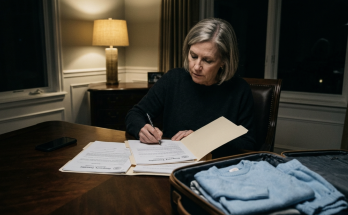
Mom’s letter began with her childhood.
I almost stopped reading.
Not because I didn’t care.
Because I had seen explanations become escape routes too many times.
Leah had warned me about that.
“Context matters,” she said. “But context is not absolution.”
So I read with that sentence in mind.
Mom wrote that her father left when she was nine.
Not metaphorically.
Not emotionally.
He packed two suitcases after an argument with her mother and never came back.
She remembered standing at the front window while his car disappeared.
Her mother spent years repeating one lesson afterward.
People leave when you let them.
I had heard stories about Grandpa leaving before.
Never that phrase.
Mom wrote that every conflict afterward became a test of whether the family would stay.
When Dad tried to take a walk during arguments, she blocked the doorway.
When Vanessa went to her room, Mom followed.
When I put on headphones as a teenager, she pulled them off.
She had called it finishing the conversation.
Now she called it panic.
I lowered the letter.
Memories arrived with new edges.
Being sixteen and standing beside the front door while Mom demanded I keep talking.
Dad sitting at the kitchen table long after arguments became pointless.
Vanessa screaming that she wanted to be left alone while Mom insisted silence was disrespect.
We had all lived inside Mom’s fear.
She continued.
I taught Vanessa that staying and fighting proved love. I taught Rachel that leaving made her cold. I taught your father that avoiding me was easier than disagreeing openly. Then I watched all three of you become exactly what those rules produced.
That was the most accountable sentence in the letter.
No passive voice.
No “mistakes were made.”
I kept reading.
Mom described how Vanessa’s emotional intensity frightened her because it reminded her of her own mother after the abandonment.
So she reassured Vanessa constantly.
Then overcorrected.
Then protected her.
Then began interpreting every slight as confirmation that Vanessa needed protection.
When I was born, Mom feared Vanessa would feel replaced.
When Emma was born, she believed history was repeating.
Not because it was.
Because she expected it.
She wrote:
I was looking for evidence before there was evidence.
The photographs.
The notebook.
The bows.
The dresses.
All of them became proof of a theory she had created before Emma could walk.
I reached the end slowly.
Mom did not ask to see Emma.
That mattered.
She wrote:
I want contact with you. I want contact with Emma. But wanting is not the same as being entitled. I do not trust myself yet to know when my longing is actually fear wearing a better name.
I sat with that sentence for a long time.
Then:
If you never allow me back into Emma’s life, I will have to live with that. I hope someday you choose differently, but I understand that hoping is mine to carry, not yours to satisfy.
I cried then.
Hard.
The kind of crying that left my chest aching.
Maya came over after I called.
She read the letter.
“Different.”
“Yes.”
“Enough?”
“No.”
“Good answer.”
I looked at her.
“Why good?”
“Because you don’t need a dramatic answer. Different doesn’t have to mean enough.”
That was exactly where I was.
Mom had finally said things I needed to hear.
That did not place Emma back in her arms.
Trust was not a prize for insight.
It was something built after insight through consistent behavior.
If it was built at all.
I sent no response.
Not immediately.
Instead I brought the letter to my own therapist.
I had started seeing one at Leah’s suggestion, mostly because I was tired of processing family history in parked cars and kitchens.
Her name was Dr. Alvarez.
She asked what I wanted from Mom.
“I don’t know.”
“What do you not want?”
“That’s easier.”
“Start there.”
“I don’t want to become responsible for whether she heals.”
“Good.”
“I don’t want Emma used as proof that I forgive her.”
“Good.”
“I don’t want every apology to become a request.”
Dr. Alvarez nodded.
“What might you want eventually?”
I stared at the rug.
“Maybe a mother.”
She did not say anything.
That silence hurt.
I laughed once.
“That sounds pathetic.”
“It sounds honest.”
“I’m thirty-two.”
“Adults can still want parents.”
I looked away.
“I don’t know if the mother I want exists.”
“That is a different question.”
And one I was not ready to answer.
Meanwhile, Vanessa’s supervised visits continued.
Reports remained positive.
She was punctual.
She followed rules.
She did not discuss court.
She did not criticize me.
Lily returned from visits calm rather than confused.
After the fourth one, Claire told me something surprising.
“Lily asked whether Vanessa could come to her school play.”
My stomach tightened.
“When is it?”
“Next month.”
“Will Emma be there?”
“Yes.”
There it was.
The first real collision.
Not a controlled visit.
Not separate households.
A shared event.
Two children who deserved both sides of their lives if those sides could coexist safely.
“What does Vanessa want?”
“She says she’ll stay on the opposite side of the auditorium.”
“Mom?”
“Not invited.”
That helped.
“Would Vanessa approach Emma?”
“She says no.”
I thought for a long time.
Then I asked the question that had become my standard.
“What does Emma want?”
Claire smiled slightly.
“I knew you’d say that.”
We asked her carefully.
“Lily’s mommy might be at the school play,” I said.
Emma’s body stiffened.
That was enough to tell me this mattered.
“Will she throw something?”
“No.”
“She’ll be sitting far away.”
“Can I sit with you?”
“Yes.”
“Can Lily come to us if she wants?”
“Yes.”
Emma thought.
“Okay.”
Not enthusiasm.
Not panic.
Okay.
I brought it to Dr. Singh.
She supported trying, provided Emma had a clear exit plan and knew she could leave at any time.
That phrase again.
Leave at any time.
The corrective lesson.
At the play, I arrived early with Emma.
We sat near an aisle.
Claire sat beside us.
Dad sat several rows back, by agreement.
Vanessa arrived ten minutes before the lights dimmed.
I saw her immediately.
She wore a dark sweater.
No coat.
No bag.
Nothing in her hands.
I realized later that was probably deliberate.
She saw us.
Stopped.
Then chose a seat across the auditorium.
No approach.
No gesture.
Emma noticed.
Her hand tightened around mine.
“Is that Aunt Vanessa?”
“Yes.”
“She’s far.”
“Yes.”
“Okay.”
The lights dimmed.
Lily came onto the stage wearing cardboard butterfly wings.
Emma forgot everything else.
“That’s her!”
She whispered too loudly.
Parents around us smiled.
Lily found us in the audience.
Then looked across the room.
She found Vanessa.
Her face brightened.
For the first time, both parts of her world were present without demanding she choose.
I cried quietly through most of the performance.
Afterward, the lobby became crowded.
This was the part I feared.
People moving unpredictably.
Children running.
Adults converging.
I took Emma’s hand.
“Ready to go?”
She nodded.
Then Lily appeared.
“Wait!”
She ran toward us.
Vanessa remained twenty feet away.
Claire joined her.
Lily hugged Emma.
“You saw my wings?”
“Yes!”
“I almost fell.”
“I saw!”
They laughed.
Then Lily looked toward Vanessa.
“Can Mommy see my picture?”
Claire glanced at me.
Not permission.
Information.
I looked at Emma.
She looked too.
Vanessa remained where she was.
“Do you want to go?” I asked.
Emma shook her head.
“No.”
So we stayed.
Lily ran to Vanessa, showed her a drawing, hugged her, then returned.
No collision.
No forced reconciliation.
No performance.
Just distance respected.
On the way home, Emma said, “Aunt Vanessa stayed over there.”
“Yes.”
“She listened.”
That word mattered.
Listened.
Not apologized.
Not loved.
Not changed forever.
She listened to a boundary.
One behavior.
One night.
Trust, I realized, might be nothing more dramatic than enough nights like that.
The next week, Vanessa’s attorney proposed modifying the restrictions slightly.
Not direct contact.
Not visits with Emma.
Only permission for her to attend certain child-centered public events if I agreed in writing beforehand.
Leah asked what I wanted.
“Keep it case by case.”
“Reasonable.”
“Nothing automatic.”
“Good.”
That became the agreement.
Mom heard about the school play.
Dad told me she cried.
“Because she wasn’t invited?”
“Yes.”
“Did she complain?”
“No.”
That surprised me.
“What did she say?”
“That she understood.”
I sat quietly.
Dad continued.
“She asked whether Lily looked happy.”
“And?”
“I said yes.”
“Did she ask about Emma?”
“Yes.”
My body tightened.
“What did you say?”
“That she looked okay.”
“Anything else?”
“No.”
Good.
Mom had begun respecting informational boundaries too.
Small things.
Almost invisible.
Still meaningful.
I finally responded to her letter.
Four sentences.
I read what you wrote. I believe you understand more than you did before. I am not ready for contact between you and Emma. If that ever changes, it will happen slowly and because I believe it is healthy for her. Please continue respecting the boundary without asking for updates through Dad or Claire.
She replied through Leah.
I will.
And then she did.
For six weeks.
No calls.
No hidden numbers.
No gifts sent through others.
No messages asking Dad to persuade me.
No photos requested.
No questions passed through Lily.
The absence itself became evidence.
I had never realized how much pressure Mom applied until she stopped.
One Sunday morning, Emma and I made pancakes.
She spilled flour across the counter.
“I’m sorry.”
“It’s flour.”
“I know.”
She dipped one finger into it and drew a smiley face.
Then another.
“Lily.”
“Which one is you?”
She drew a third.
“That’s you.”
“And this?”
A fourth.
“Grandpa.”
She paused.
Then made another small face.
“Grandma.”
I watched her.
No fear.
No anger.
Just a place on a flour-covered counter.
Children did not erase people as efficiently as adults imagined.
Emma looked at me.
“Can Grandma get better too?”
I thought of the letter.
The silence.
The respected boundary.
“I think she’s trying to understand herself better.”
“Like Aunt Vanessa?”
“In a different way.”
Emma nodded.
Then asked, “Can Biscuit get better?”
I laughed.
“What’s wrong with Biscuit?”
“He bites Maya’s socks.”
“Tragic.”
She smiled.
The moment passed.
But that night I found myself thinking about Mom’s name in the flour.
Not an invitation.
Not forgiveness.
Just evidence that Emma’s memory held more than terror.
That mattered too.
A month later, Dr. Singh told me something I wasn’t prepared to hear.
“Emma may eventually benefit from a carefully controlled repair conversation with your mother.”
My chest tightened.
“She’s four.”
“Not now necessarily.”
“Why would she need that?”
“Because children sometimes fill silence with self-blame.”
“She knows it wasn’t her fault.”
“Yes.”
“But?”
“She still asks whether Grandma was angry because of the dress.”
I looked down.
“I answer her.”
“I know.”
“Hearing a safe adult take responsibility directly can sometimes help.”
I hated the idea.
Not because Dr. Singh was wrong.
Because safety now required considering contact I had spent months preventing.
“What would it look like?”
“Short. Supervised. No physical contact unless Emma initiates it. No explanations about adult conflict. No mention of Vanessa’s responsibility. Your mother would need to say one thing clearly.”
“What?”
“That Emma did nothing wrong.”
I closed my eyes.
The sentence Mom should have said while Emma was still covered in sauce.
“I’m not ready.”
“That’s okay.”
“Is Emma?”
“Not yet.”
“Then why discuss it?”
“So if the time comes, fear isn’t making the decision alone.”
That landed.
Fear with authority.
Mom’s phrase from her letter.
I did not want to become the next person letting fear decide every boundary automatically.
But I also would not confuse courage with access.
So I said, “Not now.”
Dr. Singh nodded.
“Not now is a complete decision.”
And for the first time, I understood that waiting was not the same as avoidance.
Sometimes waiting was what responsible adults did before opening a door.
Click here to continue reading: PART 16: Months After the Skillet, One Carefully Supervised Meeting Forced My Mother to Say the Words Emma Had Needed From Her All Along
Two Little Girls Arrived in Matching Blue Dresses, and My Sister’s Expression Told Me Sunday Dinner Was Already in Trouble
Part 15 of 18