Evelyn Ross was arrested in a private medical facility three days later.
She was too ill to stand for long, but not too ill to understand the charges.
Detective Chen told me she asked for Mark.
He refused to go.
That surprised me.
Not because I thought he loved her.
Because part of Mark had spent most of his adult life answering when Evelyn called.
Even after their relationship ended, she had learned how to pull him back with guilt, secrets, warnings, and fragments of information.
This time he said no.
“She doesn't get another private conversation.”
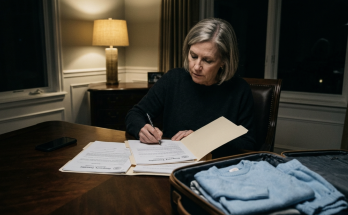
We were sitting at the dining table when he said it.
The same table where Lily's photograph had first reopened our lives.
I nodded.
“Good.”
Daniel Price was arrested the following morning.
His story changed several times.
First, he denied being paid.
Then he admitted the payment but claimed it was for disposal work.
When investigators showed him the photograph marked Friday. Same route. Scare him, he asked for an attorney.
Two days later, through his lawyer, he began cooperating.
The truth was uglier because it was smaller than murder.
Evelyn had not ordered him to kill Emma.
She had ordered him to frighten Mark.
Damage the car.
Force Mark to feel threatened.
Make him vulnerable enough to return her calls and discuss the clinic records she had become obsessed with protecting.
Daniel drank before doing it because he was afraid.
Then he drove too fast.
He entered the intersection at the wrong angle.
And Emma died.
That distinction mattered legally.
Emotionally, it changed very little.
Intent had set the event in motion.
Recklessness finished it.
For ten years, Mark blamed himself because he was driving.
For ten years, I had sometimes blamed him too, silently and unfairly, because grief always looks for a person standing close enough to punish.
Now we knew another person had placed the danger there deliberately.
It did not erase Mark's guilt.
It relocated it.
That was different.
Evelyn admitted enough to make denial impossible.
Unauthorized donor use.
Falsified records.
Private tracking of children.
Identity experiments.
Bribery.
Concealment.
She continued insisting the collision was never supposed to be serious.
Detective Chen asked whether I wanted to hear the full recorded interview.
I said no.
I already knew enough.
Some truths illuminate.
Others merely contaminate.
I did not need Evelyn's voice living inside my head.
The adoption agency suspended Rebecca while authorities reviewed her history.
She expected it.
“I should have spoken years ago,” she told me.
“Yes.”
She nodded.
There was no argument.
Sofia entered a formal cooperation agreement.
Mara traveled home to meet investigators in person.
Anna stayed nearby under temporary protective arrangements while her legal identity was reconstructed.
That process turned out to be nearly as complicated as everything else.
Anna Keller had never existed legally in any clean sense.
Neither had Emily, not at first.
The child Evelyn had created from donor records and hidden placements had spent most of her life carrying names other adults chose for convenience.
When a social worker asked which name she wanted recorded permanently, she said Emily Vaughn.
For Teresa.
The nurse who helped her escape.
That choice mattered to me.
She did not choose Emma.
She did not choose Anna.
She chose herself.
Mark underwent DNA testing.
So did Lily.
The result arrived eighteen days after our first meeting with her.
Probability of biological paternity: greater than 99.99%.
I stared at the report.
Mark sat beside me.
Neither of us spoke for a while.
Then he said, “She's my daughter.”
“Biologically.”
“Yes.”
The distinction mattered.
Fatherhood was not a blood result.
He knew that better than anyone.
“What do we do?” he asked.
I looked at him.
“We tell the people responsible for her case the truth.”
“And adoption?”
“That cannot be about replacing Emma.”
“It isn't.”
“Not for you?”
He looked offended.
Then stopped.
He understood why I asked.
“No.”
“Why do you want her?”
His answer took time.
“Because she exists.”
I waited.
“And because I knew, the moment I saw her face, that I had spent years pretending children like her were abstract.”
His voice shook.
“They weren't abstract. They were children. Some of them may have needed answers I refused to help find.”
I looked down at the DNA report.
“That's guilt.”
“Partly.”
“Guilt isn't enough to raise a child.”
“I know.”
“What else?”
Mark thought.
“I liked that she told you Noah's sharks looked like potatoes.”
Despite myself, I smiled.
He did too.
“And?”
“I want to know what books she likes. What she sounds like when she's angry. Whether she always pushes one sleeve up. I want to find out who she is when no one is comparing her to anyone.”
That answer was better.
Not perfect.
Better.
The agency arranged more visits.
Slowly.
Carefully.
Lily learned about the biological connection through professionals trained to explain complicated family histories to children.
Her first response was practical.
“So Mark is my dad?”
Her caseworker said, “Biologically, yes.”
Lily frowned.
“Does he know?”
The caseworker smiled.
“Yes.”
“Was he surprised?”
“Very.”
Lily considered that.
“Good.”
When she saw Mark afterward, she looked him over for nearly thirty seconds.
He sat across from her, visibly terrified.
Finally she said, “Our hair is almost the same.”
Mark swallowed.
“Yeah.”
“Mine is better.”
He laughed.
“So I've been told.”
“By who?”
His face changed.
I knew the answer.
Emma.
He looked at me.
I nodded.
“By my daughter Emma.”
Lily studied him.
“The one who died?”
“Yes.”
“Claire told me.”
Mark's eyes filled.
Lily noticed.
Children notice everything.
“You don't have to cry.”
“I know.”
“Are you going to?”
“Probably.”
She sighed.
“Adults are weird.”
That broke the tension.
Later, she asked to see Emma's picture.
I showed her one.
Not the school portrait.
Not the photograph most similar to Lily.
A picture of Emma standing in rain boots with mud up to her knees, laughing so hard her eyes were nearly closed.
Lily smiled.
“She was messy.”
“Extremely.”
“Did she like foxes?”
“Yes.”
“Me too.”
I waited for pain.
It came.
But not like before.
Similarity no longer felt like theft.
It was simply one thread among many.
Weeks passed.
The legal case grew.
News outlets began calling Evelyn's clinic scandal one of the region's most disturbing reproductive-fraud investigations.
I avoided most coverage.
I had spent enough years letting strangers summarize Emma's death.
I would not let them own her life too.
Mark and I returned to counseling.
Together this time.
The first session was awful.
The second was worse.
In the third, I told him I still did not know whether our marriage would survive.
He nodded.
“I understand.”
No plea.
No performance.
That mattered.
“I love you,” he said.
“That doesn't solve it.”
“I know.”
“You hid things from me for years.”
“Yes.”
“You decided what truths I could handle.”
“Yes.”
“You let Evelyn remain in the edges of our life.”
“Yes.”
“And Emma died inside a danger connected to that.”
His face crumpled.
“Yes.”
I cried then.
Not neatly.
Not the restrained grief I had perfected over ten years.
I cried for Emma.
For myself.
For Mark.
For Anna.
For Lily.
For every child whose face had been reduced to an outcome column in Evelyn's files.
Our counselor did not interrupt.
Afterward, Mark and I sat in the parking lot for forty minutes.
We did not fix anything.
But for the first time, I believed fixing might not require pretending the damage had never happened.
Emily visited us two months later.
That was the name I used now.
She asked me to.
We sat in Emma's old bedroom.
I had not changed much.
The bed remained.
The shelves.
The faded stars painted along one wall.
The construction-paper moon was still on the dresser.
Emily saw it and stopped.
“That's it.”
“Yes.”
She did not touch it.
Neither did I.
For a while, we stood beside it.
“I always wondered whether they gave it back.”
“They did.”
“She loved it.”
“You saw her with it?”
“The night before.”
I nodded.
Emily swallowed.
“I used to hate her.”
The confession surprised me.
“Emma?”
“Yes.”
“Why?”
“Because Evelyn made me learn everything about her.”
Her voice remained quiet.
“She had a mother. A father. school. friends. A room. A real name.”
I said nothing.
“I thought if I became her, maybe I'd get those things.”
My chest tightened.
“Then I met her.”
“And?”
“She was nice to me.”
Emily looked at the floor.
“That made it worse.”
I understood.
“If she'd been mean, replacing her would have felt easier.”
“Yes.”
She looked at me, startled.
I gave a sad smile.
“People are complicated.”
“Evelyn always told me I should be grateful because I looked like someone wanted.”
I felt anger rise.
I kept it out of my voice.
“You never needed to resemble anyone to deserve a home.”
Emily looked away.
“I know that now.”
I hoped someday she would believe it fully.
She pointed toward the moon.
“Can I tell you something about Emma?”
“Yes.”
“The night before the accident, after Mark yelled, she gave me something.”
“What?”
Emily reached into her pocket.
For one impossible second, I expected magic.
Instead, she opened her hand.
A tiny folded paper star.
Yellowed with age.
Crushed at one point, then flattened carefully.
“She said I looked sad.”
My throat tightened.
“What did she say?”
“That stars were better when you kept them in your pocket.”
I laughed through tears.
“That sounds like her.”
“I kept it.”
“For ten years.”
“Yes.”
“Why?”
Emily looked at me.
“Because it was the first thing anyone gave me without wanting me to become something.”
I could not speak.
She held out the star.
I shook my head.
“No.”
Her hand stopped.
“Keep it.”
“You don't want it?”
“I do.”
“Then why—”
“Because she gave it to you.”
Emily closed her fingers around it.
Something changed in her face.
Not relief exactly.
Permission.
We left the room together.
Months later, Lily's adoption process moved forward.
Not automatically.
Being biologically related to Mark did not erase the requirements.
There were evaluations.
Home studies.
Counseling.
Interviews.
Questions about our grief and our marriage.
Questions we deserved to answer.
The caseworker asked me privately, “If Lily looked nothing like Emma, would you still want her?”
I thought carefully.
“Yes.”
“How do you know?”
“Because now when I picture Lily, I think about fox books, terrible handwriting, and the way she watches adults before deciding whether to trust them.”
I smiled.
“I don't see Emma first anymore.”
That was true.
It had taken time.
Lily eventually asked whether she could choose what to call us.
“Of course.”
“No Mom and Dad yet.”
“Of course.”
She chose Claire and Mark.
Three months later, without announcement, she called Mark Dad while asking him to fix a broken zipper.
He had to leave the room afterward.
She rolled her eyes.
I followed him to the hallway.
He was crying.
“She called me Dad.”
“I heard.”
“I don't deserve that.”
I looked at him.
“Then spend the rest of your life becoming someone who does.”
He nodded.
That was the work.
Not redemption as a single event.
Daily behavior.
Truth when truth was uncomfortable.
Presence when disappearance was easier.
A year after the investigation began, Evelyn Ross died while awaiting trial.
Some charges ended with her.
Others did not.
Daniel Price accepted responsibility for his role in the planned collision and faced renewed prosecution related to conspiracy and reckless conduct.
Civil cases against the clinic's estate continued.
Families came forward.
Dozens.
Some children wanted answers.
Some wanted nothing to do with the donor who connected them.
Mark respected both.
He provided medical history and DNA information through a legal intermediary.
He did not call himself their father.
Lily remained different.
Not because of blood alone.
Because she chose us, slowly, while we chose her.
Mara stayed in contact with Emily.
They called each other sisters.
That seemed right.
Emily came for holidays occasionally.
Never because anyone forced a family structure onto her.
She had survived too many adults defining her relationships.
At Emma's cemetery on the anniversary of her death, I went alone.
I preferred it that way.
I carried fresh flowers.
The headstone looked smaller than I remembered.
Maybe grief had once made everything around it enormous.
I sat on the grass.
For ten years, I had believed I understood the shape of what happened.
Then truth shattered even that.
Emma was still dead.
No revelation changed it.
No hidden sister became her.
No adoption repaired the empty years.
No arrest balanced the scale.
But truth gave her death back its proper name.
She had not died because Mark failed her.
She had not died because I was absent.
She had died because adults made selfish, reckless choices and a planned act of intimidation became a fatal crash.
That knowledge did not heal me.
It released me from questions that had been poisoning the wrong people.
I touched the carved letters of Emma's name.
“I met the girl from the gate.”
Wind moved through the grass.
I smiled faintly.
“She kept your star.”
My eyes filled.
“And Lily likes foxes.”
I sat there until evening.
When I returned home, lights glowed through the windows.
Through the glass, I could see Lily at the table doing homework.
Mark stood beside her holding two pencils while she argued about which one was sharper.
Emily had sent Lily a postcard from California.
Mara had mailed a book.
The house was not the house we had before Emma died.
It never would be.
That was no longer the goal.
I opened the door.
Lily looked up.
“You were gone forever.”
“Forty minutes.”
“Same thing.”
Mark glanced at me.
“You okay?”
I thought about the question.
Not as something people say when they want reassurance.
As a real question.
“Yes.”
Not healed.
Not finished grieving.
Not untouched.
But yes.
Lily pushed a worksheet toward me.
“I need help.”
“With what?”
“Fractions.”
“I thought you were good at math.”
“I am.”
“Then why do you need help?”
She looked offended.
“Because fractions are disrespectful.”
Mark laughed.
I sat beside her.
On the refrigerator behind us hung three photographs.
Emma in muddy boots.
Lily holding a fox book.
Emily and Mara standing together during a visit.
No one replaced anyone.
That was the truth Evelyn had never understood.
People were not interchangeable because their faces resembled one another.
Blood could explain connection.
It could not create identity.
Love could make a family.
It could not erase the dead.
And grief, when finally given truth, did not disappear.
It changed shape.
For ten years, I had believed surviving Emma meant learning to live around an empty place.
I had been wrong.
Surviving meant learning that the empty place could remain without consuming every other room.
Lily tapped her pencil impatiently.
“Claire.”
“Sorry.”
“You're staring.”
“I know.”
“At what?”
I looked at her.
Not Emma's eyes.
Lily's.
Not Emma's freckles.
Lily's.
Not a miracle.
Not a replacement.
A six-year-old girl who deserved to be seen exactly as herself.
“You.”
“Why?”
I smiled.
“No reason.”
She narrowed her eyes.
“That's weird.”
“Probably.”
She went back to her fractions.
Mark sat across from us.
For a moment, he met my eyes.
There was still work between us.
Apologies that needed years behind them.
Trust that had to be rebuilt without shortcuts.
But he stayed.
So did I.
And in the quiet, ordinary noise of pencils, paper, dishes, and a child complaining about homework, I understood something I had once thought impossible.
The future had not betrayed Emma by arriving.
It had simply arrived.
The End
Read more original stories on Feel Every Story.
Ten Years After One Ordinary Drive Destroyed Our Family, I Finally Asked Mark Whether We Were Allowed to Want a Future
Part 15 of 15