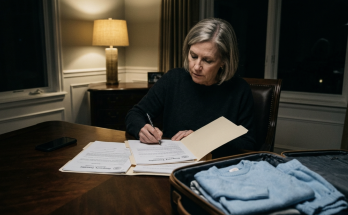
I arrived at the children's home ten minutes early.
The same chalk drawings covered the walkway, though overnight rain had blurred several into pastel streaks. Yesterday the building had seemed welcoming. Today every window felt as though it contained something hidden behind it.
A receptionist recognized me.
"Miss Jameson is expecting you."
"Thank you."
My voice sounded steady.
My hands were not.
She led me down the familiar hallway and stopped outside the director's office.
Before she opened the door, I heard a man's voice.
Young.
Nervous.
Then silence.
Miss Jameson stood when I entered.
A man sat beside her desk.
He looked barely older than twenty-five. Thin, dark jacket, closely cut hair. One knee bounced uncontrollably beneath the chair.
"Claire," Miss Jameson said, "this is Charles Mercer."
He stood too quickly.
"Hi."
"Hello."
We shook hands.
His palm was cold.
I sat across from them.
"Miss Jameson said you know something about the fertility clinic."
Charles glanced at her.
"I worked there."
"Doing what?"
"Records and donor coordination, mostly. I started part-time during college. Stayed longer than I meant to."
"Do you still work there?"
"No."
"Why did you leave?"
His knee stopped moving.
"Because of what I found."
My attention sharpened.
Miss Jameson spoke.
"Charles has been cooperating with people reviewing irregularities at the facility. He agreed to speak to you because of the photograph you showed me."
I took out my phone.
Emma's face appeared on the screen.
Charles stared at it.
The reaction was immediate.
He whispered something under his breath.
"What?"
He shook his head.
"Nothing."
"That's the second time someone in this office has looked at my daughter's photograph like they've seen a ghost. Please don't tell me it's nothing."
Charles swallowed.
"Your daughter had red hair."
"Yes."
"Blue eyes."
"Yes."
"Freckles."
I stared at him.
"You can see that."
"Yeah."
He rubbed his palms over his knees.
"Was that her natural coloring?"
The question irritated me.
"Of course."
"Both sides of the family?"
"Her father has the same coloring. Mine doesn't."
His eyes flicked toward Miss Jameson.
I noticed.
"My husband's name is Mark Bennett."
Charles's posture changed.
"Do you know him?"
He looked down.
Miss Jameson intervened.
"Claire, we agreed we would explain the pattern first."
"What pattern?"
Charles inhaled slowly.
"For several years, the clinic maintained a large donor program. Most facilities set practical limits on how often material from one donor is used within a geographic area."
"I understand why."
"Genetic diversity. Accidental relatives meeting. Ethical concerns. There are multiple reasons."
"Go on."
"There was one donor who appeared in the records far more frequently than anyone else."
"How frequently?"
Charles hesitated.
"Enough that it raised questions."
"Dozens?"
"Potentially."
My stomach tightened.
"Children?"
"Yes."
I looked at Miss Jameson.
"And Lily?"
She said nothing.
Charles continued.
"At first, nobody noticed because the records weren't transparent. Different client files. Different physicians. Different treatment dates. Sometimes procedures were entered under internal codes instead of donor numbers."
"Why?"
"That's one of the things being investigated."
"Was it deliberate?"
Charles's expression hardened.
"I believe so."
I sat back.
"What exactly are you saying happened?"
"People came to the clinic expecting one donor profile and sometimes received material connected to another."
For several seconds, the sentence made no sense.
Then it did.
"Without knowing?"
"That's what the records suggest."
My mouth went dry.
"That's horrifying."
"Yes."
"Why would anyone do that?"
Charles glanced at Miss Jameson again.
She gave him a small nod.
"The clinic owner became personally involved with one donor."
"Personally?"
"They were having a relationship."
I felt an unpleasant chill.
"And she used his donations?"
"Much more often than clients realized."
"Why?"
Charles gave a helpless shrug.
"Favoritism. Obsession. Maybe both. She seemed convinced his profile was exceptional. Good health screenings. Strong family history. Appearance people requested."
"Appearance?"
He looked uncomfortable.
"Red hair. Light eyes. Freckles."
The room became very quiet.
I looked at Emma's photograph.
Then at Charles.
"You're telling me the donor looked like her."
"I'm telling you those traits appeared repeatedly."
My heartbeat accelerated.
"How does Lily fit into this?"
Miss Jameson answered.
"Her biological origins connect to the clinic."
"What does that mean?"
"Her birth family sought assisted reproduction there."
"And the placement?"
"Later circumstances brought her into care."
"Did her parents discover she wasn't biologically connected to the donor they chose?"
Silence.
I felt suddenly sick.
"Is that why she's here?"
"It's more complicated than that," Miss Jameson said. "But yes, questions about her conception contributed to instability in the family."
Anger replaced shock.
"Someone abandoned a child because a clinic made a decision she had nothing to do with?"
"I wouldn't describe everything that happened so simply."
"I would."
Miss Jameson did not argue.
I turned back to Charles.
"How many children look like Lily?"
He exhaled.
"We don't know."
"Guess."
"Claire—"
"Please."
His voice dropped.
"Dozens may have been conceived using that donor over a period of several years."
My fingers went numb.
"Several years?"
"At least five that we can document clearly."
Five.
My mind caught on the number.
Emma had died ten years earlier.
The pattern Charles described apparently began later.
That should have reassured me.
Instead, something more disturbing occurred to me.
"When did this donor first register with the clinic?"
Charles went still.
Miss Jameson's gaze shifted toward him.
"When?"
"I don't have the exact date."
"But you know approximately."
"Yes."
"Before five years ago?"
He hesitated.
"Yes."
"How much before?"
"His registration existed earlier. The unusually high usage came later."
My pulse thudded in my neck.
"Ten years?"
Charles did not answer.
I leaned forward.
"Was he registered ten years ago?"
"Possibly."
"Possibly isn't an answer."
"It's the most accurate answer I can give without the archived files in front of me."
I stood and began pacing because sitting had become impossible.
"Why did Miss Jameson bring me here?"
Charles looked toward her.
She answered quietly.
"Because when I saw Emma's photograph, I saw characteristics that have become familiar to everyone who knows about this case."
"Red hair and freckles aren't evidence."
"No."
"Blue eyes aren't evidence."
"No."
"So what am I missing?"
Charles spoke.
"The resemblance isn't limited to coloring."
I stopped.
"What?"
"There are recurring facial traits. Bone structure. Nose shape. Chin. Expressions sometimes."
"Expressions aren't genetic evidence."
"I know."
"Then don't talk as though they are."
"I'm not."
He looked genuinely apologetic.
"I'm telling you why your daughter's photograph startled us."
I returned to the chair.
"Show me."
Charles's eyebrows lifted.
"Show you what?"
"Photographs."
"I can't."
"Then profiles."
"I can't release identifying material."
"You're asking me to believe there are dozens of children who resemble my dead daughter."
"I'm not asking you to believe anything."
"Then why am I here?"
Miss Jameson answered.
"Because there's one question we hoped you could answer."
I looked at her.
"What?"
"When you showed your husband's name yesterday, I made a call."
Every muscle in my body tightened.
"To whom?"
"Charles."
I turned toward him.
His face had gone pale.
I heard myself ask, "Do you know Mark?"
Charles took too long.
"Not personally."
"Have you seen his name?"
Another pause.
"Claire—"
"Have you?"
He rubbed the back of his neck.
"I can't reveal names from protected records."
My chair scraped backward as I stood.
"Then this meeting is pointless."
I grabbed my bag.
Miss Jameson rose.
"Please wait."
"I have spent two days being told enough to frighten me and not enough to understand why."
"We're trying to stay within legal boundaries."
"My marriage is sitting inside those boundaries."
Charles looked at me sharply.
"What do you mean?"
"My husband saw Lily's photograph and panicked. He tried to stop me from coming here. Last night he slept in another room. This morning he left without speaking to me."
Charles stared at the desk.
That was when I knew.
Not the full truth.
But something.
I walked directly toward him.
"You recognize my husband's name."
He closed his eyes briefly.
Miss Jameson said, "Charles."
"I know."
He looked up at me.
"I'm sorry."
Those two words frightened me more than any answer.
"For what?"
"I can't confirm donor identity from confidential files."
My breath caught.
"You just did."
"No."
"You practically did."
"I'm telling you what I'm legally allowed to tell you."
"Then tell me everything legally allowed."
Charles looked miserable.
"I can tell you the donor connected to Lily had physical characteristics consistent with what you described."
"My husband?"
"I didn't say that."
"How old?"
"Early forties now, I think."
Mark was forty-three.
"What did he do for work?"
"I can't tell you."
"Married?"
"I can't tell you."
"Children?"
Charles swallowed.
"One documented child outside the donor program."
The room tilted.
Miss Jameson stood.
"Claire."
I gripped the desk.
"Alive?"
Neither answered.
I looked from one to the other.
"Was that child alive?"
Charles's face told me before his mouth did.
"Not anymore."
My knees nearly failed.
I sat.
The office faded around the edges.
One biological child.
Dead.
I heard Emma laughing in my memory.
I saw Mark carrying her on his shoulders at the county fair.
I saw their red hair catching sunlight in the photograph at the park.
My mouth moved before sound came.
"How old?"
Charles stared at his hands.
"I don't know."
"Boy or girl?"
"I don't know."
"You're lying."
"I'm not. The database wasn't designed around the donor's family history."
I breathed through my nose.
"Was the child recorded before he began donating?"
Charles hesitated.
"Yes."
A terrible possibility had begun taking shape.
Not logical yet.
Not proven.
But possible.
I stood again.
"I need his name."
"I can't give it."
"Then I'll find it another way."
Miss Jameson stepped closer.
"Claire, don't confront anyone based solely on what you've heard here."
"I haven't heard anything. That's apparently the problem."
"You've heard allegations involving serious misconduct. These records need proper verification."
I nodded.
"Fine."
I put my phone into my bag.
"I'll verify them."
I walked out before either could stop me.
Outside, the sunlight looked offensively bright.
I reached my car and sat behind the wheel.
For several minutes, I did nothing.
Then I opened Emma's school photograph on my phone.
Red curls.
Blue eyes.
Freckles.
I looked at another photograph.
Mark standing beside her.
The resemblance was undeniable because he was her father.
A simple fact.
A fact I had never questioned.
Now one sentence from Charles repeated in my head.
One documented child outside the donor program.
Not alive anymore.
I started the engine.
I should have driven home.
Instead, I entered Mark's office address into the navigation system.
His workplace was seventeen minutes away.
The entire drive, I argued with myself.
Maybe Charles had been describing another man.
Maybe Miss Jameson had made an assumption.
Maybe Mark's strange behavior came from fear that adoption would reopen our grief.
Maybe I had allowed coincidence to become suspicion because suspicion gave me something to do with pain.
Then I remembered how Mark had looked at Lily.
Not surprised.
Recognizing.
I parked outside his office.
The receptionist smiled when she saw me.
"Claire! Haven't seen you in forever."
"Hi, Denise."
"Mark's in his office."
"Busy?"
"Always."
"Don't tell him I'm here."
She grinned.
"Surprise visit?"
"Something like that."
I walked down the corridor.
Every step felt heavier than the last.
Outside Mark's door, I stopped.
Through the narrow glass panel, I could see him sitting at his desk.
Red hair threaded with gray.
Freckles faint beneath his eyes.
Those same blue eyes lowered toward paperwork.
Emma's eyes.
Lily's eyes.
My hand closed around the door handle.
Ten years earlier, Mark had survived the accident that killed our daughter.
For a decade, I had accepted that survival as one of life's cruel imbalances.
Now I wondered whether another part of him had been trying to survive her death in a way I had never imagined.
I opened the door.
Mark looked up.
His expression changed the moment he saw me.
"Claire?"
I closed the door behind me.
He stood.
"What are you doing here?"
I looked directly at his face.
For the first time in our marriage, I did not see my husband first.
I saw the features shared by a dead six-year-old girl and a living child waiting in an adoption home.
"Mark," I said quietly, "I need you to tell me why children connected to that fertility clinic look like you."
He went completely still.
And in that silence, before he said a single word, I knew I had finally asked the question he had been afraid to hear.
Click here to continue reading: PART 5: Mark Finally Admitted He Had Donated Before Emma Was Born, but His Explanation Left One Question He Could Not Avoid
Ten Years After One Ordinary Drive Destroyed Our Family, I Finally Asked Mark Whether We Were Allowed to Want a Future
Part 4 of 15