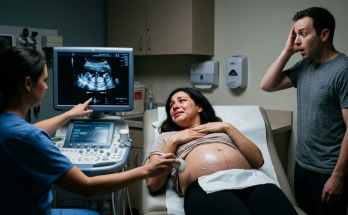
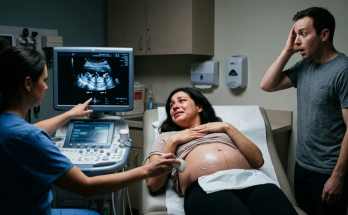
Dr. Bennett studied the screen for several seconds before speaking. The silence was almost unbearable. I watched the movement of her eyes as she compared measurements, and I tried to determine whether her concentration meant something was wrong with the pregnancy. Mark shifted impatiently beside the examination table. He had arrived expecting the doctor to validate his accusation, and he seemed disturbed that she wasn't providing an immediate answer. Ashley stood close to him, watching the monitor with an expression I couldn't read. I gripped the edge of the paper sheet beneath me, painfully aware that the conversation concerned my body while everyone else waited to decide what my pregnancy meant.
"Before we discuss the images," Dr. Bennett said, "I want to be certain I understand the timeline." She addressed Mark directly. He confirmed that his vasectomy had taken place approximately two months earlier. She asked whether the surgeon had scheduled a follow-up semen analysis. He said yes but explained that he hadn't attended. When she asked why, he gave a dismissive shrug and said he had assumed the surgery had accomplished what it was supposed to accomplish. Dr. Bennett didn't challenge him emotionally. She simply explained that the operation and confirmation of sterility were separate steps. Without the required analysis, there was no documented evidence that his semen was free of sperm.
Mark reacted as though she had insulted his intelligence. He argued that the procedure had been performed successfully and that the doctor had told him everything went well. Dr. Bennett clarified that an uncomplicated operation did not mean immediate sterility. I listened with a mixture of relief and dread. Every sentence confirmed what I had been trying to explain, but I could already see how difficult it would be for Mark to accept that his certainty had never been justified. He had built weeks of anger upon an assumption, and the doctor was dismantling it in front of the woman he had brought to support him.
Ashley interrupted to ask whether a man could still father a child after undergoing the procedure. Dr. Bennett said pregnancy remained possible before the follow-up testing confirmed clearance. She added that the timing mattered in this case and returned her attention to the monitor. I noticed that Ashley's face had lost some of its color. Until then, she had seemed interested in proving me dishonest. Now she appeared unusually concerned with the dates. I couldn't understand why. Perhaps she feared the examination would expose Mark's accusation as baseless. Perhaps she simply disliked losing the confidence she had displayed in the waiting room.
The doctor adjusted the image and enlarged a measurement. She explained that the pregnancy appeared farther along than we had believed. According to the structures visible on the scan, I was approximately eleven weeks pregnant, with several additional days indicated by the measurements. I stared at her, trying to place those weeks on a calendar. My mind moved backward through the missed period, the nausea, the weeks of exhaustion, and the day Mark had undergone his surgery. If the estimate was accurate, the pregnancy had already existed before he entered the operating room. The realization made the table beneath me feel strangely unstable.
Mark asked her to repeat the estimate. She did, explaining that ultrasound dating in early pregnancy was generally useful but still involved a margin of uncertainty. The important point was that the timing did not support his claim that the pregnancy had necessarily occurred after his vasectomy. I watched Mark calculate the dates in his head. His eyes narrowed, then widened slightly. He glanced toward Ashley, who had begun rubbing one thumb against the side of her handbag. I wanted to speak, but my throat had tightened. The answer was right there, no longer dependent on my ability to persuade him.
Dr. Bennett was careful about what the scan could and couldn't establish. It could estimate gestational age, identify developing fetal structures, and help determine whether the pregnancy appeared to be progressing appropriately. It could not prove biological paternity. She told Mark that the date of his procedure was not, by itself, evidence of infidelity. If he had questions about paternity, those would require an appropriate test rather than speculation. Her measured explanation made his earlier certainty seem even more reckless. I had spent days defending my honesty against a conclusion he had reached without the basic medical information necessary to support it.
Mark looked at me then, and for the first time since the pregnancy test, he seemed unsure what to say. The anger that had been so immediate in our kitchen was no longer there in the same form. In its place was a wary expression, as though he had discovered a mistake in a calculation that had guided an important decision. He asked why I hadn't recognized the pregnancy sooner. I explained that my cycle had been irregular, that I had mistaken the symptoms for illness and stress, and that I had not expected to become pregnant under the circumstances. Dr. Bennett confirmed that delayed recognition could happen, especially when early symptoms were difficult to distinguish from other changes.
I wanted to ask Mark whether he believed me now. The question rose to my lips, but I couldn't bring myself to say it. Belief offered under pressure from a medical professional was not the same as trust. He had ignored my explanation when it came from me. He had repeated accusations to other people and treated me like a stranger whose words required independent verification. The scan might prove that his reasoning was unsound, but it would not erase the fact that he had preferred to condemn me rather than investigate the possibility that he was mistaken.
Dr. Bennett returned to the image. She told us there was another finding she wanted to examine more closely. Her tone was gentle, though focused, and that seriousness frightened me more than the discussion about dates. I immediately wondered whether there was an abnormality. I asked if something was wrong. She reassured me that she had not identified a reason to panic, but she wanted a clearer view before explaining what she was seeing. She moved the probe slightly, changed a setting, and waited for the picture to sharpen. On the screen, the shape I had noticed earlier became more distinct. So did the second shape beside it.
I had never learned how to interpret an ultrasound image. To my eyes, the screen contained shadows and blurred outlines, interrupted by bright edges that appeared and disappeared whenever the doctor adjusted the view. Yet I could see that she was examining two separate areas. Her gaze moved from one to the other, and she made an additional measurement. Mark leaned forward, suddenly interested in something beyond his accusation. Ashley stepped closer to the examination table, although no one had invited her. I heard myself ask whether the baby was all right. Dr. Bennett said she wanted us to look at the monitor together.
She indicated the first developing fetus and explained what we were seeing. I could make out a curved outline and a small flickering movement. My breath caught. Until that moment, pregnancy had existed primarily as two lines on plastic and a collection of frightening conversations. Now something living appeared before me. The doctor adjusted the image again and directed my attention to a second area. Another small figure came into view. For a moment, I couldn't understand why the first image seemed to have been repeated. Then she explained that these were two distinct fetal structures.
"Two?" I whispered.
Dr. Bennett nodded. She showed us the first heartbeat and then the second, explaining that both were visible and that she wanted to document their measurements carefully. The rhythmic movement was almost impossible to comprehend. Two small hearts were beating inside me, each maintaining its own pace. I brought a hand to my mouth. For several seconds, the room and everyone in it seemed to recede. My husband, Ashley, the accusations, even the fear that had followed me into the clinic became distant. I was looking at two lives that had been developing quietly while the adults around them argued about betrayal.
The doctor told me I was carrying twins. I began to cry before I could answer. The tears surprised me because I had spent so much of the previous week struggling not to cry. These were different. I felt astonishment, tenderness, fear, and an unexpected sense of responsibility arriving together. I had entered the clinic hoping to confirm one pregnancy and perhaps settle the argument about its timing. Instead, I was learning that two babies were growing inside me. The future I had barely begun to imagine expanded so suddenly that I couldn't see its boundaries.
Mark moved toward the monitor. His expression was difficult to interpret. He looked from the first fetus to the second, then back toward Dr. Bennett. He asked whether she was certain. She explained that two separate developing fetuses and their cardiac activity were visible. She would document the findings and arrange appropriate follow-up care. He asked again about the dates, this time without the force he had used earlier. Dr. Bennett repeated that the pregnancy was already underway before his surgery. I watched the information settle over him. His silence was no longer an attempt to intimidate me. He appeared to be confronting a reality he had refused to consider.
Ashley spoke next, asking whether the dating meant I couldn't have been unfaithful. Dr. Bennett corrected the question. The ultrasound couldn't establish the identity of the father, she explained, but it undermined the claim that a post-vasectomy pregnancy necessarily indicated an affair. Nothing in the scan supported Mark's assumption that the procedure had made conception impossible. Ashley looked at him sharply. Their eyes met for an instant, and something passed between them that I didn't understand. It was a brief exchange, almost invisible, but I would remember it later when I began examining the circumstances of Mark's departure.
Mark finally addressed me. He spoke my name quietly, as though testing whether I would still respond to it. I looked at him without answering. He said he hadn't known the pregnancy could have started before the procedure. I reminded him that I had tried to explain exactly that. He lowered his eyes. He said he had been certain. I asked whether certainty had justified humiliating me in front of our friends and neighbors. He opened his mouth but produced no answer. Dr. Bennett remained respectfully silent, allowing us a moment while she finished recording the measurements.
The doctor explained that a twin pregnancy required additional attention and that she wanted me to consult maternal-fetal medicine. She discussed scheduling further examinations and watching my health carefully. I listened, forcing myself to concentrate despite the emotional turmoil. I asked questions about the babies' development, what the next appointment would involve, and whether the early findings were reassuring. She answered without offering promises beyond what the examination showed. For the first time that morning, I felt involved in a conversation about my health rather than forced to defend my character.
When the scan was finished, Dr. Bennett printed several photographs. She placed them in my hands, and I examined the small black-and-white images. Each seemed astonishingly fragile, a narrow rectangle containing information that had already changed my life. Mark watched me turn the pictures over. Then he asked whether he could have a copy. His request was quiet enough that I nearly missed it. I looked at him, remembering how he had spoken about the pregnancy in our kitchen and how easily he had announced his conclusions to people who knew us. I asked why he wanted the photographs.
He said the babies were his children. The words struck me with unexpected force. Only days earlier, he had treated the pregnancy as proof that I belonged to someone else. Now that the doctor had challenged his assumptions, he wanted to claim a place beside the lives on the screen. I asked whether he understood what had happened between those two moments. He said he knew he had been wrong. But he had said many things before, and I no longer trusted the emotional weight of a sentence merely because it was delivered softly. I told him that recognizing an error was not the same as repairing the harm caused by it.
Ashley shifted beside him. Until then, she had seemed uncomfortable but unwilling to leave. I turned toward her and asked whether she had anything to say. She replied that she had only come to support Mark. I asked whether she had encouraged him to accuse me. She looked away and said it wasn't her place to interfere in our marriage. The answer was so absurd that I almost laughed. She had accompanied my husband to an intimate medical appointment while I was being accused of infidelity. She stood beside him publicly while my marriage collapsed. Yet she wanted to describe herself as uninvolved.
I rose carefully from the examination table and adjusted my clothes. My knees felt weak, but my thinking had become unexpectedly clear. I thanked Dr. Bennett for her patience and gathered the paperwork. Mark reached toward the photographs, and I pulled them closer to my chest. I wasn't trying to deny him information about his possible children. I simply couldn't accept his assumption that he could decide when to reject them and when to claim them without acknowledging the consequences. He followed me toward the door and asked whether we could talk somewhere private.
In the hallway, he said he wanted to reconsider everything. The phrase sounded almost reasonable until I remembered how far events had already progressed. I asked whether he had told our friends he was mistaken. He said he would. I asked whether he had corrected the accusations he made to his family. He said he needed time. Then I asked whether he intended to stop seeing Ashley. He glanced toward the examination room, where she remained standing. That hesitation answered more than any speech could have. He wanted relief from the consequences without yet deciding what he was prepared to surrender.
I told him I would not make decisions about our marriage in a hospital hallway. He asked whether I was angry. I said anger was only a small part of what I felt. There was grief for the trust I had lost, fear about raising twins, and an exhaustion so deep I could scarcely recognize myself. I said I needed to protect my health and the babies' future. If he wished to be involved, he would have to approach the situation seriously, not through threats, gossip, or demands for forgiveness. Mark looked down at the photographs in my hands and asked whether there was any possibility we could recover what we had lost.
I had once believed that almost anything could be repaired if two people were willing to speak honestly. But honesty had been absent from our marriage in ways I was only beginning to understand. The photograph of Mark and Ashley at the restaurant returned to me. So did his refusal to answer when I asked where he had been staying. He had not merely misunderstood a medical procedure. He had moved toward another woman while refusing to hear his wife. I told him I couldn't answer his question because I no longer knew the whole truth about our relationship.
We reached the waiting room together. Ashley collected her handbag and approached Mark, but he hardly looked at her. I could see the beginning of an argument in their restrained expressions. For the first time, I felt no obligation to settle it. I placed the ultrasound photographs inside my purse and stepped toward the exit. Mark followed, calling after me. When I turned, he said he wanted us to talk about the babies and our future. I asked whether he was prepared to do that without threatening me or accusing me of things he couldn't prove. He said yes, but the answer came too quickly.
Outside, the sunlight was almost painfully bright. Cars moved through the parking lot, and someone nearby was laughing into a phone. I leaned against my vehicle for a moment and felt the hard edge of the keys against my palm. I was carrying two children, my marriage was collapsing, and the man who had helped create both problems now wanted me to reassure him. I realized I couldn't keep waiting for Mark to become reasonable before protecting myself. I called the attorney whose name a friend had once given me and left a message requesting an appointment. When I finally drove away, I had made a decision I knew would change everything: I would not sign a single document or accept another promise until I understood exactly what Mark had been doing.
Click here to continue reading: PART 3: Two Heartbeats Changed What My Husband Believed, but the Divorce Papers and a Hidden Trail of Money Exposed His Real Intentions
The Morning I Discovered I Was Pregnant, My Husband Turned a Medical Surprise Into an Accusation That Threatened Our Marriage
Part 2 of 10