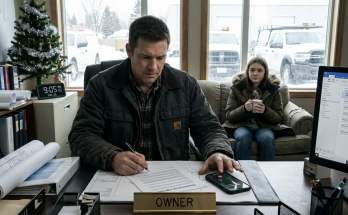
I sat at Arthur's desk with the notebooks spread around me.
I kept thinking about Aurora.
Our younger daughter had been born after we lost Maisie.
She was twenty-nine now.
She had grown into a woman who could make me laugh when I wanted to cry and challenge me when I wanted to hide.
Arthur adored her.
I knew that.
There had never been any doubt in my mind.
He had carried her as a baby.
He had played with her.
He had sat through her childhood worries and her endless questions.
He had loved being her father.
So why wasn't she in his manuscript?
I looked through the chapters I had already read.
Maisie at five.
Maisie learning to cycle.
Maisie imagining her future.
Maisie meeting a boyfriend.
Maisie moving away.
Maisie getting married.
All those pages.
All those years.
But I hadn't found Aurora's name.
It bothered me.
Not because I believed Arthur loved one child more than the other.
I knew him too well for that.
But I couldn't understand how he could write so much about the daughter we lost without mentioning the daughter who had filled our home with life afterward.
I picked up the notebook again.
There were years of notes about Maisie.
There were instructions about making her believable.
There were reminders about chapters he wanted to write.
Still, no answer.
I wanted Arthur to explain himself.
I wanted him to sit beside me and tell me what I was missing.
But he couldn't.
I could only read what he had left.
And for the first time since opening the parcel, I wondered whether the manuscript might hurt someone besides me.
Aurora.
I looked toward the bedroom.
I remembered her sitting on that miserable couch, telling me I didn't have to keep everything unchanged.
She had wanted me to move forward.
She had been patient with me.
She had listened to excuses I knew were weak.
And now I was sitting with a book that made me question how much our daughter had understood about our family.
I gathered the pages.
I put the notebooks back where I had found them.
Then I carried the manuscript downstairs.
I didn't know what I planned to say.
I only knew I didn't want to keep it from Aurora.
Arthur had already spent too many years keeping it private.
I wasn't going to do the same.
I picked up my purse and keys.
Then I drove to her apartment.
By the time I reached her door, I was nervous.
Not because I expected her to be angry.
Because I didn't know how to explain what her father had written.
I knocked.
Aurora opened the door.
She looked at my face first.
"Mom? Is everything all right?"
I held up the pages.
"I found something your dad wrote."
She stepped aside immediately.
"Come in."
I entered the apartment and followed her toward the table.
She offered to make coffee.
I said yes.
Then I remembered the last cup she'd served me.
"Nothing fancy this time, please."
She laughed.
"Mom, it wasn't fancy."
"It tasted like someone had burned the bread and poured water over it."
"That was normal coffee."
"Then I'll have a different kind of normal."
She shook her head and went into the kitchen.
I was grateful for the joke.
It made the visit feel ordinary for a moment.
I placed the manuscript on her table.
The title faced upward.
When Aurora returned, she noticed it.
She set the coffee down.
"What's this?"
"Your father's writing."
She moved closer.
"An entire book?"
"I think so."
She read the title.
Then she looked at me.
"Is it about Maisie?"
I nodded.
"About the things she might have done if she'd lived."
Aurora pulled out a chair.
I sat across from her.
She turned the first page.
I watched her expression as she read.
She smiled at the scene with the socks.
She paused over the birthday cake.
Then she read more slowly.
I wanted to explain everything.
I wanted to tell her what I had felt reading it.
How strange it was.
How beautiful some of the scenes were.
How much they hurt.
But I kept quiet.
For once, I let her read without telling her how she should feel.
After several pages, she looked up.
"I wish Dad had let me see this."
I frowned.
"Why?"
She seemed surprised by the question.
"Because it's about my sister."
I looked at the manuscript.
"Honey, these things didn't really happen."
"I understand that."
"We only had Maisie for eight months."
"I know, Mom."
I didn't know why I kept explaining what she already understood.
Maybe I was trying to protect the memory of what was real.
Maybe I was frightened by how easily Arthur's imagined life had affected me.
Aurora closed the pages gently.
"I would've liked hearing more about her."
I reached for her hand.
"We didn't get to learn much about her ourselves."
She nodded.
"I know."
Then she looked at me for a long moment.
"Why didn't we talk about her more when I was growing up?"
I sat back.
"We did talk about her."
"Not very much."
"Of course we did."
Aurora looked down at the table.
Then she raised her eyes.
"Mom, we really didn't."
Her voice was calm.
That made it harder.
If she had been angry, I could have argued.
If she had accused me, I could have defended myself.
But she was simply telling me what she remembered.
And I didn't like hearing it.
I folded my hands together.
"We never tried to hide the fact that you had a sister."
"I know."
"Your father and I loved Maisie."
"I know that too."
I felt frustrated.
"Then I don't understand what you're saying."
Aurora was quiet for a moment.
Then she reminded me of something that had happened when she was six.
She had found a photograph in Arthur's drawer.
I remembered the picture.
Maisie was wearing a little outfit decorated with yellow ducks.
Her hand was curled around Arthur's finger.
It was one of the photographs I had loved most.
And one of the hardest for me to look at.
Aurora had discovered it and brought it to me.
She wanted to know who the baby was.
I remembered explaining that the little girl was her older sister.
Then I remembered taking the picture.
Putting it away.
Ending the conversation.
Aurora watched me.
"Do you remember?"
I nodded.
"Yes."
"I wanted to ask if she looked like me."
I swallowed.
"You didn't ask."
"Because you looked upset."
I stared at her.
"I didn't want to frighten you."
"I know."
"You were only six."
"Exactly."
She didn't raise her voice.
She didn't need to.
I had thought I was protecting her.
I had believed that a child so young shouldn't have to carry our grief.
So I put the photograph away.
I put my feelings away.
And I expected her to accept the short explanation I had given.
Aurora leaned back.
"I wasn't scared of knowing about Maisie."
I looked at her.
"I just wanted to know her a little."
I felt something tighten inside me.
We had done our best.
I wanted her to understand that.
I wanted her to know how hard those years had been.
How frightened I had been of saying the wrong thing.
How often I had tried to keep my sadness away from her.
"Your father and I were doing what we thought was right."
She nodded.
"I believe you."
"Then why are we arguing?"
"We're not arguing."
"It feels like we are."
She looked down briefly.
Then she said something I wasn't prepared to hear.
"Mom, when I tell you how something felt to me, you keep explaining why you did it."
I stared at her.
I had no answer.
She wasn't asking for my defense.
She was asking me to listen.
But I couldn't manage it.
Not then.
I felt embarrassed.
And hurt.
And, if I'm being truthful, a little angry that the conversation had become about mistakes I hadn't known I was making.
I pushed my chair back.
"I think I should go."
Aurora looked up quickly.
"Mom."
I picked up my purse.
"I've given you enough to think about."
"Please stay."
I shook my head.
She stood.
"We don't have to agree about everything."
"I know."
"Then don't leave just because this is uncomfortable."
I wanted to sit back down.
I wanted to tell her I understood.
But I wasn't ready to admit how deeply her words had reached me.
I gathered the manuscript.
She watched me.
I could see that I was hurting her.
And still, I walked toward the door.
"Mom, please."
"I'll call you."
I left.
That was my mistake.
Not the first one.
But the one I could still correct.
I drove home with Arthur's pages on the passenger seat.
I didn't turn on the radio.
I kept hearing Aurora's voice.
She had been six years old.
She had found a photograph of her sister.
And she had wanted to know whether they looked alike.
That was all.
Such a simple question.
I could have told her about Maisie's eyes.
I could have described the way her little fingers held on to Arthur.
I could have shown her other photographs.
I could have let her ask questions.
Instead, I had put the picture away.
I thought I was sparing her from sadness.
But I had also taught her that Maisie was someone we weren't supposed to discuss.
I hadn't meant to.
That was the awful part.
I had loved both my daughters with everything I had.
Yet I had made one daughter's memory feel forbidden to the other.
I thought about Arthur writing his chapters.
About all those imagined birthdays and small arguments.
Maybe he had been trying to give himself the conversations we hadn't known how to have.
Maybe he had needed to make Maisie ordinary again.
A little girl who argued about socks.
A teenager who annoyed her father.
A grown woman who made mistakes.
Not just a baby whose photograph was kept in a drawer.
I looked at the manuscript beside me.
Then I remembered Aurora asking why we hadn't spoken more.
I had answered every question except the one she was really asking.
How had our silence felt to her?
I pulled into my driveway.
I didn't get out of the car immediately.
I sat with my hands resting on the steering wheel.
I had walked away from my daughter because I couldn't bear hearing that I had hurt her.
That was the truth.
I told myself I needed time to think.
But she had asked me to stay.
And I had left anyway.
I reached for my phone.
I called her.
She answered quickly.
"Mom?"
I closed my eyes.
"I'm sorry I walked out."
There was a pause.
Then Aurora spoke.
"Okay."
"No, honey. It wasn't okay."
I looked toward the house.
"I didn't like hearing what you said. But that doesn't mean you shouldn't have said it."
She stayed quiet.
I continued.
"I thought I was protecting you when you were little."
"I know."
"But I didn't think about what it felt like on your side."
My voice became unsteady.
"I should have listened."
Aurora took a moment before answering.
"That's what I wanted."
I swallowed.
I wanted to tell her I had never wished away any part of the life we had with her.
I wanted to tell her that losing Maisie had never made loving Aurora complicated.
But I knew those words needed more than a rushed conversation in the car.
They needed time.
They needed honesty.
And I needed to stop defending myself long enough to hear her.
"I'd like us to talk again," I said.
"We can."
"Come over tomorrow. I'll make dinner."
She hesitated.
"Are you sure?"
"Yes."
I looked at the manuscript.
"I want to hear the rest of what you were trying to tell me."
Her voice softened.
"All right, Mom."
I promised not to walk away the next time the conversation became difficult.
Then we said goodbye.
I put the phone down.
Arthur's manuscript was still beside me.
I hadn't finished reading it.
I still didn't understand why Aurora seemed absent from his story.
And I still didn't know what Arthur had been afraid to show me.
But one thing had become clear.
My husband wasn't the only person who had kept important things unspoken.
I had done it too.
And tomorrow, I was going to listen to our daughter.
Click here to continue reading: PART 5: My Daughter Came to Dinner Carrying a Pie, but the Conversation We Had Avoided for Years Was Waiting at My Table
I Sold the Couch My Husband Refused to Replace, Never Imagining a Stranger Would Bring Something Back the Very Next Morning
Part 4 of 12