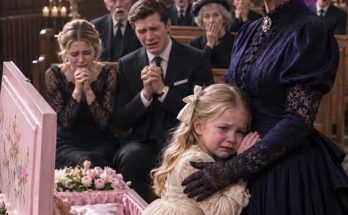
I had never felt so old as I did when I reached the hospital.
My hands ached.
My clothes smelled of lilies.
And every time I closed my eyes, I saw Jessi lying inside that coffin.
I had thought leaving Arthur's house would make me feel safer.
In some ways, it did.
There were people here whose job was to help sick children.
There were nurses moving through the halls.
Doctors speaking quietly.
Machines making ordinary hospital sounds.
Everything looked familiar.
Yet nothing about that night felt ordinary.
I kept expecting someone to tell me that I had misunderstood what happened.
That I had imagined the restraints.
That grief had confused me.
But I could still feel the silver key against my palm.
I had put it in my handbag before leaving.
I checked for it more than once.
It was there.
Real.
Cold.
And impossible to explain away.
Jessi had been taken into the hospital for treatment.
I was not allowed to follow her everywhere.
I understood that.
The doctors needed room to work.
They needed information.
They needed to examine her without a frightened grandmother standing over their shoulders.
I tried to be patient.
I sat in a chair near the area where I had been told to wait.
My wool shawl was folded across my knees.
I had brought it from Arthur's entrance hall.
Earlier, I had set it down because I could not bear to leave Jessi.
Now I held it tightly.
The fabric still carried the smell of the house.
Lilies.
I wanted to wash it.
I wanted to get that scent off everything I owned.
But I did not move.
I was afraid someone would come looking for me while I was gone.
I stared at the floor.
There were faint marks on the tiles.
People had walked through that hallway all night.
Families.
Patients.
Hospital workers.
Everyone carrying some burden I could not see.
I wondered whether any of them had arrived with a story as strange as mine.
A child believed dead.
A coffin.
Locked restraints.
Parents who already knew.
I rubbed my hands together.
The cuts across my fingers stung.
I remembered pulling the satin lining apart.
The little key hidden near Jessi's hip.
The heavy click when the first buckle opened.
I closed my eyes.
Then opened them again.
I was afraid of what I would see if I let myself think too long.
A nurse came toward me.
She asked whether I was Margaret.
I stood immediately.
“Yes.”
She spoke gently.
She needed some information about Jessi.
I answered what I could.
Her full name.
Her age.
Her parents' names.
The history of illness I had been told about.
I explained that I was not sure which details were accurate.
The nurse listened carefully.
I could see her taking my uncertainty seriously.
That was a relief.
For months, every question I asked had seemed to annoy someone.
Now a stranger was willing to listen.
She asked about the medical care Jessi had received.
I described what Arthur and Patricia had told me.
Respiratory problems.
Increasing weakness.
Long periods of rest.
But I could not name every doctor.
I could not explain the treatment plan.
I did not know exactly what medication Jessi had taken.
I had asked about those things.
I had not been given clear answers.
Saying that aloud made me feel ashamed.
I had allowed my granddaughter's medical care to become something I knew almost nothing about.
I had convinced myself that was normal.
That her parents had the right to privacy.
That I should not interfere.
The nurse did not comment on my guilt.
She simply asked another question.
“When did you last see her awake before tonight?”
I had to think.
There had been so many brief visits.
So many occasions when Jessi was described as too tired to talk.
I told her what I remembered.
I explained that my granddaughter had often been brought downstairs for short periods.
Sometimes in a wheelchair.
Usually with Patricia nearby.
I described how little energy she seemed to have.
How her eyes sometimes struggled to stay open.
How different she had become from the active child I remembered.
The nurse listened.
Then she asked what had happened on the night of the funeral.
I took a breath.
I began at the beginning.
Arthur and Patricia had gone upstairs.
They had told me to return to my hotel.
I had walked toward the front door.
Then I had changed my mind.
I explained that I wanted to say goodbye.
I had opened the coffin.
Touched Jessi's cheek.
Felt the heat.
Seen her chest move.
Found her pulse.
The nurse's expression remained calm.
I was grateful for that.
I needed someone who could hear the facts without making me feel that I was losing my mind.
I continued.
I described the straps.
The key.
Jessi's words.
Arthur's reaction.
Patricia's reaction.
My emergency call.
I did not leave out the parts that made my own son look terrible.
That was hard.
Harder than I expected.
Arthur was still my child.
For decades, my instinct had been to protect him.
When he was young, I had defended him.
When he made mistakes, I had tried to help him correct them.
I had been proud of his successes.
I had wanted his marriage to work.
I had wanted his family to be happy.
Now I was describing things that could change his life.
I knew that.
But every time I felt tempted to soften a detail, I remembered Jessi.
Her small voice.
The pressure marks beneath her dress.
The question about punishment.
So I kept telling the truth.
When I finished, the nurse thanked me.
She told me that the medical team was caring for Jessi and that the information would be passed along appropriately.
I nodded.
I wanted to ask whether my granddaughter would live.
But I knew the nurse could not promise me that.
I sat down again.
My shawl slipped from my knees.
I picked it up.
Then I waited.
Waiting gave me too much time to remember.
I thought about the first weeks of Jessi's illness.
Arthur had sounded worried when he told me she was having breathing problems.
I had been worried, too.
I wanted to visit.
He told me they were still trying to understand what was happening.
I accepted that.
Later, Patricia said Jessi needed more rest.
I accepted that, too.
Then came the restrictions.
Short visits.
Closed doors.
No unexpected calls.
No suggestions about treatment.
Every boundary had been presented as something that would help Jessi recover.
I had tried to respect them.
I remembered one afternoon when I stood outside her bedroom.
Patricia had told me not to enter.
I had heard almost nothing from inside.
I had wondered whether Jessi was asleep.
Now I wondered whether she had been able to speak.
I remembered the wheelchair.
The way Jessi's hands rested in her lap.
The unfocused look in her eyes.
I had thought it was exhaustion.
Now I knew I did not have enough information to say what caused it.
That frightened me.
Because it meant I had spent months accepting appearances as explanations.
A tired child did not tell me why she was tired.
A closed bedroom door did not tell me whether she was getting proper care.
A parent's confidence did not make a medical decision correct.
And a coffin did not prove a child was dead.
I had learned that last lesson in the worst way imaginable.
I looked down at my hands.
The cuts were beginning to dry.
There was a small dark mark near my thumb.
I pressed my fingers together.
I remembered Jessi saying she had listened to her mother.
I remembered her asking if she had been good.
My stomach tightened.
What kind of little girl would think being locked in a coffin was punishment?
What had she been told?
How long had she been frightened?
I did not know.
And I had promised myself that I would not invent answers simply because I was angry.
I needed facts.
Real ones.
The doctors would have to determine what was happening medically.
Other people would have to examine the circumstances that brought Jessi there.
I could tell them what I had seen.
I could tell them what I had heard.
I could give them the key.
That was what I had.
I would not make the mistake of claiming knowledge I did not possess.
But neither would I let anyone persuade me that what I had witnessed did not matter.
A little later, Arthur arrived.
I saw him before he saw me.
He came into the waiting area looking exhausted.
His shoulders were bent forward.
His eyes moved quickly around the room.
For a moment, I remembered him as a young man standing outside a hospital room when someone he loved was sick.
I had comforted him then.
My body almost moved toward him out of habit.
I stayed in my chair.
He saw me.
Then he approached slowly.
“Mom.”
I looked at him.
He sat down beside me.
For a while, neither of us spoke.
I could hear distant footsteps.
A cart moving along the hallway.
The quiet voices of hospital staff.
Arthur rubbed his hands together.
I noticed how much they were shaking.
“Have they told you anything?”
“Not much.”
He nodded.
I watched him.
There were so many questions I wanted to ask.
Some were about Jessi.
Others were about the son sitting beside me.
I wanted to know when he had become a man who could look at a living child inside a coffin and speak about everything falling apart.
I wanted to know what had happened in that house during the eight months when I was kept away.
But I knew that asking all those questions at once would accomplish very little.
I began with the simplest one.
“Why didn't you tell me she was alive?”
Arthur looked at the floor.
I waited.
He rubbed his forehead.
“Mom, I don't know how to explain it.”
“Try.”
He remained silent.
I watched his hands.
They were clasped tightly between his knees.
I remembered holding those hands when he was little.
I remembered teaching him to cross the street.
I remembered telling him to be honest even when the truth would get him into trouble.
I wondered whether he remembered those lessons.
“Arthur, you told me my granddaughter had died.”
His eyes filled with tears.
“I know.”
“You watched me prepare to bury her.”
He swallowed.
“I know.”
I looked away.
I could not bear hearing him say those two words again.
Knowing was the problem.
He knew.
He had admitted it.
And somehow he had still allowed the funeral to go forward.
I looked back at him.
“Did you know about the straps?”
His face tightened.
He did not answer.
I waited.
Then he nodded.
I felt my chest ache.
There it was.
Another piece of the truth.
Not enough to explain everything.
But enough to make denial impossible.
“Why?”
His lips trembled.
He looked toward the hallway.
“I was afraid.”
I stared at him.
“Of what?”
He shook his head.
“I don't know what to say.”
I felt anger rising.
I forced myself to keep my voice low.
“You were afraid. Jessi was locked inside a coffin.”
He covered his face with his hands.
I looked away.
I had seen him cry before.
But I could not comfort him now.
Not while his daughter was fighting to recover.
I waited for him to speak again.
Eventually, he lowered his hands.
“I didn't know how to stop things.”
I looked at him.
“Then you should have asked for help.”
He closed his eyes.
I continued.
“You could have called me.”
He said nothing.
“You could have called a doctor.”
His face tightened.
“You could have told someone the truth.”
I stopped.
There was nothing more to say.
I had offered to help months earlier.
He had refused.
Now I was sitting in a hospital because I had discovered his daughter was alive by touching her cheek during what was supposed to be my final goodbye.
Arthur leaned back.
He looked exhausted.
For the first time, I noticed how little resemblance there was between the confident man who owned the large house and the frightened person sitting beside me.
I wondered whether he had been living with fear for months.
Then I remembered Jessi.
Whatever Arthur feared, he was an adult.
He had choices.
Jessi had been six years old.
She had trusted the people who cared for her.
That difference mattered.
I looked at Arthur.
“I won't lie for you.”
He turned toward me.
“I haven't asked you to.”
“Not with words.”
He lowered his eyes.
I continued.
“I won't pretend I didn't find those straps.”
He nodded.
“I won't forget what Jessi said.”
He pressed his lips together.
“And I won't tell anyone that she was dead when I found her.”
He looked at me.
There were tears on his face.
I had never felt less comforted by my son's tears.
I wanted him to tell me the truth.
Not because I wanted to hurt him.
Because his daughter deserved to have what happened to her understood.
Arthur wiped his face.
“I know I've done something terrible.”
I stared at him.
It was the first thing he had said that sounded like an admission rather than an excuse.
I waited.
He did not add anything.
I decided not to push him further at that moment.
I was too tired.
And Jessi was still receiving treatment.
I looked toward the hallway.
I wanted to see a doctor.
I wanted to hear that my granddaughter was breathing more easily.
That her fever was being treated.
That someone understood why she had become so weak.
I wanted ordinary medical news.
Something concrete.
Something that did not depend on Arthur's willingness to tell the truth.
A member of the hospital staff approached us.
I stood before she reached the chairs.
She looked at Arthur and then at me.
She confirmed our relationship to Jessi.
Then she explained that the team was continuing to evaluate her condition.
They were taking her breathing and lack of responsiveness seriously.
I listened to every word.
I asked whether she was still alive.
The woman looked at me gently.
“Yes. She's receiving care.”
I held the back of the chair.
That was all I needed to hear in that moment.
Still alive.
Not safe yet.
Not recovered.
But alive.
I thanked her.
She told us that further updates would come when the medical team had more information.
I nodded.
Arthur was standing beside me.
I could feel him looking at me.
I did not turn.
I thought about the long night.
The lilies.
The coffin.
The key.
The sound of his footsteps on the stairs.
I had spent months doubting my own judgment because Arthur and Patricia seemed certain of theirs.
Now I understood something I should have understood much earlier.
Being a parent did not make a person incapable of doing harm.
Being successful did not make a person trustworthy.
And loving someone did not require believing every explanation they offered.
I sat down again.
Arthur remained standing for a moment.
Then he moved to a chair a little farther away.
I did not ask him to sit beside me.
I folded my shawl across my knees.
My hands were still sore.
I placed them on top of the fabric.
For the first time that night, I allowed myself to think about what would happen when Jessi woke up.
Not what Arthur wanted.
Not what Patricia would say.
What Jessi needed.
She would need people who listened.
People who believed her when she said she was frightened.
People who did not punish her for speaking.
I did not know whether I would be allowed to make decisions for her.
I did not know what the doctors would find.
I did not know what would happen to Arthur and Patricia.
But I knew what I could do.
I could tell the truth.
I could remain available.
I could stop mistaking silence for peace.
I looked toward the hallway where Jessi had been taken.
Then I made a decision I should have made months before.
No matter how uncomfortable the truth became, I would not stop asking what had happened to my granddaughter.
And this time, I would not accept an answer simply because it came from my son.
Click here to continue reading: PART 9: When the Doctors Began Asking Questions About Jessi’s Illness, I Realized How Much of Her Life Had Been Hidden From Me
I Stayed Behind After Everyone Went Upstairs Because Something About My Granddaughter’s Funeral Had Been Troubling Me for Months
Part 8 of 15