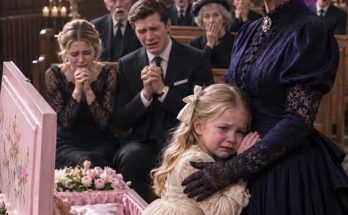
I used to believe that a mother could always tell when her child was lying.
I was wrong.
And by the time I admitted that to myself, my six-year-old granddaughter was lying inside a coffin in my son's living room.
Her name was Jessi.
She was the kind of little girl who used to make an ordinary afternoon feel special without even trying.
I remembered her laughter.
I remembered the way she looked at me when she wanted my attention.
And I remembered the last several months, when I had watched that little girl slowly become someone I barely recognized.
That was what I couldn't stop thinking about on the night before her funeral.
Not the funeral arrangements.
Not the expensive flowers.
Not the people who had sent their condolences.
I kept thinking about the changes I had seen and all the questions I had been told to stop asking.
It was a little after eleven that night.
I was standing inside my son Arthur's enormous house in one of the wealthier suburbs outside Chicago.
The house had always seemed too large to me.
There were walls of glass, polished floors, and rooms that seemed designed more for showing people around than for living in.
Arthur had worked hard for what he owned.
I had always been proud of that.
But standing there that night, I would have traded every expensive thing in that house for another ordinary afternoon with Jessi.
Just one.
The air conditioning was running.
I could hear it even from the entrance hall.
Usually, a sound like that disappeared into the background.
That night, it seemed to be the only thing in the house that was still carrying on as usual.
The living room was ahead of me.
It was lower than the surrounding floor, reached by a few broad steps.
In the middle of it sat Jessi's coffin.
Dark wood.
Shining brass handles.
White satin inside.
I had spent hours trying not to look at it.
Now I couldn't look anywhere else.
The coffin stood on a raised platform covered in dark velvet.
Flowers surrounded it on every side.
White lilies were arranged in tall vases near the fireplace.
More flowers lined the stairs.
There were so many that their smell had settled into everything.
My shawl smelled of them.
My hair probably did, too.
I had never disliked lilies before.
That night, their sweetness made my stomach turn.
People had sent them because they cared.
I understood that.
Arthur and Patricia knew many people.
Neighbors.
Business associates.
Friends from their country club.
They had all heard about Jessi's illness.
Some had followed it for months.
They had been told about the breathing problems, the exhausting treatments, and the terrible decline that had finally taken her life.
Eight months.
That was how long the illness had shaped everything in our family.
Eight months of phone calls that ended before I was ready.
Eight months of visits arranged around Jessi's rest.
Eight months of being reminded that her parents knew what was best.
I had believed most of it.
Or perhaps I had wanted to believe it.
That distinction mattered to me now.
It was easier to accept an explanation than to imagine that my own son might be keeping something important from me.
Arthur was my boy.
Even as a grown man with an expensive house and a family of his own, some part of me still saw the child I had raised.
I knew his face.
I knew when he was tired.
I knew the way he looked away when a conversation made him uncomfortable.
At least, I thought I did.
Earlier that evening, he had stood near Jessi's coffin without speaking much.
He looked worn down.
His shoulders were bent forward.
His eyes kept moving away from mine.
I told myself grief was doing that to him.
What else was I supposed to think?
A father was preparing to bury his little girl.
I had no wish to judge how he handled such a thing.
Patricia had stayed beside him.
My daughter-in-law was dressed in black.
Her dress was expensive, perfectly fitted, and without a wrinkle that I could see.
She carried a small silk handkerchief.
Every so often she pressed it beneath one eye.
I noticed that the handkerchief stayed dry.
Then I felt ashamed for noticing.
Grief did not always come with tears.
I knew that.
Some people cried constantly.
Others went quiet.
I had no right to decide what a grieving mother ought to look like.
That was what I told myself.
It was what I had been telling myself about Patricia for months.
She had always been particular about Jessi.
Her meals.
Her sleep.
Her visitors.
Her medical care.
I had disagreed with her more than once, but I usually kept those disagreements small.
I did not want to become the mother-in-law who interfered with every decision.
I had seen families damaged by that.
I told myself I would never be one of those women.
So when Patricia said Jessi needed quiet, I gave her quiet.
When she said visitors were too much, I shortened my visits.
When she explained that Jessi became distressed around too many people, I stopped asking to spend time alone with her.
I thought I was helping.
Looking back, that is the part I find hardest to say.
I thought I was helping.
There had been a time when Jessi ran toward me as soon as she saw me.
She did not wait to be invited.
She came straight into my arms.
Then the illness began.
At first, I was told she was tired.
Then she was too weak to play.
Then she needed to stay in her room.
Eventually, I saw her only for short periods.
Sometimes she was brought downstairs in a wheelchair.
I remember how small she looked sitting there.
Her face had lost its usual brightness.
Her movements were slow.
Even when I spoke to her, she seemed to have trouble staying focused.
She had once been such an active child.
Now she barely moved.
I wanted to ask her what was happening.
I wanted to hear her describe how she felt.
But Patricia was usually nearby.
And Jessi was always taken away before I felt I had really spoken to her.
I had raised my concerns.
More than once.
Arthur did not welcome them.
There was one conversation I remembered especially clearly.
I had suggested taking Jessi to a specialist in Boston.
I wasn't claiming to know more than her doctors.
I simply wanted another opinion.
When a child was getting worse, surely another physician might see something the first one had missed.
That seemed reasonable to me.
Arthur did not think so.
“Mom, we've already made our decisions about her treatment.”
His voice was sharp.
I had tried to explain.
“I only want someone else to look at her records.”
“We're her parents.”
“I know that, Arthur.”
“Then please let us make these choices.”
I remembered how embarrassed I had felt.
Not because I thought my suggestion was wrong.
Because my own son had spoken to me as though I were a stranger interfering in his home.
I apologized.
That was another thing I regretted.
I apologized for worrying about Jessi.
There had also been the day Patricia stopped me outside Jessi's bedroom.
I had gone upstairs hoping to sit with my granddaughter for a little while.
The door was closed.
Patricia stood directly in front of it.
“She needs to be left alone today.”
I had looked past her shoulder.
I could not see Jessi.
“Could I just say hello?”
“No, Margaret. She gets upset when people keep coming in.”
“I won't stay long.”
“Please don't make this harder.”
The way she said it ended the conversation.
I stepped away.
I told myself a sick child needed her mother's protection.
That was true.
What I had failed to ask was whether Jessi was actually being protected.
Those memories kept returning while I stood in Arthur's living room.
They came without any order.
The bedroom door.
The wheelchair.
Arthur's raised voice.
Patricia's handkerchief.
Jessi's quiet face.
I wanted to push them away.
It was the night before a funeral.
Surely I should have been thinking only about the little girl we had lost.
But I could not separate Jessi's death from the months leading up to it.
Something had bothered me for a long time.
I had repeatedly told myself it was nothing.
I had even wondered whether I was making things worse by refusing to accept how serious her illness had become.
There was no comfort in that thought now.
Only regret.
Patricia came toward me shortly after ten.
Arthur followed a few steps behind her.
They had been receiving visitors and managing arrangements for hours.
I could see they wanted the evening to end.
Patricia stopped beside the entrance to the living room.
She brought the handkerchief to her face.
“Margaret, we can't stay downstairs any longer.”
I nodded.
“Of course.”
“We've been given something to help us sleep.”
I looked at Arthur.
He was staring toward the coffin.
Patricia continued.
“The service starts very early. You should get back to your hotel.”
I understood what she was saying.
They wanted me to leave.
It was their house.
I was their guest.
And they had every reason to need privacy.
Still, the idea of walking away from Jessi made my chest ache.
“I was hoping to stay a little longer.”
Patricia glanced toward the stairs.
“We really need to rest.”
Arthur said nothing.
I waited for him to look at me.
He didn't.
“All right,” I finally said.
It was a small answer.
I had been giving small answers for months.
Patricia touched Arthur's arm.
He followed her toward the staircase.
I watched them climb.
Her shoes made a light sound against the steps.
Arthur moved more heavily.
At the top, they turned down the hallway toward their bedroom.
The door closed behind them.
I stood where they had left me.
For a long moment, I did nothing.
Then I picked up my handbag and my wool shawl.
I walked into the entrance hall.
My shoes made a faint sound on the marble.
The front door was only a few steps away.
I could have opened it.
I could have returned to my hotel and spent the night waiting for the funeral.
That would have been the sensible thing.
It was what I had been asked to do.
But I stopped.
My hand was resting against the strap of my handbag.
I could smell the lilies all the way from the living room.
I looked back.
The coffin was still there, surrounded by flowers and small artificial candles.
Jessi was there.
My granddaughter.
The little girl whose illness I had questioned and whose parents had repeatedly asked me to trust them.
I had trusted them.
I had obeyed them.
I had stayed out of their way.
And now I was supposed to walk out of that house without speaking to Jessi one last time.
I couldn't do it.
I put my handbag down on the console table.
The shawl went beside it.
I turned around.
Then I walked back toward the living room.
I had no plan.
I was not looking for proof of anything.
I was an old woman who had lost her granddaughter and could not bear to leave her alone.
At least, that was what I believed when I took the first step down into the room.
The air conditioner kept humming.
The lilies filled the air.
And somewhere upstairs, behind a closed bedroom door, my son and his wife had gone to sleep.
I approached the coffin.
For the first time that evening, I knew exactly what I wanted to do.
I wanted to say goodbye without anyone standing beside me.
Without anyone telling me to hurry.
Without anyone deciding how much time I was allowed.
Just Jessi and me.
I reached the polished wooden side.
I placed one hand on it.
The wood felt smooth beneath my palm.
I looked at the brass handle on the lid.
Then I whispered her name.
“Jessi.”
No answer came.
Of course there was no answer.
I knew that.
Still, I waited a moment before reaching for the handle.
I had come back because I needed one last goodbye.
What I did not yet understand was how much I had failed to see while my granddaughter was still alive.
Click here to continue reading: PART 2: When I Opened My Granddaughter’s Coffin to Say Goodbye, One Small Detail Made Me Question Everything Her Parents Had Told Me
I Stayed Behind After Everyone Went Upstairs Because Something About My Granddaughter’s Funeral Had Been Troubling Me for Months
Part 1 of 15