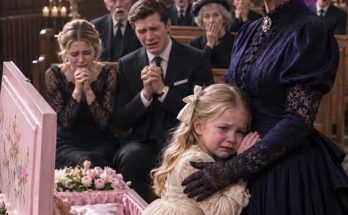
I had always tried to be fair to Patricia.
Even when I disagreed with her.
Even when she spoke to me in a way that hurt.
I reminded myself that Jessi was her daughter.
That mothers could become protective when their children were ill.
That fear sometimes made people difficult.
I had spent eight months giving Patricia the benefit of every doubt.
Now I was sitting in a hospital wondering whether my kindness had made me blind.
Arthur had admitted that he was present when Jessi was placed inside the coffin.
He had also admitted that he did not stop it.
Those words kept returning.
I didn't stop it.
I could not understand how he had reached that point.
I knew he had been frightened.
I knew his marriage mattered to him.
But Jessi was his child.
His responsibility.
There were things a parent could never excuse by saying someone else made the decision.
I looked at the empty chair beside me.
Arthur had gone to answer more questions.
I was relieved to be alone.
Not because I wanted to abandon him.
Because I needed a little space from everything he had said.
My hands were resting in my lap.
The cuts on my fingers had begun to ache again.
I looked at the small mark beside my thumb.
That injury had come from trying to free Jessi.
It seemed impossible that such an ordinary little cut could be connected to something so terrible.
I thought about Patricia's hands.
Her beautifully kept nails.
The silk handkerchief she had carried through the evening.
The way she adjusted her dress before speaking with visitors.
I had noticed those details at the funeral.
At the time, I had felt ashamed of noticing them.
Now I wondered why she had seemed so concerned with appearances.
I did not know what was in her mind.
I could not claim to.
But I knew what she had done in front of me.
She had repeatedly kept me from Jessi.
She had insisted that my granddaughter needed to remain alone.
She had reacted with anger when she learned Jessi was alive and that I had called for help.
And she had said Arthur told her Jessi would not wake up.
I could not explain those facts away.
A member of the hospital staff came to speak with me.
She asked whether I needed anything.
Water.
A place to rest.
Someone to contact.
I thanked her.
I accepted some water.
Then I asked whether there was any news about Jessi.
She explained that the medical team was still working.
I nodded.
I had begun to understand that no one could give me certainty simply because I desperately wanted it.
I took a sip of water.
My throat was dry.
I had been crying and talking for hours.
Every sentence seemed to scrape against it.
The woman sat nearby for a moment.
She asked whether I had someone I trusted who could be with me.
I thought about that.
Arthur was my son.
Patricia was my daughter-in-law.
They should have been the people I trusted most during a family emergency.
Instead, I was afraid of what they might say.
And afraid of what they might leave out.
I shook my head.
“Not here.”
She nodded.
I did not need to explain further.
She asked whether I felt safe.
I thought about Arthur standing in front of me near the entrance hall.
I remembered telling him I would scream if he did not move.
Then I remembered Patricia demanding that I hand Jessi over.
“I feel safer here.”
The woman listened.
I explained that I did not want to return to Arthur's house.
Not that night.
Perhaps not for a very long time.
She assured me that my concerns could be documented.
I thanked her.
After she left, I sat with the water in my hands.
I kept thinking about the first time Patricia had told me Jessi needed more privacy.
It had sounded reasonable.
Jessi was ill.
Too much attention might exhaust her.
I did not argue.
Later, Patricia began shortening visits.
Then she stopped allowing me into Jessi's bedroom.
Each change was small enough to explain.
That was what troubled me now.
There had never been one moment when Patricia announced that I was no longer allowed to care about my granddaughter.
Instead, the distance grew gradually.
One shortened visit.
One postponed afternoon.
One unanswered question.
One conversation that ended because I had supposedly upset someone.
By the time I understood how little access I had, it had become normal.
I remembered standing beside Jessi's wheelchair.
She had looked exhausted.
I had tried to ask whether she wanted to sit with me.
Patricia had answered before Jessi could.
“She needs to go back upstairs.”
I had stepped aside.
I still remembered the way Jessi's head leaned against the chair.
She did not protest.
At the time, I thought she was too tired.
Now I wondered whether she had learned that protesting would not help.
I closed my eyes.
I could not know that.
Not yet.
But the possibility hurt.
I took another sip of water.
Then I made myself think carefully.
I did not want my anger to become another problem Jessi would have to endure.
When she recovered enough to speak, she needed someone willing to listen without putting words in her mouth.
She had already been surrounded by adults who spoke for her.
I did not want to become another one.
I would ask what she needed.
I would listen to what she actually said.
I would not insist that she remember things on my schedule.
And I would not make her responsible for my grief.
Those were promises I could keep.
Arthur returned a little later.
He looked at the cup in my hands.
“Have you eaten?”
I stared at him.
The question sounded ordinary.
Almost tender.
For a second, I remembered him bringing me tea when I was ill.
I had always been grateful for his concern.
Now I did not know how to respond.
“No.”
He nodded.
“You should.”
I looked toward the hallway.
“I'm not hungry.”
He sat down.
For a moment, neither of us spoke.
Then he said Patricia had been contacted about the situation.
I looked at him.
“What did she say?”
He rubbed his forehead.
“She was upset.”
I almost laughed.
I caught myself.
Of course she was upset.
Her daughter was in the hospital.
The funeral had been interrupted.
People were asking questions.
But I did not know which part distressed her most.
I would not pretend to.
“Did she ask about Jessi?”
Arthur looked down.
“Yes.”
I watched him.
“What did you tell her?”
“That they're treating her.”
I nodded.
He seemed to expect more.
I said nothing.
Then he added, “She's afraid.”
I looked at him.
“So am I.”
He nodded.
I continued.
“But I'm afraid Jessi might die.”
He flinched.
I did not soften the words.
“I'm afraid she's been suffering for months and nobody listened.”
Arthur stared at the floor.
“I'm afraid she might wake up and think she's still being punished.”
His face tightened.
“And I'm afraid that she'll be too frightened to tell anyone what happened.”
I stopped.
My throat hurt.
Arthur wiped his face.
I looked at him.
“Those are the things I care about.”
He nodded slowly.
“I understand.”
I was not sure he did.
But I had said what I needed to say.
A few minutes passed.
Then he spoke again.
“Patricia was always very careful about who could see Jessi.”
I turned toward him.
“Careful?”
He looked uncomfortable.
“She didn't want people upsetting her.”
I felt my chest tighten.
There was that explanation again.
The one that had kept Jessi hidden for months.
I spoke quietly.
“Arthur, you cannot keep repeating Patricia's reasons as though they explain everything.”
He looked at me.
“I'm trying to tell you what happened.”
“Then tell me what you saw.”
He swallowed.
I continued.
“Not what Patricia said. What you saw.”
He stared at his hands.
For a long time, he said nothing.
Then he told me Jessi had become quieter.
That she often seemed exhausted.
That he had begun noticing how little she spoke during the visits he was allowed to have with her.
I listened.
He described occasions when he wanted to spend time with Jessi but was told she needed rest.
He said Patricia handled most of her care.
I let him speak without interrupting.
He seemed relieved.
But I was not.
Because every detail he described raised another question.
Why had he accepted being kept away?
Why had he not insisted on speaking with her doctors?
Why had he allowed her condition to worsen without obtaining another opinion?
And why had he participated in what happened at the coffin?
I waited until he finished.
Then I asked one question.
“Did Jessi ever tell you she was being punished?”
Arthur looked at me.
His face changed.
He swallowed.
“I don't remember her saying that.”
I watched him carefully.
“That's not the same as no.”
He looked away.
I waited.
He shook his head.
“I don't know.”
I could not tell whether he was avoiding the answer.
But I knew I could not force honesty out of him by asking the same question again and again.
I looked toward the hallway.
“Then someone needs to ask Jessi when she's well enough.”
Arthur nodded.
I added, “And she needs to know she can answer without being afraid.”
He looked down.
I had never thought I would need to say that to my son.
A child should be able to tell her parents when she is frightened.
When something hurts.
When she needs help.
I had raised Arthur believing those things were obvious.
Now I was wondering how his daughter had ended up whispering about punishment from inside a coffin.
I thought about Patricia again.
Her hand on the bedroom door.
Her perfectly pressed dress.
Her demand that I leave the house.
I wondered whether she had been controlling every part of Jessi's life or whether Arthur had simply allowed her to make decisions he did not want to question.
Perhaps both things were true.
Perhaps there were facts I had not yet learned.
I reminded myself not to decide everything in advance.
There were professionals gathering information.
Doctors examining Jessi.
People documenting what I had seen.
The truth needed to come from evidence.
Not only from my anger.
Arthur leaned back in his chair.
“Mom, do you think Jessi will ever forgive us?”
I turned toward him.
The question startled me.
For the first time, he was asking about what Jessi might feel.
Not what the neighbors would say.
Not what Patricia would think.
Not whether his reputation could survive.
Jessi.
I looked at him carefully.
“I don't know.”
His eyes filled.
I continued.
“She's six years old.”
He nodded.
“She shouldn't have to think about forgiving anyone right now.”
Arthur looked away.
“She needs to get better.”
He wiped his face.
“She needs to feel safe.”
I paused.
“And if she's angry or frightened when she wakes up, you need to let her feel that.”
Arthur was silent.
I watched him.
I wanted to believe he understood.
But belief had been my weakness.
For months, I had believed his explanations because they came from someone I loved.
Now I needed more than words.
I needed to see what he did.
A nurse came through the doors.
I stood immediately.
She approached and told me the medical team had an update.
My heart began beating hard.
I looked at Arthur.
He stood beside me.
For one moment, we were simply a grandmother and father waiting for news about a child.
I wished that were all we had ever been.
The nurse explained that Jessi remained under close medical care.
Her condition was serious, but the team was continuing treatment and reassessing her response.
I listened carefully.
I asked whether she was conscious.
Not fully, the nurse explained.
I nodded.
I had hoped for more.
Still, she was alive.
I held onto that.
The nurse reminded us that the situation was being handled with particular attention to Jessi's safety.
I thanked her.
Arthur said nothing.
After she left, I remained standing.
I could feel the exhaustion in my legs.
But I did not want to sit down.
I looked at the hallway.
For months, I had been told Jessi needed to be left alone.
Now I understood that being left alone had not made her safe.
It had made it easier for others to decide who could see her and what information could reach us.
I would not let that happen again without asking questions.
I looked at Arthur.
“You need to cooperate with everyone trying to help her.”
He nodded.
“Even if it means telling them things that make you look bad.”
His face tightened.
Then he nodded again.
I wanted to believe him.
But this time, I did not mistake a nod for a promise kept.
I returned to my chair.
I folded my shawl over my knees.
Then I looked toward the treatment area.
Jessi was still alive.
She was still receiving care.
And the people around her were finally asking questions that had gone unanswered for eight months.
That was not justice.
It was not recovery.
But it was the first time I felt that the silence surrounding my granddaughter was beginning to break.
Click here to continue reading: PART 12: When I Was Finally Allowed Near My Granddaughter Again, I Understood That Saving Her Meant More Than Opening the Coffin
I Stayed Behind After Everyone Went Upstairs Because Something About My Granddaughter’s Funeral Had Been Troubling Me for Months
Part 11 of 15