I never imagined I would have to defend my own home against my son.
Not a stranger.
Not a bank.
My son.
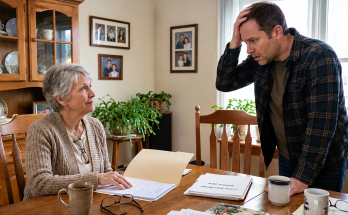
I was seventy-five years old when Kyle stood in my living room and started talking about where I should live next.
He spoke as though everything had already been decided.
As though I had no reason to disagree.
As though the house where I had spent thirty-eight years of my life was already his.
I remember looking at his face and wondering when he had begun thinking that way.
Because the boy I raised had not been a cruel child.
He could be impatient.
He could be careless.
But I had never believed he would look at his widowed mother and see an obstacle standing between him and a house.
My name is Margaret.
My husband, Frank, had been gone for several years by then.
We had spent most of our marriage building a life on a piece of land that had once seemed far beyond what we could afford.
There was the farmhouse.
The rented fields.
The old barn.
And the little apartment above the garage.
Nothing about the place had come easily.
Frank had worked for forty-six years, and I had worked beside him in all the ways a family and a home required.
We had worried over bills.
Put off purchases.
Repaired things instead of replacing them.
And made every dollar serve a purpose.
Some years, we could afford something extra.
Other years, we were grateful to have enough.
But we kept going.
That was how we eventually owned the house without owing anyone a mortgage payment.
The day we finished paying it off, Frank was happier than I had seen him in years.
We bought hamburgers and a bottle of sparkling cider.
It was hardly an elegant celebration.
We didn't care.
We stood beside our first tractor while someone took our picture.
Frank put his arm around me and said we finally had a place where nobody could make decisions for us.
I believed him.
For decades, that house represented the security we had earned.
Then Frank died.
And security began to feel different.
I still had the house.
I still had the land.
I still had enough money to live comfortably if I continued being careful.
What I no longer had was the man who understood why every part of it mattered.
Kyle was our only son.
I loved him more than he probably understood.
Even when he was grown, married to Jenna, and raising children of his own, I still remembered the little boy who had followed Frank around the barn.
He had wanted to touch every tool.
Sit on every tractor.
Ask a hundred questions before breakfast.
Frank used to laugh and tell me the boy had inherited his curiosity but none of his patience.
That had been a harmless joke when Kyle was young.
As an adult, his impatience became more expensive.
He wanted things before he could comfortably afford them.
If someone bought a newer vehicle, Kyle started thinking about replacing his.
If somebody he knew went on an expensive vacation, he wanted a similar one.
Frank noticed.
I noticed too.
But I kept telling myself Kyle would settle down.
He had a job.
A wife.
Children who depended on him.
Surely responsibility would teach him what our lectures never could.
I held on to that belief longer than I should have.
In March, Kyle came to see me about money.
He didn't begin by asking how I was managing alone.
He didn't ask whether the farm rental payments were coming in properly or whether I needed help maintaining the property.
He wanted to discuss his inheritance.
His inheritance.
While I was still alive and sitting across from him.
I remember the discomfort of hearing that word.
I didn't say anything immediately.
Kyle explained that receiving some money now would be more useful than receiving it later.
He was an adult with a family.
There were things he wanted to do.
He said it made sense for me to help while he was young enough to enjoy the benefits.
I asked what amount he had in mind.
He said one hundred and twenty thousand dollars.
I repeated the number because I thought I might have misunderstood.
“That's the amount you're asking me for?”
He nodded.
“Mom, it isn't as though I'm asking for money that wouldn't eventually come to me.”
I remember looking down at my hands.
He had made it sound so ordinary.
Like asking to collect something that was already waiting at a counter.
I told him that his father and I had saved for many years.
I reminded him that I was still responsible for my own future.
He said he understood.
He also said that I had more than enough.
That sentence stayed with me.
Not because he was entirely wrong about my financial position.
I was comfortable.
But there was something troubling about hearing my son decide how much of my money I needed.
Still, I wanted to help.
That was the truth.
I also wanted to believe he would use the opportunity wisely.
Perhaps I was trying to make life easier for him in a way life had never been easy for Frank and me.
Looking back, I can admit that.
I was also lonely.
Since Frank's death, the house had been quieter than I liked.
Kyle had his own life, and I understood that.
But I missed feeling needed as his mother.
When he came asking for help, part of me was relieved that he still came to me.
That is not a particularly sensible reason to hand someone such a large amount of money.
But it was part of what I felt.
I told Kyle I would consider his request.
I also told him that any payment would have to be handled properly.
His father and I had discussed inheritance arrangements long before Frank died.
We had wanted Kyle provided for.
We had also wanted to make certain that I remained financially secure and in control of my property.
I wasn't going to ignore those decisions simply because my son wanted money immediately.
I contacted Mr. Dunne, the attorney who handled my estate documents.
He had worked with our family arrangements and knew what Frank and I intended.
I explained Kyle's request.
I told him the amount.
I also explained that Kyle considered the payment an early portion of what he might eventually inherit.
Mr. Dunne listened.
Then he said the arrangement needed to be clearly documented.
I agreed.
If I was going to give Kyle such a substantial sum, I wanted no confusion about what it meant.
Mr. Dunne prepared the necessary paperwork.
He updated the relevant estate provisions and arranged for Kyle to come in and sign the agreement concerning the advancement.
We met in his office.
I remember Kyle sitting across from us, appearing more interested in completing the transaction than in discussing its terms.
Mr. Dunne went through the document carefully.
He explained that the $120,000 was being treated as an advancement against Kyle's eventual inheritance.
He explained that the money would be considered when determining any later distribution.
He also explained that the agreement contained provisions affecting how much Kyle could receive in the future.
Kyle was asked whether he understood.
He said he did.
He signed where he was instructed.
Three separate signatures.
I watched him put down the pen.
I felt uneasy, though I couldn't have explained exactly why.
Perhaps it was the speed with which he seemed ready to accept an arrangement involving so much money.
Perhaps I simply wished Frank had been sitting beside me.
Frank had always been better at recognizing when Kyle was getting ahead of himself.
He would have asked questions.
Hard questions.
I was more inclined to hope for the best.
Once the paperwork was completed, I arranged the payment.
One hundred and twenty thousand dollars.
I remember thinking about all the years represented by that amount.
The mornings Frank had left for work before the sun came up.
The bills we had paid instead of taking vacations.
The repairs we had handled ourselves.
The things we had wanted and decided we could live without.
I didn't tell Kyle all of that.
I didn't want to turn the payment into a lecture.
I wanted him to appreciate it without being made to feel ashamed.
He thanked me.
I told him to be responsible.
He assured me he would.
For a little while, I believed the matter was finished.
Kyle had received the assistance he wanted.
The paperwork was in order.
My own finances remained protected.
And I thought I had helped my son move forward.
Then I learned about the boat.
He had purchased a boat that cost far more than I would ever have considered spending on something meant for recreation.
I remember hearing about the insurance.
The storage.
The equipment.
The other expenses that came with owning it.
I asked whether he had considered the ongoing costs.
He brushed away my concerns.
“Mom, I've worked it out.”
I wanted to believe him.
So I stopped asking.
That was one of my mistakes.
I mistook silence for respect.
I told myself Kyle was an adult and could manage his own finances.
After all, the money belonged to him once it was given.
He had made his choice.
And I had made mine.
Four months passed.
I continued with my ordinary days.
I watered the flowers near the porch.
Collected the mail.
Checked the garden.
And watched the rented fields beyond the house.
Every morning, I walked into the kitchen Frank and I had planned together.
I opened the curtains over the sink.
I made coffee.
Sometimes I sat at the table and remembered hearing his footsteps in the hallway.
There were mornings when I still turned my head, expecting him to come around the corner.
That never quite went away.
The house held so much of him.
The kitchen cabinets.
The porch railing.
The photograph above the fireplace.
Even the wooden chair he had always preferred.
I wasn't ready to leave any of it.
I hadn't considered leaving.
Then Kyle arrived.
At first, the visit seemed ordinary.
He came into the living room and sat down.
We talked briefly.
But he seemed distracted.
He kept looking around the room as though measuring it.
Finally, he brought up the future.
He said Jenna and he had been thinking about what would make sense for the family.
I asked what he meant.
He mentioned the farmhouse.
Then the property.
Then how much work went into maintaining a place of that size.
I listened.
I assumed he was offering to help.
Instead, he began explaining that Jenna and he would eventually need more room.
He talked about the children.
Their plans.
The advantages of moving to the farm.
I asked where I fit into those plans.
Kyle hesitated.
Then he mentioned the apartment over the garage.
I stared at him.
The apartment was small.
About four hundred square feet.
It had never been meant to replace the farmhouse as my permanent home.
But Kyle spoke about it as though he were offering me a thoughtful arrangement.
He said I would still be nearby.
I wouldn't have to worry about maintaining such a large house.
And the rest of the family would have room to settle in.
I felt my fingers tighten against the arm of Frank's chair.
“Are you suggesting I live above the garage?”
He looked uncomfortable.
“Mom, I'm saying it could work for everybody.”
I looked toward the kitchen.
Three bedrooms.
Two bathrooms.
The porch Frank had repaired and painted.
The windows I had washed more times than I could count.
Everything we had spent our lives building.
Kyle continued speaking.
He thought it would be sensible for me to move by spring.
By spring.
He had already chosen a season.
I asked whether Jenna knew about this.
He said they had discussed it.
That was when I realized the conversation wasn't an idea he had just come to share.
It was a plan.
A plan made without me.
I asked him why he thought he had the authority to decide where I lived.
He looked genuinely surprised.
“Mom, eventually the place is going to be mine.”
I waited for him to correct himself.
He didn't.
Instead, he explained that he was the only son.
That Dad had left everything to me.
That there was nobody else who would inherit the property.
So, in his mind, moving into the farmhouse early simply made sense.
I looked at Frank's photograph over the fireplace.
For a moment, I couldn't find my voice.
Then I asked Kyle a question.
“Do you remember the paperwork you signed in March?”
He frowned.
“The papers for the money?”
“Yes.”
“What about them?”
I stood and went to get my copy.
When I returned, I placed the document on the coffee table.
Kyle looked irritated.
I asked him to read it.
He picked it up.
His eyes moved over the first paragraph.
Then the next.
He stopped when he reached the section explaining how the early payment would affect his inheritance.
I watched his expression change.
For the first time since he had arrived, my son stopped talking about my house as though it belonged to him.
Click here to continue reading: PART 2: The Agreement My Son Signed for One Hundred and Twenty Thousand Dollars Contained a Condition He Had Never Bothered to Understand
My Only Son Walked Into My Living Room and Told Me to Leave the Home His Father and I Had Built
Part 1 of 15