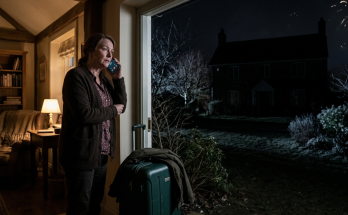
Sarah came into my kitchen at four minutes past noon on New Year’s Eve and told me, with the careful voice people use when they have already decided something for you, that I should stay out of the main house that evening.
I was standing at the cottage counter slicing an apple. Outside the window, two men were carrying rented cocktail tables through the side gate. Silver balloons knocked together in the winter wind, and somewhere near the patio David was giving impatient instructions about outdoor heaters. I set the knife down before I answered my daughter.
“What exactly do you mean by stay out?”
Sarah shifted her handbag higher on her shoulder. She was thirty-seven years old, beautifully dressed even for errands, with her dark hair pulled into the smooth knot she wore whenever she wanted to appear completely in control. “I mean the party is going to be crowded. David invited some clients, his parents are coming, and there’ll be people you don’t know. It would just be easier.”
“Easier for whom?”
Her eyes moved briefly toward the window. “Mom.”
That one word contained a warning. Do not make this difficult. Do not embarrass me. Do not force me to say the unpleasant part aloud.
I folded my hands on the counter. “I’m listening.”
Sarah let out a breath. “David thinks it would be awkward if you came in and out all night. Some of the guests believe we live here on our own, and explaining the cottage arrangement becomes this whole conversation. You hate parties anyway.”
There were several things I might have said. I might have reminded her that I had hosted New Year’s Eve in the main house for nearly twenty years. I might have told her that her father, Michael, used to stand by the fireplace at midnight pouring champagne while Sarah ran barefoot through the hall with sparklers she was absolutely forbidden to light indoors.
Instead I asked, “They believe this is your house?”
Sarah’s expression tightened almost imperceptibly. “People make assumptions.”
“And you don’t correct them?”
“Why would it matter?”
Through the glass behind her, I could see the house itself. Brick, cream trim, three chimneys, and the wide windows Michael and I had chosen twenty-nine years earlier after arguing for an entire Saturday about whether divided panes would look too traditional. We had bought that property when Sarah was eight. Michael had planted the maple near the driveway with his own hands.
After his death, I had kept the place because selling it felt like burying him twice.
Now my daughter was standing in a cottage at the back of that same property, explaining why my existence complicated the story she told her friends.
“It matters to me,” I said.
Sarah rubbed her forehead. “Please don’t turn this into something bigger than it is.”
I almost smiled. That sentence had become one of her favorites during the past two years. Whenever David renovated something without asking, I was making it bigger than it was. Whenever their friends occupied the main house for an entire weekend, I was being sensitive. Whenever another expensive charge appeared on the credit card I had allowed Sarah to use for household emergencies, I was misunderstanding.
I looked past her again. Someone had hung white lights along the pergola Michael built one summer because Sarah wanted an outdoor graduation party. Half the boards were crooked. He had refused to redo them because, as he put it, perfection was an excellent way to ruin a Saturday.
“Are you asking me not to attend the party,” I said, “or are you asking me not to leave the cottage?”
Sarah hesitated.
That hesitation answered me before she did.
“It would be better if you stayed here.”
I felt something small and cold settle behind my ribs.
The cottage had once been Michael’s workshop. After he retired, we converted it into a guesthouse with a bedroom, kitchenette, bathroom, and small sitting room. Following his death, it remained mostly empty until Sarah and David came to me two years earlier with what they called a temporary problem.
Their lease was ending. Their rent had increased. David had changed jobs. They wanted six months to rebuild their savings so they could buy a place of their own.
I had offered them the cottage.
Sarah had cried.
David had hugged me and called me the best mother-in-law alive.
Three days later, Sarah said the cottage would be difficult for two people because David sometimes worked from home. Would I mind if they used the guest bedroom in the main house instead?
Then the guest bedroom became two rooms.
Then two rooms became the upstairs.
Then David wanted the garage.
Within four months they were living throughout the main house, and I was sleeping in the cottage because Sarah said the arrangement gave everyone more privacy.
At the time, I had told myself I preferred it.
That was easier than admitting I had been displaced from my own home by degrees so small that every individual step seemed unreasonable to fight.
Sarah glanced at her phone. “I have to go. The caterer is already behind.”
“Who is paying the caterer?”
She looked up sharply.
It was not an accusation. Not yet.
But she heard one.
“David arranged it.”
“That wasn’t my question.”
Her mouth flattened. “We are handling the party.”
“Good.”
I picked up the knife again and cut another slice from the apple. My hand was surprisingly steady.
Sarah remained by the door. “So you’re okay with tonight?”
“No.”
The answer came so quietly that she seemed unsure she had heard it.
“What?”
“I said I’m not okay with it.”
Her shoulders dropped. “Mom, please.”
“But I understand what you’re asking.”
“That isn’t the same thing.”
“No.”
For a second we looked at one another without the comforting habits of mother and daughter between us. I saw a grown woman calculating whether my feelings would interfere with her evening. She saw, perhaps, a mother she expected to complain and eventually surrender.
Sarah stepped closer. “You know I love you.”
I wondered when those words had begun arriving most reliably just before she wanted something.
“I know you believe you do.”
Her face changed.
I regretted the sentence immediately, though not because it was entirely false.
“What is that supposed to mean?”
“Nothing you have time to discuss with the caterer waiting.”
“Mom.”
I rinsed the knife and placed it in the drying rack.
Sarah stood there another moment. Then, as she had done countless times after conversations she disliked, she decided the conversation was finished.
“Please keep the cottage lights low once people start arriving. We’re doing photographs in the backyard.”
I turned.
She already had her hand on the doorknob.
“You want my lights off?”
“Not off. Just… maybe the front ones. The photographers are using that direction, and the cottage doesn’t fit the setup.”
The cottage didn’t fit the setup.
Neither, apparently, did I.
I thought of Michael sitting at this same little table years earlier while we discussed whether to install a second window. He wanted morning light. I had teased him because he almost never woke before eight after retirement.
He would have laughed if anyone suggested his wife should hide so wealthy strangers could admire the property.
But Michael had been dead for four years.
And I had spent most of those four years making decisions based on what would keep Sarah close.
“Anything else?” I asked.
Sarah must have mistaken my calmness for surrender because relief softened her face. “No. That’s all.”
She kissed my cheek.
The gesture was automatic. Her perfume lingered after she stepped away.
“Thank you, Mom.”
I did not say you’re welcome.
She opened the door, letting in a burst of cold air and noise from the backyard. Someone shouted for an extension cord. Glassware rattled inside plastic crates. From the main house came the bass of a sound system being tested.
Sarah stepped outside.
Then she stopped.
“Oh, one more thing.”
I waited.
“David’s parents may use the cottage bathroom if there’s a line inside. Is that okay?”
For the first time that afternoon, I laughed.
It was only one sound, brief and astonished.
Sarah frowned. “What?”
“Nothing.”
“Is it okay?”
“No.”
Her eyebrows rose.
“No?”
“No one is using the cottage tonight.”
“Mom, it’s a bathroom.”
“It is my home.”
The words changed the air between us.
Sarah stared at me.
I had called the cottage many things over the previous two years. Cozy. Convenient. Enough for me. Easier at my age.
I had never called it my home in front of her.
She recovered quickly. “Fine. Whatever. I’ll tell them.”
“Thank you.”
She stepped outside and shut the door harder than necessary.
I remained beside the counter until I heard her heels cross the stones toward the main house.
Only then did I open the drawer beneath the telephone.
Inside lay a black folder.
The property deed was there.
So were six months of statements, photographs, correspondence, account records, copies of documents Sarah and David had asked me to sign, and a letter from an attorney named Patricia Monroe.
On top rested one final piece of paper that Sarah had never seen.
A signed agreement from a prospective buyer.
I touched the corner of it.
For months, I had wondered what would finally make me act.
The unauthorized spending had not done it.
The renovations had not done it.
The attempt to obtain my signature on refinancing paperwork had not done it.
Even overhearing David tell his father that there was no reason to buy a house when they could eventually get mine had not been enough to make me confront them.
Apparently I had still needed one last lesson.
My daughter had just given it to me.
That evening she would celebrate a new year inside the home Michael and I had spent decades building.
She believed I would be sitting quietly in the cottage, hidden behind darkened windows, waiting for the party to end.
She was right about one thing.
I would be quiet.
She was wrong about everything that would happen after that.