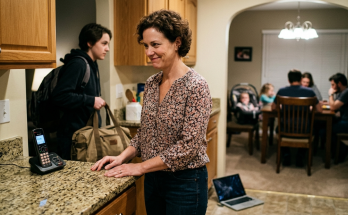
By six that evening, none of us cared about the Willow Creek house anymore. Brooke sat at one end of my dining table with a stack of printed emails. Evan paced between the windows. I had reopened every document they could access, and with each page the story Glenn had told them became less believable.
Brooke had received the first message about Fairground Holdings eight months earlier. Glenn wrote that he had found a way to “build a financing bridge” that would eventually make buying a home easier. He told her he needed someone with cleaner credit history to appear as manager of a temporary company.
“Why would you agree to that?” Evan asked.
Brooke looked exhausted. “Because every time we tried to save a down payment, something happened. Rent went up. Your car transmission died. Lainey needed dental work. Glenn kept saying we were throwing money away.”
Lainey was their six-year-old daughter. When Brooke mentioned her, Evan stopped pacing.
Glenn had always been good at finding the sensitive place in a conversation and pressing exactly hard enough. With me, he used Dad. With Brooke, apparently, he had used the fear that she and Evan were failing their daughter.
I sorted the emails by date.
At first, Glenn’s instructions were vague. Sign a corporate registration. Open a business account. Provide identification so a lender could verify management. Later the requests became more specific: upload bank statements, sign a borrowing resolution, approve a line of credit.
“Did you ever speak directly with Martin Keller?” I asked.
Brooke nodded. “Twice. Maybe three times.”
“What did he tell you?”
“That Glenn knew what he was doing.”
Evan gave a humorless laugh.
Brooke glared at him. “I know how it sounds now.”
“Did Martin explain the $280,000 loan?”
“He called it asset-based financing. Glenn said they were buying Fairground below market, cleaning it up, then refinancing. We would get paid out and use the profit for our down payment.”
“You were supposed to receive profit?”
“Yes.”
“How much?”
“Glenn said maybe sixty or seventy thousand.”
I leaned back in my chair.
There it was.
The scheme had not been sold to Brooke merely as a technical shortcut. She had believed she was making an investment that might solve their housing problem.
“Did you put money into it?”
“Three thousand at the beginning.”
Evan turned toward her. “From where?”
“Our savings.”
“What savings?”
Brooke rubbed both hands over her face.
I saw the next revelation before she spoke.
“The account for the house.”
Evan closed his eyes.
Their marriage was moving into territory where I did not belong, so I focused on the paperwork.
The county foreclosure filing showed the first missed payment had occurred only seven weeks after Fairground Holdings acquired the property. That did not make sense if the plan had been a legitimate renovation and refinance. Even worse, the original mortgage amount was far higher than the recorded purchase price.
Fairground Holdings had paid $196,000.
The primary loan was $280,000.
A second lien had later appeared for $75,000.
I wrote the numbers on a legal pad.
“Where did the difference go?”
Neither Brooke nor Evan answered.
I searched the recorded mortgage instrument.
The borrower signature was Brooke’s.
The guarantor signature was Evan Carter’s.
Evan stopped behind my chair.
“That isn’t mine.”
Brooke looked up sharply.
I enlarged the signature.
The name was written in a loose version of Evan’s handwriting, but anyone who had seen him sign birthday cards for thirty years would have noticed the mistake. Evan’s real signature ended the final r with a long downward stroke. This one curled upward.
“Did you sign a personal guarantee?” I asked.
“No.”
“Are you certain?”
“I would remember signing for two hundred eighty thousand dollars.”
A second document appeared in the packet.
Authorization to obtain credit.
Applicant: Evan Carter.
Social Security number partially masked.
Date of birth correct.
Employer correct.
Annual income wrong.
Evan gripped the back of my chair.
“That says I make one hundred forty-two thousand dollars.”
“How much do you actually make?” Brooke asked.
“Eighty-seven.”
Her eyes widened.
The application listed investment assets he did not own and a bank relationship he had never had.
Then I found another name.
Mine.
The guarantor-support section referenced “anticipated family capital contribution from Stacey Carter” and included the $45,000 amount.
No signature appeared there yet.
The blank waiting for it was precisely why Glenn needed my gift letter.
I pushed the laptop away.
“He isn’t helping you qualify for a house.”
Evan’s jaw tightened. “What is he doing?”
“He’s trying to stabilize Fairground.”
Brooke shook her head. “That makes no sense. He said Fairground was temporary.”
“It is in foreclosure. Your company owes more than the property appears to be worth. Evan has been placed on the debt without his knowledge, and my money is being documented as incoming capital.”
Brooke stood. “I need to call Glenn.”
“No.”
“He can explain.”
“Do not warn him yet.”
“You think my uncle committed fraud and your first instinct is to play detective?”
“My first instinct is to stop him from deleting anything.”
That silenced her.
Evan took out his phone. “I’m changing my passwords.”
“Start with email, banking, credit monitoring, and anything tied to tax records.”
Brooke said, “You’re making this sound criminal.”
I looked at her. “Someone used your husband’s identity to apply for credit. What would you call it?”
Her face crumpled slightly, then steadied.
We spent the next hour securing accounts.
Evan found three credit inquiries he did not recognize.
Two were from commercial lenders.
The third came from a financial institution in Florida.
“Florida?” he said.
Something in my memory shifted.
Dad had owned no property in Florida. He had never lived there. Yet after his death, Glenn had once mentioned that final insurance distributions took longer because “some money was being moved through Florida.”
At the time I assumed he meant the insurer’s processing center.
I opened the folder where I kept scanned copies of Dad’s estate documents.
Gene Carter had been stubborn about paperwork. He saved warranties for appliances he no longer owned and tax records from decades earlier. After he died, Sheila wanted to throw most of it away. I couldn’t.
His insurance file was in a folder labeled GENE — FINAL.
I opened the beneficiary statement.
The policy had paid $132,600.
My share was $45,000 after several expenses and adjustments.
Sheila had received a similar amount.
The remaining money had been designated for a small education account Dad wanted maintained for Lainey and any future grandchildren.
Evan leaned over my shoulder. “What education account?”
I froze.
“You know about that?”
“No.”
Brooke came closer.
I found the letter from Dad’s attorney.
Gene had directed $15,000 into a custodial account for Lainey. Because she was a minor, an adult custodian had to be named.
I remembered the conversation now. Dad had asked Glenn to help set it up because Evan and Brooke were in the middle of moving apartments and caring for a newborn.
Glenn had later told me it was done.
“Where is that account?” Evan asked.
“I don’t know.”
“What bank?”
“I don’t know.”
Brooke whispered, “Glenn set something up for Lainey.”
Evan turned sharply. “What?”
“A savings account. He gave us the information after Gene died.”
“Where is it?”
“I haven’t checked it recently.”
“How recently?”
She looked down. “Maybe a year.”
Brooke logged into an old financial portal from her phone.
The password failed.
She tried another.
Then she asked for a reset.
The verification code went to an email address she no longer used, so we opened her laptop and recovered access there.
The account balance loaded.
$412.67.
Brooke made a sound I had never heard from her before, something between a gasp and a whisper.
“I had over twelve thousand in here.”
Evan sat down beside her.
The transaction history showed repeated transfers beginning fourteen months earlier. Most were small enough not to attract attention: $700, $1,100, $950. Then larger withdrawals began.
Each transfer was initiated through Brooke’s authorized profile.
The destination account displayed only the final four digits.
I copied them onto my legal pad.
Evan asked, “Did you move this money?”
“No.”
“Did Glenn have access?”
Brooke’s expression answered before her voice did.
“He helped set up the account.”
We downloaded every statement we could.
One transfer memo contained an abbreviation.
FGH.
Fairground Holdings.
Another showed a routing number associated with Florida.
By then it was nearly ten at night.
Evan went outside to breathe.
Brooke remained at the table, staring at the shrinking balances from month to month.
“I thought your family hated me because they thought I wasn’t good enough for him,” she said quietly.
I closed one of the statements.
“Some of them have been unkind to you.”
She shook her head. “Glenn was always nice.”
That was the cruelty of it. Glenn had not needed Brooke to trust everyone.
Only him.
My phone rang.
Glenn.
All three of us looked at the screen.
He could not have known what we had found unless someone had alerted him.
I answered without putting the call on speaker.
“Stacey, what’s going on?” he said immediately. “Brooke tells me there’s some confusion about the house money.”
Across the table, Brooke shook her head frantically.
She had not contacted him.
“I haven’t decided whether I’m giving them anything,” I said.
His tone hardened just slightly. “You already committed.”
“I committed to helping Evan buy a home.”
“That’s what this is.”
“Then why does my gift letter list Fairground Road?”
A pause.
Only one second.
Maybe two.
But Glenn was rarely slow with an answer.
“That’s just how Martin structured the funding.”
“Martin Keller?”
“Yes.”
I looked at Brooke.
“Does Daniel Mercer work with Martin?”
The line went silent.
Then Glenn laughed.
Not naturally.
“Daniel? Where did you get Daniel’s name?”
I looked again at the corporate filing.
“Why does that matter?”
“It doesn’t. I’m asking because you’re clearly digging through things you don’t understand.”
My pulse stayed steady.
“Maybe.”
“Stacey, don’t turn this into one of your investigations. Evan needs the money. Brooke has already done the work. If you interfere now, they could lose everything.”
I looked at the foreclosure notice.
“They may already have.”
Glenn inhaled sharply.
Then he said something that told me more than he realized.
“You have no idea what Fairground is tied to.”
I lowered my eyes to the paperwork.
“No,” I said. “But I’m starting to.”
He hung up.
Evan came back inside just as I set down the phone.
“What did he say?”
I turned my laptop toward him and opened the forged credit application again.
“Your uncle is scared.”
Evan stared at his name beneath the guarantee.
Then he looked at Brooke.
“Tomorrow morning,” he said, “we find out exactly who signed this.”
Click here to continue reading: PART 3: My Brother Said the Loan Was Harmless, but the Missing Laptop and a Witness Signature Changed the Entire Family Story
Everyone Thought I Was the Stingy Mother Until One Address on a Gift Letter Made Me Stop Smiling
Part 2 of 18