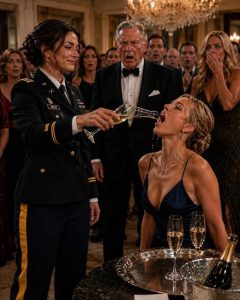
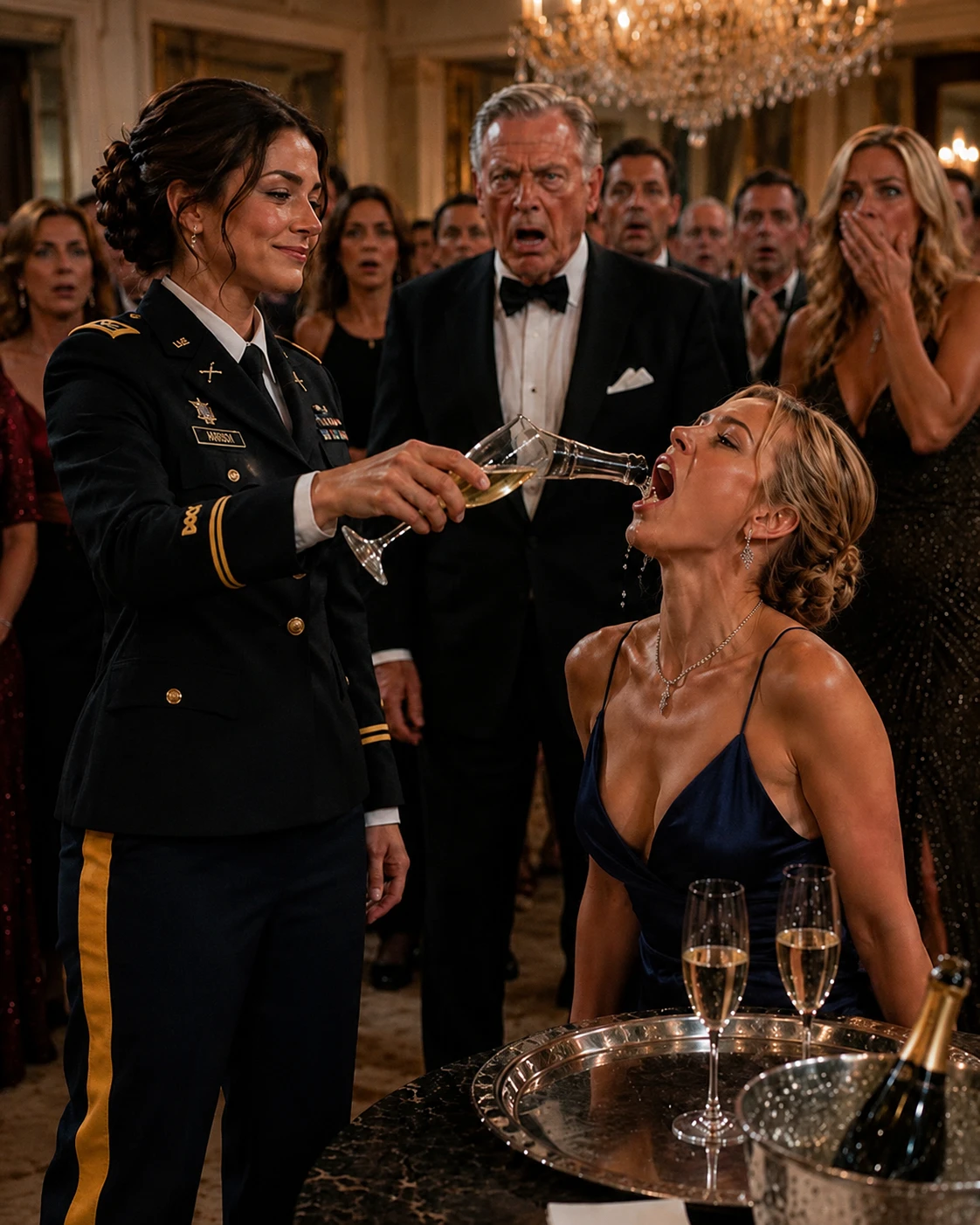
The moment I saw my father pour white powder into my champagne, every medal on my uniform felt suddenly heavier than armor.
I stood thirty feet away in the ballroom of the house where I had grown up, surrounded by people applauding the life I had built despite him. Crystal chandeliers glowed above polished floors. A string quartet played near the French doors, and officers in dress uniforms mingled with neighbors who had known me since childhood.
Only my father stood perfectly still.
Richard Brooks was beside the champagne table, one hand shielding a folded paper packet from view. He tipped the powder into the flute marked with a silver ribbon—the glass he had personally instructed the caterers to reserve for me.
Then he stirred it with one finger.
He looked up.
Our eyes nearly met, but I turned toward Colonel Nathan Reed and pretended to listen as he praised my new assignment.
“You have earned this, Captain,” Reed said warmly. “Not through family influence. Not through luck. Through discipline.”
He rested a hand on my shoulder.
For most of my military career, Nathan Reed had been the senior officer I trusted most. He had encouraged me when I was a young lieutenant, recommended me for difficult assignments, and written the evaluation that helped secure my promotion.
At sixty-one, he carried himself with the calm confidence of a man accustomed to being obeyed. His silver hair was cut close, his blue dress uniform immaculate.
I forced myself to smile.
“Thank you, sir.”
Across the room, my father slipped the empty packet back into his jacket.
My heart hammered, but my face remained composed.
Years in the Army had taught me that panic was a luxury. When something exploded, you did not scream at the smoke. You located the source, assessed the damage, and protected the people around you.
My father began walking toward us.
He was sixty-seven, tall and broad-shouldered, with the dignified appearance of a man who had spent his life being photographed beside politicians, generals, and charity boards. Brooks Strategic Logistics, the company he had built, supplied vehicle components and communications equipment to government contractors.
To the outside world, he was a patriotic businessman.
To me, he was the man who could turn cruelty into concern before anyone else realized what he had done.
“There she is,” he announced, lifting the prepared glass. “The pride of the Brooks family.”
A few guests applauded.
My mother, Eleanor, stood near the fireplace. Tears shone in her eyes. She had seemed fragile for nearly two years, troubled by sudden confusion, lost conversations, and episodes the doctors called mild cognitive decline.
Beside her stood my younger sister, Madison, beautiful in a pale blue dress, laughing at something one of the guests had said.
My father handed me the champagne.
The silver ribbon brushed my fingers.
“Your first toast as Captain Brooks,” he said.
His smile never reached his eyes.
I accepted the glass.
“Thank you, Dad.”
He watched me raise it.
I could not accuse him without proof. If I shouted that he had poisoned my drink, he would deny it. He would call me exhausted, emotional, or damaged from deployment. He had spent decades perfecting the art of making other people question what they had seen.
Then Madison slipped her arm through mine.
“Congratulations, Captain,” she said. “I guess you’re finally the family hero.”
She leaned toward the champagne as if she might steal a sip.
I pulled the glass away so quickly that a few drops struck my glove.
Her smile faded.
“Natalie?”
I looked around the ballroom.
My commanding officer was present. So were several senior officers, local officials, business associates, and Major Elena Vargas from the Army Criminal Investigation Division. Elena had served with me overseas and remained one of the few people who understood that silence could be more dangerous than gunfire.
I raised my voice.
“Before we make this toast, I need everyone’s attention.”
The quartet stopped playing.
Conversations died one by one.
My father’s expression tightened.
I held up the glass.
“There is something in this champagne that should not be here.”
A nervous laugh came from somewhere near the doors.
My father tilted his head.
“What are you talking about?”
“I watched someone pour white powder into this glass.”
My mother gripped the back of a chair.
Madison stepped away from me.
Colonel Reed moved closer. “Who did you see?”
I looked directly at Richard Brooks.
“My father.”
The silence that followed seemed to drain every breath from the room.
My father stared at me for several seconds. Then he laughed softly, as though I had made an embarrassing joke.
“Natalie, you have been under tremendous pressure.”
“I know what I saw.”
“You have barely slept this week.”
“I watched you remove a packet from your jacket and empty it into my champagne.”
His face changed—not dramatically, but enough. The corners of his mouth flattened. His eyes became cold.
“That is absurd.”
Major Vargas approached.
“Captain Brooks, do not drink from that glass.”
“I wasn’t planning to.”
“Place it on the table.”
Before I could move, Colonel Reed reached for it.
“I’ll secure it,” he said.
Elena caught his wrist.
“With respect, sir, please don’t touch the evidence.”
For the briefest moment, irritation crossed his face.
Then it vanished.
“Of course.”
Elena pulled an unused evidence pouch from the small field kit she kept in her vehicle. Within minutes, the glass was sealed. The catering supervisor confirmed that my father had requested the silver ribbon and reserved the flute for me.
Richard remained calm.
“I crushed one of Eleanor’s tablets earlier,” he said. “She has difficulty swallowing. I must have approached the wrong glass.”
My mother looked at him.
“You told me I wasn’t taking medicine tonight.”
He turned toward her with a patient smile.
“You forgot, darling.”
“No,” she whispered. “I didn’t.”
His expression sharpened.
Madison’s breathing grew shallow.
I noticed and reached for her hand.
“What is it?”
She looked at our father as though she were seeing him from the bottom of a deep well.
“Not again,” my mother said.
Then her knees gave way.
I caught her before her head struck the floor.
Guests began shouting for a doctor. Madison dropped beside us while Elena called emergency services.
My father did not kneel.
He stood above us, his hands at his sides.
Colonel Reed moved close to him and spoke in a voice almost too low to hear.
“What did you do?”
Richard answered without looking at him.
“What was necessary.”
I heard every word.
And for the first time that night, Colonel Nathan Reed looked afraid.
PART TWO
WHAT THE HOUSE REMEMBERED
My mother was taken to the hospital, where doctors found enough sedative in her bloodstream to explain her collapse.
She swore she had taken nothing.
My father insisted she had become confused and swallowed an extra dose of her prescribed medication. Because the prescription bottle carried her name and had been found in their bedroom, the police could not immediately prove otherwise.
The substance in my champagne was more troubling.
The laboratory identified a crushed prescription sedative mixed with a drug capable of causing disorientation and gaps in memory. The combination might not have killed me, but when mixed with alcohol, it could have left me unconscious, confused, and unable to recall what had happened.
Richard’s attorney released a statement calling the incident “an unfortunate family misunderstanding.”
My father went home.
I remained at the hospital with Madison.
We sat beneath the harsh lights of a waiting room that smelled of coffee and disinfectant. Madison had removed her shoes and curled her feet beneath her on the chair, looking younger than her thirty-three years.
For most of our lives, we had played the roles our father assigned us.
I was the difficult daughter—the stubborn one who left home, joined the Army, and refused financial help.
Madison was the adored daughter—the beautiful one who stayed close, attended charity galas, and smiled beside our father in photographs.
I had resented her for years.
Now her hands were trembling.
“Has he done this before?” I asked.
She stared at the floor.
“Madison.”
“I don’t know.”
“That isn’t an answer.”
She looked up, tears filling her eyes.
“I wake up sometimes and can’t remember the night before.”
The words struck me harder than I expected.
“How often?”
“A few times a year. Maybe more.”
“After drinking?”
“That’s what Dad always said. He said I inherited Mom’s weakness. He said some women simply couldn’t handle alcohol.”
“You barely drink.”
“I know.”
She pressed both hands against her forehead.
“Three years ago, after my engagement dinner, I woke up in my bedroom wearing the same dress. My shoes were muddy. There was a document on my desk with my signature on it.”
“What kind of document?”
“A financial agreement. It gave Dad control over the trust Grandmother left me.”
“Did you remember signing it?”
“No.”
“Why didn’t you go to the police?”
“Because Thomas told me Dad had drugged me.”
Thomas Hale had been Madison’s fiancé, a quiet forensic accountant who asked precise questions and rarely smiled unless Madison entered the room. Their engagement ended abruptly. My father told everyone Thomas had demanded money and fled when Richard refused.
“What happened to him?” I asked.
Madison’s face crumpled.
“I accused him of trying to turn me against the family. Dad showed me messages that made Thomas look dishonest. Then Thomas disappeared.”
“Disappeared?”
“He closed his office and left town. I received one letter. Dad found it before I could finish reading.”
“What did it say?”
“That I was in danger.”
A terrible understanding began forming inside me.
“And you stayed.”
“Where would I go?” she whispered. “You had your career. Mom was getting worse. Dad controlled the accounts, the cars, the house, everything. Every time I tried to leave, Mom had another episode.”
I felt shame spread through me.
I had believed Madison remained because she enjoyed comfort. I had never considered that luxury could be another kind of locked door.
Colonel Reed arrived shortly after midnight.
He brought coffee and concern, as he had done after difficult missions and battlefield losses.
“Natalie,” he said, sitting across from me, “I have spoken with the commanding general. You need to protect yourself.”
“From my father?”
“From public speculation.”
“My mother was drugged.”
“The evidence is not complete.”
“My champagne contained an amnestic sedative.”
“And you were wise not to drink it. But accusations involving a prominent defense contractor can become complicated.”
“Complicated for whom?”
His eyes hardened.
“I am trying to preserve your career.”
“Why did my father say he did what was necessary?”
Reed went still.
“You heard that?”
“So did you.”
“He was upset.”
“He didn’t sound upset.”
Reed leaned closer.
“Do not turn this into something larger before investigators finish their work.”
“My father tried to incapacitate me in a room full of witnesses. How much larger does it need to become?”
He glanced at Madison.
“Family situations often look different from the outside.”
Madison laughed bitterly.
“That is exactly what Dad always says.”
Reed stood.
“I will speak with you when you’ve had some rest.”
As he walked away, Madison watched him.
“How long have you known Colonel Reed?” she asked.
“Since before I entered the Academy.”
“He has been at our house longer than that.”
I turned to her.
“What?”
“When I was little, I used to see him in Dad’s study. They would close the door whenever Mom came near.”
I thought of Reed reaching for the champagne glass.
A memory surfaced—not clear enough to trust, but sharp enough to trouble me.
I was seventeen, sitting on our front steps after an argument with my father. Reed had joined me and said, “Some men are threatened by daughters who refuse to remain small.”
At the time, his kindness had felt like rescue.
Now I wondered whether it had been surveillance.
My mother woke before dawn.
She seemed confused until the nurse left. Then her eyes cleared.
“Close the door,” she said.
I did.
Madison took her hand.
“Mom, did Dad give you something?”
Eleanor looked toward the hallway.
“He has been giving me things for years.”
Madison covered her mouth.
I sat beside the bed.
“What things?”
“Pills. Drops in tea. Powder in wine.” Her voice shook. “At first I thought I was losing my mind. Then I stopped swallowing everything he handed me.”
“Why didn’t you tell us?”
“I tried.”
“When?”
“Every time I tried, he made sure I became confused before I could finish.”
She reached beneath the blanket and clutched my wrist.
“There is a blue ledger in the greenhouse. Under the stone planter your grandmother brought from Savannah.”
“What is in it?”
“Names. Dates. Payments.”
“Payments for what?”
“I don’t know all of it.”
She closed her eyes, exhausted.
“But your father isn’t the only man you need to fear.”
I already knew the answer before she whispered it.
“Nathan Reed.”
PART THREE
THE MEN BEHIND THE MEDALS
The Brooks estate looked different when I returned the next morning.
The white columns no longer seemed stately. The broad windows no longer suggested openness. The house appeared to be watching us, guarding secrets buried beneath decades of respectable dinners and carefully posed family portraits.
My father had been ordered to stay away pending the investigation.
Madison and I entered through the kitchen.
Neither of us spoke until we reached the greenhouse.
My grandmother’s stone planter sat beneath a dying lemon tree. We moved it together and found a rusted key taped beneath its base.
The key opened a narrow cabinet behind my father’s desk.
Inside were three ledgers, prescription records, military procurement files, and photographs dating back nearly forty years.
One picture showed Richard and Nathan Reed standing beside an Army transport vehicle in 1987. They were young men then—Reed in uniform, Richard wearing the confident smile I had known all my life.
On the back, my mother had written:
THE BEGINNING.
Madison opened the first ledger.
Next to dates and dollar amounts were initials.
E.B.
M.B.
T.H.
N.B.
Our mother.
Madison.
Thomas Hale.
Me.
Beside my initials was the date of the promotion reception.
I felt something inside me become very still.
“He planned it,” Madison whispered.
I turned the page.
The financial records showed payments from government contractors to shell companies owned through trusts controlled by my father. Several companies supplied replacement components for military transport vehicles.
One invoice carried a serial number I recognized.
Five years earlier, during my second deployment, a convoy vehicle had lost steering on a mountain road. It rolled down an embankment, killing Sergeant Luis Ortega and two other soldiers.
The investigation blamed maintenance failure.
Luis had been forty-six, a father of three, with a laugh so loud it could fill a tent during a sandstorm. I had written the letter to his wife.
The replacement steering component listed in the report had come from one of my father’s shell companies.
My hands began to shake.
Madison read over my shoulder.
“Natalie?”
“He sold them defective parts.”
“You don’t know that.”
“The approved manufacturer is listed here, but the shipment came from somewhere else. Look at the price difference.”
She looked.
My father had charged the government for certified components while purchasing cheaper, untested substitutes through another supplier.
The profit was enormous.
A note beside the shipment read:
N.R. approved waiver.
Nathan Reed.
I sank into my father’s chair.
My military career had been built on duty, discipline, and loyalty. Reed had taught me that soldiers trusted one another with their lives.
All the while, he and my father had been placing those lives on a balance sheet.
Madison found a small digital recorder beneath the files.
The last recording was dated six weeks earlier.
My mother’s voice came first.
“I copied the invoices.”
My father answered.
“You have no idea what you’re looking at.”
“I know soldiers died.”
“You know what Nathan told you.”
“Nathan is lying.”
A chair scraped.
Then Reed spoke.
“Eleanor, listen to me. What happened overseas was tragic, but the military accepted the findings.”
“Because you altered the findings.”
“You are ill.”
“I am not ill.”
“You have memory problems.”
“Because Richard drugs me.”
My father’s voice became soft.
That tone frightened me more than shouting ever could.
“No one will believe you, Eleanor.”
My mother said, “Natalie will.”
There was a long silence.
Then Reed answered.
“Natalie is about to assume a position where questions like these could damage more than this family.”
My father said, “Then we make sure she never asks them.”
The recording ended.
Madison stared at me.
“They were talking about the promotion.”
My new assignment involved reviewing operational readiness reports for transport units. I would have access to maintenance records and procurement discrepancies. I had assumed Reed recommended me because he respected my judgment.
He had promoted me because he believed he could control me.
When he realized he could not, he ordered my father to silence me.
A car door slammed outside.
Madison ran to the window.
My father was crossing the lawn.
“He isn’t supposed to be here.”
“He doesn’t care.”
Richard entered the study without knocking.
He looked at the open cabinet, the ledgers, and the recorder.
For once, he did not pretend.
“You should have left that locked,” I said.
“It was my house.”
“It belonged to Mom’s family before she married you.”
His eyes moved toward Madison.
“You brought her into this?”
“She was already in it,” I said. “You made sure of that.”
Madison held up the ledger.
“You drugged me.”
“I protected you.”
“From what?”
“Bad decisions. Predatory men. Your own weakness.”
“Thomas was not predatory.”
“Thomas wanted access to this family’s finances.”
“He discovered your shell companies.”
Richard sighed.
“Your sister joins the Army and suddenly imagines every disagreement is a battlefield. You fall in love with an accountant and assume he is a hero. Neither of you understands what it takes to preserve a family.”
“You mean control it,” I said.
“I mean survive.”
“Luis Ortega did not survive.”
Something flickered in his face.
“You remember him?”
“I remember all three soldiers who died in that vehicle.”
“That accident was not my fault.”
“You supplied the part.”
“I supplied what Nathan approved.”
“So Reed is responsible?”
“I did not say that.”
“You just did.”
He stepped closer.
“Natalie, there are decisions made at levels you do not understand. Budgets are reduced. Deadlines are shortened. Suppliers fail. We adapted.”
“You stole.”
“We maintained a company that employed four hundred people.”
“You put counterfeit components in military vehicles.”
“They passed inspection.”
“Because Reed signed the waiver.”
His jaw tightened.
Madison moved beside me.
“Why did you drug Natalie?”
Richard looked at her almost tenderly.
“Because your sister was going to destroy everything.”
“Then you admit it.”
“I admit nothing.”
“You watched her raise the glass.”
“I needed time.”
“To do what?”
“To move the records. To persuade Nathan to delay her assignment. To keep Eleanor from making another scene.”
Madison began crying.
“You could have killed her.”
“I knew the dosage.”
The room became silent.
My father seemed to realize what he had said.
I removed my phone from my pocket.
A red light glowed on the screen.
“I recorded every word.”
He lunged.
I moved faster.
I caught his wrist, turned, and forced him against the desk without striking him. The movement was automatic, learned through years of training.
For the first time in my life, my father looked small.
Not physically small.
Morally small.
A man who had mistaken obedience for love and fear for respect.
“You think this makes you strong?” he hissed.
“No,” I said. “Letting you go would make me weak.”
He stopped struggling.
Then he looked at me with a hatred so old it seemed almost inherited.
“You were always his daughter.”
I tightened my grip.
“What did you say?”
He smiled against the polished wood.
“You think Nathan Reed took an interest in you because you were talented?”
Madison went pale.
My father turned his head enough to look at me.
“He took an interest because you are his.”
PART FOUR
THE FATHER I CHOSE TO BELIEVE
My mother told me the truth that evening.
We sat in a private hospital room with the curtains closed. Madison stood near the window while I remained beside the bed, still wearing the uniform from a life that no longer felt entirely mine.
Eleanor looked older than she had the day before.
“Richard knew before he married me,” she said.
I stared at her.
“Knew what?”
“That I was carrying Nathan’s child.”
The room seemed to tilt.
She continued before I could speak.
“Nathan and I had known each other since college. We planned to marry, but he chose the Army, and I chose not to follow him from post to post. Years later, we met again when he returned home before an overseas assignment. I was lonely and foolish, and I believed old love could still be trusted.”
“Was Dad already in your life?”
“We were engaged but separated. Richard knew our relationship was ending. Then I discovered I was pregnant.”
“Why did you marry him?”
“Because Nathan left.”
“Did he know about me?”
“Not at first.”
My mother’s eyes filled with tears.
“Richard offered stability. He said he would raise you as his own. I wanted to believe kindness had appeared where love had failed.”
“When did Reed find out?”
“When you were sixteen.”
That was the year Reed began appearing at school ceremonies, charity events, and family dinners. He had encouraged me to apply for military scholarships. He had told me I possessed “the temperament of an officer.”
“What did Richard demand from him?”
“Contract approvals. Introductions. Protection.”
“And Reed agreed?”
“At first, only to remain near you. Later, because the money became too large and the lies too dangerous.”
“Why didn’t either of you tell me?”
“Because both men believed your life belonged to them.”
Her answer cut through every excuse I might have made for Reed.
Richard had raised me with resentment.
Nathan had guided me with secrecy.
One used cruelty. The other used admiration.
Both had used me.
The next morning, Army investigators searched Colonel Reed’s office.
He was suspended, but not arrested. His attorney argued that the ledger and recordings could have been altered. Richard claimed his confession had been coerced because I physically restrained him.
The story reached the newspapers.
Some called me courageous.
Others called me unstable.
Television commentators wondered whether combat stress had caused me to misinterpret an innocent family incident. Anonymous sources described me as ambitious, rigid, and emotionally detached.
Those were my father’s words.
Or Reed’s.
Perhaps both.
Two days later, Reed asked to meet me at the chapel on base.
Major Vargas advised me not to go alone. She and two investigators waited outside while I entered wearing a recording device beneath my jacket.
Reed stood at the front pew, facing a plain wooden cross.
“I used to come here before deployments,” he said.
“I used to believe you prayed for your soldiers.”
“I did.”
“Did you pray for Luis Ortega?”
His shoulders lowered.
“Natalie—”
“Did you know the steering component was counterfeit?”
“I knew the supplier had changed.”
“Did you know it had failed testing?”
He turned toward me.
“I was told the failure was within an acceptable margin.”
“Acceptable to whom?”
“To men dealing with impossible deadlines.”
“Luis had three children.”
“I know.”
“You sent a wreath.”
Pain crossed his face.
“I attended the funeral.”
“You stood beside his widow while knowing your signature helped kill him.”
“It was not that simple.”
“It is always simple after someone dies. They are gone, and the people who made the choices remain.”
He walked toward me.
“I loved you before I ever met you.”
“You met me when I was seventeen.”
“I saw photographs. I followed your life from a distance.”
“Then you helped Richard poison my mother.”
“No.”
“You allowed it.”
“I tried to stop him.”
“You stood in our ballroom and reached for the contaminated glass.”
“I wanted to remove it before you made an accusation that would destroy your career.”
“You wanted to destroy the evidence.”
His silence answered me.
I felt grief then—not the hot grief of sudden death, but the cold grief of recognizing that a person you loved had never existed.
“You recommended me for promotion,” I said.
“Because you deserved it.”
“You recommended me for a position where I would review the records you falsified.”
“I believed I could correct the files before you saw them.”
“And when you realized you could not?”
He looked away.
“Richard acted without my permission.”
“The recording says otherwise.”
“The recording is incomplete.”
“Then complete it.”
He sat in the first pew.
For a moment he looked tired, almost gentle, like the mentor who had once waited outside a hospital tent while I mourned a soldier.
“I told Richard to delay you,” he admitted. “I never told him to drug you.”
“You knew how he delayed people.”
“I underestimated him.”
“You had thirty-eight years to stop underestimating him.”
He covered his face with both hands.
“I was afraid of losing you.”
“You never had me.”
The chapel doors opened behind us.
Madison entered.
Her face was pale, and she carried an envelope.
“Natalie,” she said, “I need to speak to Colonel Reed alone.”
I stared at her.
“No.”
“It is important.”
Reed rose.
“What is this about?”
Madison handed him the envelope.
Inside was a signed statement.
He read it and exhaled.
“What did you do?” I asked.
She would not look at me.
“I told investigators that you pressured Mom and me to accuse Dad.”
My chest tightened.
“You lied?”
“I corrected my statement.”
“Why?”
“Because this needs to stop.”
“Madison, he drugged you.”
“I was confused.”
“You showed me the agreement you signed after losing an entire night.”
“I had been drinking.”
“You barely drink.”
She turned on me.
“You always think you know better than everyone. You left us for years, and now you come home wearing medals and decide you can fix everything.”
The words were cruel because part of them was true.
I had left.
I had built a life far from the house where she remained trapped.
Reed folded the statement and placed it inside his coat.
“You have made a wise decision,” he told her.
Madison looked at him.
“Have I?”
“You have protected your family.”
She glanced at me once.
There was fear in her eyes—but beneath it, something else.
A warning.
Then she left.
Reed touched my arm.
“Let her go.”
I pulled away.
“You turned her against me.”
“No, Natalie. Your certainty did that.”
For one terrible hour, I believed him.
Then Major Vargas met me outside and handed me an earpiece.
A live transmission crackled through it.
Madison’s voice came from inside Reed’s car.
“I gave you the statement. Now tell me where Thomas is.”
Reed answered calmly.
“Thomas Hale is alive.”
“Where?”
“Safe, as long as you continue cooperating.”
“And my mother?”
“Richard will accept responsibility for the medication.”
“What about Natalie?”
“Her career will survive if she stops asking questions.”
“And if she doesn’t?”
A pause followed.
Then Reed said, “Your father failed with the champagne. I will not.”
Major Vargas looked at me.
“Your sister is wearing a wire.”
I closed my eyes.
Madison had not betrayed me.
She had stepped into the cage and locked the door behind herself so Reed would believe he was safe.
PART FIVE
THE LAST TOAST
Colonel Nathan Reed was arrested before he reached the highway.
The statement Madison had handed him was not a legal recantation. It was bait drafted with investigators after Thomas Hale contacted federal authorities.
Thomas had spent three years assembling evidence against Brooks Strategic Logistics. He had not abandoned Madison. He had entered protective custody after Richard’s security chief threatened to kill him and make his death appear self-inflicted.
Madison had learned he was alive only hours before she entered the chapel.
Her voice shook when she explained.
“I knew Reed would never speak honestly in front of Natalie. He wanted her admiration too much. But he thought I was weak.”
“He thought all of us were weak,” my mother said.
The investigation expanded across six states.
Auditors uncovered falsified certifications, bribed inspectors, altered accident reports, and millions of dollars routed through shell companies. At least four military vehicle failures were linked to components supplied by my father’s network.
Nine service members had died.
Others had been permanently injured.
Richard and Reed blamed each other.
Richard claimed Reed had created the scheme.
Reed claimed Richard had substituted inferior parts without his knowledge.
Neither man mentioned the soldiers unless an attorney reminded them.
My mother’s medical records proved that her cognitive decline had been chemically induced. After weeks without the drugs Richard had given her, much of her clarity returned.
Not all of it.
Damage, once done, does not always leave when the danger does.
There were mornings when she forgot where she had placed her glasses. There were afternoons when she repeated a question. But she no longer apologized for every lapse, and she no longer looked toward the door before speaking.
At the federal hearing, my father sat beneath cold fluorescent lights, wearing a gray suit instead of handcuffs.
For most of my life, he had controlled rooms through silence.
That morning, no one waited for his permission.
The prosecutor played the ballroom surveillance footage. It showed Richard removing the packet, pouring the powder, stirring the champagne, and watching me accept the glass.
Then came the recording from his study.
“I needed time,” his voice said.
“To do what?” Madison had asked.
“To keep Eleanor from making another scene.”
The courtroom remained silent.
Richard’s attorney rose.
“My client was under emotional distress. Captain Brooks had physically restrained him.”
The prosecutor looked toward me.
“Captain Brooks prevented him from destroying evidence.”
My father stared straight ahead.
Reed’s trial followed.
His defense argued that he had been blackmailed for decades by Richard, forced into contract fraud after learning I was his biological daughter.
When I testified, his attorney approached the witness stand.
“Captain Brooks, Colonel Reed supported your career, did he not?”
“Yes.”
“He recommended you for assignments?”
“Yes.”
“He praised your service?”
“Yes.”
“Would you agree that he cared for you deeply?”
I looked across the courtroom at Nathan Reed.
For years, I had mistaken attention for love.
“No,” I said. “He cared about how I made him feel. That is not the same as caring for me.”
The attorney paused.
“Colonel Reed considered you his daughter.”
“A father does not falsify records that endanger his daughter’s soldiers. A father does not help poison her mother. A father does not arrange to destroy her credibility when she becomes inconvenient.”
Reed lowered his head.
The defense attorney changed direction.
“You appear very certain about what a father should be.”
“I am certain about what a father should not be.”
The most damaging evidence came from my mother.
Eleanor entered the courtroom using a cane. Richard watched her with the same expression he once used when correcting her memory in front of guests.
His attorney expected a confused woman.
What he received was a witness who had spent two years pretending to be more impaired than she was.
That was the secret none of us had known.
Six months before my promotion, my mother had discovered that Richard was drugging her. She began hiding the medication beneath her tongue and removing it when he left the room.
She allowed him to believe her condition was worsening.
She misplaced objects deliberately.
She repeated questions.
She pretended not to understand bank statements while copying every document he left on his desk.
She hid recorders in the study and greenhouse. She contacted Thomas through an old email account. Together, they began tracing the shell companies.
“Why didn’t you tell your daughters?” the prosecutor asked.
“Because Richard watched them,” she said. “Madison lived under his roof, and Natalie spoke regularly with Colonel Reed. I did not know which telephone was safe.”
“Did you know Captain Brooks would be drugged at her celebration?”
My mother’s composure broke.
“No.”
She looked at me.
“I believed Richard would attempt to discredit her. I believed he might create a scene or plant documents in her room. I did not believe he would put something in her glass in front of a hundred people.”
“Why do you think he did?”
“Because he was desperate.”
She turned toward Richard.
“And desperate men often reveal what careful men spend their lives hiding.”
The prosecutor lifted a sealed envelope.
“What is this?”
“My final insurance policy.”
Inside was a handwritten letter Richard had given my mother twenty-eight years earlier.
It was not a love letter.
It was an agreement.
Richard promised not to expose Nathan Reed as my biological father if Reed approved Brooks Strategic Logistics as a military subcontractor once he reached a position of influence.
The fraud had not grown from a single bad decision.
It had been planned before I entered grade school.
My existence had been the first currency they exchanged.
That revelation destroyed both defenses.
Richard could no longer claim Reed had manipulated him.
Reed could no longer claim he had been blackmailed into an unexpected crime.
They had built the arrangement together—one contract, one secret, and eventually one dead soldier at a time.
Richard accepted a plea only after learning that Reed intended to portray him as the sole architect of the poisonings.
For the first time, my father discovered what it felt like to be discarded by a man he trusted.
He testified against Reed.
Reed was convicted of conspiracy, fraud, obstruction of justice, and crimes connected to the military procurement scheme. He was stripped of rank and sentenced to spend the remaining years of his life in prison.
Richard was convicted of poisoning, financial fraud, coercive control, and conspiracy. He received a sentence long enough that none of us expected him to return to the estate.
Months later, I visited him once.
He sat behind thick glass in a prison visitation room.
His hair had become completely white.
“You kept the Brooks name,” he said through the telephone.
“Yes.”
“I assumed you would change it.”
“Why?”
“Because you hate me.”
“I do not carry the name for you.”
His mouth tightened.
“You would have had nothing without me.”
“I would have had a mother who wasn’t drugged. A sister who wasn’t frightened. Soldiers who might still be alive.”
“You became strong because of me.”
“No. I became strong while surviving you.”
He leaned closer to the glass.
“Nathan was never your father.”
“I know.”
A faint smile appeared on his face.
“Then you finally understand.”
“I do.”
I looked directly into his eyes.
“Neither were you.”
I placed the telephone back in its cradle and walked away.
A year after the promotion celebration, Madison married Thomas in my mother’s garden.
There were no politicians, military bands, or photographers.
Only family, friends, and a few folding chairs beneath the oak trees.
My mother wore a lavender dress and carried no cane. She still had difficult days, but she had begun volunteering with an organization that helped older women recognize financial and medical abuse.
Madison sold the estate and used part of her trust to establish a fund for families of service members harmed by fraudulent military equipment.
I remained in uniform.
Some people assumed I would resign after learning that Reed had influenced parts of my career. For a time, I considered it.
Then Major Vargas reminded me of something.
“Reed may have opened doors,” she said, “but he did not walk through them for you. He did not lead your soldiers. He did not earn your medals. Do not give him victories the court never awarded.”
I accepted a new assignment helping review military procurement safeguards.
My first recommendation required independent testing of replacement vehicle components.
The policy carried Luis Ortega’s name.
At Madison’s wedding reception, a waiter approached with a tray of champagne.
The sight of silver ribbons around the stems stopped me cold.
My mother noticed.
She came beside me and slipped her hand into mine.
“You don’t have to drink it,” she said.
“I know.”
Madison joined us, still wearing her wedding dress.
Thomas stood a few feet away, speaking with old friends. Sunlight passed through the oak branches, laying gold patterns across the grass.
Madison lifted three unopened bottles of sparkling cider from beneath the table.
“I brought these myself,” she said. “The seals are intact, Captain.”
I laughed.
It was the first time the memory of that night did not feel like a hand around my throat.
She opened the bottles, and we poured our own glasses.
My mother raised hers.
“To the daughter who saw what all of us had been trained not to see.”
Madison lifted her glass.
“To the mother who survived by remembering who she was.”
I looked at them—the two women I had misunderstood for most of my life.
One had never been as helpless as my father believed.
The other had never been as shallow as I believed.
I raised my glass toward the clear autumn sky.
“To the people who were silenced,” I said. “And to the truth that outlived the men who tried to bury it.”
We drank.
The cider was sweet and harmless.
No one watched to see whether I would fall.
And for the first time in my life, a family toast did not belong to either of my fathers.
It belonged to us.