PART ONE — THE BRUISES UNDER THE LIGHT
By the time I saw the bruises on my daughter’s back, I had already survived three wars, two ambushes, and one desert night when I genuinely believed God had forgotten my name.
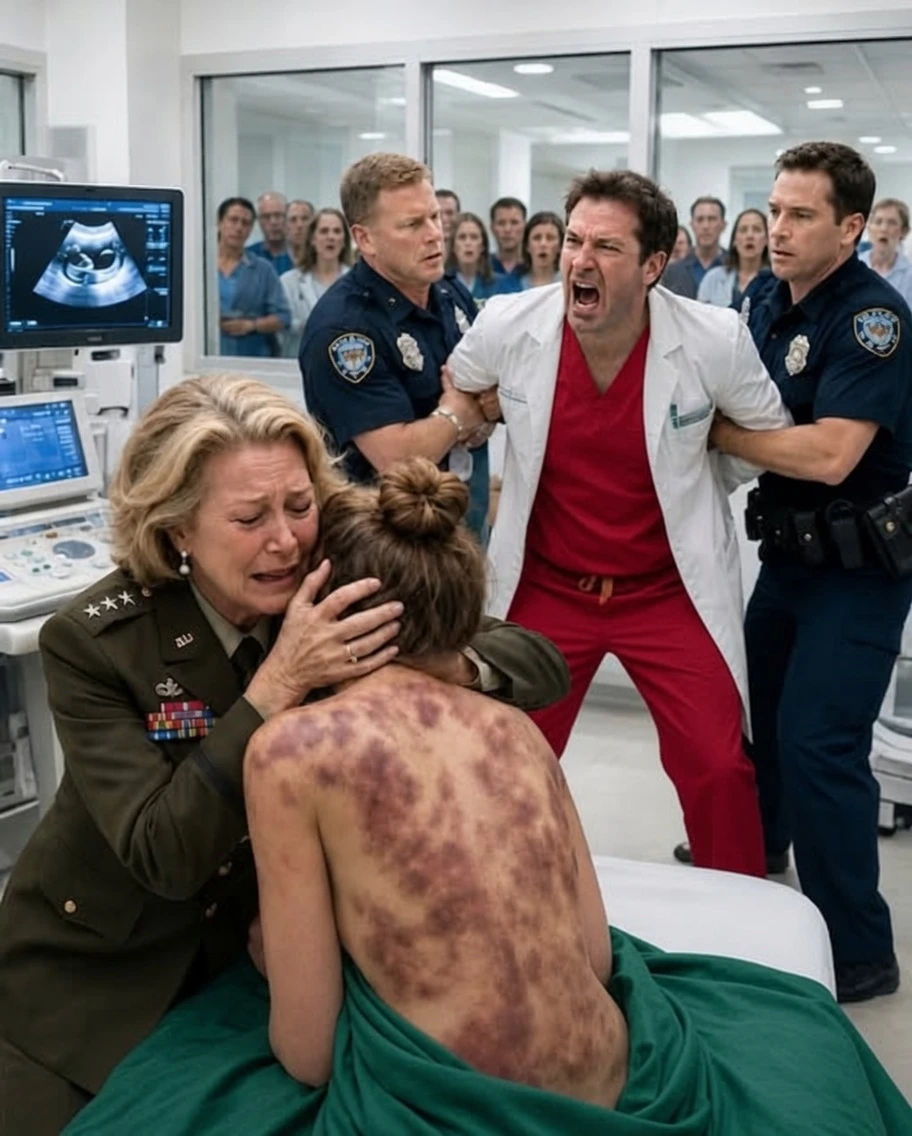
But nothing in thirty-two years of military service had prepared me for the sight of Chloe standing in that hospital changing room, thirty-eight weeks pregnant, trembling under fluorescent lights while trying to hide what her husband had done to her.
There are wounds that only a soldier recognizes.
Not because we are tougher than other people. We are not. We are just trained to notice what others politely ignore.
A person who has fallen leaves chaos on the body. A bruise on the hip, a scrape near the elbow, a clumsy purple bloom on the knee.
But Chloe’s bruises were not chaos.
They were arranged.
Dark, fading marks spread across her ribs and shoulders, spaced with cold precision. Someone had known exactly how to hurt her without sending her to an emergency room. Someone had known how to keep the damage hidden beneath silk blouses, maternity dresses, and the bright smile she had worn at family dinners for nearly four years.
My daughter’s blouse had slipped from one shoulder while she changed into the hospital gown for her final ultrasound.
That was all it took.
One inch of exposed skin.
One second of truth.
“Chloe,” I said softly.
She froze.
Not turned. Not startled. Froze.
Her hands clutched the fabric against her chest, and her whole body went still in a way I had seen before in young soldiers after incoming fire. It was the stillness of someone waiting to see whether the next sound meant safety or death.
“Mom,” she whispered. “Please.”
I took one step closer.
She flinched.
That flinch broke something inside me far more deeply than the bruises did.
Because my daughter had not merely been hurt.
She had been trained to fear kindness.
For a moment, the woman in front of me vanished, and I saw my little girl again. Chloe at seven, racing across our backyard in my oversized Army cap, laughing whenever it slid over her eyes. Chloe at twelve, leaving notes in my duffel bag before deployments. Chloe at sixteen, pretending she did not cry when I missed her school concert because a mission ran long.
And now Chloe at thirty-four, pregnant with her first child, asking me with her eyes to pretend I had seen nothing.
“Who did this?” I asked.
My voice sounded calm.
That was not because I felt calm.
It was because the Army had taught me the most useful lie in the world: a steady voice can keep a room from catching fire.
Chloe’s lips trembled.
“Mom, please don’t say anything.”
“Who did this, sweetheart?”
Her eyes filled with tears.
“Julian.”
The name landed between us like a round fired in a silent room.
Dr. Julian Thorne.
Chief executive of Saint Gabriel Women’s Medical Center, the most respected maternity hospital in the country.
The man on magazine covers.
The man who raised millions for maternal care.
The man who had charmed donors, senators, hospital boards, and my entire family.
The man who had once kissed my hand at Thanksgiving and said, “General Walker, I hope I can be half as brave as your daughter says you are.”
I remembered smiling at him.
I remembered liking him.
That memory now disgusted me.
Chloe grabbed my hand so hard her nails pressed crescents into my skin.
“If I leave him,” she whispered, “he said I won’t survive the C-section.”
I stared at her.
She swallowed, barely able to breathe.
“He said accidents happen in operating rooms. He said mothers hemorrhage. He said anesthesia is delicate. He told me nobody would question it because he runs this hospital.”
Outside the changing room, a nurse laughed lightly at something near the hallway. Somewhere, a printer hummed. Life continued around us with unbearable normalcy.
Inside me, everything went still.
People imagine soldiers respond to rage by shouting.
We don’t.
Not the ones who have lived long enough to become old soldiers.
Old soldiers understand that anger is fuel, not strategy. You do not spill fuel on the ground and strike a match. You put it in the engine. You drive.
“Has he hurt you before?” I asked.
Chloe looked down.
That was answer enough.
“How long?”
Her mouth twisted as though the truth itself were bitter.
“After the wedding, it was just words. Then pushing. Then grabbing. After I got pregnant, he changed. Or maybe I finally saw him clearly.” She wiped at her face with the heel of her hand. “He said the baby made me valuable, but replaceable.”
I felt my fingers curl.
“Look at me,” I said.
She did.
“You are not replaceable.”
Her face crumpled.
For one second, she was my child again. Not a wife. Not a mother-to-be. Not a hostage in a rich man’s polished cage. Just my Chloe, terrified and exhausted.
“He controls everyone here,” she whispered. “Doctors. Administrators. Lawyers. Security. If I report him, he’ll say I’m unstable. He already started telling people I’m anxious. Hormonal. Paranoid.” She lowered her voice. “He said he would take my baby.”
I glanced toward the camera mounted high in the corner.
A hospital changing room camera was already an offense. It had no business being there. Julian had built his kingdom with enough arrogance to leave fingerprints everywhere.
That was useful.
“Mom,” Chloe begged, “promise me you won’t do anything.”
I helped her gently into the hospital gown, careful not to brush the bruises.
Then I tied the strings behind her shoulders and smiled.
“Come on,” I said. “Let’s go hear the baby’s heartbeat.”
She searched my face and mistook discipline for surrender.
My poor daughter.
She had forgotten who raised her.
While she checked in at the ultrasound desk, I slipped my phone from my purse and typed one encrypted message.
Activate the contingency plan. Immediate priority. Full legal and investigative response. I’ll explain in person.
Thirty seconds later, my phone vibrated.
Understood, General. We’re moving now.
I locked the screen before Chloe turned around.
In the ultrasound room, the technician warmed the gel between her palms and smiled with practiced tenderness.
“Almost time,” she said. “You must be excited.”
Chloe nodded, though fear still lived in the corners of her mouth.
Then the sound came.
Fast. Strong. Miraculous.
The heartbeat of my grandchild filled the room.
Chloe began to cry.
I held her hand and looked at the monitor, at the flickering life inside her, and made a promise without speaking.
Julian Thorne thought he owned the hospital.
He did not know I had once helped dismantle warlords who owned whole provinces.
PART TWO — THE MAN EVERYONE APPLAUDED
Julian arrived twenty minutes after the ultrasound began.
He did not knock.
He simply opened the door as if every room in Saint Gabriel belonged to him, including the room where my daughter lay vulnerable on an exam table with her belly exposed and her heart in pieces.
“There’s my family,” he said warmly.
To anyone else, he looked perfect.
Tall, silver at the temples, wearing a tailored navy suit instead of a white coat. His smile had the polished confidence of a man who had spent years being photographed beside grateful mothers and newborns. He carried himself with that relaxed authority powerful men often mistake for virtue.
He kissed Chloe’s forehead.
She went rigid.
I saw it.
He saw me see it.
For the smallest fraction of a second, something cold moved behind his eyes.
Then he smiled wider.
“General Walker,” he said. “Always an honor.”
“Julian.”
His gaze lingered on me.
“Chloe didn’t mention you were coming today.”
“I surprised her.”
“How thoughtful.”
The ultrasound technician became very busy adjusting the machine.
Julian rested his hand on Chloe’s shoulder.
Too firmly.
“Everything all right?” he asked.
Chloe nodded quickly.
“Baby looks healthy,” the technician said. “Strong heartbeat.”
“Of course,” Julian replied. “I’ve made certain she’s had the very best care.”
He said it as though the baby were a building he had financed.
I watched Chloe’s face. She did not look at him. She looked at the ceiling with the desperate focus of someone counting seconds.
Julian turned to me.
“You must be relieved. At Chloe’s age, pregnancy can be a little more complicated.”
Chloe was thirty-four.
His cruelty wore perfume.
“She’s strong,” I said.
“Yes,” he said. “Though lately she’s been emotional. Anxious. I’m sure you understand. Hormones can distort perception.”
There it was.
The groundwork.
A respected physician preparing the world to doubt his wife before she even spoke.
I smiled faintly.
“In my experience, women are often called emotional when men are afraid they’re telling the truth.”
The technician froze.
Julian’s smile remained.
Only his eyes changed.
“Military humor,” he said.
“Not humor.”
For three seconds, no one breathed naturally.
Then he laughed.
“Still sharp, General. I admire that.”
He stayed for the rest of the appointment, performing affection like a man reading from a script. He asked about the baby. He praised Chloe’s “resilience.” He told the technician to send him the images personally.
Every word sounded harmless.
Every word was a leash.
When we left the ultrasound suite, Chloe walked between us like a prisoner escorted through a palace.
In the hallway, nurses greeted Julian with adoration.
“Dr. Thorne.”
“Good morning, sir.”
“Congratulations again on the award.”
He accepted every compliment with modest nods.
This, I knew, was his armor.
Reputation.
A man like Julian did not merely hide behind locked doors. He hid behind charity events, hospital wings named after donors, newspaper profiles, and the gratitude of people who could not imagine that a man who saved strangers might destroy his own wife.
At the elevator, he touched Chloe’s lower back.
She flinched again.
“Darling,” he said softly, “why don’t you wait in the car? I’d like a word with your mother.”
Chloe’s eyes flew to mine.
“It’s all right,” I told her.
It was not all right.
But she needed to believe I was not afraid.
When the elevator doors closed with Chloe inside, Julian and I stood alone near a wall of framed hospital awards.
His smile disappeared.
“You should be careful,” he said.
I looked at him.
He adjusted his cufflinks.
“Chloe is fragile. Pregnancy has intensified some concerning tendencies.”
“What tendencies?”
“Confusion. Paranoia. Mood instability.” He sighed like a saddened husband. “I’ve protected her dignity by keeping it private.”
“How generous.”
He studied me.
“I know what you think you saw.”
“And what did I see?”
“A woman under stress. A woman who bruises easily. A woman who sometimes creates narratives because reality overwhelms her.”
I had interrogated insurgent commanders with more subtlety.
“You’re not as clever as you believe,” I said.
He stepped closer.
“General, your career is impressive. Truly. But this is not a battlefield. This is medicine. My medicine. My hospital.”
His voice dropped.
“And if you disrupt Chloe’s care at this stage, and something goes wrong, you will have to live with that.”
There it was.
The threat hidden inside concern.
I nodded once.
“Thank you for clarifying your position.”
He looked puzzled.
Men like Julian expect fear, anger, pleading. They do not know what to do with documentation.
My phone buzzed once in my purse.
Not a call.
A signal.
My old network was already moving.
Colonel Evelyn Ross, retired Judge Advocate General attorney.
Marcus Reed, former Army CID investigator.
Dr. Helen Park, maternal-fetal medicine specialist and the most stubborn physician I had ever met.
And my younger brother Samuel, a federal judge who had spent forty years pretending not to enjoy frightening arrogant lawyers.
Contingency plans sound dramatic until you are a woman in your sixties with a daughter, a grandchild, and a powerful man standing between them and survival. Then they sound like common sense.
Julian stepped back and restored his public face.
“Let’s keep Chloe calm,” he said. “For the baby.”
“For the baby,” I repeated.
He smiled.
I smiled back.
And while he thought he had warned me off, Marcus Reed was already outside the hospital photographing security exits, Evelyn Ross was preparing emergency filings, Helen Park was arranging a transfer to a private surgical team, and Samuel was clearing his afternoon calendar.
Julian owned a hospital.
I owned favors from people who still remembered what loyalty meant.
PART THREE — THE QUIET EVACUATION
The first rule of extracting someone from danger is simple.
Do not let the enemy know the rescue has begun.
So I went to lunch with Julian.
He insisted on it.
There was a restaurant on the hospital’s top floor, all glass walls and white tablecloths, where donors could look down on the city while discussing compassion over seventy-dollar salads.
Chloe sat beside me, pale and silent.
Julian ordered for her without asking.
“She’ll have the poached salmon,” he told the waiter. “No dressing. She’s been retaining fluid.”
Chloe’s cheeks flushed with humiliation.
I folded my napkin in my lap.
“She can order for herself.”
Julian gave a soft laugh.
“Of course.”
Chloe stared at the menu but did not read it.
“I’ll have soup,” she said.
Julian’s jaw tightened.
“Soup isn’t enough.”
“I want soup.”
The words were small.
But they were hers.
I saw the effort it cost her.
So did Julian.
He leaned closer, smiling for the waiter.
“Darling, we discussed this.”
I reached across the table and placed my hand over Chloe’s.
“She said soup.”
The waiter, sensing weather, nodded quickly and disappeared.
For a moment, Julian’s expression became naked.
Not angry, exactly.
Possessive.
As though I had touched property.
Then he leaned back.
“You’ve always had a strong influence on her,” he said.
“I raised her.”
“Yes. That explains a great deal.”
Chloe’s breathing changed.
She was bracing herself for the price she would pay later.
Under the table, I pressed two fingers against her wrist twice.
A signal from her childhood.
I’m here.
Her eyes flicked toward mine.
For the first time that day, I saw the smallest spark of trust.
Lunch passed like a chess game played with butter knives. Julian discussed hospital policy, maternal outcomes, donor relations. He mentioned, too casually, that Chloe’s C-section was scheduled in forty-eight hours.
“With my team,” he said. “Naturally.”
“Will you operate?” I asked.
He smiled at Chloe.
“I wouldn’t trust anyone else.”
She looked as if she might be sick.
My phone buzzed again.
This time, I excused myself and went to the restroom.
Inside a stall, I read Evelyn’s message.
Emergency protective order draft ready. Need Chloe’s verbal confirmation. Hospital transfer window: tonight. Park has privileges at Mercy Providence. Reed found irregular camera placement and restricted access logs. We need more.
More.
There was always more.
Abusers like Julian do not commit one sin. They build systems that allow sin to breathe.
When I returned, Julian was speaking quietly to Chloe.
I caught only the last sentence.
“Remember what happens when you embarrass me.”
Chloe’s face had gone white.
I sat down.
“What happens?” I asked.
Julian did not blink.
“I said she shouldn’t exhaust herself.”
“No,” I said. “You didn’t.”
The silence at our table spread outward.
Julian smiled for the room.
“You must be mishearing.”
“I rarely mishear threats.”
His fingers tightened around his glass.
Chloe whispered, “Mom.”
Not warning.
Begging.
Not yet.
So I let it go.
That evening, I drove Chloe home under the pretense that I wanted to help organize baby clothes. Julian followed in his own car, of course. Men who control everything do not trust even the road.
Their house sat behind iron gates in a neighborhood where every lawn looked professionally forgiven. Inside, everything was elegant and cold. Cream furniture. Abstract art. Fresh flowers. No clutter. No warmth. No sign that a baby was coming except one immaculate nursery that looked staged for a magazine.
Chloe stood in the doorway of the nursery and touched the crib rail.
“I used to come in here at night,” she said softly, after Julian went upstairs to take a call. “I would sit on the floor and promise her I’d get us out.”
“Her?” I asked.
Chloe looked at me.
“The baby. It’s a girl.”
My granddaughter.
A girl.
The room blurred for one brief second.
“What’s her name?” I whispered.
Chloe’s smile trembled.
“Grace.”
Of course.
Grace.
A thing none of us deserve and all of us need.
I took both of Chloe’s hands.
“Listen to me carefully. Tonight, you are leaving.”
Fear swallowed her face.
“No. Mom, no. He’ll know. He always knows.”
“He knows what frightened people do. He doesn’t know what trained people do.”
“I can’t.”
“You can.”
“He’ll ruin you.”
“He can try.”
“He’ll kill me.”
My daughter said it plainly.
Not dramatically.
That was the worst part.
I cupped her face.
“Chloe, when you were little, you asked me once what courage felt like. Do you remember?”
She shook her head.
“You were eight. I had just come home from deployment. You thought brave people didn’t feel scared.”
A tear slid down her cheek.
“I told you courage feels exactly like fear. The difference is what you do next.”
She closed her eyes.
“I’m so tired.”
“I know.”
“I don’t know who I am anymore.”
“You’re my daughter. You’re Grace’s mother. That is enough for tonight.”
Footsteps sounded overhead.
Julian’s voice drifted from the hallway, clipped and irritated.
He was coming down.
Chloe panicked.
I squeezed her hands once.
“Bathroom,” I whispered.
She moved.
Julian appeared moments later at the nursery door.
“Where is Chloe?”
“Bathroom.”
He looked at the crib, then at me.
“You shouldn’t fill her head with ideas.”
“She has a head of her own.”
“Not lately.”
“You keep saying that.”
“Because it’s true.”
“No,” I said. “Because you need it to be true.”
He stepped into the nursery.
Behind him, my phone was open on the dresser, recording.
Not hidden well.
Hidden just enough.
Julian saw it.
For the first time, real alarm crossed his face.
I picked it up calmly.
“Problem?”
He smiled, but sweat had appeared along his hairline.
“Recording someone without consent can be illegal.”
“Depends on the state. Depends on the circumstances. Depends on whether a credible threat is involved.”
His mask slipped.
“You have no idea what you’re interfering with.”
“Then explain it to me.”
He lowered his voice.
“She belongs with me.”
There.
Three words.
Not love.
Ownership.
I let the silence hold them.
Then the doorbell rang.
Julian turned sharply.
I walked past him and opened the front door.
Marcus Reed stood there in a gray suit with two women behind him. One was Evelyn Ross. The other was Dr. Helen Park, carrying a medical bag and wearing the expression of a woman who had never once been intimidated by an expensive driveway.
Julian’s face hardened.
“What is this?”
Evelyn held up a folder.
“Dr. Thorne, we are here on behalf of Chloe Walker Thorne. She is leaving this residence voluntarily.”
“She is not competent to make that decision.”
From the hallway, Chloe appeared.
Barefoot. Shaking. One hand on her belly.
But standing.
“Yes,” she said. “I am.”
Julian turned to her.
One look.
That was all it took for Chloe to nearly fold.
But I stepped between them.
“Do not look at her like that.”
He laughed softly.
“You people have made a terrible mistake.”
Evelyn’s voice was crisp.
“No. You did. Repeatedly.”
Within ten minutes, Chloe was in my car with a hospital bag, her medical records copied onto a secure drive by a nurse who had been waiting years for someone to challenge Julian, and a police escort arranged quietly through channels Julian did not control.
As we pulled away, Chloe looked back at the house.
Not sadly.
As if she were watching a prison burn in the distance.
Then she whispered, “What if he still finds us?”
I looked at the road ahead.
“He will.”
Her breath caught.
“And when he does,” I said, “we’ll be ready.”
PART FOUR — THE OPERATING ROOM
Julian found us eighteen hours later.
Not physically at first.
Legally.
His attorney filed an emergency petition claiming Chloe was mentally unstable, unlawfully influenced by her mother, and endangering the unborn child by refusing the scheduled C-section at Saint Gabriel.
The petition was elegant. Cruel. Professional.
Exactly the kind of document wealthy men use when fists are no longer convenient.
By then, Chloe was safely admitted under Dr. Park’s care at Mercy Providence, a smaller hospital with older walls, kinder nurses, and no portraits of Julian Thorne in the lobby.
Evelyn sat beside Chloe’s bed reading the petition aloud only where necessary.
“He’s asking the court to compel transfer back to Saint Gabriel,” she said.
Chloe closed her eyes.
“He’s going to win.”
“No,” Evelyn said.
“You don’t know him.”
“I know judges.”
I sat in the corner, watching Grace’s heartbeat pulse across the fetal monitor.
Strong. Steady.
Like a tiny drum calling us forward.
A nurse entered with ice chips and gave Chloe a warm smile.
“You’re safe here, honey.”
Chloe stared at her.
People who have lived under fear do not trust safety quickly. Safety feels like a trick at first. A pause before punishment.
“Thank you,” Chloe whispered.
By late afternoon, we were in a hearing conducted by video from Chloe’s hospital room. My brother Samuel was not the judge, of course. He would never touch a family case involving us. But he had made one call to ensure the matter landed before someone who understood urgency.
Julian appeared on screen in a dark suit, face solemn with wounded dignity.
He looked like a man grieving the irrational behavior of a beloved wife.
He was good.
I will give him that.
His attorney argued that Chloe’s mother, a retired general with “a documented history of combat exposure,” had created paranoia and disrupted critical medical care.
There it was again.
Make the woman unstable.
Make the mother dangerous.
Make the abuser reasonable.
Then Chloe spoke.
At first, her voice shook.
Julian watched her from his little square on the screen.
“Chloe,” he said gently, interrupting. “You don’t have to do this.”
The judge warned him once.
Chloe swallowed.
“My husband told me I would not wake up from my C-section if I left him.”
Julian closed his eyes, pained.
“Your Honor,” his attorney said, “this is exactly the delusion we referenced.”
Evelyn clicked a button.
The recording from the nursery played.
You shouldn’t fill her head with ideas.
She belongs with me.
Then another recording.
Remember what happens when you embarrass me.
Then photographs.
Medical reports.
Security irregularities.
Statements from two nurses.
One administrator.
A former patient who had been pressured into silence after reporting Julian’s misconduct.
With every document, Julian’s face changed.
Not much.
Just enough.
The judge denied the transfer.
Then granted temporary protection.
Julian remained silent.
But before the screen went dark, he looked directly at Chloe.
And smiled.
That smile sent Chloe into labor.
The body has its own wisdom. Sometimes terror opens doors no doctor can close.
By midnight, Grace was coming.
But labor stalled.
Chloe’s blood pressure climbed. Grace’s heart rate dipped once, then recovered.
Dr. Park stood at the foot of the bed and said what we all knew.
“We need to move to C-section.”
Chloe grabbed my wrist.
“No.”
“Chloe,” Dr. Park said gently, “I am not Julian. This is not Saint Gabriel. You are not alone.”
Chloe sobbed.
“What if I don’t wake up?”
I leaned close to her face.
“Then I will be the first thing you see when you do.”
“You can’t promise that.”
“Yes,” I said. “I can.”
It was not medically precise.
It was a mother’s oath.
In the operating room, they let me stand near Chloe’s head. I wore scrubs, mask, cap, and the old dog tags I had not worn in years tucked beneath the fabric.
Chloe shook uncontrollably.
“I’m scared,” she whispered.
“I know.”
“Talk to me.”
So I talked.
I told her about the day she was born, how she had screamed before the doctor fully lifted her into the world. How the nurse had laughed and said, “That one has opinions.” I told her about the time she painted the dog blue. About the first letter she wrote me overseas, all crooked letters and stickers. About how she had always been stronger than she believed.
Then Grace cried.
Not politely.
Not softly.
She arrived furious.
The whole operating room seemed to exhale.
Dr. Park lifted her just high enough for Chloe to see.
“She’s here,” she said. “Your daughter is here.”
Chloe made a sound I cannot describe.
Half laugh. Half sob. Half resurrection.
Yes, that makes three halves.
Some moments are too large for arithmetic.
They placed Grace against Chloe’s cheek, and my daughter whispered, “I got you out.”
I turned away then.
Not because I was ashamed to cry.
Because old soldiers deserve privacy too.
PART FIVE — THE LAST SECRET
Julian Thorne’s empire collapsed slowly at first, then all at once.
The hospital board suspended him pending investigation.
Then donors withdrew.
Then former staff began speaking.
Then women who had been dismissed, discredited, and paid into silence found one another.
A pattern emerged.
Julian had not only abused Chloe.
He had built an entire kingdom around control.
Control of patients.
Control of staff.
Control of narratives.
Control of women at their most vulnerable.
The news called it a scandal.
I called it overdue.
Chloe spent the first weeks after Grace’s birth in my home. At night, I often found her standing beside the bassinet, one hand hovering over her daughter’s chest, needing to feel each breath.
Healing did not arrive like sunrise.
It came in fragments.
The first time Chloe laughed without looking guilty.
The first time she took a shower without locking the bathroom door twice.
The first time Grace wrapped tiny fingers around hers and Chloe whispered, “You’ll never be afraid of love.”
One morning, about six weeks after the birth, Chloe found me in the kitchen.
“Mom,” she said. “There’s something I never told you.”
I set down my coffee.
She held an old envelope.
Inside was a photograph.
Julian, younger, standing beside another pregnant woman.
My breath caught.
“Who is she?”
“His first wife.”
I stared at Chloe.
“I thought you said he’d never been married.”
“That’s what he told everyone.”
The woman in the photograph had dark hair, tired eyes, and one hand resting protectively over her belly.
Chloe sat down.
“Her name was Mara. She died during childbirth at Saint Gabriel twelve years ago.”
The kitchen seemed to tilt.
I picked up the photograph again.
“Julian operated?”
Chloe nodded.
“The official record said complications. Hemorrhage. Nothing suspicious.” Her voice thinned. “But I found old messages on his computer. He wrote to someone afterward. He said, ‘The child was never the objective. The inheritance was.’”
A coldness moved through me.
“What inheritance?”
Chloe opened the envelope further and pulled out a folded legal document.
“Mara came from old money. No close relatives except a grandmother. If Mara had a living child, the child inherited everything. If both Mara and the child died, Julian inherited through a trust clause as surviving spouse.”
“But the baby?”
Chloe’s eyes filled.
“The baby was listed as deceased.”
“Listed?”
She nodded.
“I found another file. Adoption records. Sealed. Paid for through a foundation connected to Saint Gabriel.”
My hands went numb.
“Chloe.”
“There’s more.”
She pulled out one final page.
A birth certificate.
Not Grace’s.
A girl born twelve years earlier.
Mother: Mara Ellison Thorne.
Father: Julian Andrew Thorne.
The child had not died.
She had been hidden.
“Where is she?” I asked.
Chloe looked toward the living room, where Grace slept in her bassinet.
Then back at me.
“She’s alive. Her name is Lily. And Mom…” Chloe’s voice broke. “She’s Julian’s daughter.”
I frowned.
“I understand that.”
“No,” Chloe whispered. “You don’t.”
She handed me a printed photo from a foster care database.
A twelve-year-old girl with serious eyes, dark hair, and a familiar chin.
Too familiar.
My knees weakened.
Because I had seen that face before.
Not in Julian.
Not in Mara.
In my own family albums.
Chloe covered her mouth.
“I did a private DNA test after I found her. I thought maybe I was being paranoid, but…”
She could not finish.
I read the report myself.
Lily was not Julian’s biological daughter.
She was my granddaughter.
Not through Chloe.
Through my son, Daniel.
My son who had died thirteen years earlier in a training accident.
My son who had once, briefly and secretly, loved a woman named Mara Ellison before she married Julian Thorne.
The room went silent except for Grace’s soft breathing.
Julian had known.
Somehow, he had known Mara’s baby was not his.
He had let the world believe the infant died, buried the truth, stolen the inheritance, and erased a child because she was living proof of his humiliation.
And then, years later, he had married Chloe.
My Chloe.
Not by chance.
By design.
He had married my daughter because she was Daniel’s sister.
Because getting close to our family let him watch whether anyone ever discovered Lily.
Because Chloe’s pregnancy gave him a second chance to create a child he could control, a legacy he could claim, a story he could finally own.
I had thought I was rescuing one daughter and one baby.
But the battlefield was larger than I had imagined.
Three days later, Marcus found Lily in a group home outside Richmond.
When Chloe met her, she did not explain everything at once. How could she? How do you tell a child that her life was stolen before she could speak?
Instead, Chloe knelt in front of her and said, “Hi, Lily. My name is Chloe. I knew your father.”
The girl’s guarded eyes sharpened.
“My real father?”
Chloe began to cry.
“Yes.”
Lily looked at me.
“And you?”
I could barely speak.
“I’m your grandmother.”
She stared at us for a long time.
Then she asked, with the heartbreaking suspicion of a child who has learned not to hope, “Does that mean I can come home?”
Chloe reached for her hand.
“Yes,” she said. “It means you already have.”
Julian’s trial lasted eight months.
He did not smile much by the end.
The charges were many. Fraud. Coercion. Assault. Medical misconduct. Evidence tampering. Conspiracy. The investigation into Mara’s death reopened and swallowed what remained of his reputation whole.
But the moment I remember most did not happen in court.
It happened on my back porch the following spring.
Chloe sat in a rocking chair with Grace asleep against her chest. Lily sat beside her, reading aloud from one of Daniel’s old books, stumbling over big words and pretending not to like it when I helped.
The dogwood trees were blooming.
The air smelled of rain and cut grass.
For the first time in years, my daughter’s shoulders were relaxed.
Lily paused and looked at Chloe.
“Do you think my dad would have liked me?”
Chloe’s eyes softened.
“No,” she said. “He would have loved you.”
Lily considered this.
Then she leaned against Chloe’s side.
Grace stirred, opened her tiny eyes, and grabbed Lily’s finger.
And just like that, two stolen sisters became a family.
People later asked me how I brought Julian Thorne down.
They wanted drama. Secrets. Strategy. War stories.
But the truth was simpler.
I listened when my daughter whispered.
I believed her when the world might not have.
And I remembered something the Army had taught me long ago.
No fortress falls because the walls are weak.
A fortress falls because someone inside finally opens a door.
Chloe opened hers.
And when she did, we did not run from the war.
We ended it.