PART ONE
THE SILENCE IN THE BEDROOM
By the time my father lifted the blanket, I had spent ninety-three days learning how fear could make an ordinary bedroom feel smaller than a coffin.
The room had one window, a chipped white dresser, and a ceiling fan that clicked every fourth turn. I knew every crack in the paint above the bed. I knew the exact hour the afternoon sun crossed the wall and vanished behind the neighboring apartment building.
Most of all, I knew how to lie without changing my expression.
I was seven months pregnant, but pregnancy was not the reason I had stopped leaving the bed.
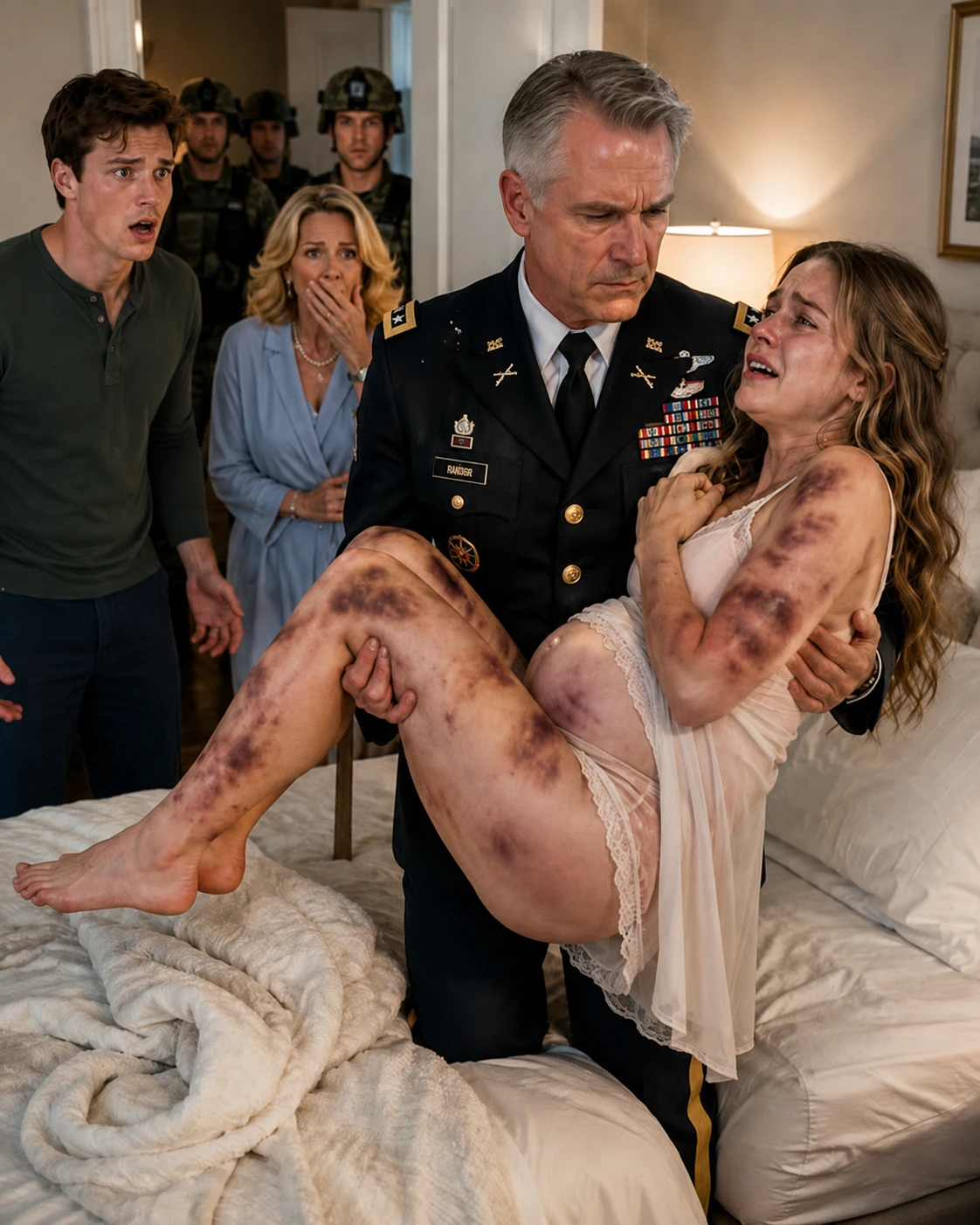
My father, Colonel James Bennett, stood beside me in his dress uniform, his shoulders straight and his face pale beneath the bronze complexion years of outdoor training had given him. A silver eagle gleamed on each shoulder.
He had come directly from a ceremony at Fort Sheridan, expecting to surprise me.
Instead, he had walked into a silence so unnatural that the soldier in him recognized danger before the father in him was willing to believe it.
My husband, Ryan, stood near the foot of the bed.
His mother, Linda, blocked the doorway.
Neither of them looked at me.
“Emily,” Dad said quietly. “Look at me.”
I could not.
My fingers remained locked around the edge of the thick blue blanket.
Linda gave a sharp, humorless laugh.
“She’s been like this for weeks. Sulking. Refusing to cooperate. Pregnancy hormones can turn a perfectly normal woman into a stranger.”
Dad’s eyes moved toward her.
“I wasn’t speaking to you.”
Linda’s mouth tightened.
Ryan folded his arms. “Colonel, with respect, this is our home.”
“With respect,” Dad replied, “my daughter sounds frightened.”
“She’s emotional.”
“Then let her tell me that herself.”
Ryan looked at me.
It was not a husband’s concerned glance. It was a warning.
I had seen that look before.
It meant I should agree.
It meant I should smile.
It meant there would be consequences later if I embarrassed him in front of anyone.
“I’m tired,” I whispered.
Dad sat on the edge of the mattress.
He took my hand, and his thumb brushed the place where my wedding ring used to be. Linda had removed it two weeks earlier, saying my fingers were too swollen.
My father noticed everything.
“Why aren’t you wearing your ring?”
“My hands swelled.”
“Where is your phone?”
“The battery died.”
“Where are your prenatal vitamins?”
“I finished them.”
“Why haven’t you been to your last two appointments?”
My heart stopped.
Ryan stepped forward. “That isn’t true.”
Dad did not turn around.
“I called her obstetrician this morning.”
Linda’s face changed.
Only slightly, but I saw it.
Dad saw it too.
He leaned closer to me.
“The office said you missed two appointments. They also said someone called and canceled a third appointment, claiming you had transferred to another physician.”
“I didn’t call,” I whispered.
Ryan’s voice hardened. “She forgets things.”
Dad looked at him then.
It was a long, measured look—the kind of look I imagined he gave young officers who had lied directly to his face.
“Leave the room.”
Ryan blinked. “Excuse me?”
“You heard me.”
“This is my wife.”
“And she is my daughter.”
Linda stepped farther inside.
“Colonel Bennett, Emily is not a child. You cannot march into a private residence and issue commands.”
Dad rose slowly.
“No,” he said. “I cannot.”
For half a second, Linda looked victorious.
Then Dad reached inside his uniform jacket and removed his phone.
“But the Chicago police can.”
The color drained from Ryan’s face.
I heard Linda inhale.
Dad’s voice remained calm.
“They are waiting downstairs with paramedics.”
Ryan stared at him. “Why?”
“Because three days ago, someone mailed me a photograph of my daughter’s arm.”
The room tilted.
I looked at Ryan.
He looked away.
Dad continued.
“There was no return address. Only a note.”
“What did it say?” Linda asked.
Dad’s eyes never left Ryan.
“It said, ‘Come Tuesday before six. Do not warn them.’”
A heavy silence settled over the room.
My father turned back to me.
“Emily, I need you to show me.”
I shook my head.
“Show me what they’ve done.”
“If you see it, everything will fall apart.”
His expression softened.
“No, sweetheart. Everything has already fallen apart. I’m here to help you stop pretending it hasn’t.”
Ryan moved toward the bed.
“Sir, don’t touch the blanket.”
Linda spoke almost at the same moment.
“She fell. Pregnant women fall all the time.”
Dad’s hand froze.
His eyes met mine.
“Did you fall?”
My lips trembled.
There are moments when a life divides itself into before and after.
Before that moment, I was still trying to protect the marriage I had dreamed of, the man I had once loved, and the illusion that I could somehow endure until my baby was born.
After that moment, I understood that silence was no longer protecting my child.
It was protecting the people hurting us.
I released the blanket.
Dad pulled it back.
The bruises covered my arms, thighs, ribs, and hips. Some were yellow and fading. Others were dark and new. Near the curve of my swollen belly was the shape of a hand.
My father stared at it.
For the first time in my life, Colonel James Bennett looked completely helpless.
Ryan swallowed.
“Sir, I can explain.”
Dad turned toward him.
“No.”
His voice was barely louder than a breath.
“You will explain to the police.”
The footsteps arrived then.
Several people moved quickly through the apartment. A female paramedic entered first, followed by her partner and two Chicago police officers.
Linda immediately began talking.
“She is mentally unstable. She has been hurting herself. We have recordings. We have proof.”
One of the officers raised a hand.
“Ma’am, step into the living room.”
“You don’t understand!”
“I understand that a pregnant woman requires medical attention.”
Ryan remained still.
He looked less like an angry husband than a man standing on the edge of a cliff.
The female paramedic knelt beside me.
“My name is Teresa. I’m going to examine you, all right?”
I nodded.
She pulled the blanket gently around my shoulders.
“No one here is angry with you,” she said.
That kindness broke something inside me.
I began to cry so violently that I could barely breathe.
Dad knelt on the other side of the bed.
“I’m sorry,” I whispered.
He took my face between his hands.
“You have nothing to apologize for.”
“I lied to you.”
“You survived long enough for me to find you.”
The paramedics helped me onto a stretcher.
As they wheeled me through the living room, Linda stood between the officers, her arms crossed defiantly.
“This family will regret humiliating me,” she said.
Dad stopped beside her.
“You mistook my daughter’s gentleness for weakness.”
Linda met his stare.
“And you mistake a uniform for power.”
Dad glanced toward the stretcher where I lay.
“No,” he said. “My daughter is my power.”
Ryan said nothing as they took me away.
But just before the apartment door closed, I looked back.
He was staring at the thick blue blanket lying crumpled on the bedroom floor.
And there were tears running down his face.
PART TWO
THE WOMAN I HAD BECOME
At the hospital, I learned that a person could be rescued and still feel trapped.
The doctors placed monitors around my belly. Every electronic beep made me flinch. A nurse dimmed the lights and explained each procedure before touching me.
My baby’s heartbeat filled the room.
Fast.
Steady.
Alive.
Dad stood near the window with his hands clasped behind his back. He had removed his uniform jacket, but he still looked like a colonel—controlled, alert, ready to act.
Only his eyes betrayed him.
Dr. Mara Chen, my obstetrician’s senior partner, entered after examining my test results.
She was a small woman with silver at her temples and a voice that carried the calm authority of someone who had spent decades delivering difficult truths.
“Emily,” she said, sitting beside the bed, “your baby appears stable. That is the most important news.”
Dad released a breath.
“But,” Dr. Chen continued, “your blood tests show traces of a sedative called clonazepam.”
I looked at her blankly.
“I don’t take that.”
“I know. It is not listed in your medical records.”
Dad turned from the window.
“How much?”
“Enough to cause fatigue, confusion, memory problems, and impaired judgment, especially if administered repeatedly.”
My stomach tightened.
“The tea,” I whispered.
“What tea?” Dad asked.
“Linda made it every night. She said it helped with nausea.”
Dr. Chen glanced at the nurse.
“We have already notified the police.”
I pulled the hospital blanket toward my chin.
“No. Please.”
Dad came closer.
“Emily, they drugged you.”
“You don’t know that.”
“Who else prepared the tea?”
“Sometimes Ryan.”
Dad closed his eyes.
The truth did not arrive all at once. It came in pieces too sharp to hold.
Ryan had controlled the bank account because he said pregnancy made me forgetful.
Linda had answered my phone because she said I needed rest.
They had hidden my car keys after I threatened to visit Dad.
They told neighbors I was suffering from prenatal depression.
When I cried, they recorded me.
When I begged them to stop, they called me hysterical.
When I became angry, they said anger proved I was unstable.
The first time Ryan grabbed me, he apologized.
He had seized my wrist during an argument about money. The next morning, he brought home flowers and pressed his forehead against mine.
“I’m under pressure,” he had whispered. “I’m terrified of becoming a father. I never meant to frighten you.”
I believed him because I remembered the man he had been when we met.
Ryan used to open doors for strangers and carry groceries for elderly neighbors. He called Dad “sir,” even at family dinners. He kept a photograph from our wedding on his desk.
Abuse did not enter our marriage wearing a monster’s face.
It arrived wearing Ryan’s face—the face I trusted.
The second time, he pushed me against the dresser after I accused Linda of reading my messages.
Afterward, he knelt on the floor and cried.
“My mother gets inside my head,” he said. “You don’t understand what she does to people.”
I should have left then.
Instead, I comforted him.
That is one of the cruelties of loving someone who hurts you. You spend so much time searching for the wounded person inside them that you forget to protect the wounded person inside yourself.
Linda’s cruelty was different.
She never apologized.
She began by making small remarks.
“You’re gaining too much weight.”
“Ryan needs a wife, not another responsibility.”
“Your father raised you like a spoiled military princess.”
Then she moved into our apartment “temporarily” after claiming the plumbing in her house had failed.
Within a month, she controlled the kitchen, the laundry, and our schedules.
Within two months, she controlled Ryan.
By the third month, she controlled me.
“Did Ryan hit you?” Dad asked in the hospital room.
I stared at the monitor.
“Sometimes.”
The word hung between us.
“And Linda?”
“Yes.”
Dad sat down as if his legs had lost their strength.
“She said no one would believe me,” I continued. “She said they had recordings of me screaming. She said Ryan had spoken to an attorney about having me declared incompetent after the baby was born.”
Dr. Chen leaned forward.
“Why would they want that?”
“They said I wasn’t fit to be a mother.”
“That isn’t what I asked,” she said gently. “Why would they want legal control over you?”
I hesitated.
“I don’t know.”
Dad looked toward the door.
For the first time, uncertainty crossed his face.
“Dad?”
He did not answer.
“Do you know something?”
He returned to the bed.
“Your mother’s family had money.”
I almost laughed.
“We never had money.”
“No. We didn’t.”
“What does that mean?”
He lowered his voice.
“Your mother’s maiden name was Vale.”
The name meant nothing to me.
“The Vale family owned manufacturing companies throughout the Midwest,” he continued. “Factories, land, investments. Your grandfather was worth millions.”
I stared at him.
“Why didn’t Mom ever tell me?”
“Because she wanted nothing from them.”
“Why?”
Dad’s jaw tightened.
“Because her sister tried to destroy her.”
He told me the story slowly.
My mother, Catherine Vale, had grown up in a family where appearances mattered more than affection. Her older sister, Lorraine, was brilliant, charming, and ruthless. After their father became ill, Lorraine allegedly moved money through false companies and forged signatures.
Catherine discovered it.
She planned to report her sister.
Before she could, Lorraine disappeared with several million dollars.
“She was never found,” Dad said.
“What does that have to do with me?”
“Your grandfather placed part of the estate in a trust for you. Your mother believed the matter had been settled years ago.”
“How much?”
“I don’t know.”
“You’re lying.”
His face tightened.
“I was told the trust had been dissolved.”
“By whom?”
“Your mother.”
The room became quiet.
Dad continued.
“After she died, I found old papers suggesting the trust might still exist. But the documents were incomplete. I never pursued it because I didn’t want money from that family touching your life.”
I felt anger rising through the fear.
“You had no right to decide that for me.”
“You’re right.”
His answer stopped me.
Dad lowered his head.
“I was afraid,” he said. “I had already lost your mother. I thought keeping the past buried would keep you safe.”
“Everyone keeps burying things and calling it protection.”
He accepted that without argument.
A nurse entered and told us two detectives wanted to speak with me.
Before they arrived, Dad took my hand.
“There is something else.”
I looked at him.
“The photograph mailed to me was taken inside your bedroom.”
“I know.”
“Whoever sent it was close enough to see what was happening.”
Only three people had been in that room.
Linda.
Ryan.
And me.
“I didn’t send it,” I said.
“I know.”
“Linda would never expose herself.”
“No.”
We both looked toward the door.
Ryan had mailed the photograph.
But why?
PART THREE
THE NAME SHE STOLE
The next morning, Linda and Ryan were released pending further investigation.
The bruises were evidence, but they did not explain who had caused which injury. Linda claimed I had fallen repeatedly. Ryan claimed I suffered from violent emotional episodes and had injured myself.
Their attorney, Calvin Price, arrived at the hospital before breakfast.
He did not enter my room. Instead, he delivered papers to Dad in the hallway.
Ryan was petitioning for temporary decision-making authority over my medical care, alleging that my father had manipulated me during a pregnancy-related psychological crisis.
“They’re trying to take control again,” I said when Dad showed me the documents.
“They won’t succeed.”
“You don’t know that.”
“No,” he admitted. “But this time, you will not face them alone.”
Attorney Naomi Brooks joined us that afternoon.
Naomi was in her early sixties, with short gray hair, red glasses, and the habit of pausing before every important sentence.
She read the petition twice.
“They have been preparing this for months,” she said.
“How can you tell?” I asked.
“They included dates, recordings, statements from neighbors, and copies of texts. This is not the work of frightened relatives reacting to an emergency. It is a campaign.”
“They recorded me without telling me.”
“That may help us. Context matters.”
“What if the recordings make me sound insane?”
Naomi looked directly at me.
“A person can be terrified, angry, confused, and desperate without being insane. The law sometimes forgets that. Our job is to remind it.”
The police searched the apartment later that day.
They found hidden cameras in the bedroom and kitchen.
They found sedatives inside a vitamin bottle.
They found two copies of my signature practiced on sheets of paper.
And inside a locked metal case beneath Linda’s bed, they found a thick folder labeled BENNETT.
The folder contained photographs of me going back nearly three years.
There were copies of my bank records, my mother’s death certificate, Dad’s military schedule, and documents related to the Vale family trust.
The oldest photograph showed Ryan sitting two tables away from me in a coffee shop six months before we supposedly met by accident.
He had been watching me long before he introduced himself.
When Detective Elena Ruiz placed the photograph on my hospital tray, my hands began shaking.
“Our first date,” I whispered. “He said he had noticed me reading by the window and finally gathered the courage to speak.”
Detective Ruiz sat across from me.
“He was assigned to that coffee shop.”
“Assigned by whom?”
“We believe Linda sent him.”
Dad stood behind the detective, motionless.
Ruiz removed another photograph from the folder.
It was black and white, taken more than thirty years earlier.
Two young women stood outside a large stone house. One was my mother. I recognized her smile immediately.
The second woman was taller, with dark hair and sharp cheekbones.
Even in youth, she had Linda’s eyes.
“Linda is Lorraine,” I said.
Detective Ruiz nodded.
“Her fingerprints match partial prints from an old federal fraud investigation. Linda Mercer does not exist before 1994.”
The woman who had stood in my kitchen criticizing my cooking, folding my baby clothes, and calling herself my mother-in-law was my mother’s missing sister.
My aunt.
The woman my mother had feared.
The woman who had vanished with millions.
Dad leaned against the wall.
“She found Emily.”
Ruiz looked at him.
“It appears she never stopped looking.”
A hearing was scheduled two days later.
Because of my condition, I appeared by video from a private hospital room. Dad and Naomi sat beside me. Ryan and Linda were in the courtroom.
Linda looked composed.
She wore a navy dress, pearls, and a small gold cross.
Anyone seeing her for the first time would have thought she was a dignified grandmother waiting for the arrival of her first grandchild.
Ryan sat several feet away from her.
He looked exhausted.
Calvin Price argued that my father had used his military rank to frighten witnesses and influence the police.
“Colonel Bennett stormed into a private residence in full dress uniform,” he said. “He arrived with officers and removed an emotionally fragile pregnant woman from the care of her husband.”
Dad whispered, “Care?”
Naomi placed a hand on his arm.
When Linda testified, her voice trembled at exactly the right moments.
“I loved Emily,” she said. “I cooked for her. I cleaned for her. I protected her when she became confused and aggressive.”
“Did you give her medication?” Naomi asked.
“Only herbal tea.”
“Did you know the tea contained clonazepam?”
“No.”
“Did you strike her?”
“Never.”
“Are you Emily’s aunt, Lorraine Vale?”
For the first time, Linda’s expression faltered.
Calvin Price objected, but the judge allowed the question.
Linda lifted her chin.
“My name is Linda Mercer.”
“Were you born Lorraine Elizabeth Vale?”
“No.”
Naomi held up the old photograph.
“Is this you?”
Linda stared at the photograph.
Then she looked directly into the camera.
Directly at me.
“You have your mother’s weakness,” she said.
The courtroom went silent.
Naomi did not move.
“So you admit Catherine Vale was your sister?”
Linda smiled.
“I admit Catherine lied. She lied about money. She lied about me. And she lied to that child.”
My skin turned cold.
“What lie?” I whispered.
Dad’s hand closed around mine.
Linda’s smile widened.
“Colonel Bennett is not Emily’s father.”
I turned toward Dad.
He did not deny it.
The judge called for order.
I heard Naomi speaking, but her words sounded far away.
“Dad?”
He looked at me with tears in his eyes.
“I was going to tell you.”
“When?”
“When I could find the courage.”
“You told me we weren’t hiding anything anymore.”
“I know.”
“Is she telling the truth?”
He nodded.
The room seemed to lose all air.
Dad asked Naomi to request a recess.
When the video connection ended, I pulled my hand away from him.
“Who was my father?”
“His name was Daniel Ross.”
“Did Mom love him?”
“She was nineteen. He was older. He controlled her. Hurt her. When she became pregnant, she left him.”
“And then she met you?”
“Two years later.”
“Did you know about me?”
“From the beginning.”
“Why did you adopt me?”
His face crumpled.
“Because the first time you called me Daddy, I understood that I had been waiting my entire life to hear it.”
I covered my face.
“You should have told me.”
“Yes.”
“You let me believe your blood was in me.”
“I was afraid blood would matter to you.”
“It matters that you lied.”
He nodded.
“I cannot change that.”
I looked at the man who had taught me to ride a bicycle, waited outside every school play, and called me every morning of my pregnancy.
Linda had revealed the truth to break us.
For a few terrible minutes, she nearly succeeded.
Then I remembered her saying I had my mother’s weakness.
I lowered my hands.
“Was Daniel Ross my father?”
“Biologically.”
“And who stayed when I had pneumonia at six?”
“I did.”
“Who taught me to drive?”
“I did.”
“Who walked me down the aisle?”
His voice broke.
“I did.”
I held out my hand.
“Then come back over here, Dad.”
He took my hand and wept.
The hearing resumed.
The judge denied Ryan’s petition and issued a protective order.
As officers prepared to escort Linda from the courtroom, she turned toward Ryan.
“Tell them,” she said.
He did not respond.
Her voice sharpened.
“Tell them what she is.”
Ryan stared down at the table.
Linda’s composure vanished.
“I made you,” she shouted. “You belong to me.”
Ryan slowly raised his head.
“No,” he said. “I never did.”
PART FOUR
THE HUSBAND WHO SENT THE PHOTOGRAPH
That evening, Ryan asked to speak with the prosecutor.
He offered evidence in exchange for a plea agreement.
When Naomi told me, anger swept through me.
“He wants to save himself.”
“Yes,” she said.
“He helped her.”
“Yes.”
“He watched.”
“Yes.”
“Then why should anyone listen to him?”
“Because guilty people sometimes possess truthful evidence.”
Ryan’s confession lasted six hours.
Linda was not his biological mother.
She had met him when he was twelve years old and living in a foster home outside Milwaukee. His father was in prison, and his mother had died from an overdose.
Linda presented herself as a charitable woman who helped troubled children.
She became his foster parent.
At first, she gave him everything he had never known—new clothes, a warm bedroom, steady meals, praise.
Then the rules began.
Ryan was not allowed friends she had not approved.
He was not allowed to lock his bedroom door.
He had to report every conversation he had at school.
If he disobeyed, she reminded him that no one else wanted him.
“She trained him to confuse control with love,” Naomi explained.
“That doesn’t excuse what he did to me.”
“No. It explains the road. It does not erase the destination.”
Linda eventually told Ryan about the Vale trust.
She believed the money stolen decades earlier was only a fraction of what Catherine had hidden from her. She became convinced that Emily’s first child would trigger the release of a secret inheritance.
She spent years searching for me.
When she found my social media profile, she sent Ryan to the coffee shop.
Their plan was simple.
He would meet me.
Charm me.
Marry me.
After I became pregnant, they would isolate me, document emotional breakdowns, and persuade a court that I was incapable of managing my affairs.
Once the baby was born, Ryan would control our household finances. Linda intended to become trustee or guardian if necessary.
“What changed?” I asked.
Naomi hesitated.
“Ryan claims he fell in love with you.”
I laughed bitterly.
“He has an interesting way of showing it.”
“He admits that.”
Ryan told the prosecutor that Linda’s behavior became more dangerous after she moved into our apartment.
At first, he followed her instructions because he wanted the money.
Later, he followed them because he was afraid of her.
He had seen what she did to people who tried to leave.
“Did he hit me?” I asked.
“Yes.”
The answer hurt even though I already knew it.
“He admitted grabbing you, pushing you, restraining you, and helping Linda keep you from leaving.”
“The handprint near my stomach?”
“Linda’s.”
I closed my eyes.
“And the photograph?”
“Ryan took it.”
“Why?”
“He heard Linda discussing a plan to increase the medication in your tea. She wanted you unconscious long enough to obtain your signature on several documents.”
My hand moved instinctively to my belly.
“Was she trying to kill me?”
“Ryan believes she did not care whether you survived.”
The anonymous note had been Ryan’s first act of open rebellion.
He photographed my bruised arm while Linda was out of the apartment. He mailed the picture to Dad from a post office two suburbs away.
He also called the police from a prepaid phone shortly before Dad arrived.
That was why the officers had been close enough to respond quickly.
The heavy footsteps outside the apartment had not been summoned only by my father.
My husband had called them.
For three days, I refused Ryan’s request to see me.
On the fourth day, I agreed.
The meeting took place in a small interview room at the county courthouse. A deputy stood outside. Naomi sat beside me.
Ryan entered wearing county-issued clothing and handcuffs.
He looked thinner.
He did not try to smile.
“Hello, Emily.”
I stared at him.
He sat across the table.
For a long time, neither of us spoke.
Finally, I asked, “Was any of it real?”
His face tightened.
“Yes.”
“That isn’t an answer.”
“I loved you.”
“You studied me before you met me.”
“I know.”
“You memorized what books I read.”
“Yes.”
“You pretended to bump into me.”
“Yes.”
“You proposed in the park because you knew my mother used to take me there.”
Tears filled his eyes.
“Yes.”
“Was there one moment, Ryan? One moment that was not planned?”
He looked down at his cuffed hands.
“The night the power went out.”
I remembered it.
We had been married six months. A winter storm had darkened the neighborhood. We ate peanut butter sandwiches by candlelight and spent hours talking.
“You told me you were afraid of becoming like your father,” I said.
“I was.”
“You said your mother had saved you from him.”
“That was the story Linda taught me to tell.”
“Did you know then what she planned?”
“Yes.”
I swallowed.
“And you still let me love you.”
“Yes.”
“Why did you send the photograph?”
His shoulders shook.
“Because she told me the baby didn’t matter.”
I waited.
“She said once you signed the papers, she would take you somewhere no one could find you. I asked what would happen to the baby.”
His voice broke.
“She said babies forget their mothers.”
A cold fury moved through me.
Ryan continued.
“I realized she had said the same thing to me when I was a child. She always told me my real mother had forgotten me. But my mother was dead. She couldn’t come back and prove Linda wrong.”
“You had months to help me.”
“I know.”
“You watched her hurt me.”
“I know.”
“You helped.”
“I know.”
“Stop saying that as though knowing makes you brave.”
He looked up.
“I’m not brave.”
For the first time, his voice held no defense.
“I am a coward who waited until the woman I loved was nearly destroyed before I acted.”
The room became very quiet.
“I do not expect forgiveness,” he said. “I only wanted you to know that calling your father was not part of another plan.”
“Did you love the money more than me?”
“At first.”
“And later?”
“Later, I hated the money. But I was still too weak to walk away from her.”
I leaned forward.
“You keep calling yourself weak as though weakness is something that happened to you. Weakness became a choice every time you saw me afraid and decided your fear mattered more.”
He nodded.
“You’re right.”
“I believe Linda damaged you.”
He began to cry.
“But damaged people can still damage others,” I continued. “Your pain explains you. It does not absolve you.”
“I understand.”
“No, you don’t. But perhaps someday you will.”
I stood carefully.
He watched me turn toward the door.
“Emily?”
I stopped.
“I am glad you sent the photograph,” I said without looking back. “It may be the one decent thing you did when it mattered.”
“Can you ever forgive me?”
I thought about the man I had married and the stranger he had always been.
“Perhaps.”
Hope flickered in his face.
Then I finished.
“But forgiveness is not the same as returning.”
I left him at the table.
PART FIVE
THE FORTUNE THAT NEVER EXISTED
Linda’s trial began six weeks before my due date.
Ryan pleaded guilty to unlawful restraint, assault, conspiracy, and administering a controlled substance. In exchange for his testimony and recordings, prosecutors agreed to recommend a reduced sentence.
He would still go to prison.
Dad attended every day of the trial.
He no longer wore his uniform.
“I want the jury to see a father,” he said, “not a colonel.”
Linda’s defense portrayed Ryan as the architect of the scheme.
She claimed she had been deceived by a manipulative foster son and had only wanted to care for me.
Then the prosecution played Ryan’s recordings.
Linda’s voice filled the courtroom.
“She does not need to be awake to sign.”
Ryan’s recorded voice answered.
“What if something happens to the baby?”
“A child that young will attach to whoever feeds it.”
“What about Emily?”
A pause followed.
Then Linda laughed.
“Emily is Catherine’s daughter. She was born to disappear.”
Dad’s hand closed into a fist.
Another recording revealed Linda explaining the trust.
“The money activates when the child is born. Once she is declared unstable, you control the household. If she becomes inconvenient, we place her somewhere private.”
“And if Colonel Bennett fights?”
“He is not her real father. Blood wins.”
The final recording was the most damaging.
Ryan asked Linda what she would do once the money was released.
“Leave,” she said.
“What about me?”
“You were useful because you were handsome and empty. Do not confuse usefulness with importance.”
Ryan’s silence lasted several seconds.
That was the night he took the photograph.
The jury heard from doctors, detectives, handwriting experts, and a woman named Rebecca Sloan.
Rebecca had met Linda fifteen years earlier.
Linda used a different name then.
Rebecca had been a recently widowed woman who inherited a small trucking company. Linda introduced her to a charming young man who attempted to isolate her from her adult children.
Rebecca escaped after discovering forged documents in his car.
She had reported the scheme, but Linda vanished before police could arrest her.
My marriage had not been Linda’s first plan.
It was simply her most ambitious one.
On the final day of testimony, Naomi received a call from a bank in Ohio.
An attorney had discovered a sealed package connected to my mother’s estate.
The package could only be opened if someone attempted to claim the Vale trust through guardianship, coercion, or a finding of incapacity.
My mother had anticipated Linda’s return.
Inside the package were two documents and a videotape.
The judge allowed the video to be played during a hearing regarding the financial motive.
The screen flickered.
Then my mother appeared.
She looked younger than I remembered her, perhaps thirty-five. She sat in our old kitchen wearing the blue sweater Dad had kept folded in a cedar chest after her death.
Dad covered his mouth.
“Emily,” my mother said into the camera, “if you are watching this, then my sister has found you.”
I stopped breathing.
“I spent much of my life believing that silence could protect the people I loved. Silence protected no one. It only gave Lorraine more room to move.”
Mom explained that the trust documents Linda had discovered were real—but obsolete.
They had been deliberately left in the public estate records as bait.
The trust contained no money.
The Vale fortune Linda had spent decades pursuing had been transferred years earlier.
My grandfather, after discovering Lorraine’s theft, recovered most of the missing funds with the help of federal investigators. At Catherine’s request, the money was placed in a private charitable foundation.
The foundation had spent twenty-five years supporting shelters, legal services, and housing programs for women and children escaping abusive homes.
Linda had built an entire criminal plan around a fortune that no longer existed.
A murmur moved through the courtroom.
Linda stood suddenly.
“She’s lying!”
The judge ordered her to sit.
On the screen, my mother continued.
“Lorraine believes money belongs to whoever is ruthless enough to seize it. I decided the money should belong to people who are brave enough to leave.”
Tears blurred my vision.
“The foundation’s next director will be Emily when she is ready. Not because she is my daughter. Not because of blood. Because I hope she will understand what the money was meant to repair.”
Mom looked away from the camera for a moment.
When she looked back, her expression softened.
“There is one final truth.”
Dad began to cry before she said it.
“James Bennett is not Emily’s biological father. Lorraine may use that truth as a weapon. She has always believed blood is ownership.”
Mom smiled.
“But James chose Emily before she could offer him anything in return. He sat beside her bed through childhood fevers. He learned how to braid her hair badly. He attended school plays after sleepless nights on duty. He became her father through thousands of ordinary acts no blood test can measure.”
I reached for Dad’s hand.
My mother’s final words filled the courtroom.
“Emily, do not let anyone teach you that love is proven by possession. Real love does not make you smaller. Real love helps you return to yourself.”
The screen went dark.
Linda stared at it as though she had seen a ghost.
All those years.
All those lies.
All the people she had manipulated.
She had done it for money that had already been given away to the very women she despised.
The jury returned a guilty verdict on every major charge.
Linda was convicted of conspiracy, aggravated battery, unlawful administration of drugs, identity fraud, attempted financial exploitation, and multiple offenses connected to earlier schemes.
When the judge asked whether she wished to speak before sentencing, Linda stood.
She did not apologize.
She looked at me.
“You think you won because they rescued you.”
I rested one hand on my stomach.
“No,” I said. “I won when I stopped believing I needed your permission to survive.”
She was sentenced to thirty-two years in prison.
Ryan received seven years, with credit for cooperation and mandatory counseling.
Before he was taken away, he looked toward me.
I nodded once.
Not in forgiveness.
Not in love.
In recognition that he had finally told the truth, even though it could not undo the lies.
My daughter was born three weeks later.
Dad was in the waiting room wearing the same expression he had worn before military deployments—alert, solemn, and unable to sit still.
When the nurse placed the baby in my arms, I studied her tiny face.
She opened her eyes and wrapped her fingers around mine.
“What will you name her?” Dad asked.
“Catherine Grace Bennett.”
His eyes filled.
“Bennett?”
I looked at him.
“It is my name.”
A year later, the foundation opened a new residential center outside Chicago.
We called it the Blue Blanket House.
The building contained twelve apartments, a childcare room, a legal clinic, and a garden surrounded by tall maple trees.
No uniforms.
No locked doors.
No one was told to prove how frightened they had been before receiving help.
At the opening ceremony, Dad stood in the back holding Catherine Grace.
He had retired from the Army two months earlier.
Without his uniform, he looked smaller somehow.
Older.
But when our eyes met, he stood straighter.
I walked toward the podium.
For a moment, I thought about the woman I had been in that bedroom—the woman gripping a blanket and believing exposure would destroy her life.
She had not been weak.
She had been surviving with the tools available to her.
But survival was not the end of the story.
“I used to believe the worst day of my life was the day my father pulled back that blanket,” I told the crowd.
Dad lowered his eyes.
“I was wrong. That was the day my worst life ended.”
The audience became silent.
“My father did not save me because he was a colonel. He saved me because he noticed that my voice had changed. He came because he loved me enough to question the lie I kept repeating.”
I looked at the women standing near the front—survivors who had helped design the center.
“Sometimes rescue arrives as police officers in a hallway. Sometimes it arrives as a doctor who believes you. Sometimes it arrives as an attorney who refuses to let fear be mistaken for madness.”
I paused.
“And sometimes rescue begins with the smallest decision a person can make.”
I glanced toward the blue ribbon stretched across the entrance.
“The decision to stop saying, ‘I’m okay.’”
After the ceremony, Dad and I stood beneath a maple tree while Catherine Grace slept against his shoulder.
“I’m proud of you,” he said.
“You always say that.”
“I always mean it.”
I touched the silver eagle pin attached to his jacket. His soldiers had presented it to him at retirement.
“You know something?” I said.
“What?”
“When Linda told me you weren’t my biological father, I thought the ground had disappeared beneath me.”
He looked down.
“I am sorry.”
“But then I realized something.”
He waited.
“She was right about one thing.”
Dad raised an eyebrow.
“Blood does matter.”
Pain moved across his face.
I smiled.
“It matters because it proves how little biology has to do with being a father.”
He laughed through his tears.
Catherine Grace stirred.
Dad gently rocked her.
“She has your mother’s nose,” he said.
“And your stubbornness.”
“That is scientifically impossible.”
“So is surviving this family.”
We stood together beneath the tree, laughing quietly while late-afternoon sunlight moved across the grass.
For most of my life, I thought family was something a person inherited.
Ryan and Linda had believed the same thing.
They believed marriage gave ownership.
They believed blood gave power.
They believed fear created loyalty.
They were wrong.
Family is not the name written on a birth certificate.
It is not the person who demands your silence or the person who calls control protection.
Family is the one who comes when your voice changes.
The one who sits beside your bed.
The one who lifts the blanket, sees every hidden wound, and does not turn away.
My father had arrived at the apartment as Colonel James Bennett.
But he saved my life as something far more powerful.
He saved me as Dad.
“`