The waiter had stepped away when Richard decided to make his next remark.
I remember that clearly.
A small spill near the kitchen had drawn the server's attention.
The dessert course was underway.
Conversation had slowed.
Some guests were looking toward the far end of the room.
Others were finishing their meals.
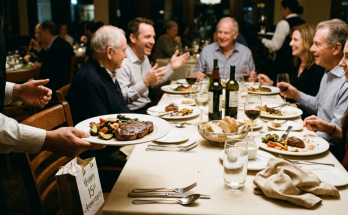
A bottle of vintage Bordeaux stood near the center of the table.
It was closer to me than to Richard.
I noticed it only because he began looking in my direction.
His face had grown flushed over the course of dinner.
He had been drinking expensive scotch.
His voice had become louder.
His confidence had become less restrained.
I knew the combination.
I had seen people become careless when alcohol removed the hesitation they normally used to disguise their opinions.
Richard was not struggling to find words.
He was looking for an opportunity.
He lifted his empty crystal glass.
Then he pushed it across the polished table toward me.
The base made a small, hard sound against the mahogany.
It stopped near my plate.
I looked at the glass.
Then I looked at him.
For a moment, I thought he might be asking me to pass the bottle.
That would have been ordinary.
People helped one another at dinner all the time.
I would not have objected.
But he was not asking for help.
He was preparing to make a point.
He told me to pour his wine.
Then he added that it would be nice to see me doing something useful.
A few heads turned.
He did not lower his voice.
Instead, he continued.
He remarked that the catering service had seemed short on employees.
Then he suggested that my appearance and circumstances made me a natural replacement.
A single mother.
A woman with what he believed was an unimportant government job.
Someone who ought to appreciate being allowed to attend a gathering in such an expensive home.
His words were accompanied by a laugh.
It was the laugh that settled the matter for me.
He was not embarrassed by what he had said.
He was enjoying it.
He wanted the people at the table to understand that he considered me beneath them.
I looked at the wineglass again.
It was perfectly ordinary.
Clear crystal.
Heavy base.
Empty.
There was nothing about the object itself that offended me.
I had served food before.
I had poured drinks for friends and colleagues.
I had cleared tables and washed dishes.
I had done plenty of ordinary work without imagining that it reduced my dignity.
That was not what Richard was asking me to do.
He wanted me to accept humiliation as a condition of being welcomed into his family.
He wanted me to demonstrate submission.
In front of my daughter.
That was the difference.
I had spent years working alongside people whose duties ranged from physical labor to high-level command.
I knew how much depended on people who rarely received public recognition.
I had seen senior officers praised for operations that could not have succeeded without mechanics, drivers, clerks, cooks, and supply personnel.
I respected those people.
I respected their work.
And I could not tolerate the idea that comparing someone to a member of the service staff was a suitable insult.
Richard had revealed something about his attitude toward the employees working in his home.
He believed their work made them lesser.
He believed using that comparison would embarrass me.
That judgment said far more about him than it did about me.
But I did not answer him immediately.
The room had become quiet.
The sound was almost startling after the conversations that had filled it for hours.
Nobody laughed with him.
Not openly.
The younger officers looked down.
A few guests shifted in their chairs.
One of the contractors seemed suddenly interested in his plate.
The moment stretched.
I could feel people waiting for me to respond.
Some probably expected an apology.
Others may have hoped I would pour the wine and allow the evening to continue.
I understood the temptation.
Sometimes the easiest response to a rude person was to satisfy the immediate demand and leave the confrontation for another day.
I had done that in situations where the larger mission mattered more than a personal slight.
But this was not a military operation.
No lives depended on my preserving Richard's comfort.
There was only my daughter.
And she was watching.
I lifted my eyes toward Olivia.
I knew her expressions better than I knew my own.
I had watched her grow from a little girl into an independent woman.
I knew when she was angry.
I knew when she was frightened.
I knew when she was trying not to cry.
That evening, all three emotions were visible.
Her face had lost its color.
Her hands were still.
Her eyes looked wet.
She was staring at Ethan.
I followed her gaze.
He was seated beside her.
For the first time that evening, his response mattered more to me than anything his father had said.
Richard had shown us the sort of man he was prepared to be.
Ethan still had a choice.
He could tell his father that the remark was unacceptable.
He could ask him to apologize.
He could stand beside Olivia without raising his voice.
He did not need to create a scene.
He only needed to make it clear that the woman he intended to marry did not have to watch her mother be mocked.
I waited.
Ethan looked from Olivia to Richard.
He swallowed.
His expression was tense.
I could see he was uncomfortable.
For one moment, I thought he was gathering the courage to speak.
I wanted that to be true.
I wanted to give him credit before he had earned it.
That was my mistake.
He leaned toward Olivia.
His voice was low, but the room was quiet enough that I could hear him.
He told her to persuade me to pour the wine.
He said we should not create an embarrassing situation for his father.
He referred to the admiral among the guests.
He made it clear that preserving Richard's reputation mattered more to him than the way Richard had spoken to me.
Then he suggested that I was being difficult.
I remember the feeling that followed.
It was not the sharp anger I might have expected.
It was disappointment.
A deep, immediate disappointment.
Ethan had been given a simple opportunity to show his character.
He had chosen his father's approval.
Not reluctantly enough to object.
Not courageously enough to protect Olivia.
He had made his decision.
And he wanted my daughter to enforce it for him.
That was what hurt.
I could endure Richard's arrogance.
I could dismiss an ignorant assumption about my career.
I could ignore a man who thought wealth and rank allowed him to insult people.
But I could not ignore what Ethan's response meant for Olivia.
I thought about the years ahead of her.
The family dinners.
The holidays.
The private disagreements.
The moments when she might need her husband to stand beside her while someone more powerful demanded obedience.
Would Ethan protect her dignity?
Or would he tell her to remain quiet because someone important might be offended?
I did not have to imagine the answer.
He had just given it.
I looked at Olivia.
She had heard him.
Her expression changed.
There was disbelief first.
Then pain.
She looked toward me as though she wanted to apologize for something she had not done.
I felt that familiar instinct to protect her.
For years, my responsibilities had sometimes required me to make decisions quickly.
When an operational situation changed, hesitation could multiply the damage.
You gathered the relevant facts.
You identified what mattered.
You acted.
That discipline returned to me at the dinner table.
I had enough information.
There was no benefit in arguing with Richard.
There was no benefit in reminding him of my rank.
There was no reason to demand respect from people who had already demonstrated that they believed respect depended on power.
I would not give him the confrontation he appeared to want.
I would not perform authority for his entertainment.
I looked at the empty glass.
Then I reached for my napkin.
I unfolded it from my lap.
I smoothed the fabric.
I folded it carefully.
My hands were steady.
I placed it beside my plate.
That small action seemed to draw everyone's attention.
Perhaps they expected me to reach for the wine.
Perhaps Richard believed his demand had finally been accepted.
I did not touch the bottle.
I stood.
My chair moved backward across the floor.
The sound was louder than I expected.
Nobody spoke.
I looked directly at Olivia.
I told her it was time to collect her coat.
That was all.
I did not explain.
I did not apologize.
I did not ask Richard's permission to leave his home.
Olivia rose immediately.
There was no argument.
No hesitation.
She moved away from Ethan and came around the table toward me.
I watched her walk.
Her steps were quick but controlled.
She did not look back at her fiancé.
I understood how much that moment must have cost her.
She had come to celebrate a future.
She was now leaving the celebration because the people involved in that future had made her mother unwelcome.
I wanted to tell her we could discuss everything later.
I wanted to assure her that she had done nothing wrong.
But we were still in the dining room.
And I did not intend to make her feelings part of Richard's public spectacle.
Ethan reached after her.
His hand did not find hers.
He looked stunned.
I wondered whether he had expected her to remain seated.
Perhaps he had believed she would accept his instruction simply because his father had spoken.
Perhaps he had assumed that the evening's expense made leaving unthinkable.
Whatever he expected, Olivia had chosen differently.
She came to my side.
I did not need to pull her away.
I did not need to convince her.
We stood together.
That mattered.
Richard slammed his palm against the table.
The silverware rattled.
His voice rose.
He told us that the matter was not finished.
I turned toward him.
Until then, I had avoided meeting his aggression with my own.
Now I looked straight at him.
I told him that, for us, the evening was over.
I did not shout.
I did not need to.
The words were simple.
I meant them.
He stared at me.
For a moment, I saw surprise behind his anger.
He was accustomed to people adjusting themselves to his demands.
I had not done so.
And he did not seem to understand why.
I turned back to Olivia.
We began walking toward the doors.
I knew Richard was furious.
I could hear it in his breathing.
I could feel the attention of everyone at the table following us.
But I had stopped caring what those guests thought.
I had learned enough.
I had seen Richard without the protection of a polite introduction.
I had seen Ethan when loyalty required courage.
And I had seen Olivia make a decision without waiting for either man to approve.
That was the only part of the evening that gave me comfort.
The empty wineglass remained on the table.
Untouched.
Click here to continue reading: PART 4: We Left the Whitmore Estate in Silence, Until a Secure Message Revealed Why Richard’s Monday Morning Would Be Very Different
I Went to My Daughter’s Engagement Party as an Ordinary Mother, Never Expecting Her Future Father-in-Law to Judge My Entire Life
Part 3 of 15