I had spent most of my life believing that difficult decisions became easier with experience.
That evening proved otherwise.
Experience helped me recognize a problem.
It helped me remain calm.
It helped me understand the difference between what I wanted to do and what I was responsible for doing.
But it did not remove the pain of watching my daughter suffer.
And it did not make the name on my secure phone any less troubling.
Captain Richard Whitmore.
I could still see those words on the docket.
They belonged to the same man who had pushed his glass toward me.
The same man who had laughed while insulting my work.
The same man who had threatened to end his son's wedding because I refused to be humiliated.
I looked toward his house.
The windows were still glowing.
Snow moved through the light near the entrance.
Inside, the guests had been celebrating an engagement.
Outside, I stood beside the daughter whose engagement had just been thrown into doubt.
It was a strange contrast.
Everything around us looked peaceful.
Nothing about the estate suggested that a family celebration had fallen apart only minutes earlier.
I thought about that as I moved toward my car.
The valet had brought it to the entrance.
I thanked him.
He had nothing to do with Richard's behavior.
I wanted to make sure my anger did not spill onto someone who had simply been doing his job.
That mattered to me.
The people who worked in the Whitmore home had spent the evening serving guests.
They had carried trays.
They had cleared dishes.
They had attended to requests without drawing attention to themselves.
Richard had used their work as an insult.
I found that difficult to forget.
He had believed comparing me to the staff would make everyone understand how little he valued me.
But I had never considered honest work humiliating.
I had known military personnel who performed physically exhausting jobs with extraordinary dedication.
I had known civilian employees who kept complicated systems running while receiving very little recognition.
Some of the most dependable people I had worked with had held positions that would never appear impressive on a dinner invitation.
Their work mattered.
Their dignity mattered.
Richard seemed unable to recognize either fact unless a person carried a title he admired.
I opened the car door.
Olivia was nearby.
I could see the strain on her face.
Her eyes had been wet when we left the dining room.
Now she looked exhausted.
I wanted to say something that would make the evening less painful.
There were no words capable of doing that.
I had learned long ago that not every injury could be repaired with an explanation.
Sometimes people needed time to understand what had happened.
Sometimes the kindest thing was not to rush them toward a conclusion.
I sat in the driver's seat.
For a moment, I kept my hands away from the steering wheel.
I wanted to be certain that I was thinking clearly.
The anger I felt toward Richard had not disappeared.
It sat beneath the surface.
Quiet.
Persistent.
I did not want it directing my decisions.
Olivia settled beside me.
I could feel the difference between us.
She was dealing with the possible loss of a future she had wanted.
I was dealing with the discovery that her future father-in-law's command was involved in a serious professional review.
Both matters were important.
But they were not the same matter.
I needed to remember that.
The engine started.
The familiar sound was comforting.
I looked at the entrance one more time.
The house had seemed enormous when I arrived.
Now it seemed smaller.
Not physically.
The building had not changed.
But Richard had filled every room with the importance he assigned to himself.
Once I stopped accepting his judgment, the effect disappeared.
It was still an expensive house.
Still beautifully decorated.
Still full of influential guests.
But it was only a house.
It could not determine my worth.
And it could not make Richard's conduct acceptable.
I began driving away.
The road was dark.
Snow continued falling lightly.
I concentrated on the pavement and the movement of the car.
Driving gave me something ordinary to do.
Something that did not require explaining feelings or considering official responsibilities.
For a few minutes, I wanted that simplicity.
I wanted to be a mother taking her daughter home after a difficult evening.
I did not want to be a lieutenant general.
I did not want to think about classified documents.
I did not want to imagine how Monday's assessment might be affected by what had happened.
But those responsibilities were still there.
They had followed me into the Whitmore driveway through the secure notification.
They would not disappear because I wished for a quieter evening.
I thought about what the message actually said.
The finalized docket identified Richard's regional logistics division among commands under investigation.
The discrepancies were substantial.
Millions of dollars.
That was not a minor accounting concern.
It was a matter that required careful examination.
But the document did not provide a final conclusion.
I reminded myself of that distinction again.
I had not seen enough to determine personal responsibility.
I had not reviewed all the supporting material.
I had not heard explanations from those responsible for the records.
I could not treat the existence of an investigation as proof of wrongdoing.
The fact that Richard had insulted me changed none of those obligations.
I knew how easily resentment could distort judgment.
A person behaved badly.
Then every unfamiliar fact about them began to look suspicious.
People started connecting things that had not been proven connected.
An expensive house became evidence of corruption.
A boastful remark became evidence of dishonesty.
An unpleasant personality became proof of professional misconduct.
I would not allow myself to make those leaps.
The Whitmore estate was wealthy.
Richard was arrogant.
His division faced serious questions.
Those facts existed.
But they did not establish that one caused the others.
If the panel's work eventually supported serious findings, the evidence would have to carry that conclusion.
Not my anger.
Not the dinner.
Not my daughter's tears.
Evidence.
I repeated the word silently.
I had taught younger officers to respect it.
I had insisted on it during difficult reviews.
I had expected it from people who served under my command.
Now I had to hold myself to the same standard.
That was not optional.
The uniform hanging in my closet carried responsibilities whether I wore it or not.
I looked briefly toward Olivia.
I wondered what she was thinking.
Richard had threatened the wedding.
Ethan had failed to protect her from the humiliation.
She had left beside me.
Those actions had occurred in only a few minutes.
But their consequences could last much longer.
I wanted to ask whether she regretted leaving.
I did not.
I wanted to ask whether Ethan had ever treated her this way before.
I did not ask that either.
Not yet.
I was afraid my questions might sound like accusations.
I did not want Olivia to believe that choosing Ethan had been a mistake I was eager to expose.
She loved him.
I respected that love.
But I also respected her enough to acknowledge that love did not automatically make someone's behavior acceptable.
Both things could be true.
I thought about the moment Ethan leaned toward her.
His face had tightened.
He had looked frightened of embarrassing his father.
I could understand that fear.
Richard was intimidating.
He was accustomed to commanding a room.
He had surrounded himself with people who seemed reluctant to challenge him.
A son raised within that atmosphere might find it difficult to disagree.
But difficulty did not eliminate responsibility.
Ethan was no longer a child.
He was preparing to become Olivia's husband.
He needed to be able to make choices that did not depend entirely on his father's approval.
At the dinner table, he had not shown that ability.
I could not pretend otherwise.
I also could not decide whether that failure defined him forever.
That was something his future actions would have to answer.
The road continued ahead.
The car's interior was warm.
Outside, snow caught the headlights before disappearing into the darkness.
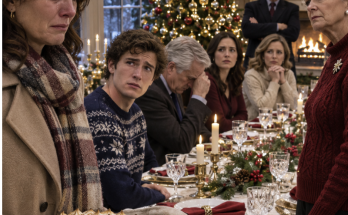
I remembered the chandelier.
The silver trays.
The tall floral arrangements that made it difficult to see across the table.
So much had been designed to impress.
So little had been designed to make people comfortable.
I had noticed that before Richard's final insult.
Now it seemed almost symbolic.
The decorations were beautiful.
They also obstructed conversation.
The uniforms were immaculate.
They did not guarantee integrity.
The expensive wine was carefully selected.
It became an instrument of humiliation.
The evening had been full of impressive objects.
None of them had made Richard a gracious host.
I considered how he would have behaved if I had arrived in uniform.
Three silver stars would have changed the conversation immediately.
I knew that.
He would have recognized my position.
He would have understood that I was not a junior administrative employee.
He might have been careful.
He might have offered professional courtesy.
He might have invited me into one of his long conversations about logistics.
But I would not have known whether he respected the woman beneath the uniform.
I had wanted that knowledge.
Now I possessed it.
The price had been higher than expected.
Olivia had paid part of it.
That was what troubled me most.
I could tolerate being underestimated.
I had endured far worse than an arrogant man's remarks.
My daughter should not have been forced to endure them with me.
I wondered whether leaving immediately had been the only reasonable response.
I examined the decision as I would examine a difficult command choice.
What alternatives had existed?
I could have poured the wine.
That would have ended the immediate confrontation.
It also would have taught Richard that he could publicly insult me and expect obedience.
I could have challenged him.
I could have told him my rank.
That might have embarrassed him and impressed the guests.
It would also have turned Olivia's engagement celebration into a contest of military authority.
I could have asked him to apologize.
But his laughter and the comments that followed suggested he was not interested in understanding the harm he had caused.
I had chosen to leave.
It was the only option that did not require me to accept the humiliation or escalate the argument.
I still believed it was the right choice.
Yet I did not feel victorious.
I felt sad.
Sad for Olivia.
Sad that Ethan had disappointed her.
Sad that Richard could not offer ordinary kindness without first measuring the importance of the person receiving it.
I wondered whether he understood what had happened.
Perhaps he believed I had been unreasonable.
Perhaps he thought I had embarrassed him deliberately.
Perhaps he expected an apology before allowing the wedding to proceed.
I had no way of knowing.
What I knew was that his threat had not stopped us.
For once, someone had refused to organize their behavior around his approval.
I hoped he might eventually recognize why.
But that hope did not belong in the professional review.
The thought returned me to Monday.
The Joint Readiness Assessment Panel would have responsibilities larger than the incident at his house.
I could not allow the panel to become an extension of my personal disagreement.
I needed to ensure that any potential conflict arising from my connection to Richard was properly addressed.
I knew that acknowledging such a conflict did not mean surrendering responsibility.
It meant respecting the process.
If my involvement required review under the applicable procedures, that review needed to occur.
If another authorized official needed to handle some matter, the appropriate decision would have to be made through official channels.
I could not resolve those questions privately in my car.
But I could recognize them.
And I could refuse to conceal the connection.
That distinction mattered.
Integrity did not mean pretending a conflict did not exist.
It meant handling it openly and correctly.
I had spent years asking other officers to demonstrate that kind of judgment.
Now the circumstances required it from me.
I thought about Richard's pride in his title.
Captain.
He had corrected me almost immediately.
He had wanted the word spoken.
I wondered whether he understood that the title also meant being answerable for decisions made under his command.
The privileges of rank were visible.
The burdens were often less glamorous.
Reviewing records.
Explaining discrepancies.
Accepting responsibility for failures.
Facing questions from people whose opinions might be uncomfortable.
Those tasks were not optional parts of leadership.
They were central to it.
Richard had demonstrated how much he enjoyed being recognized.
Monday's docket raised a different question.
How would his command account for the concerns under investigation?
That answer would have to come from the evidence.
I would not invent it.
I would not anticipate it.
I would not allow my disappointment in him to become a conclusion.
The car continued through the winter evening.
Olivia remained beside me.
I felt the secure phone resting in my purse.
For the first time since reading the message, I stopped imagining Richard's reaction when he eventually learned my rank.
His surprise was not the important part.
His command's accountability was.
My daughter's well-being was.
My own responsibility to act fairly was.
Those were the matters that deserved my attention.
The empty glass had exposed Richard's character.
The docket had introduced a professional obligation.
Neither gave me permission to abandon my principles.
I looked ahead at the road.
I had left his house without telling him who I was.
I intended to let the truth of my position remain separate from the humiliation he had attempted.
Whatever happened Monday, it would not be because I wanted revenge.
It would have to be because the facts required an answer.
Click here to continue reading: PART 10: I Could Have Used My Three Silver Stars to Frighten Richard, but My Daughter Needed Something More Important Than Revenge
I Went to My Daughter’s Engagement Party as an Ordinary Mother, Never Expecting Her Future Father-in-Law to Judge My Entire Life
Part 9 of 15