The last thing Richard Whitmore wanted me to understand that evening was my place.
He had said it plainly.
He had shouted it as Olivia and I walked away.
He believed his wealth, his home, and his Navy rank gave him the right to decide how I should behave.
He believed I needed to recognize the hierarchy he had placed between us.
And he believed that threatening my daughter's wedding would make me obey.
He had been wrong.
But not for the reason he would have expected.
He was wrong because my dignity had never depended on his permission.
It did not come from my salary.
It did not come from my car.
It did not come from the clothes I wore.
And it did not come from the three silver stars hanging inside my closet.
Those things described parts of my life.
They did not establish my worth.
I had understood that before attending his party.
The evening had forced me to defend it.
I remembered walking into his home.
The doors had opened onto a beautiful foyer.
The chandelier had filled the room with light.
A string quartet had been playing.
Guests had been gathered in carefully dressed groups.
Everything had suggested a celebration of wealth and influence.
I had felt hopeful.
I wanted to see Olivia happy.
I wanted to meet the family she was preparing to join.
I wanted a pleasant evening without military formality.
That was why I had chosen the simple dress.
That was why I had left my uniform behind.
I wanted to be a mother first.
I had not wanted to enter the room as an officer whose rank might change how people behaved.
I thought the Whitmores deserved an opportunity to know me without that influence.
Looking back, I still believed the intention was reasonable.
But I had underestimated how much Richard cared about status.
He had examined me before he really spoke to me.
He had corrected my greeting.
He had made assumptions about my job.
He had decided that a woman raising a daughter alone and working in government must occupy a modest position.
Then he had treated that imagined position as permission to be condescending.
I had listened.
I had answered politely.
I had refused to make the evening about my career.
The restraint had cost me nothing at first.
But Richard had continued.
He explained things I already understood.
He interrupted me.
He treated expensive food as though it belonged to a world I had never encountered.
He enjoyed reminding the table of his expertise.
I had remained quiet.
I wanted Olivia's evening to succeed.
I wanted to give Richard every reasonable opportunity to behave graciously.
He had not taken it.
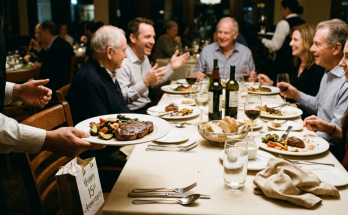
By dessert, the pattern was clear.
The waiter had stepped away.
The wine bottle was near the center of the table.
Richard had looked toward me.
Then he pushed his empty glass across the wood.
I could still hear it.
A short clink.
Almost nothing.
Yet it became the sound I remembered most clearly from the entire celebration.
Richard told me to pour the wine.
He made a joke about the catering staff.
He compared my appearance and circumstances to the people serving the meal.
He suggested that I should be grateful simply to sit among his guests.
He laughed.
That was the moment when the evening changed.
I had no objection to serving someone a drink.
I had done ordinary work throughout my life.
I respected the people doing that work in his home.
But I would not participate in a performance designed to make me feel inferior.
Richard was not asking for hospitality.
He was demanding submission.
I looked at Olivia.
Her eyes were wet.
Her face had gone pale.
She was staring at Ethan.
I remembered how much hope I had placed in his response.
I had wanted him to show that he understood.
He could have spoken quietly.
He could have asked his father to stop.
He could have acknowledged that the remark was unkind.
Instead, he asked Olivia to persuade me to obey.
He worried about his father's embarrassment.
He worried about the admiral's opinion.
He wanted the evening to continue as though Richard had done nothing wrong.
That was when I understood the problem was larger than one rude man.
My daughter was preparing to join a family in which her future husband might expect her to protect his father's pride at the expense of her own judgment.
I could not ignore that.
It frightened me more than Richard's insults.
Richard was the man he was.
I had seen enough to understand that I did not admire his behavior.
But Ethan was the man Olivia had chosen.
His response could shape her life for years.
I thought about how she would feel if she were expected to remain silent every time Richard demanded obedience.
Would she begin doubting her own judgment?
Would she learn to apologize for objecting to cruelty?
Would she come to believe that keeping the family comfortable mattered more than protecting herself?
I did not know.
I could not claim one evening proved what her entire marriage would become.
But I believed the questions were serious.
And I believed Olivia deserved to consider them.
I had not needed to explain all of that at the table.
I had simply stood.
I folded my napkin.
I placed it beside my plate.
I told Olivia it was time to collect her coat.
She rose.
She came to my side.
That was the moment I felt proudest of her.
Not because she had obeyed me.
Because she had made her own decision.
She had seen what happened.
She had understood why remaining would be painful.
And she had chosen to leave.
I did not know what her relationship with Ethan would become after that evening.
I did not know whether he would apologize.
I did not know whether Richard would withdraw his threat.
I did not know whether the wedding would proceed.
Those answers were not contained in the events I had witnessed.
I could not invent them.
What I knew was that Olivia had not remained at the table while her mother was being humiliated.
She had walked beside me.
And whatever decisions she made about her engagement afterward, that courage belonged to her.
I thought about the moment we crossed the dining room.
Richard had struck the table.
His voice had risen.
He told us we were not finished.
I had turned toward him.
I had answered quietly.
For us, the evening was finished.
That was not a military order.
It was a personal boundary.
I had no need to make it more complicated.
Richard had responded by threatening the wedding.
He had shouted about hierarchy.
He wanted me to understand that leaving his home would carry consequences.
I had continued walking.
I did not believe a family relationship could be healthy if it depended on accepting public humiliation.
I still did not.
The doors had closed behind us.
The cold Maryland night had felt sharp after the warmth of the estate.
Snow was falling.
The valet had brought my sedan around.
Everything outside had seemed ordinary.
The car.
The driveway.
The winter air.
I had been grateful for that ordinary world.
Then my secure phone vibrated twice.
The notification came from my chief of staff at the Pentagon.
It concerned the finalized docket for Monday morning's Joint Readiness Assessment Panel.
I chaired that panel.
I remembered opening the communication.
The classification warnings appeared.
I moved through them.
Then I read the list of commands under investigation for serious financial discrepancies.
At the top was a regional logistics division.
Its commanding officer was Captain Richard Whitmore.
For a moment, I had felt the evening turn again.
The man who had mocked my supposed lack of importance was connected to a serious review under the responsibility of a panel I chaired.
He had no idea.
He did not know my rank.
He did not know the extent of my responsibilities.
He did not know that the woman he had treated as a minor government employee was a lieutenant general.
He did not know about the three silver stars.
He had never asked enough questions to discover any of those things.
The irony was extraordinary.
I could acknowledge that without turning it into revenge.
Richard had made assumptions about my authority.
The docket revealed those assumptions were wrong.
But the docket did something else.
It reminded me that authority was a responsibility, not a personal weapon.
The financial discrepancies involving his command were serious.
Millions of dollars.
Those questions deserved examination.
They did not deserve to be ignored because Richard was wealthy or influential.
They also did not deserve to be exaggerated because he had insulted me.
I knew the difference.
I had spent decades learning it.
The document did not establish that Richard had personally committed a crime.
It did not identify a final judgment.
It did not tell me what the investigation would ultimately prove.
And I would not claim otherwise.
The official process had to remain fair.
That was not something I owed Richard because I liked him.
I did not like him.
It was something I owed the responsibilities of my position.
I could not allow my feelings about his treatment of Olivia to decide professional questions that required evidence.
I could not use classified information to settle a family dispute.
I could not conceal a personal connection if it needed to be addressed under the applicable procedures.
Those limits mattered.
They were part of the responsibility represented by my rank.
I thought about what Richard's Monday morning might bring.
He would have to face the legitimate questions associated with his command through the appropriate official process.
His confidence at dinner would not resolve financial discrepancies.
His impressive uniform would not replace records.
His wealth would not serve as evidence of compliance.
His connections would not answer questions that required facts.
But neither would my anger serve as evidence against him.
That was equally important.
I had no right to use my position to make him suffer because he had embarrassed me.
The system was larger than either of us.
It had to remain that way.
I thought about how satisfying it might be for Richard to discover the truth about my identity.
He had been so certain.
So dismissive.
So pleased with his own authority.
Learning that I outranked him would contradict his assumptions.
I could imagine his surprise.
But I did not need that surprise to feel vindicated.
I had already made the decision that mattered.
I had refused his treatment.
I had left with my daughter.
I had not needed my stars to do either.
That was the answer to his humiliation.
The official review was a separate obligation.
I hoped it would establish the facts accurately.
Whatever those facts proved.
I thought about the guests who had witnessed the confrontation.
The junior officers.
The defense contractors.
The local politicians.
The admiral whose opinion had mattered so much to Ethan.
They had seen Richard's behavior.
They had seen my refusal.
They had seen Olivia stand.
I did not know what they thought afterward.
I did not know what they said.
I did not need to know.
Their opinions could not change the basic facts.
Richard had treated a guest cruelly.
Ethan had failed to defend her.
Olivia had refused to remain.
That was what happened.
I did not need an audience to confirm it.
I did not need those guests to recognize my rank before I could believe my own experience.
For years, I had worked in environments where rank was visible.
A person's position could be identified immediately.
The uniform carried information before anyone spoke.
At the Whitmore estate, I had removed that signal.
I had discovered how Richard treated me without it.
It had been painful.
But the knowledge was real.
I would not pretend I regretted learning it.
I regretted Olivia's tears.
I regretted Ethan's response.
I regretted that the engagement celebration had become a memory of humiliation rather than joy.
But I did not regret refusing to pour the wine.
And I did not regret walking away.
Those decisions protected something that mattered more than Richard's approval.
They protected our right to be treated with dignity.
I considered the difference between the man Richard believed he was and the man I had seen.
He believed his title deserved respect.
I agreed that military service deserved appropriate professional respect.
But he seemed to believe that respect allowed him to demand submission in his private life.
I rejected that.
A captain's authority had a purpose.
It did not exist to make a woman feel small at a dinner party.
It did not exist to frighten a family into obedience.
It did not exist to turn a son's engagement into an opportunity to display power.
The same was true of my own rank.
I was a lieutenant general.
My responsibilities were extensive.
My decisions could affect many people.
But none of that made me entitled to humiliate someone with less authority.
If I used my stars that way, I would be betraying what they represented.
I knew that.
I hoped Richard might someday understand it too.
But his understanding was not something I could command.
Nor was an apology.
He could decide to recognize the harm he had caused.
He could choose not to.
I could not control him.
I could only control whether I allowed his behavior to change my principles.
I would not.
I thought about Olivia one final time.
My daughter had entered the Whitmore estate hoping to celebrate her future.
She had left facing painful questions about it.
I wanted to protect her from every disappointment.
I knew I could not.
She was an adult.
She would make choices I could support.
She might also make choices that frightened me.
That was part of loving someone who had grown into an independent person.
I could offer guidance.
I could share my concerns.
I could tell her what I had seen.
But I would not use my military position to decide her marriage.
I wanted her to choose a future where she felt respected.
A future where she could disagree without fear.
A future where love did not require silence in the face of cruelty.
Whether Ethan could offer that future remained unanswered.
His actions would have to matter more than his promises.
I hoped Olivia would remember that.
I hoped she would understand that the choice she made at the dinner table had been a strong one.
She had not created the humiliation.
She had not caused Richard's anger.
She had not forced Ethan to respond as he did.
She had simply refused to participate in pretending the behavior was acceptable.
That took courage.
And I wanted her to carry that courage into whatever came next.
I remembered standing in the driveway.
The estate behind us.
The cold air around us.
The secure phone in my hand.
The name on the docket.
For a moment, the two parts of my life had collided.
Motherhood.
Military duty.
They demanded different things from me.
As a mother, I wanted Olivia to feel safe and valued.
As an officer, I was obligated to respect evidence, procedure, and accountability.
I could not use one responsibility to avoid the other.
That understanding was the true outcome of the evening for me.
I had not gone to the Whitmore estate looking for a confrontation.
I had gone hoping to meet my daughter's future family.
I had not expected to discover Richard's contempt for people he considered unimportant.
I had not expected Ethan to choose his father's reputation over my dignity.
And I had certainly not expected to find Richard's name on a serious official docket before the night was over.
But those things happened.
I could not change them.
I could decide what they meant for my own conduct.
I would not accept humiliation as hospitality.
I would not confuse wealth with character.
I would not allow rank to substitute for integrity.
I would not turn an official investigation into personal retaliation.
And I would not use my position to take away Olivia's right to choose her own future.
Those decisions were mine.
I thought about the empty glass one last time.
Richard had wanted me to fill it.
He had believed the gesture would establish my place beneath him.
Instead, it revealed how little he understood about the responsibility that came with authority.
I had left the glass untouched.
I had walked out beside my daughter.
That part of the conflict was settled.
Richard had not made me obey.
His threat had not stopped us.
His opinion had not changed my worth.
The financial investigation remained a separate matter, with findings that the docket had not yet established.
Monday's official responsibilities would have to be handled fairly.
Nothing about my personal experience could replace that obligation.
The three silver stars would still be waiting on my uniform.
I knew what they meant.
They represented service.
Responsibility.
Accountability.
They were not proof that I deserved more dignity than someone else.
They were a reminder that I had accepted greater obligations.
Richard had wanted to teach me my place.
But I already knew it.
I was Victoria Hayes.
I was Olivia's mother.
I was a lieutenant general.
And none of those identities required me to make another person feel small.
I had arrived at his table hoping for kindness.
I had left without receiving it.
But I had not left with less dignity than I brought.
That was something Richard could never take from me.
And it was something I hoped my daughter would never allow anyone to take from her.
The End
Read more original stories on readdramaus.
I Went to My Daughter’s Engagement Party as an Ordinary Mother, Never Expecting Her Future Father-in-Law to Judge My Entire Life
Part 15 of 15