I had never believed that success would make every difficult decision easier.
But I had expected it to make some things simpler.
I thought experience would give me confidence.
I thought having a capable team would make uncertainty less frightening.
And I thought reaching a point where Rowan Capital could consider major investments would finally make me feel secure.
Sitting in Beaumont's boardroom, I understood how incomplete those expectations had been.
I had more experience than the woman who bought that first duplex.
I had more resources.
I had people I trusted to help examine complicated financial decisions.
But I still had to live with uncertainty.
And this time, my sister was sitting at the other end of the table.
I looked down at the proposal.
The pages were neatly arranged.
The figures had been reviewed.
The conditions had been explained.
Every important concern had a place in the discussion.
Yet I couldn't arrange my feelings as neatly as the documents.
I was worried about Melissa.
I was disappointed in her.
I was relieved that the investigation hadn't established that she knowingly participated in Gregory's misconduct.
And I was still hurt by what she had said to me at Christmas.
All those feelings existed together.
I had finally stopped trying to pretend otherwise.
For years, I had treated family gatherings like something I needed to endure quietly.
Melissa made jokes about my rental properties.
Dad reminded me that corporate employment was more reliable.
Mom worried aloud about whether my business was really doing well.
I smiled.
I changed the subject.
I told myself it didn't matter.
But it did.
I knew that now.
I remembered the way my stomach tightened whenever someone asked whether I was still managing those little apartments.
I remembered wanting to explain that Rowan Capital had grown.
That we owned and managed different types of property.
That we examined opportunities requiring careful financial analysis.
That my work involved considerably more than collecting rent.
Then I remembered how previous explanations had been received.
And I said very little.
That silence protected me from another argument.
It also allowed the same misunderstanding to continue.
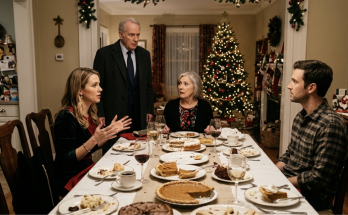
At Christmas, Arthur had changed that without intending to.
He walked into my parents' dining room and recognized me.
For him, it was a simple meeting between people who already knew each other professionally.
For my family, it was a shock.
I could still see Melissa's face.
She had been proud to bring her chairman to dessert.
Then he started discussing Harbor District with me.
He mentioned Rowan Capital.
He described the company's portfolio.
He explained our possible involvement in Beaumont's redevelopment financing.
And the room became quiet.
I had imagined that silence many times over the years.
I thought it would feel wonderful.
Instead, it made me uncomfortable.
I didn't want my parents finding out about my work because a chairman spoke highly of it.
I wanted them to care when I spoke.
That was the difference.
Arthur's recognition hadn't created my success.
It had only exposed something my family had chosen not to understand.
I thought about Mom putting the dessert plate down.
Dad lowering his wineglass.
Melissa insisting that Arthur must have misunderstood.
Those details remained painfully clear.
I had spent twelve years learning how to manage financial risk.
Yet I couldn't convince my own family that my career deserved respect.
I wondered whether I had been foolish to keep hoping.
Then I remembered what Dad said after Arthur left.
He and Mom had been afraid I would fail.
I believed him.
I knew their worry was real.
They had watched me leave a steady job and buy an old property using borrowed money.
They had seen the early problems.
They had heard about the broken heating system.
They hadn't understood how I intended to build something lasting.
But their fear had become a judgment.
And that judgment had followed me long after the circumstances changed.
I remembered telling Dad that I didn't need him to invest in my business.
I didn't need constant praise.
I only wanted him to stop making me feel like a disappointment.
I had never said those words so plainly before.
They were still difficult to remember.
Not because I regretted them.
Because I had carried them for so long.
I looked toward Melissa.
She had been part of that family pattern.
Whenever our parents praised her career, she seemed comfortable.
She had an established employer.
She worked in acquisitions.
Her chairman was a respected figure.
Those were things Mom and Dad understood.
My career didn't fit their expectations.
And Melissa had rarely missed an opportunity to remind me.
But I had never wanted her to fail.
That was what made the investigation so painful.
I didn't want to prove my success by watching her lose hers.
I didn't want Rowan Capital's financial strength to become a weapon against her.
And I didn't want her mistakes to become an excuse for humiliating her.
I wanted the truth.
Even when the truth was uncomfortable.
Especially then.
The independent investigation had made an important distinction.
Gregory Hale had deliberately arranged for Northstar Urban Services to receive inflated contracts.
He had concealed his financial connection to the company.
He had used his position to influence vendor selection.
That conduct had been established.
Melissa's role was different.
She had recommended Northstar.
She had failed to complete the required ownership checks.
She had followed Gregory's instructions to limit certain discussions.
Those failures mattered.
But the investigation found no evidence that she received payments or shared in the profits.
It also found no evidence that she knowingly participated in Gregory's arrangement.
I had insisted on that distinction from the beginning.
Now the findings supported it.
I remembered telling Daniel not to make assumptions.
Melissa's name appeared in the records.
That didn't make her guilty of everything the records concerned.
A recommendation wasn't the same as a payment approval.
A failure to verify ownership wasn't automatically proof of deliberate fraud.
And trusting Gregory didn't establish that she knew about his concealed interests.
I had learned to separate those questions through years of examining financial documents.
I wasn't going to abandon that discipline because the person involved was my sister.
But fairness worked in both directions.
The investigators hadn't excused her procedural failures.
Neither could I.
She had responsibilities within the acquisitions process.
She had not completed all of them properly.
That was a serious matter for Beaumont.
Her fear didn't change it.
Her relationship with me didn't change it.
And the fact that Gregory had committed deliberate misconduct didn't erase her own mistakes.
I thought about the telephone conversation when Melissa began crying.
She asked whether she would lose her job.
I had told her I didn't know.
Then she asked me to help.
I remembered how tired I felt when she said that.
For twelve years, she had treated my business as something beneath her.
Now she wanted me to use my position with Arthur.
I could have reminded her of that contradiction.
I didn't.
It wouldn't have helped.
She needed to understand what the investigation required.
I told her to cooperate.
I told her to explain everything.
And I told her that I could insist on fairness, but not make the evidence disappear.
That was the only promise I could responsibly make.
I looked toward the far end of the boardroom again.
Melissa was listening.
I couldn't tell what she was thinking.
Perhaps she was relieved that the auditors had not accused her of deliberate participation.
Perhaps she was frightened about the employment decision.
Perhaps she was thinking about the mistakes that had brought her into the investigation.
I didn't know.
For years, I had been hurt because my family assumed they understood my life without asking questions.
I wasn't going to make the same mistake by pretending I understood Melissa's thoughts.
I knew the facts.
I knew what she had told me.
And I knew what the investigators had established.
Everything else belonged to her.
That realization made me sad.
We were sisters.
Yet there was so much we didn't know about each other.
Melissa didn't understand my work.
And I had not realized how much professional pressure she might have been facing at Beaumont.
I had known she was proud of her position.
I had known she worked in acquisitions.
But I hadn't known about her role in recommending Northstar until Arthur showed me the documents.
I hadn't known Gregory had instructed her to restrict certain communications.
I hadn't known she had relied on his assurances about ownership checks.
Those details mattered.
But I didn't want to turn them into proof that I had been a better person all along.
I had made mistakes too.
The first duplex had taught me that.
I remembered being twenty-eight and frightened.
I thought buying the building meant I had taken control of my future.
Then the heating failed.
Suddenly, the future felt uncertain again.
I worried about the repair bill.
I worried about the money I had borrowed.
I worried that I had been too optimistic.
I spent a night on the floor because I couldn't justify another expense.
There had been no comfort in that.
No glamorous feeling of being an entrepreneur.
Just cold flooring, a broken heating system, and the knowledge that I was responsible for fixing the problem.
I remembered calling Mom.
I had wanted somebody to listen.
Instead, she reminded me of Dad's warnings.
I felt ashamed.
Looking back, I could see that I had confused wanting encouragement with needing permission.
My parents hadn't approved of my decision.
But I had already made it.
The building was mine.
The responsibility was mine.
And whatever happened, I had to decide what to do next.
I kept working.
I learned from the mistakes.
I became more careful with contractors.
More disciplined about financial information.
More willing to question assumptions.
Those lessons followed me into every later investment.
They were part of the reason I insisted on independent reviews.
They were part of the reason Daniel's warning about Harbor District mattered so much.
And they were part of the reason I wasn't willing to invest based on Arthur's confidence alone.
Arthur was experienced.
He was chairman of Beaumont.
He had been cooperative throughout our discussions.
But authority didn't replace verification.
Gregory's misconduct had demonstrated that.
I had watched what happened when a senior executive's assurances were accepted without enough independent checking.
The consequences were now sitting in front of the board.
Approximately 4.8 million dollars in discrepancies.
Inflated contracts.
Unverifiable work.
A concealed financial interest.
And failures in internal controls.
Those weren't abstract concerns.
They affected the project's financial position.
They affected the company's need for restructuring.
And they affected employees who had participated in the processes under investigation.
I couldn't treat them lightly.
I looked down at the revised financial projections.
Arthur's team had improved the information provided during negotiations.
I recognized that.
But some concerns remained.
The construction liabilities needed proper treatment.
The outstanding lender agreements required attention.
And the board needed to accept safeguards that would allow Rowan Capital to assess the investment responsibly.
I had explained those conditions.
I hadn't promised the money.
That distinction was important.
A company facing financing pressure might understandably want an investor to provide certainty.
But certainty couldn't be manufactured.
I couldn't approve a transaction just because Beaumont needed it.
I couldn't approve it because Arthur respected me.
And I couldn't approve it because helping Beaumont might benefit my sister.
Those were not sufficient reasons.
I had built Rowan Capital through years of financial decisions.
Some were difficult.
Some involved opportunities that looked attractive until the risks became clearer.
I had learned that walking away could be as important as moving forward.
I wasn't prepared to forget that lesson.
I thought about the directors.
They were responsible for considering the proposal.
They had heard the findings.
They understood the financial issues.
And they knew the conditions under which Rowan Capital was willing to consider participating.
I couldn't decide for them.
Just as I couldn't decide whether Melissa would keep her job.
I had to let other people carry their own responsibilities.
That was harder than I expected.
I was used to solving problems.
When a property required repairs, I worked through the costs.
When a lender raised questions, I examined the terms.
When a contractor's work needed verification, I requested the information.
But I couldn't solve a family relationship through financial analysis.
I couldn't make Melissa understand why her words hurt.
I couldn't make my parents recover twelve years of conversations they hadn't wanted to have.
And I couldn't guarantee that everyone would leave this situation with the outcome they preferred.
Some things remained beyond my control.
I was beginning to accept that.
I thought about my father's question again.
How much was Rowan Capital worth?
He had asked it almost immediately after Arthur left.
I knew why.
The business suddenly seemed important to him.
Before that evening, he had shown little curiosity about its actual work.
I didn't want our relationship reduced to a number.
I wanted him to know his daughter.
Not simply her company's valuation.
I wanted Mom to understand that I had been frightened when I called about the heating system.
Not foolish.
Not irresponsible.
Frightened.
I wanted Melissa to understand that her career could matter without making mine seem insignificant.
Those were the things I had wanted for years.
None could be purchased through an investment.
None could be settled by a chairman recognizing me at Christmas.
And none would automatically happen because the directors accepted Rowan Capital's proposal.
I looked around the boardroom.
The documents were still there.
The auditors' findings remained in front of the directors.
Legal counsel had explained Melissa's situation.
And the proposed restructuring was still being considered.
The problems had been identified.
But the decisions had not all been made.
I felt the familiar pressure to find an answer.
Then I remembered the lesson from my first duplex.
Not every problem could be solved by moving faster.
Sometimes the responsible decision was to stop making assumptions.
Read the documents.
Ask the questions.
Accept what the evidence showed.
And refuse to promise more than I could deliver.
I had done that with Harbor District.
I had done it with Melissa's investigation.
Now I needed to do it with my family.
I couldn't promise reconciliation.
I couldn't pretend the Christmas conversation had repaired everything.
And I couldn't declare myself free of the hurt simply because my family finally knew what Rowan Capital had become.
I still wanted a different relationship with them.
But I wasn't going to build that relationship on silence again.
Not the silence that allowed insults to pass without challenge.
Not the silence that made my work seem unimportant.
And not the silence that left twelve years of misunderstanding untouched.
I had already told my parents why I stopped sharing.
That was a beginning.
Nothing more.
I looked toward Melissa one last time.
She had her own decisions to face.
Her mistakes had been examined.
The findings were clear.
The consequences remained for Beaumont to determine.
I hoped she would be treated fairly.
I hoped she would learn from what happened.
But I couldn't do those things for her.
Then I looked at Rowan Capital's proposal.
My responsibility remained the same.
Protect the company.
Require reliable financial information.
Insist on safeguards.
And make no commitment that the evidence could not justify.
I felt disappointed that success hadn't made family life easier.
But I also felt something steadier.
I no longer needed Melissa's failure to prove my success.
I didn't need my parents' approval to validate twelve years of work.
And I didn't need Arthur's recognition to know what Rowan Capital was.
I had built the company before Christmas.
I would remain responsible for it afterward.
Whatever Beaumont decided, that responsibility was mine.
Click here to continue reading: PART 18: My Family Finally Knew What I Had Built, but the Real Ending Was Understanding Which Decisions Were Mine and Which Were Not
I Thought Christmas Dinner Would Be Another Evening of Quiet Insults Until a Guest Looked at Me Like He Knew Something
Part 17 of 18