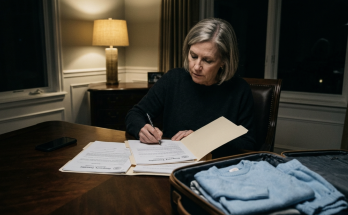
At 9:17 on the morning I buried my father, my doorbell camera sent me a video of an excavator crushing the guest house he had built with his own hands.
At 9:19, the president of Cedar Ridge Estates texted me a photograph of the wreckage and wrote, “Unauthorized structure removed. You were warned.”
At 9:22, she sent me an invoice for $38,400.
I stood beneath the white portico of a funeral home three hundred miles away, wearing a black dress and holding the folded American flag the honor guard had just placed in my arms.
Behind me, people were still speaking softly about my father.
About how he had served twenty-six years in the Army Corps of Engineers.
About how he could repair anything except his own heart.
About how he had spent his final months worried that someone in Cedar Ridge was trying to steal our land.
My phone vibrated again.
A second video appeared.
This one had been filmed by someone standing near the excavator.
The cedar siding folded inward. The chimney broke at the roofline. My father’s blue workbench vanished beneath a bucket of splintered beams and red clay.
Three men in reflective vests watched from the driveway.
Beside them stood a woman in cream-colored slacks, spotless loafers, and a green silk blouse.
Vanessa Whitcomb.
President of the Cedar Ridge Homeowners Association.
She lifted one hand toward the camera as if conducting an orchestra.
The excavator dropped its bucket.
The front wall collapsed.
Someone behind the phone laughed.
I watched the video twice.
Then I locked the screen.
I did not scream.
I did not call Vanessa.
I did not leave my father’s funeral.
I did not give her the panic she had expected.
I did not tell her that the guest house had been standing there since 1963, thirty-four years before Cedar Ridge Estates existed.
I slipped the phone into my purse, tightened my fingers around the folded flag, and went back inside to finish saying goodbye to the man who had taught me that angry people made mistakes, but patient people collected evidence.
My name is Claire Mercer.
I was forty-two years old when the HOA bulldozed my guest house.
By sunset the following day, they would discover that the building was not the most valuable thing they had destroyed.
And before the week was over, the county surveyor would drive a steel rod into the ground in front of Vanessa’s entire board and say twelve words that turned every face around him pale.
“This marker means the HOA has been building on the wrong property.”
But that came later.
First, I had to bury my father.
Colonel Thomas Mercer had never actually been a colonel.
Everyone called him that because he stood straight even when age bent him, polished his boots every Sunday, and could silence an argument by looking over the top of his glasses.
He had retired as a master sergeant, then spent another eighteen years working as a civilian field inspector for the Army Corps of Engineers.
He understood dams, culverts, retaining walls, drainage easements, boundary monuments, and the ways men lied when millions of dollars sat on the other side of a line.
He also understood silence.
Two weeks before he died, I found him sitting at the kitchen table in our farmhouse with three yellowed plats spread around his coffee.
He had marked several places in red pencil.
The HOA clubhouse.
The eastern entrance road.
The stormwater pond.
And the guest house.
“You’re drawing battle plans,” I said.
He looked up.
“I’m checking somebody else’s.”
My father had lived on Mercer Farm almost his entire life.
Our family owned forty-six acres outside the town of Bellwether, North Carolina, where the land rose from a creek bottom into oak-covered hills. The farmhouse sat near the western edge. The guest house stood on a low ridge to the east, half a mile from the main road.
My grandfather had built it after returning from Korea.
At first it was a hunting cabin.
Then it became a place for relatives at Thanksgiving, cousins in summer, and anyone who needed somewhere quiet to begin again.
My mother stayed there for three months before she agreed to marry my father.
My aunt lived there during a divorce.
I lived there after college, when I had eight dollars in my checking account and believed my life had ended because a man named Travis had married someone else.
The guest house was not large.
Two bedrooms.
One bathroom.
A stone fireplace.
A screened porch facing the creek.
But every board had a history.
My grandfather’s initials were carved beneath the porch rail.
My father had measured my height against the pantry door every year until I was sixteen.
The kitchen table still carried a crescent-shaped burn from the Christmas Eve when Aunt Ruth placed a hot cast-iron skillet directly on the wood.
To Vanessa Whitcomb, it was an unauthorized structure.
To me, it was the place where three generations of my family had learned how to survive disappointment.
Cedar Ridge Estates appeared in 1997, when a developer named Jonathan Vale bought the neighboring cattle farm and carved it into one hundred and eighty upscale lots.
The subdivision had stone entrance pillars, curved streets, ornamental ponds, and houses with three-car garages.
It also had an HOA that believed the world had been created so it could issue violation letters.
For years, Cedar Ridge barely affected us.
Its western boundary touched approximately nine hundred feet of our eastern property line. A strip of woods separated our guest house from the nearest subdivision street.
Then Cedar Ridge began expanding.
First came a clubhouse.
Then tennis courts.
Then a swimming pool.
Then a second entrance road.
Then a walking trail that appeared one spring without anyone asking permission.
My father removed three trail markers from our trees and delivered them to the HOA office in a grocery bag.
The trail disappeared for a while.
After Vanessa became HOA president, it returned.
She was fifty-one, polished, wealthy, and always dressed as if a television crew might arrive.
Her husband owned a chain of orthopedic clinics. She had no profession she discussed, though she referred to herself as a “community executive.”
She spoke in a low, controlled voice that made ordinary insults sound like corporate policy.
The first time she came to our farmhouse, she brought a leather binder.
“Mr. Mercer,” she said to my father, “your eastern parcel creates visual inconsistency along the Cedar Ridge greenbelt.”
My father looked at her over his glasses.
“Does the greenbelt know?”
Vanessa smiled as though she had expected him to be difficult.
She explained that Cedar Ridge wanted to “integrate” the guest house into its architectural standards.
My father asked how an HOA could regulate a building outside its jurisdiction.
Vanessa opened her binder to a map.
The map showed a red line passing directly through our guest house.
“According to our records,” she said, “the structure falls within Parcel B of the Cedar Ridge common area.”
My father studied the page for less than ten seconds.
“That map is wrong.”
“The county accepted it.”
“No, ma’am. The county recorded it. Those aren’t the same thing.”
She closed the binder.
“Either way, the structure is not compliant.”
“With what?”
“Our standards.”
“I don’t belong to your HOA.”
“The land does.”
“No, ma’am.”
Vanessa’s smile tightened.
“We can resolve this cooperatively.”
My father leaned back.
“I’ve noticed people only say that when they want something that isn’t theirs.”
After she left, he copied the map from her binder onto a legal pad from memory.
I thought he was amused.
Now I understood that he was alarmed.
Six months later, he received the first violation notice.
It claimed the guest house violated Cedar Ridge rules regarding roof color, exterior materials, setbacks, landscaping, window dimensions, septic certification, and rental use.
The penalty was $250 per day.
He returned the letter with four handwritten words.
Not your property. Stop.
The second notice came by certified mail.
It included a photograph taken through the guest house window.
That was the moment I got involved.
I worked as a construction claims consultant in Raleigh. My job was to untangle disputes after contractors, owners, architects, and insurance companies had all decided that somebody else was responsible.
I understood schedules.
I understood invoices.
I understood how documents could contradict what powerful people said in rooms where they expected no resistance.
I called Vanessa.
“You entered our property,” I said.
“I conducted a compliance inspection.”
“You looked through a window on private land.”
“The structure is part of Cedar Ridge.”
“Show me a recorded deed transferring it.”
“Our counsel has reviewed the matter.”
“That is not a deed.”
“You may direct further communications to the board.”
“That is not a deed either.”
She hung up.
After that, the letters became more aggressive.
The HOA claimed unpaid fines of $7,500.
Then $14,000.
Then $22,250.
They threatened to place a lien against the guest house.
My father responded to each notice with the same sentence.
We dispute your jurisdiction in full.
He kept copies in a red file.
He also began visiting the county records office.
At first, he told me he was checking plats.
Then he stopped explaining.
He carried an old brass compass in his jacket pocket and spent several afternoons in the woods with a shovel.
One evening I found him washing red clay from his hands beside the barn.
“What are you looking for?” I asked.
“A witness.”
“In the dirt?”
“The best ones usually are.”
That was my father.
He answered questions by giving you better ones.
Three days before he died, he called me at work.
His voice sounded tired.
“Claire, if anything happens to me, don’t let them touch the guest house.”
I stood from my desk.
“What happened?”
“Nothing yet.”
“Dad.”
“I found one marker. I need the second.”
“What marker?”
“The original east corner.”
“Who are you worried about?”
He went quiet.
Then he said, “Jonathan Vale didn’t sell Cedar Ridge all the land he claimed he sold.”
Jonathan Vale had been dead for nine years.
His development company had dissolved.
His son, Bryce Vale, now managed a luxury resort group in Charlotte and had recently announced plans for a new gated community south of Cedar Ridge.
I knew those facts only because my father had clipped newspaper articles about him.
“Why would that matter now?” I asked.
“Because somebody is getting ready to sell it again.”
“What exactly did you find?”
A breath moved across the phone.
Then a metallic sound.
Like a door closing.
My father lowered his voice.
“I’ll show you Sunday.”
He died Saturday morning.
The doctors called it a massive cardiac event.
He had been found in the equipment shed, seated on an overturned bucket with one hand gripping his shirt.
There were no signs of violence.
No reason to suspect anything except a failing heart.
But when I arrived at the farm, his red file was gone.
So was the brass compass.
I searched the farmhouse.
The truck.
The guest house.
The equipment shed.
I found nothing.
Then the funeral home called, and grief pushed every other question aside.
Vanessa knew I would be away for the funeral.
I had told one neighbor, Daniel Cross, who had promised to feed my father’s old hound and check the property.
Daniel lived in Cedar Ridge but had never liked the HOA.
He was a retired firefighter with a bad knee and a talent for noticing things other people missed.
At eight forty-five on the morning of the funeral, Daniel saw three trucks turn onto our gravel drive.
He called me.
My phone was silenced.
He called the sheriff’s office.
By the time a deputy arrived, Vanessa had produced a packet of papers bearing a county seal, a judge’s name, and the words EMERGENCY NUISANCE ABATEMENT ORDER.
The deputy examined the first page.
Vanessa told him the structure was unstable, contaminated with mold, and located on HOA property.
The demolition contractor showed a permit.
The deputy called dispatch to verify the order.
Dispatch found a matching case number in the county system.
Daniel protested from the road.
Vanessa ordered the contractor to proceed.
The excavator crossed the lawn.
The first bucket struck the porch at 9:11.
Daniel filmed everything from behind his mailbox.
The deputy remained until the guest house was gone.
Then the demolition crew loaded the largest debris into two roll-off containers.
They did not simply flatten the building.
They removed it.
They took the appliances.
The stone mantel.
The cabinets.
The porch beams.
My father’s workbench.
Even the pantry door with my childhood measurements.
By noon, all that remained was a field of crushed brick, broken pipes, exposed earth, and tire tracks.
Vanessa placed a laminated notice on a stake.
SITE REMEDIATED BY CEDAR RIDGE HOA.
The amount due was listed below.
$38,400.
I returned to Bellwether the next afternoon.
Daniel was waiting at the farmhouse.
His gray pickup sat near the barn. My father’s hound lay beneath it, chin on his paws.
Daniel hugged me without speaking.
Then he handed me a flash drive.
“Every video I took,” he said. “Backed up twice.”
“Did they enter the farmhouse?”
“I never saw them.”
“Did they enter the equipment shed?”
His eyes shifted.
“Maybe.”
“What does that mean?”
“The shed door was open after they left. I’m almost sure it was closed before.”
I placed the funeral flowers on the kitchen counter.
The house smelled empty.
Not quiet.
Empty.
There is a difference.
Quiet waits for someone to speak.
Empty already knows no one will.
I changed from my black dress into jeans, boots, and my father’s old canvas jacket.
Then Daniel and I walked toward the guest house.
The path curved through pines planted by my grandfather.
When we reached the ridge, I stopped.
The absence of a building has weight.
People think demolition leaves nothing.
That is not true.
It leaves outlines.
It leaves interruptions in the grass.
It leaves a staircase rising toward air.
The stone fireplace lay in pieces.
Copper pipes twisted from the earth.
A white bathtub had been broken down the middle.
The pantry door was gone.
I could see the excavator tracks running over the flower bed my mother had planted.
Daniel removed his cap.
“I’m sorry, Claire.”
I walked slowly around the site.
The porch had faced south.
The septic field lay downhill.
The old well cap should have been near the northeast corner.
I found it crushed beneath a concrete block.
The building’s concrete footings had been ripped from the ground.
That bothered me.
A demolition crew removing an unsafe structure would normally break the slab, cap utilities, and haul debris.
They had dug below the footings in three places.
Deep holes marked the eastern wall.
One hole was nearly four feet across.
“What were they digging for?” I asked.
Daniel looked at the holes.
“I thought they were pulling foundation.”
“They didn’t pull foundation here.”
I pointed toward the western side, where concrete remained.
“They dug selectively.”
“Looking for your dad’s marker?”
“Maybe.”
A glint caught my eye.
I stepped into the shallow depression where the kitchen had stood.
Near a broken section of drainpipe lay a brass screw.
Not a construction screw.
It was small, flat-headed, and green with age.
I picked it up.
My father owned a wooden surveyor’s case.
It had brass hinges and six screws exactly like this one.
The case had disappeared with the red file.
I slipped the screw into my pocket.
“Who ordered the containers removed?” I asked.
“Vanessa.”
“Did you see where they went?”
“One truck turned north on Highway Nine. The other went toward the old textile mill.”
“Which company?”
“Piedmont Siteworks.”
I photographed everything.
Every hole.
Every tire track.
Every utility cut.
Every fragment of the laminated notice.
Then I photographed the photographs I had taken, because my father believed in backups that did not depend on one device.
At the equipment shed, the latch was bent.
Inside, a metal filing cabinet stood open.
Two drawers had been searched.
The dust on the floor showed fresh boot prints.
My father’s old map cabinet had been dragged six inches from the wall.
A row of rolled plans was disturbed.
I opened each one.
Drainage maps.
Farm improvements.
A 1984 soil survey.
No red file.
No brass compass.
No surveyor’s case.
Daniel watched from the doorway.
“You think they came for papers?”
“They spent almost thirty-nine thousand dollars to destroy a building they didn’t own while the owner was at a funeral.”
“You think the building was an excuse.”
“I think the building was in the way.”
My phone rang.
The caller ID displayed CEDAR RIDGE HOA.
I answered on speaker.
Vanessa’s voice came through smooth and composed.
“Claire, I understand you have returned.”
“How?”
“Several residents observed you near the remediation site.”
“The demolition site.”
“The unsafe structure was removed under county authority.”
“Send me the full order.”
“You received a copy by email.”
“I received three pages. The footer says page one of eleven, page two of eleven, and page eleven of eleven.”
A pause.
“The remaining pages are administrative.”
“Send them.”
“Our counsel will contact you.”
“Tell your counsel to preserve every email, text, invoice, map, photograph, board-minute record, contractor communication, and internal message concerning my property.”
Vanessa’s tone cooled.
“There is no need for threats.”
“That was not a threat. It was notice.”
“You have repeatedly refused to cooperate.”
“I refused to surrender land.”
“The boundary question has been resolved.”
“By whom?”
“The county.”
“Name the surveyor.”
Another pause.
“This is not a productive conversation.”
“Name the surveyor who located the boundary.”
“Our attorney will—”
“You bulldozed my father’s guest house while I was burying him, Vanessa. You posted the video before the roof stopped falling. Do not mistake my lack of screaming for lack of anger.”
Daniel looked at me.
The line remained silent.
I continued.
“You have until five o’clock to send every page of the order and every survey you relied upon.”
“You do not dictate terms to this association.”
“I do on my property.”
She disconnected.
At four fifty-eight, an email arrived from attorney Malcolm Rusk.
Mr. Rusk represented Cedar Ridge Estates and several developers in the county. His photograph on the firm’s website showed silver hair, a navy suit, and the satisfied expression of a man who billed by the hour for saying no.
His email contained no additional pages.
Instead, it demanded payment of the demolition cost plus accumulated fines totaling $63,150.
It also warned that the HOA would seek reimbursement for legal fees and “quiet title relief” if I continued disputing ownership.
Quiet title.
Those two words told me more than the rest of the email.
A quiet title action asks a court to decide who owns disputed property.
If Cedar Ridge truly possessed an unquestionable deed, it would not need one.
I forwarded the email to my attorney, Lena Ortiz.
Lena had represented me in construction disputes for seven years. She was five feet tall, wore bright red glasses, and treated legal aggression like a personal invitation.
She called six minutes later.
“They demolished it?” she asked.
“Yes.”
“After your father died?”
“During his funeral.”
“Oh, good.”
“Good?”
“I mean terrible personally. Excellent legally.”
“That is a disturbing distinction.”
“It is why you pay me.”
I described the videos, the partial order, the holes near the foundation, and the missing files.
Lena stopped joking.
“Do not touch anything else.”
“I already photographed it.”
“Good. Do not confront anyone. Do not enter the HOA property. Do not move debris. I’m filing for an emergency preservation order tonight.”
“What about the county order?”
“I’ll verify it directly with the clerk.”
“It had a real case number.”
“Real numbers can be attached to fake documents.”
“Could they have altered a county record?”
“Let me find out before we use the word altered.”
At seven twenty, Lena called again.
Her voice had changed.
“The case number belongs to a nuisance action.”
“Against me?”
“No. Against an abandoned gas station twelve miles south.”
I leaned against the kitchen counter.
“The judge’s name?”
“Correct.”
“The county seal?”
“Correct.”
“The address?”
“Removed from the pages you received.”
“And the demolition permit?”
“I haven’t seen it.”
“Daniel saw one.”
“Then somebody needs to preserve it before it disappears.”
“What are we dealing with?”
“Either spectacular incompetence or deliberate fraud.”
“Which do you think?”
“Claire, they edited a court order and used it to demolish a building during a funeral. I’m trying not to insult incompetence.”
The sheriff’s department sent Detective Aaron Pike the next morning.
He was broad-shouldered, patient, and younger than the gray in his beard suggested.
Daniel met us at the site.
Detective Pike watched the doorbell footage, Daniel’s videos, Vanessa’s demolition clip, and the deputy’s body camera.
The deputy had repeatedly asked whether the order applied to the guest house.
Vanessa had pointed to a highlighted parcel map.
The map was folded so that only the guest-house area showed.
At one point, the deputy requested the full legal description.
Malcolm Rusk, standing beside Vanessa, said, “The highlighted area is the operative description.”
The demolition permit was shown for less than ten seconds.
Detective Pike froze the footage.
The permit number was visible.
He called the county inspections office.
No demolition permit existed under that number.
It belonged to a roof replacement in another town.
Pike lowered the phone.
“Ms. Mercer, I’m going to ask you not to contact Mrs. Whitcomb.”
“I already did yesterday.”
“Don’t do it again.”
“Understood.”
He looked toward the holes.
“Why would they excavate here?”
“My father was searching for an original boundary marker.”
“You believe the HOA knew that?”
“I believe someone entered his shed and searched his files.”
“Any proof?”
“Fresh boot prints. Bent latch. Missing documents.”
“Who knew your father had found something?”
“I did. Maybe the county records staff. Possibly Vanessa.”
Pike wrote in a small notebook.
“What exactly did he say?”
“He said Jonathan Vale didn’t sell Cedar Ridge all the land he claimed.”
Pike stopped writing.
“The developer?”
“Yes.”
“And Mr. Vale is deceased.”
“Yes.”
“Who controls the development company records?”
“I don’t know.”
Pike closed the notebook.
“I’ll find out.”
At noon, Lena obtained a temporary restraining order.
Cedar Ridge was prohibited from entering, altering, removing, photographing, surveying, landscaping, or otherwise interfering with any portion of Mercer Farm.
The order also required the HOA, its officers, attorneys, contractors, and agents to preserve all evidence related to the demolition.
A process server delivered copies during an HOA luncheon.
Daniel sent me a text.
Vanessa left before dessert.
That was the first small victory.
The second came an hour later.
Piedmont Siteworks called.
The owner, a man named Roy Bell, said he had just learned the demolition order might be fraudulent.
He sounded frightened.
“We relied on the HOA’s attorney,” he said.
“You entered private property.”
“We were told it was common land.”
“You removed personal property.”
“We hauled what we were directed to haul.”
“Where?”
A long silence.
“Our yard.”
“All of it?”
“Most.”
“What does most mean?”
“One container went to our sorting yard. One went to Vale Development’s storage site.”
The name tightened something in my chest.
“Vale Development dissolved.”
“Maybe it’s a different company. The work order said Vale Asset Management.”
“Who gave you that destination?”
“Mrs. Whitcomb.”
“Why would demolition debris be delivered to an asset management company?”
“I didn’t ask.”
“Start asking.”
Lena took over the call.
By two o’clock, we had an agreement to inspect the Piedmont yard with law enforcement present.
Detective Pike met us there.
The yard covered several acres behind a chain-link fence. Piles of concrete, lumber, scrap metal, and soil rose between yellow machines.
Roy Bell led us to a roll-off container near the back.
The guest house lay inside it in broken pieces.
I recognized the green kitchen cabinets.
The iron stove door.
The corner of my mother’s flowered wallpaper.
A section of the pantry door was wedged beneath a roof beam.
My height marks remained on it.
Claire, age 7.
Claire, age 9.
Claire, age 12.
My father’s handwriting.
I looked away.
Lena touched my elbow once, then turned to Roy.
“This container is evidence,” she said. “Nothing moves.”
Roy nodded rapidly.
Detective Pike photographed the contents.
We found the stone mantel in another pile. We found the bathtub. We found two windows.
We did not find my father’s workbench.
We did not find the wooden surveyor’s case.
We did not find the brass compass.
The second container had been delivered to a fenced warehouse property owned by Bellwether Land Holdings.
The registered manager of Bellwether Land Holdings was Bryce Vale.
Jonathan Vale’s son.
Detective Pike requested a warrant.
While he waited, I went to the county records office.
The building occupied a former bank downtown. The deed room still had a marble floor and brass teller windows.
My father had spent hours there during his final weeks.
A clerk named Margaret Hanley recognized him from the photograph I carried.
“Yes,” she said. “Mr. Mercer came in several times.”
“Do you remember what he researched?”
“Old plats. Road books. Annexation records.”
“Was anyone with him?”
“Once.”
“Who?”
Margaret looked toward the supervisor’s desk.
“A woman.”
“Vanessa Whitcomb?”
“No. Younger. Dark hair. Expensive coat.”
“Did my father know her?”
“I couldn’t tell. They argued quietly.”
“About what?”
“A map.”
Margaret lowered her voice.
“Your father asked for the original field notes from the 1962 Mercer survey. The woman said those notes had been superseded.”
“What did he say?”
“He said, ‘A lie does not supersede a monument.’”
That sounded exactly like him.
“Did he obtain the field notes?”
Margaret glanced toward the back room.
“He requested the archive box.”
“And?”
“The box was missing.”
“Missing from county storage?”
“It had been checked out.”
“By whom?”
“I can’t disclose—”
I placed Lena’s card on the counter.
“My attorney will subpoena the record.”
Margaret studied the card.
Then she exhaled.
“The planning department.”
“Who in planning?”
“Deputy Director Nolan Pierce.”
“When?”
“Three weeks ago.”
“Has it been returned?”
“No.”
I knew Nolan Pierce.
Not personally.
His name appeared on Cedar Ridge zoning approvals, stormwater amendments, and subdivision maps.
It also appeared on the newspaper announcement for Bryce Vale’s proposed luxury development south of town.
Pierce was listed as the county liaison.
I left the records office and called Lena.
She listened without interrupting.
“Do not approach Pierce,” she said.
“I wasn’t planning to.”
“You were thinking about it.”
“I was thinking loudly.”
“We’ll subpoena the checkout log.”
“What about the original surveyor?”
“The 1962 surveyor died in 1988.”
“His company?”
“Closed.”
“His records?”
“I’m looking.”
I sat in my truck outside the courthouse.
Across the street, contractors were restoring an old brick hotel. A mason tapped a stone into place with three careful strikes.
My father’s voice returned to me.
Find the witness.
The best ones are usually in the dirt.
“Lena,” I said, “I need an independent boundary survey.”
“Already scheduled.”
“Who?”
“Samuel Reed.”
“No.”
“He’s respected.”
“He designed the Cedar Ridge phase-three drainage plan.”
A pause.
“You remember that?”
“I read the plat last night.”
“Fine. Who do you trust?”
“Someone without Cedar Ridge contracts.”
“Give me an hour.”
Forty minutes later, she called back.
“County Surveyor Elijah Warren has agreed to inspect the site.”
“The county surveyor?”
“He normally avoids private boundary disputes, but the possible misuse of county documents changes things.”
“When?”
“Tomorrow morning.”
Elijah Warren arrived in a white county truck at seven thirty.
He was sixty, tall, narrow, and weathered by decades outdoors. His boots were clean enough to show care but worn enough to show work.
He carried a robotic total station, GPS equipment, a metal detector, wooden stakes, and a canvas field book.
A younger survey technician named Maya Chen accompanied him.
Lena arrived shortly after.
So did Detective Pike.
Across the tree line, Cedar Ridge residents gathered near the walking trail.
Vanessa was not among them.
Warren began at the western boundary, far from the dispute.
“Why start here?” I asked.
“Because arguments happen at the end,” he said. “Measurements start where people agree.”
He located two undisputed monuments along the county road.
Then he and Maya established control points through the property.
They worked slowly.
No drama.
No guesses.
Maya carried the prism pole through wet grass while Warren checked angles and distances against old deed calls.
At the eastern ridge, he studied the disturbed ground.
“Where did your father believe the original marker was located?”
“Near the northeast corner of the guest house.”
“Believe or determine?”
“He said he found one marker and needed a second.”
“What did he show you?”
“Nothing.”
Warren nodded.
“Then we rely on evidence, not inheritance.”
He asked for every deed, plat, photograph, and survey I possessed.
I had arranged them in chronological order.
The oldest was a 1911 deed describing the property using trees, a creek bend, and a stone “marked with a cross.”
The 1948 deed referenced an iron axle at the eastern corner.
The 1962 survey showed a capped iron pipe.
The 1997 Cedar Ridge plat showed a concrete monument sixteen feet west of that location.
The 2004 amended plat shifted the line another twenty-two feet.
The 2013 greenbelt plan shifted it nine more.
Three maps.
Three boundary locations.
Each moved deeper into Mercer Farm.
Warren placed transparent sheets over them.
“That is unusual,” Lena said.
“That is polite,” he replied.
He examined the guest-house site.
The excavator had churned the soil so thoroughly that any shallow evidence might have been moved.
Maya swept the metal detector near the northeast corner.
It chirped repeatedly over nails, pipes, flashing, and buried debris.
For two hours they found nothing useful.
Then Warren walked downhill toward the creek.
He stopped beside an old white oak.
Its trunk was thick enough that two people could not have joined hands around it.
A scar cut through the bark at shoulder height.
Warren touched it.
“Your 1911 deed references a witness tree.”
“That tree?”
“Possibly.”
He measured its position.
Maya entered the data.
They moved to the creek bend and found a sandstone outcrop marked with a weathered cross.
The mark was barely visible beneath moss.
Warren cleaned it with a soft brush.
“Original call,” he said.
He measured again.
Then he returned to the ridge.
This time, he did not begin near the demolished house.
He walked twenty feet east, across what Cedar Ridge claimed as common greenbelt.
The metal detector sounded.
Maya dug carefully.
Six inches down, she uncovered the top of an iron pipe filled with lead.
Stamped into the lead was a small letter M.
My last name.
Mercer.
Warren crouched beside it.
“This appears consistent with the 1962 plat.”
“How far is it from Cedar Ridge’s claimed line?” Lena asked.
Maya checked the instrument.
“Forty-seven point eight feet.”
Everyone went silent.
The entire guest house had stood west of the original marker.
Not partly.
Not close.
Entirely on our property.
The walking trail, however, lay west of the marker too.
So did a decorative stone wall.
So did a row of irrigation valves.
Warren stood.
“We need the southeast monument.”
They followed the deed course toward the road.
The line passed through the woods, crossed the walking trail twice, and approached the Cedar Ridge clubhouse.
The clubhouse was a two-story brick building with white columns, a restaurant terrace, locker rooms, and a ballroom.
Beside it sat the swimming pool.
A wrought-iron fence surrounded both.
Warren stopped outside the fence.
According to the 1962 measurements, the southeast Mercer corner lay on the other side.
Inside Cedar Ridge.
Near the pool.
Vanessa appeared on the clubhouse terrace.
She wore sunglasses, white slacks, and a green blazer.
Malcolm Rusk stood beside her.
Two security guards walked toward us.
Rusk raised his voice.
“This survey is not authorized on association property.”
Warren displayed his county identification.
“I’m investigating potential discrepancies in recorded subdivision documents.”
“You may investigate from public land.”
Warren pointed to the iron pipe Maya had uncovered behind us.
“That monument indicates I am currently on Mercer land.”
“The monument is disputed.”
“By you.”
“By the recorded plat.”
“Which recorded plat?”
“The controlling plat.”
“You have three plats showing three different positions.”
Rusk descended the terrace steps.
“The most recent controls.”
“Not when it conflicts with senior deed monuments.”
“That is a legal conclusion.”
“No,” Warren said. “That is surveying.”
Vanessa removed her sunglasses.
“Mr. Warren, this spectacle is unnecessary.”
He looked at the residents gathered behind her.
“I agree.”
“Then leave.”
“I need access to the calculated southeast corner.”
“You will not enter the pool area.”
Lena stepped forward.
“The court order prohibits Cedar Ridge from interfering with investigation of the boundary.”
“It prohibits interference with Mercer Farm,” Rusk said.
“That is what we are determining.”
“The HOA will seek clarification.”
Lena smiled.
“Please do. Judges enjoy clarifying orders for people who bulldoze houses with forged documents.”
Residents began whispering.
Vanessa’s face remained controlled, but her right hand tightened around her sunglasses.
A Cedar Ridge homeowner named Glen Wallace stepped through the crowd.
He was a former school principal who had known my father for years.
“Let them survey,” he said.
Vanessa turned.
“This is a board matter.”
“It became a resident matter when you spent our money on demolition.”
“We acted to protect association assets.”
“You told us the county condemned that building.”
“The legal details are confidential.”
“You emailed a video of it falling.”
“That communication was intended to demonstrate enforcement.”
Glen looked toward me.
“Was it during your father’s funeral?”
I nodded.
The whispering grew louder.
Vanessa raised her voice.
“This association will not be tried by rumor.”
Daniel, standing beside Detective Pike, held up his phone.
“I have the video.”
Vanessa looked at him.
For the first time, she seemed uncertain.
Glen opened the pool gate.
“My access card still works,” he said. “Survey away.”
Rusk ordered him to stop.
Glen did not.
Warren and Maya entered.
The calculated line crossed the pool deck.
Maya positioned the prism near a row of lounge chairs.
Warren checked the total station.
“Move east six-tenths,” he said.
She moved.
“South three-tenths.”
She moved again.
The prism pole now stood less than two feet from the pool’s edge.
Warren checked the coordinates once more.
Then he marked the point with chalk.
The southeast corner of Mercer Farm lay beneath the pool deck.
If the 1962 survey controlled, approximately one-third of the Cedar Ridge pool, a portion of the clubhouse terrace, the western service lane, and sections of the walking trail had been built on our land.
Vanessa stared at the chalk mark.
“That is impossible.”
Warren looked at her.
“Measurements rarely care.”
Rusk moved closer.
“You have located a calculated point, not a monument.”
“Correct.”
“Therefore, you have proved nothing.”
“Not yet.”
The word landed harder than a threat.
Warren studied the pool deck.
A square section of concrete near the fence had a slightly different texture.
It looked newer.
He knelt.
“When was this repaired?”
No one answered.
He tapped it with the handle of a screwdriver.
A hollow sound returned.
Maya checked the old field notes.
“The corner should be an iron axle, twelve inches below grade.”
Warren looked at Detective Pike.
“We may need permission to core this concrete.”
Rusk laughed once.
“You will not destroy HOA property searching for imaginary evidence.”
I stepped beside the chalk mark.
“You destroyed my guest house searching for something.”
Vanessa’s eyes met mine.
A flicker passed across her face.
Small.
Quick.
But I saw it.
So did Detective Pike.
“What was beneath the guest house?” he asked her.
“Nothing.”
“You answered fast.”
“I have no idea what you are implying.”
“You ordered the debris sent to property controlled by Bryce Vale.”
“That was the contractor’s logistical decision.”
Roy Bell had already contradicted her.
Pike did not reveal that.
Instead, he said, “I would like you and Mr. Rusk to remain available.”
“We have cooperated fully.”
“You provided a demolition permit that doesn’t exist.”
Rusk stepped in.
“My client will not answer questions without counsel.”
“You are her counsel.”
“Then she will not answer.”
Pike smiled without warmth.
“That simplifies things.”
Warren did not core the concrete that day.
He completed additional measurements and placed temporary wooden stakes along the 1962 line.
One stake stood in the clubhouse flower bed.
Another stood beside the service lane.
A third stood in the greenbelt, forty-eight feet east of the line Cedar Ridge had claimed.
Residents photographed them.
By afternoon, images were circulating through the HOA’s private social-media group.
Someone posted a question.
WHY DID OUR PROPERTY LINE MOVE THREE TIMES?
Someone else posted the demolition invoice.
Someone posted a copy of the board minutes approving “emergency structural remediation” at a cost not to exceed $25,000.
The actual invoice was $38,400.
At six that evening, Cedar Ridge announced an emergency board meeting.
Vanessa canceled it thirty minutes later.
That was the third small victory.
The fourth arrived at eight.
Detective Pike obtained the warehouse warrant.
We were not permitted inside during the search, but he called me shortly before midnight.
“We found material from the guest house.”
“My father’s workbench?”
“Yes.”
“The survey case?”
“A wooden case was here.”
“Was?”
“Empty. Lid broken.”
My grip tightened around the phone.
“What else?”
“A brass compass.”
My father’s compass.
“Where?”
“On a desk in a locked office.”
“Whose office?”
“The nameplate says Bryce Vale.”
“Did you find the red file?”
“No.”
“What was in the case?”
“We don’t know yet.”
“Anything else?”
Pike hesitated.
“Yes.”
“What?”
“A section of concrete foundation with a metal tube embedded in it.”
I closed my eyes.
They had not simply demolished the guest house.
They had removed part of its foundation intact.
“Was the tube opened?”
“It appears someone tried.”
“What kind of tube?”
“Brass. About fourteen inches long. Threaded cap.”
“Did they get it open?”
“No.”
“Where is it now?”
“Evidence processing.”
“Why would my father hide something in the foundation?”
“Maybe he didn’t.”
I remembered the small brass screw in my pocket.
The missing wooden case.
The selective holes.
The woman at the records office.
“The foundation was poured in 1963,” I said. “The survey happened in 1962.”
Pike understood.
“The surveyor may have embedded records during construction.”
“Or my grandfather did.”
“We’ll open it tomorrow with a conservator present.”
“Call me.”
“I’ll call your attorney.”
“Call both of us.”
The next morning, Cedar Ridge’s board issued a statement.
It blamed Piedmont Siteworks for “procedural discrepancies.”
It blamed county records for “conflicting historical data.”
It blamed my father for “failing to disclose known boundary uncertainty.”
It did not blame Vanessa.
By noon, Roy Bell had provided Detective Pike with three text-message threads.
In one, Vanessa instructed him to remove “all material around the northeast footing.”
In another, Malcolm Rusk wrote, “The tube or box must be delivered separately and not included in landfill sorting.”
In the third, Bryce Vale sent Roy a map with a red circle drawn around the corner of the guest house.
The message beneath it read:
Recover whatever is under this point before Mercer’s daughter returns.
Roy claimed he had believed the object was an HOA time capsule.
No one believed Roy.
But fear makes people generous with evidence.
He turned over invoices, truck GPS logs, emails, photographs, and a recorded voicemail.
The voicemail belonged to Vanessa.
“Do not break the container,” she said. “Mr. Vale requires the contents intact. If the old man located the original notes, we need to know before the county does.”
The old man.
My father.
He had been dead less than a week.
Lena played the recording twice in her office.
Then she removed her red glasses and rubbed the bridge of her nose.
“This is no longer a property dispute.”
“I know.”
“Pike is referring the forged court order to the district attorney.”
“Good.”
“Claire, I need you to prepare for a possibility.”
“What possibility?”
“That your father’s death gets examined more closely.”
The room changed temperature.
“There were no signs of violence.”
“That does not mean no one confronted him.”
“He had heart disease.”
“That does not mean no one frightened him, threatened him, or chased him into that shed.”
I stood.
Lena rose too.
“I am not saying that happened.”
“Then don’t say it.”
“I’m saying the evidence now shows people were searching for records he possessed. Records worth committing multiple felonies to obtain.”
I walked to the window.
Below us, downtown Bellwether moved through an ordinary Thursday.
A delivery truck blocked one lane.
A woman pushed a stroller.
Two courthouse employees ate lunch on a bench.
The world had the indecency to continue.
“My father called me from the shed,” I said.
“When?”
“Three days before he died.”
“What did you hear?”
“A door closing.”
“Did he sound afraid?”
“He lowered his voice.”
Lena remained silent.
I turned.
“I told myself it was wind.”
“You told yourself what you needed to finish the conversation.”
“I should have driven home.”
“You could not have predicted this.”
“He asked me not to let them touch the guest house.”
“You didn’t let them.”
“They destroyed it.”
“While using forged county documents, false permits, a contractor, an attorney, and the fact that you were at his funeral. That is not you failing.”
I looked down at my father’s canvas jacket.
A smear of red clay marked the sleeve.
“What do we do next?”
“We keep doing what they did not expect.”
“What is that?”
“We move carefully.”
At three, we met Detective Pike and County Surveyor Warren at the sheriff’s evidence facility.
A conservator from the state archives had been brought in to open the brass tube.
It was fourteen inches long, heavily tarnished, and dented near one end.
Concrete still clung to the exterior.
The threaded cap resisted at first.
The conservator applied penetrating oil and worked slowly with padded tools.
No one spoke.
After several minutes, the cap turned.
A smell of old paper and machine oil escaped.
Inside the tube were three tightly rolled sheets wrapped in waxed cloth.
The first was a carbon copy of the 1962 field notes.
The second was a hand-drawn monument diagram signed by surveyor Edwin Pruitt.
The third was a letter addressed to my grandfather.
Warren unfolded the field notes on a clean table.
His finger moved down the measurements.
“These are detailed,” he said.
“Do they match your work?” I asked.
“So far.”
He studied the monument diagram.
It showed the northeast iron pipe.
The southeast iron axle.
The marked stone by the creek.
The witness oak.
And a notation near the guest house:
REFERENCE MONUMENT SET IN NORTH FOOTING OF CABIN, 3.00’ WEST OF PROPERTY LINE.
Warren looked up.
“The tube was the reference monument.”
“Meaning?”
“It did not define the boundary by itself, but it preserved the location of the original corner. Surveyors sometimes established reference points when a primary monument might be disturbed.”
“Could it prove the guest house was ours?”
“It proves the surveyor who laid out your boundary personally placed this tube in the guest-house footing one year later. He documented the property line three feet east of the foundation.”
The HOA had removed the very object confirming they never owned the building.
Lena smiled.
“Vanessa stole our best evidence and stored it for the sheriff.”
Warren continued reading.
Then his expression changed.
“What?” I asked.
He placed the field notes beside the 1997 Cedar Ridge plat.
“These numbers do more than confirm the guest house.”
“How much more?”
“The original southeast corner is not merely near the pool.”
He tapped a bearing notation.
“The 1997 developer appears to have used the wrong starting monument for the entire western subdivision boundary.”
“Wrong by forty-eight feet?”
“At the north end.”
“And at the south?”
“Potentially more.”
“How much more?”
“I need to calculate.”
He and Maya moved to another table.
They entered bearings, distances, curve data, and coordinate transformations.
I watched lines appear on a laptop screen.
The 1962 Mercer boundary ran almost parallel to Cedar Ridge’s claimed boundary, but not exactly.
The difference widened as it moved south.
Forty-eight feet near the guest house.
Sixty-one near the pool.
Seventy-four near the clubhouse service lane.
Then the line continued toward the southern entrance.
Warren zoomed out.
A long wedge-shaped strip appeared between the two boundaries.
It cut across the HOA greenbelt.
The walking trail.
Part of the pool.
Part of the clubhouse.
A maintenance building.
A stormwater pond.
And nearly half of Cedar Ridge’s second entrance road.
“How large is the strip?” I asked.
Maya ran the calculation.
“Approximately seven point eight acres.”
Lena let out a low breath.
Seven point eight acres in Bellwether’s fastest-growing neighborhood could be worth several million dollars.
But the letter in the tube mattered more.
It was dated October 18, 1963.
Mr. Arthur Mercer,
At your request, I have enclosed copies of my original field notes and monument references for the eastern boundary of your family property. I have placed this package in the north footing of the new cabin, adjacent to the reference mark, because you expressed concern that Mr. Vale may later dispute the line.
The Vale tract begins east of the Mercer iron monuments. Mr. Walter Vale acknowledged this during our field inspection on March 4, 1962. He requested that I move the line to accommodate a proposed access road. I refused.
Please retain your recorded deed and this correspondence.
Respectfully,
Edwin Pruitt, Registered Land Surveyor
Walter Vale.
Jonathan Vale’s father.
The dispute had begun one generation before Vanessa bulldozed the guest house.
Warren read the letter twice.
“Do county files contain Pruitt’s original field notes?” Lena asked.
“They should.”
“They’re missing.”
His jaw tightened.
“Who checked them out?”
“Nolan Pierce.”
Warren looked at Detective Pike.
“Planning Deputy Director Pierce?”
“Yes.”
Pike wrote the name.
Warren gathered the documents carefully.
“I want to examine the concrete repair at the pool.”
Rusk fought the request.
He filed a motion claiming the survey was speculative, the tube had an unverifiable chain of custody, and the historical field notes were hearsay.
The judge scheduled an emergency hearing for Friday morning.
Judge Rebecca Holloway was not impressed.
She was sixty-three, silver-haired, and known for reading every footnote attorneys hoped she would ignore.
Malcolm Rusk argued first.
He described Cedar Ridge as a community victimized by “antiquated and inconsistent records.”
He called the demolition “an unfortunate but good-faith enforcement action.”
Judge Holloway stopped him.
“Counsel, did your client use pages from an order involving an abandoned gas station?”
“The document packet appears to have been assembled incorrectly.”
“Did it assemble itself?”
“We are investigating.”
“Did your office provide the packet to the contractor?”
“We transmitted materials supplied by the association.”
“Did you verify the legal description?”
“We relied on the county’s recorded plat.”
“Which of the three?”
Rusk paused.
“The most recent.”
“The one moving the boundary nine feet?”
“The amended greenbelt plat.”
“Was Ms. Mercer notified of that amendment?”
“I do not know.”
“Did she sign it?”
“I do not know.”
“Did her father sign it?”
“I do not know.”
“Did any Mercer transfer property to Cedar Ridge?”
Rusk looked at his notes.
“Not in a document currently before the court.”
Judge Holloway leaned forward.
“Then why was a house demolished?”
Rusk began speaking about nuisance conditions.
The judge raised one hand.
“I asked why it was demolished, not what vocabulary your client placed around the demolition.”
Lena presented the videos, permit records, text messages, and voicemail.
When Vanessa’s voice filled the courtroom saying, “If the old man located the original notes, we need to know before the county does,” every Cedar Ridge resident in the gallery turned toward her.
Vanessa sat behind Rusk in a navy dress.
She did not move.
Lena introduced the tube, the field notes, the diagram, and the letter.
Warren testified about the monuments.
He explained senior deeds.
He explained original evidence.
He explained that subdivision plats cannot simply consume neighboring land by drawing new lines.
Then Lena displayed the preliminary overlay.
The wedge-shaped strip glowed yellow on the courtroom monitor.
Seven point eight acres.
Rusk objected.
Judge Holloway overruled him.
“Mr. Warren,” she said, “what do you require to complete your investigation?”
“Access to the pool deck, maintenance building, stormwater pond, entrance road, and all monument records used for the 1997 plat.”
“Anything else?”
“The original subdivision field books.”
Rusk stood.
“Those records belonged to Vale Engineering and may no longer exist.”
A voice came from the rear of the courtroom.
“They exist.”
Everyone turned.
A thin elderly man stood beside the doors.
He wore a brown suit, a bolo tie, and hearing aids.
Warren’s eyebrows rose.
“Harold Finch?”
The man nodded.
Judge Holloway looked over her glasses.
“Sir, who are you?”
“Harold Finch. I surveyed Cedar Ridge in 1996.”
The courtroom erupted in whispers.
Judge Holloway ordered silence.
“Mr. Finch, approach the clerk.”
He walked forward carrying a battered aluminum case.
“I heard about the guest house on the news,” he said. “I brought my field book.”
Rusk’s face changed.
Not dramatically.
Just enough.
Finch was sworn in.
Lena asked how he knew my father’s property.
“I tied the subdivision boundary to an iron axle near the old Mercer cabin.”
“The guest house?”
“Yes.”
“Did you locate the Mercer northeast iron pipe?”
“Yes.”
“Did your measurements place the cabin on Mercer property?”
“Entirely.”
“Did the final Cedar Ridge plat match your field survey?”
“No.”
Silence fell.
“Explain.”
Finch opened the aluminum case.
Inside were weathered field books, photographs, and a folded blueprint.
“My original line followed the Mercer monuments. When I submitted the preliminary plat, Jonathan Vale told me the county required a revised control point. He gave me coordinates prepared by Vale Engineering.”
“Were those coordinates correct?”
“No.”
“How did you know?”
“They moved the western line onto Mercer land.”
“What did you do?”
“I objected.”
“And then?”
“I was removed from the project.”
“Who replaced you?”
“Nolan Pierce.”
The name moved through the courtroom.
At the time, Pierce had been a junior survey technician working for Vale Engineering.
Years later, he joined the county planning department.
Now he was deputy director.
Lena displayed the 1997 plat.
“Is that your signature?”
Finch looked at it.
“It resembles mine.”
“Did you sign this final plat?”
“No.”
Rusk shot to his feet.
“Objection. This witness is eighty-two years old and reviewing a document from three decades ago.”
Finch turned toward him.
“I’m eighty-four, counselor. And I remember signatures I didn’t write.”
A few people in the gallery laughed.
Judge Holloway did not, but the corner of her mouth moved.
“Overruled.”
Finch produced a copy of his preliminary plat.
The western boundary matched the 1962 Mercer survey.
The clubhouse, pool, road, and pond had been designed east of the line.
Then someone changed the line.
The final recorded plat shifted it west.
But the construction plans had not been adjusted completely.
That explained why the encroachments were irregular.
It also meant someone knew.
Someone had knowingly altered the subdivision boundary, then used later amendments to push it farther.
Judge Holloway granted Warren full access.
She ordered Cedar Ridge to preserve every record and prohibited the HOA from transferring, mortgaging, leasing, improving, or restricting any land within one hundred feet of the disputed boundary.
She also suspended all fines against me.
Then she looked at Vanessa.
“Mrs. Whitcomb, you will not enter Mercer Farm.”
Vanessa stood.
“I understand.”
“You will not direct anyone else to enter.”
“I understand.”
“You will not communicate with Ms. Mercer except through counsel.”
“I understand.”
Judge Holloway’s gaze hardened.
“And you will not send another celebratory demolition video to anyone.”
Vanessa’s face flushed.
“No, Your Honor.”
Outside the courthouse, reporters gathered around the steps.
I avoided them.
Vanessa did not.
She stood before three cameras and said the HOA welcomed a transparent review.
Behind her, Cedar Ridge residents shouted questions about the forged order.
She entered a black SUV without answering.
That afternoon, the HOA board removed her as president.
Not permanently.
They called it a temporary administrative leave.
The vice president, Owen Caldwell, sent residents a letter promising accountability.
Then he called me privately.
“I want to resolve this,” he said.
“Return the guest house.”
“You know that is impossible.”
“Then start with the truth.”
“We relied on counsel.”
“Your board approved the demolition.”
“Vanessa told us the county had condemned the structure.”
“Did anyone read the order?”
Silence.
“Did anyone ask why Cedar Ridge was demolishing a building outside its fence?”
“She said the land belonged to the association.”
“Did anyone check the deed?”
“We relied on the recorded map.”
“Which one?”
Another silence.
I had begun to enjoy that question.
Owen exhaled.
“What would settlement require?”
“It is too early.”
“We can rebuild.”
“You cannot rebuild history.”
“We can compensate you.”
“You used my father’s funeral to destroy a building and search for evidence. This is not a roofing claim.”
“I wasn’t aware of any search.”
“Then you should be very interested in who was.”
He asked me not to speak to the media.
I told him I had no plans to.
He sounded relieved.
I did not explain that silence frightened guilty people more than interviews did.
County Surveyor Warren began the full boundary investigation Saturday morning.
This time, nearly fifty Cedar Ridge residents watched.
The pool was closed.
Yellow evidence tape surrounded the patched concrete.
A county road crew brought a coring drill.
Vanessa did not appear.
Rusk did.
So did Bryce Vale.
He arrived in a dark Range Rover with two attorneys.
He was forty-six, athletic, silver at the temples, and almost unnervingly calm.
He shook Rusk’s hand, ignored me, and watched Warren mark the concrete.
Detective Pike approached him.
“Mr. Vale, I’d like to speak with you about materials found at your warehouse.”
“My attorneys will arrange a time.”
“Did you direct Piedmont Siteworks to recover a container from beneath Ms. Mercer’s guest house?”
“My attorneys will arrange a time.”
“Did you possess Thomas Mercer’s compass?”
“My attorneys will arrange a time.”
“Did you meet Mr. Mercer before his death?”
Bryce’s gaze shifted toward Pike.
Only for a second.
“My attorneys will arrange a time.”
Pike stepped back.
“That was the question you heard.”
The coring drill started.
Its motor echoed across the pool deck.
Workers cut around the patched square, then lifted a section of concrete.
Beneath it lay compacted gravel.
Maya used the metal detector.
A strong signal sounded.
They removed the gravel by hand.
Eight inches down, the curved side of an iron axle appeared.
It was old, rusted, and unmistakable.
Warren cleaned the top.
A chisel mark crossed it.
Finch leaned over the excavation.
“That’s the one.”
Warren set his instrument.
Maya placed the prism over the axle.
They checked the position against the 1962 field notes, Finch’s 1996 field book, and the brass-tube reference diagram.
The measurements matched within hundredths of a foot.
Warren drove a temporary steel rod beside the axle and capped it with orange plastic.
Residents crowded closer.
He stood and faced the HOA board.
“This marker means the HOA has been building on the wrong property.”
No one spoke.
The swimming-pool pump hummed behind him.
A flag snapped above the clubhouse.
Owen Caldwell looked as though he might be sick.
“How much?” he asked.
“Preliminary calculations indicate seven point eight acres belonging to the Mercer tract lie inside improvements claimed by Cedar Ridge.”
A woman near the fence raised her hand as though attending a meeting.
“What happens to the clubhouse?”
Warren looked at Lena.
“That is a legal question.”
“What happens to the pool?”
“Also legal.”
“What happens to our entrance?”
“Legal.”
People turned toward me.
I felt their fear.
For some, Cedar Ridge was not a corporation or a board.
It was their retirement.
Their mortgage.
Their children’s school district.
Their home.
I did not enjoy that fear.
Vanessa had expected me to be emotional.
Bryce Vale probably expected me to be greedy.
Both would have known how to fight that.
So I spoke calmly.
“I’m not closing anyone’s road today. I’m not chaining the pool. I’m not threatening residents. My dispute is with the people who altered records, entered my property, destroyed my family’s building, and tried to hide why.”
The crowd quieted.
Glen Wallace nodded.
Owen stared at the ground.
Bryce Vale finally looked directly at me.
His expression contained no apology.
Only calculation.
That told me the seven point eight acres were not his greatest concern.
Warren continued south.
The line crossed the maintenance yard.
Behind a storage shed, Maya found another iron pipe buried beneath three inches of asphalt.
At the stormwater pond, the original line passed through the western embankment.
At the entrance road, the discrepancy widened to eighty-two feet.
Then the survey reached a low wooded area beyond the stone gates.
Warren stopped.
He studied the 1911 deed.
Then the 1948 deed.
Then the 1962 field notes.
“This course does not end where the Cedar Ridge plat says it ends,” he said.
“Where does it end?” I asked.
He pointed toward an overgrown drainage channel.
“Your deed calls for the old millrace.”
“The what?”
“A channel that carried water to the Bellwether textile mill before the creek was redirected.”
The textile mill had closed in the 1980s.
Its brick buildings stood abandoned two miles north.
Warren and Maya followed the depression through the woods.
At first it looked like a shallow ditch.
Then stone retaining walls appeared beneath vines.
The old millrace curved east.
The Cedar Ridge plat treated it as if it ran straight south.
That error changed the shape of the parcel.
Warren walked another hundred yards.
Then he stopped again.
“This is not a small discrepancy.”
“How large?” Lena asked.
“I need historical maps.”
Finch opened his field book.
“Vale told us the millrace had been filled.”
“It wasn’t,” Warren said.
“Not all of it.”
Bryce’s attorneys gathered around him.
One whispered in his ear.
He left ten minutes later.
That afternoon, Detective Pike searched the planning department office of Nolan Pierce.
Pierce had called in sick.
His computer remained.
His files did not.
The 1962 archive box was gone.
So were Cedar Ridge’s original subdivision field books.
Security footage showed Pierce entering the county building at 2:13 that morning, six hours after the court hearing.
He left carrying two banker boxes.
His access card placed him inside for twenty-two minutes.
By sunset, the county suspended him.
The sheriff issued a request for information on his whereabouts.
His wife claimed she had not seen him since Thursday.
His truck was found Sunday morning at Raleigh-Durham International Airport.
No airline ticket had been purchased in his name.
The story reached statewide news.
HOA DEMOLISHES HOME USING FALSE COURT ORDER.
HISTORIC SURVEY MAY SHIFT LUXURY SUBDIVISION BOUNDARY.
COUNTY OFFICIAL MISSING AMID PROPERTY INVESTIGATION.
Reporters parked along our road.
I kept the farmhouse curtains closed.
My father’s hound growled at camera crews.
Daniel brought groceries through the back field.
Lena slept four hours in three days.
Detective Pike stopped smiling altogether.
On Sunday evening, I entered my father’s bedroom for the first time since the funeral.
His boots sat beside the closet.
A glass of water remained on the nightstand.
The book he had been reading lay facedown near the lamp.
I picked it up.
It was a history of Bellwether County.
A paper strip marked a chapter about the textile mill.
The chapter described the old millrace, the creek diversion, and a flood-control project built by the Army Corps of Engineers in 1971.
My father had underlined one sentence.
The Mercer family granted a temporary construction easement across its eastern acreage but retained all underlying title.
I read it again.
Temporary construction easement.
Retained all underlying title.
Folded inside the book was a receipt from the county archives.
My father had requested:
1971 Bellwether Creek Flood Control Easement Maps.
The maps were not listed among the missing archive materials.
I called Warren.
He answered on the second ring.
“Did you know about a 1971 Corps easement across our property?”
“No.”
“My father did.”
“Where did you find that?”
“In a county history book.”
“That is not a reliable title source.”
“The book cites project maps.”
“Which archive?”
“County engineering.”
Warren went quiet.
“Meet me there tomorrow morning.”
County engineering stored old plans in the basement of a concrete annex behind the courthouse.
The archivist rolled out three large sheets on a drafting table.
The paper had yellowed.
Blue lines showed the old creek, the millrace, the Mercer boundary, and the proposed flood-control work.
The project easement crossed our eastern property in a broad curve.
It extended much farther east than the boundary Cedar Ridge claimed.
Warren compared the map with his survey.
The old millrace was not merely a deed reference.
It had served as a project boundary.
Concrete Corps monuments had been installed along it.
“Could those monuments still exist?” I asked.
“Possibly.”
The archivist produced construction photographs.
One showed my grandfather standing beside a concrete marker while bulldozers shaped the new channel.
Another showed Walter Vale, Jonathan’s father, arguing with a federal engineer.
A typed caption identified the location.
MERCER-VALE PROPERTY DIVISION, STATION 14+50.
Warren examined it with a magnifying glass.
The marker stood east of the current Cedar Ridge entrance road.
Much farther east.
“How much land are we talking about now?” Lena asked.
Warren did not answer.
He traced the millrace.
Then he traced the Cedar Ridge plat.
Then he requested the project acquisition ledger.
The archivist returned with a thick binder.
Each easement payment was listed by landowner.
Arthur Mercer received compensation for 12.6 acres of temporary construction access.
Walter Vale received compensation for 8.2 acres.
The division between them followed the millrace.
But Cedar Ridge’s final plat placed the division west of it.
The subdivision had claimed not just the seven-point-eight-acre wedge.
It may have claimed part of the old federal project corridor too.
Warren looked at me.
“We need to locate the Corps monuments.”
The first stood behind Cedar Ridge’s entrance sign.
Workers removed ornamental shrubs and found the top of a square concrete post.
US GOVERNMENT was stamped into one side.
The second stood beneath a decorative waterfall.
The HOA drained the basin while residents watched.
A concrete monument appeared in the mud.
The third was buried near the stormwater pond.
The fourth stood inside a fenced electrical enclosure.
Each matched the 1971 map.
Each confirmed the millrace boundary.
Warren’s preliminary calculation expanded the disputed area from seven point eight acres to fourteen point three.
Fourteen point three acres.
The clubhouse.
The pool.
The maintenance building.
The stormwater pond.
Half the entrance road.
Two landscaped common areas.
And six privately owned residential lots.
That last part changed everything.
Six Cedar Ridge families had homes partly within the historical Mercer boundary.
They had mortgages.
Title insurance.
Patios.
Gardens.
Children’s bedrooms.
One homeowner, a nurse named Rebecca Hall, cried beside the road.
“Are you going to take my house?” she asked me.
“No.”
“But your attorney could.”
“My attorney can do many things. That does not mean we will.”
“My husband died last year. This house is all I have.”
I looked toward the clubhouse where Vanessa had hosted fundraising dinners and board elections beneath chandeliers partly standing on our land.
“I am not your enemy.”
“Then whose fault is this?”
“That is what we are proving.”
By Monday afternoon, five title insurance companies had hired lawyers.
The Cedar Ridge bank demanded records.
The county commissioners scheduled a closed session.
The district attorney announced an investigation into forgery, fraud, conspiracy, trespass, property destruction, obstruction, and misuse of government records.
Malcolm Rusk withdrew as counsel for the HOA.
His resignation letter stated that certain clients had withheld material facts.
Vanessa hired a criminal defense attorney.
Bryce Vale stopped answering reporters.
Nolan Pierce remained missing.
Then the first settlement offer arrived.
Cedar Ridge offered $1.2 million, reconstruction of the guest house, dismissal of all fines, and a confidentiality agreement.
Lena read the offer aloud.
I looked around her conference room.
“What do they want in return?”
“A deed transferring the disputed acreage.”
“How much acreage?”
“Whatever the final survey determines.”
“So they want to buy land after already building on it.”
“Yes.”
“For less than the clubhouse is worth.”
“Also yes.”
“And silence about the forged order.”
“Especially that.”
I slid the offer back.
“No.”
Lena nodded as if she had expected nothing else.
The second offer came from Bryce Vale personally.
Three million dollars.
No reconstruction.
No apology.
In exchange, I would release all claims against Vale-related entities and acknowledge the 1997 plat as controlling.
I rejected it.
The third offer came through a mediator.
Five million.
A rebuilt guest house.
A memorial garden for my father.
The HOA would rename the walking trail Thomas Mercer Greenway.
That offer made me angrier than the demolition invoice.
“They want to name their trespassing path after him,” I said.
Lena removed her glasses.
“I assume that is a no.”
“It is a sentence I would like stricken from human history.”
While the lawyers exchanged offers, Warren continued searching records.
He located the 1997 plat-review file in an off-site county warehouse.
The folder had been misfiled under road drainage.
Inside was a memo from Harold Finch warning that the proposed final boundary did not match existing monuments.
The memo had a handwritten response.
Proceed per Vale coordinates. Mercer dispute can be cured during HOA annexation.
The initials were N.P.
Nolan Pierce.
There had never been an HOA annexation.
My father had refused to join.
So the dispute was never cured.
It was concealed.
Another document showed why.
Jonathan Vale needed a minimum acreage to qualify Cedar Ridge for a regional wastewater permit.
Without the disputed land, his subdivision fell short.
If the true boundary had been used, he would have needed to redesign roads, reduce lots, and relocate the clubhouse.
Instead, someone moved the line.
The development moved forward.
Homes sold.
Mortgages closed.
The county collected taxes.
Cedar Ridge grew.
For nearly thirty years, the error became more expensive to admit.
Vanessa’s motive emerged gradually.
She had not created the original fraud.
She had discovered it.
Two years before the demolition, Cedar Ridge’s insurance carrier ordered a property inventory.
A consulting surveyor noted inconsistencies along the western greenbelt.
The report recommended a boundary review.
Vanessa suppressed it.
Then Bryce Vale approached the board with a proposal.
He wanted to connect Cedar Ridge’s entrance road to his new luxury development south of town.
The connection would increase the value of his project and give Cedar Ridge a second route to the highway.
But the road crossed the disputed Mercer strip.
My father would never grant it.
So Bryce needed the HOA to own the land.
Vanessa needed the boundary issue to disappear.
In exchange, Vale Asset Management offered to renovate the clubhouse, replace the pool, and fund a new fitness center.
Vanessa called it a strategic partnership.
Internal emails called it Project Bridge.
My father called it stealing.
The guest house stood near the strongest surviving monument.
Destroy the building.
Remove the tube.
Obtain the original field notes.
Record a quiet title judgment using uncontested HOA maps.
Then build the road before anyone asked what had happened.
It was a ruthless plan.
It might have worked if Vanessa had waited.
But my father died.
The funeral gave her an opportunity.
And impatience made her careless.
She sent the video.
She used altered court papers.
She ordered the tube preserved.
She delivered it to a warehouse tied to Bryce Vale.
She left a trail so clear that even her own board members began competing to cooperate.
Owen Caldwell turned over recordings of closed meetings.
The treasurer provided payment records.
The secretary produced a private email account Vanessa used for Project Bridge.
Three board members claimed they had been misled.
One admitted he suspected the demolition was illegal but voted yes because Vanessa threatened to reveal his unpaid assessments.
Another admitted receiving free landscaping from Vale Asset Management.
The HOA fractured within days.
That should have felt like justice.
Instead, I stood each evening at the guest-house site and saw my father’s absence in the dirt.
Piedmont Siteworks returned the salvaged debris under court supervision.
The pantry door came back in two pieces.
My father’s workbench returned with one drawer missing.
The brass compass was released after fingerprint processing.
I held it in my palm.
The lid carried a new scratch.
Inside, beneath the compass face, my father had placed a tiny folded note.
Two words.
Not finished.
I showed it to Lena.
She stared at the note.
“When did he write this?”
“I don’t know.”
“Not finished with what?”
“I don’t know.”
We searched the workbench.
The drawers.
The compass lining.
The jacket pockets.
The old map cabinet.
Nothing.
Then Daniel remembered something.
“The morning before he died, Tom asked me about the springhouse.”
Our springhouse stood near the creek, a small stone structure built over a natural spring.
“What did he ask?” I said.
“Whether I’d seen anyone near it.”
“Had you?”
“A dark SUV parked by the lower gate one night. I thought it was teenagers.”
We went there immediately.
The springhouse door was locked, but the lock showed fresh scratches.
Inside, cold water ran through a stone trough.
Shelves held jars, rusted tools, and old canning equipment.
My father had repaired one section of mortar recently.
The color was lighter.
Daniel touched it.
“He hated bad mortar joints.”
The repaired section was deliberately rough.
I fetched a hammer and chisel.
Lena objected.
“It is your wall,” she said. “But law enforcement should be present.”
Detective Pike arrived twenty minutes later.
We removed three stones.
Behind them was a narrow cavity.
Inside lay the missing red file.
My father had hidden it.
The cover was damp at one corner but intact.
I sat on the stone floor and opened it.
The first section contained copies of every HOA letter.
The second contained survey plats.
The third contained photographs of Nolan Pierce meeting Bryce Vale at the guest house.
My father had taken them from the woods.
In one image, Pierce held the missing county archive box.
In another, Bryce pointed toward the northeast footing.
A handwritten page recorded dates, license plates, and conversations my father had overheard.
March 12: Pierce says original notes must be removed before county audit.
March 18: B. Vale says V.W. can force demolition after title filing.
March 21: V.W. says Claire will fight. B. Vale replies everyone fights until the cost becomes personal.
The final page was dated three days before my father’s death.
B. Vale came to shed at 4:10 p.m. Demanded tube location. Told him Mercer line affects more than Cedar Ridge. Vale tract never included lower lake. He says I misunderstood old deed. Threatened condemnation. I refused.
My hands went cold.
“Lower lake?” Lena asked.
“There is no lake on Mercer Farm.”
“Cedar Ridge has a lake.”
It lay on the far side of the subdivision.
Twenty acres of water surrounded by expensive homes.
The HOA called it Lake Vale.
My father’s note continued.
Pierce arrived 4:32. Argument. Pierce says if county finds 1971 map, Project Bridge dies. Vale says lake issue worse. They left when Daniel drove past.
Daniel leaned against the wall.
“I drove past around five.”
“You may have interrupted them,” Pike said.
The last line was underlined twice.
Find Pruitt deed book 611, page 204. Not survey. Mineral reservation and water title.
Warren was already searching by the time we reached the courthouse.
Deed Book 611 had been digitized poorly. Several pages were skipped in the public database.
The physical volume remained in the archive vault.
Page 204 contained a deed from 1964.
Walter Vale conveyed part of his eastern farm to Vale Timber Company.
But before the property description, a reservation clause appeared.
Excepting and reserving all land west of the original millrace, together with water impoundment rights previously conveyed to Arthur Mercer by separate instrument.
“Separate instrument,” Lena said. “Where?”
The deed referenced Book 609, page 88.
That page showed a water-rights agreement between Walter Vale and my grandfather.
Walter had constructed a small agricultural dam upstream.
In exchange for my grandfather allowing temporary flooding across the millrace corridor, Walter granted Arthur Mercer permanent ownership of the impounded waterbed west of a described control line.
The language was old.
Complicated.
But the attached sketch was clear.
The control line crossed what later became Lake Vale.
Warren overlaid the deed sketch with current aerial imagery.
Then he leaned back.
“The lake is divided.”
“How?” I asked.
“Water surface is not always owned as people assume. Underlying title follows the deed unless law or later conveyance changes it.”
“How much belongs to us?”
“Based on this sketch, the western two-thirds of the lakebed may be part of the Mercer estate.”
Lena stared at him.
“May be?”
“We need to locate control monuments and review every later conveyance.”
“What is built around that lake?”
Warren enlarged the aerial photograph.
“Thirty-two lakefront homes. A marina. A dam. Walking paths. Utilities.”
My father’s note had been right.
The guest house was only the beginning.
The lake issue was worse.
We did not announce it.
We did not tell the HOA.
We did not tell reporters.
Warren requested archived dam permits.
Lena initiated a confidential title search.
Pike added the red file to the criminal investigation.
That night, someone broke into the farmhouse.
I woke at 2:18 to the sound of glass downstairs.
My father’s hound began barking.
I took the handgun from the bedside safe, locked the bedroom door, and called 911.
Footsteps moved through the kitchen.
A drawer opened.
Then another.
The dog snarled.
A man cursed.
Something crashed.
I heard the back door slam.
Deputies arrived four minutes later.
The intruder had entered through a pantry window.
He searched the kitchen desk and my father’s bedroom.
He ignored cash in a jar.
He ignored electronics.
He opened map tubes.
He emptied file drawers.
He was looking for documents.
A neighbor’s security camera captured a dark sedan leaving the lower road.
The license plate was stolen.
On the kitchen floor, Detective Pike found a wet shoe print containing pale gray clay.
Warren recognized the soil.
The eastern bank of Lake Vale had the same clay exposed near the marina renovation.
The next morning, Pike assigned patrols to the farm.
Lena insisted I stay elsewhere.
I refused.
“This is exactly what they want,” I said.
“They want documents.”
“They want me frightened enough to leave.”
“Being stubborn is not a security plan.”
“Neither is abandoning the property.”
Daniel solved the argument by moving into the farmhouse with his old fire-service shotgun and a suitcase.
“You two can keep billing each other,” he said. “I’ll make coffee.”
The criminal case accelerated.
Pike discovered Bryce Vale had met my father at the equipment shed on the afternoon recorded in the red file.
Traffic cameras showed his Range Rover entering our road.
Cell-tower data placed Nolan Pierce nearby.
Neither man had disclosed the meeting.
The medical examiner agreed to review my father’s death.
There was no immediate evidence of physical assault.
But Pike obtained the shed-door camera from Daniel’s barn.
The distant footage showed two vehicles arriving.
It showed my father standing outside the shed with Bryce and Pierce.
It showed an argument.
At one point, Bryce stepped close enough that my father backed against the door.
Pierce grabbed Bryce’s arm.
They left eight minutes later.
My father remained standing for nearly a minute.
Then he sat on the overturned bucket.
He never stood again.
The video did not prove murder.
It proved they lied.
Bryce was charged with obstruction and evidence tampering related to the warehouse.
Pierce remained missing.
Vanessa was charged with forgery, conspiracy, criminal trespass, destruction of property, and obstruction.
Malcolm Rusk surrendered to investigators after one of his assistants produced draft versions of the false demolition packet.
Roy Bell accepted a cooperation agreement.
The county fired Nolan Pierce.
Cedar Ridge residents filled the courthouse lawn during the first arraignment.
Vanessa arrived through a side entrance.
She wore no green.
Her attorney entered a not-guilty plea.
When she turned to leave, she saw me in the back row.
For a moment, the room disappeared around us.
She looked tired.
Not broken.
Not ashamed.
Tired.
As if I had created an inconvenience she still intended to solve.
Then she was gone.
That evening, the temporary HOA board accepted responsibility for the demolition.
Owen came to the farm with Glen Wallace and Rebecca Hall.
They stood at the guest-house site.
“We are prepared to rebuild exactly as it was,” Owen said.
“You cannot.”
“We have photographs.”
“The lumber was old-growth cedar. The fireplace stones came from the original mill. The pantry door measured my childhood.”
“We will salvage everything possible.”
“That is different from rebuilding exactly.”
He nodded.
“You’re right.”
It was the first honest thing an HOA officer had said to me.
“What do you want us to do?” Rebecca asked.
I looked across the ridge.
Temporary survey stakes marked the true line.
Beyond them, the clubhouse roof rose above the trees.
“I want the board to waive confidentiality.”
Owen stiffened.
“Regarding what?”
“Every record connected to Project Bridge, the boundary changes, the demolition, and Vale Asset Management.”
“Our insurers may object.”
“Then let them object publicly.”
“What else?”
“An independent audit going back ten years.”
He nodded slowly.
“What else?”
“No board member involved in the demolition remains in office.”
“Vanessa is already suspended.”
“I said no one involved.”
His eyes lowered.
Owen had voted yes.
“So you want my resignation.”
“I want residents to know who approved sending an excavator to a funeral.”
Rebecca closed her eyes.
Glen looked at Owen.
After a long silence, he said, “She’s right.”
Owen submitted his resignation the next morning.
Two other directors followed.
Cedar Ridge appointed a temporary receiver to manage finances.
The receiver released the suppressed survey report.
It confirmed that Vanessa had known about boundary inconsistencies for twenty-three months.
She had told the board the report contained “minor mapping noise.”
Emails showed Bryce Vale had promised her a paid consulting role after Project Bridge was completed.
Annual compensation: $240,000.
That was her motive.
Not community standards.
Not safety.
Not architecture.
A future salary purchased with somebody else’s land.
The criminal case explained the demolition.
It did not resolve ownership.
For that, Warren had to finish the survey.
He spent two more weeks tracing the old millrace, locating monuments, reviewing federal maps, and reconciling deed calls.
The fourteen-point-three-acre strip held.
Title insurers began negotiating with us on behalf of the six homeowners whose lots crossed the line.
I agreed immediately to protect their homes.
Each family would receive a boundary adjustment at no cost in exchange for the insurers funding the transaction and acknowledging the historical error.
Lena called me generous.
I called it accurate.
Those families had not altered plats.
They had not forged orders.
They had not destroyed anything.
Punishing them would have been easier.
That did not make it right.
The clubhouse and pool were different.
The HOA wanted a permanent easement.
I offered one with conditions.
Cedar Ridge would rebuild the guest house using salvaged materials where possible.
It would restore the woods damaged by its trails.
It would relocate the walking path off Mercer Farm.
It would pay damages determined by appraisal.
It would create a resident-controlled records committee.
It would fund an independent review of every boundary in the subdivision.
And it would install a permanent plaque in the clubhouse lobby.
Not naming my father.
Not praising the HOA.
The plaque would display the original 1962 Mercer survey and one sentence.
A recorded line does not become true merely because powerful people depend upon it.
The receiver accepted most conditions.
The insurers negotiated the rest.
For the first time since the funeral, I slept through the night.
Then Warren called about the lake.
“Claire, we found the first water-control monument.”
“Where?”
“Under the marina office.”
Of course it was.
We met before dawn to avoid attention.
The marina stood on the eastern shore of Lake Vale, a cedar-sided building with boat slips extending into dark water.
A construction crew had removed floorboards under court authority.
Beneath them stood a granite post.
The carving matched the 1964 water-rights sketch.
Warren located the second monument near the dam.
The line between them crossed the lake.
Everything west of it matched the Mercer waterbed description.
Approximately thirteen acres beneath Lake Vale belonged to our deed chain.
The marina extended across the line.
So did several docks.
The HOA had collected lake-access fees for decades.
Vale Development had sold lakefront lots at premium prices.
And Project Bridge included a plan to drain part of the lake, expand the marina, and connect it to Bryce’s new resort.
“Does Cedar Ridge know?” I asked.
“Not yet.”
“Does Bryce?”
“He likely always knew.”
Warren opened a waterproof map case.
“There is more.”
The dam permit listed Vale Development as owner.
But the 1971 Corps map showed the dam anchored partly on the Mercer flood-control easement.
The state inspection records classified Lake Vale as a private recreational impoundment.
If ownership was wrong, every permit required review.
Lena arrived carrying coffee and bad news.
“Nolan Pierce was found.”
“Alive?”
“Yes.”
“Where?”
“A motel outside Richmond.”
“Did he surrender?”
“He called a federal attorney.”
“Why federal?”
“Because he says county officials approved the boundary changes.”
Warren stopped unfolding his map.
“Which officials?”
“He has not named them publicly.”
“Is he cooperating?”
“He is negotiating.”
My phone rang.
Unknown number.
I answered.
For several seconds, no one spoke.
Then a man said, “Your father should have left the lake alone.”
The voice was distorted.
“Who is this?”
“The guest house was a warning. You turned it into an investigation.”
“You made that choice.”
“You think Vanessa planned this?”
“I think she signed her name often enough.”
A soft laugh.
“Vanessa planned a road. Bryce planned a development. Neither of them understands what your father found.”
My skin tightened.
“What did he find?”
“The lake was never the prize.”
The call ended.
Pike traced it to a prepaid phone discarded near the interstate.
The farmhouse received additional patrols.
The sheriff installed cameras.
Lena argued that we should release the lake documents immediately.
Pike asked us to wait forty-eight hours while federal investigators interviewed Pierce.
Warren agreed.
“He may know where the missing archive boxes went.”
“What could be worse than the lake?” I asked.
No one answered.
On the second evening, Daniel and I began sorting salvaged pieces of the guest house inside the barn.
We cleaned the pantry door.
We stacked reusable stone.
We removed nails from cedar beams.
The work felt better than waiting.
Near midnight, I opened the remaining drawer in my father’s workbench.
It stuck halfway.
I pulled harder.
The drawer came free.
A thin metal panel covered the space beneath it.
One screw was missing.
The brass screw I had found in the demolition debris fit perfectly.
I removed the panel.
Inside lay a small envelope wrapped in plastic.
My name was written across it.
Claire.
My hands trembled for the first time since the funeral.
I opened the envelope.
The first sheet was a letter.
Kiddo,
If you are reading this, then I did not get the chance to explain.
The eastern line is only one piece.
The lake deed is only another.
Do not assume the maps end where the land ends.
Jonathan Vale learned what his father had hidden. Bryce learned from Jonathan. Pierce helped them keep it buried. Vanessa stumbled into the boundary problem and thought she could profit from it, but she never understood the original transaction.
In 1971, the Corps did not build only a flood channel.
They built a containment system.
The county history is wrong about why.
Find Project Lantern.
Start with the map behind the 1968 soil report.
Trust Elijah Warren.
Do not trust the county commission.
Dad
Beneath the letter was a small black-and-white photograph.
It showed my grandfather, Walter Vale, two federal engineers, and three uniformed men standing beside a concrete tunnel entrance.
The tunnel descended beneath the ridge now occupied by Cedar Ridge.
One man held a sign.
PROJECT LANTERN
ACCESS SHAFT 3
On the back, my father had written:
Shaft 3 is beneath the lake.
Daniel read the words over my shoulder.
“What the hell was Project Lantern?”
Before I could answer, headlights swept across the barn wall.
Three black SUVs turned into the lower field with their lights off.
They did not come from the county road.
They came through the woods beyond the old millrace.
Daniel reached for his shotgun.
My phone vibrated.
A message from County Surveyor Warren appeared.
CLAIRE, DO NOT GO NEAR THE LAKE. THE 1971 MAP HAS A SECOND LAYER. I FOUND WHAT THE DAM IS HIDING.
Another message followed.
Then a photograph.
It showed the full Corps map beneath ultraviolet light.
A sealed chamber was drawn under Lake Vale.
A pipeline ran south from it, beyond Cedar Ridge, beyond Bryce Vale’s proposed resort, and into land owned by the county.
At the bottom of the map, beside my grandfather’s signature, someone had typed a warning.
LAND TITLE MUST REMAIN WITH MERCER HEIRS. TRANSFER OR EXCAVATION MAY COMPROMISE CONTAINMENT.
The barn door handle began to turn.
THE END