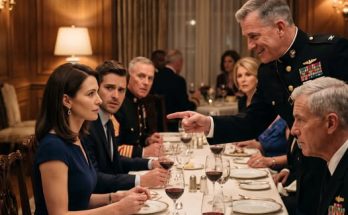
For the first time that evening, the question did not feel like a demand. Admiral Brooks had used almost exactly the same words Colonel Coleman had used seconds earlier, yet everything about them was different. Coleman had asked because he believed my silence proved weakness. William asked because he understood what the answer might cost.
The room waited.
Ethan remained half out of his chair.
Natalie’s eyes moved from her father to me.
Coleman wore the expression of a man expecting reinforcement.
He had misunderstood William as completely as he had misunderstood me.
I looked at the admiral.
He did not nod.
He did not encourage me.
He simply waited.
That mattered.
For months he had carried whatever recognition had passed across his face the first evening we met. He had never used it to impress his family. Never confronted me. Never hinted to Ethan. Never converted another person’s history into social currency.
He had given me privacy before I trusted him enough to ask for it.
That earned an answer.
I placed both hands flat beside my plate.
“Lantern.”
The word was not loud.
It did not need to be.
William’s expression changed instantly.
The tension around his mouth eased. Something older came into his eyes—memory, recognition, perhaps relief at finally confirming what he had suspected.
Across from me, Captain Reed looked up sharply.
Coleman did not move.
William repeated the name.
“Lantern.”
A silence followed that felt completely unlike the silence before.
Coleman’s eyebrows drew together.
I watched him search his memory.
At first there was nothing.
Then William gave him one more word.
“Meridian.”
The blood drained from Coleman’s face.
Not dramatically.
It simply left.
His mouth parted.
He looked at William, then at me, then back at William as though hoping he had misheard.
Captain Reed whispered something under his breath.
Natalie frowned.
Ethan looked entirely lost.
“What’s Meridian?” he asked.
No one answered him immediately.
Coleman’s glass remained suspended halfway above the table.
I knew exactly what had happened inside his mind.
Meridian had not been public in the way civilians understood publicity. There had been no television tour, no magazine feature, no photographs of my crew smiling beneath triumphant headlines.
Within naval aviation, however, the incident had traveled.
After-action reviews had been circulated.
Operational decisions examined.
Weather data reconstructed.
Fuel calculations debated.
Training officers argued over whether what we had done represented exceptional judgment or an unacceptable gamble that happened to succeed.
Senior officers knew the case.
Some Marines did too.
Coleman, apparently, was one of them.
He lowered his glass very slowly.
“No.”
It was nearly a whisper.
William watched him.
Coleman looked at me.
“You were Lantern?”
I said nothing.
The answer had already been given.
He leaned back as if physical distance might help him rearrange what he believed.
Ethan sat down again.
“Somebody please explain.”
Natalie nodded. “Preferably before Dad turns this into another mysterious-admiral moment.”
Margaret gave her daughter a warning look, but even she was watching William now.
William did not speak immediately.
His eyes remained on me.
“Claire?”
Permission.
Even now.
I appreciated it more than anyone else at the table could have known.
“You can tell them what’s already known,” I said.
His gaze stayed on mine for another second.
Then he turned toward his family.
“Meridian was an extraction operation several years ago.”
Coleman interrupted.
“It was more than an extraction.”
William looked at him.
The colonel fell silent.
William continued.
“Two naval officers ended up in the Atlantic after an operation failed.”
Ethan looked at me.
I kept my eyes on William.
“The weather deteriorated rapidly,” he said. “Visibility collapsed. Surface conditions became severe enough that locating two people in the water was becoming increasingly difficult.”
Captain Reed’s face had changed.
“When was this?”
William gave him the year.
Reed’s eyes narrowed.
“I remember hearing about that storm.”
“You should,” William said. “Several aircraft were redirected.”
Coleman spoke quietly.
“Because command considered the approach unsafe.”
There was no challenge in his voice now.
Only memory.
William turned slightly toward him.
“That was the assessment.”
Coleman rubbed a hand across his mouth.
“I saw part of the review.”
I had suspected as much.
His eyes returned to me.
“You were there?”
“Yes.”
“Which aircraft?”
I almost laughed.
The question was the same one he had demanded earlier.
Now it sounded entirely different.
Not accusatory.
Stunned.
I still did not answer.
William spared me from needing to.
“The platform isn’t relevant.”
Coleman nodded immediately.
That, more than his pale face, told me how completely the balance had changed.
Twenty minutes earlier he had argued that nothing I withheld could possibly matter.
Now one sentence from an admiral had taught him restraint.
I was not impressed.
Ethan looked at his father.
“What happened to the officers?”
William answered.
“They were weakening.”
His voice became quieter.
“By the time the final rescue window developed, they had been exposed long enough that waiting carried its own risk.”
I looked down at my hands.
One of them still remembered the controls.
That was absurd, of course. Muscle memory belonged to nerves and training, not to individual fingers.
Yet sometimes when I remembered Meridian, I felt the aircraft around me again.
The vibration through the seat.
Rain striking the windshield.
My gloves damp against my skin.
The cockpit filled with instrument glow while the world beyond the glass disappeared.
William kept speaking.
“A number of crews were available in the broader area. Conditions forced changes in the response.”
Coleman’s eyes closed briefly.
“We were told they’d been advised to hold.”
My head came up.
That distinction again.
Advised.
Not ordered.
William looked toward him.
“Yes.”
Coleman looked at me.
“You continued.”
I did not answer.
Because his wording was still wrong.
He must have recognized something in my face.
“You didn’t?”
“We didn’t simply continue.”
He waited.
The room did too.
I had not intended to tell any part of Meridian that evening.
Certainly not here.
Yet if William carried the story forward without me, it would become something happening around me again—a report, an analysis, a famous decision with the human parts stripped away.
So I spoke.
“We reached the point where waiting was also a decision.”
Ethan’s attention fixed on me.
I continued.
“The weather was getting worse. Fuel was not unlimited. The people in the water were not becoming stronger.”
Coleman swallowed.
“What guidance did you have?”
I looked at him.
“Enough to understand the risk.”
“Were you told to hold?”
“No.”
His eyebrows rose.
“We were advised to hold our position while conditions were reassessed.”
Coleman sat very still.
“That’s what the review said.”
“Yes.”
“But the recommendation—”
“Was a recommendation.”
William’s gaze shifted toward Coleman.
“You remember that now?”
The colonel nodded.
I saw the after-action report in his face.
Not the whole thing.
Fragments.
Maybe he had attended a briefing. Maybe he had reviewed operational decisions during joint training. Whatever the path, he had once known enough about Meridian to understand what Lantern meant.
He simply had never imagined the quiet woman beside Ethan Brooks could be that person.
That was the part he could not escape.
Natalie asked softly, “What did you do?”
I turned toward her.
Unlike Coleman, she was not asking for credentials.
She wanted to understand.
“We calculated how much time we had.”
“For what?”
“One attempt.”
Nobody moved.
“We had a narrow window where the aircraft, the fuel state, the weather, and the survivors’ condition gave us a chance.”
Ethan stared at me.
“You went in.”
I looked at him.
His expression contained fear about something already finished years ago.
That was why I had hated telling this story.
People heard the ending first.
Then they imagined courage where I remembered uncertainty.
“We made an approach.”
“That storm?” Reed asked.
“Yes.”
He shook his head slowly.
“Jesus.”
I disliked that reaction too.
Not because it was insulting.
Because it pulled us toward legend.
I wanted facts.
“We had a trained crew,” I said. “Nobody did anything alone.”
William nodded once.
Coleman looked down.
“What was visibility?”
“I’m not discussing the full operation.”
He accepted that instantly.
The irony was almost painful.
Twenty minutes earlier, he had insisted he deserved any harmless detail he requested.
Now he finally understood that whether information was harmless was not his decision.
Margaret spoke for the first time in several minutes.
“Were they rescued?”
I looked at her.
A mother asking whether two people came home.
Not an officer asking how.
That question I could answer.
“Yes.”
Her shoulders lowered.
“Both?”
“Yes.”
The table breathed again.
Ethan did not.
He was still looking at me.
I knew there would be another conversation after dinner.
Perhaps several.
The revelation had ended Coleman’s argument, but it had exposed how much of myself I had kept separate from the man sitting beside me.
I could not pretend otherwise.
Coleman rubbed his thumb along the edge of his napkin.
“The final approach.”
I stiffened.
He looked up.
“Who flew it?”
William answered before I could decide whether to.
“Lantern.”
Coleman stared at me.
I did not enjoy the recognition on his face.
It did not feel like victory.
If anything, it irritated me.
Five minutes earlier, I had been the same pilot.
Same training.
Same experience.
Same decisions.
Same person.
Nothing about me had changed except his information.
Yet now he looked at me with something approaching awe.
That was almost as uncomfortable as contempt.
“You were aircraft commander?” he asked.
“Yes.”
“And you made the approach?”
“Yes.”
He lowered his head.
“I didn’t know.”
William’s voice came from the head of the table.
“No.”
Coleman looked toward him.
William’s face was calm.
“You didn’t know.”
A pause.
“Because you never asked a question whose answer you were actually willing to hear.”
Coleman flinched.
Nobody rescued him from the sentence.
William continued.
“You made your conclusion first.”
Coleman’s eyes moved toward his plate.
“You spent the evening gathering reasons to protect that conclusion.”
“Bill—”
“No.”
The single word stopped him.
William rarely sounded angry.
That made the anger unmistakable.
“You served thirty-one years.”
Coleman’s shoulders stiffened.
“Yes.”
“You commanded Marines.”
“Yes.”
“You evaluated officers.”
“Yes.”
“Then you know the difference between verification and assumption.”
Coleman said nothing.
William leaned back.
“You did not verify Claire’s experience. You judged her appearance, her personality, and her unwillingness to satisfy your curiosity. Then you treated every boundary as evidence that your first impression was correct.”
The room remained silent.
I wished, suddenly, that the conversation would end.
Not because William was wrong.
Because humiliation was no better a teaching method when aimed in the opposite direction.
Coleman looked at me.
Whatever arrogance had carried him through dinner was gone.
“I owe you an apology.”
I raised one hand.
“Not tonight.”
He stopped.
“I mean it.”
“I believe you believe you mean it.”
His expression tightened with confusion.
I chose my words carefully.
“You doubted me when you thought nobody important knew who I was.”
He looked toward William.
Then back to me.
“Now an admiral has confirmed it, and suddenly you respect me.”
“That isn’t—”
“It is.”
He fell silent.
I continued.
“If your apology exists only because the audience changed, I don’t want it.”
His face reddened again, but for a different reason.
I was tired now.
Not angry.
Simply tired.
“Finish your dinner, Colonel.”
William looked at me.
Then he gave a small nod.
Not approval.
Understanding.
Conversation eventually restarted, though it moved cautiously at first.
Reed told a story about landing at the wrong airfield thirty years earlier. Natalie deliberately asked Margaret about dessert. Ethan kept his hand over mine beneath the table.
I let him.
But I could feel the questions in his fingers.
Later, when the candles had burned lower and guests began collecting coats, Coleman approached me once.
He stopped several feet away.
Not close enough to trap me in conversation.
“I heard you.”
That was all he said.
I nodded.
He left.
Outside, rain had started.
Ethan and I stood beneath the restaurant awning while cars hissed along the wet street.
For several seconds neither of us spoke.
Then he put both hands into his coat pockets.
“Meridian.”
I looked toward the traffic.
“Yes.”
“The mission my father knew about.”
“Yes.”
“You were the pilot.”
“Yes.”
He breathed out slowly.
I waited.
His voice, when it came, held no accusation.
That made it worse.
“Why didn’t you tell me?”
I turned toward him.
Inside the restaurant, Coleman’s interrogation had ended the moment my call sign became recognizable.
Outside, under cold rain and city light, I realized the harder interrogation had never belonged to him at all.
It belonged to the man I loved.
And this time, I did owe an answer.
Click here to continue reading: PART 5: Ethan Did Not Ask Whether Meridian Made Me Brave; He Asked Why I Had Trusted Him With Everything Except the Truth
The Quiet Detail in Ethan’s Family Dinner Invitation That Told Me His Father Had Already Recognized Something I Never Discussed
Part 4 of 16