I used to believe that being a good mother meant making the right sacrifices.
I believed that even when those sacrifices took me thousands of miles away from my child.
That belief lasted until three in the morning, when a telephone rang on my desk in Djibouti.
I was thirty-something hours into a stretch of work that had left me barely able to remember when I had last slept properly.
My name was Sarah Jenkins.
I was a captain in military intelligence, stationed at Camp Lemonnier.
My job was to notice things other people missed.
Small changes.
Unusual behavior.
Information that did not quite fit.
I had spent years learning how to recognize danger before it became obvious.
And somehow, while I was doing that work, I had failed to recognize what was happening inside my own daughter's home.
That is the part I still have trouble saying out loud.
My daughter, Maya, was nine years old.
She was living in Seattle with her father, David, and his new wife, Chloe.
I was supposed to be able to trust them.
At least, that was what I kept telling myself.
The night everything changed, I was sitting in an operations center surrounded by computers, radios, and people who looked as tired as I felt.
The air conditioning made a steady rattling noise.
Somewhere beyond the building, vehicles moved through the compound.
Inside, nobody was talking much.
We were all working.
My coffee had been sitting beside my keyboard for so long that a dark ring had formed around the inside of the mug.
I picked it up.
The coffee was cold.
I put it down without drinking.
Twenty minutes.
That was how much time I had left before I could step away and get some rest.
I remember looking at the clock and making that small calculation.
Twenty more minutes.
Then sleep.
It seems like such an ordinary thing to remember.
But I remember it because I had no idea how quickly an ordinary night could disappear.
I glanced toward the map on the wall.
Colored markers covered different locations.
Every marker represented something someone needed to monitor, understand, or prepare for.
I had been studying that map for hours.
I was good at my job.
I knew the difference between a routine development and something that demanded immediate attention.
I knew how to remain composed when information was incomplete.
I knew how to keep my voice steady when everyone around me was worried.
Those skills had taken years to develop.
None of them prepared me for the voice that came through the telephone.
The secure line on my desk started blinking.
I looked at it for a moment.
That line did not usually ring without a reason.
I assumed someone needed information about a deployment or a logistical problem.
Something I could handle.
Something with procedures and answers.
I lifted the receiver.
"Captain Jenkins."
There was a brief pause.
Then a man asked whether he was speaking to Sarah Jenkins.
I confirmed that he was.
His voice was controlled and professional.
He introduced himself as Dr. Aris Thorne.
He told me he was calling from Harborview Medical Center in Seattle.
I sat a little straighter.
Seattle.
That was the first thing I noticed.
Not his title.
Not the hospital.
The city.
The place where my daughter was supposed to be asleep.
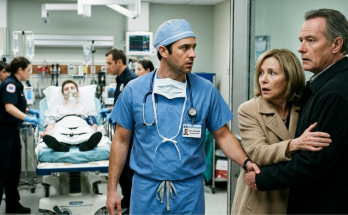
He explained that Maya had been brought into the pediatric emergency department.
For a moment, I did not understand the sentence.
I heard every word.
But I could not make them belong together.
Maya.
Emergency department.
Hospital.
I looked at the clock.
Three in the morning in Djibouti.
I tried to work out what time it was in Seattle.
My mind reached for that simple arithmetic because it was easier than thinking about why a hospital was calling me.
"Is my daughter alive?"
I had not planned to ask it that way.
The words came out before I could stop them.
The doctor answered immediately.
He said she was alive.
He said her condition was stable.
I closed my eyes.
Alive.
For one second, that was enough.
My hand relaxed around the telephone.
Then he continued.
Maya had a serious fracture involving her left wrist.
There was bruising along her forearm.
The medical team had stabilized the injury and was treating her pain.
I opened my eyes again.
A fracture.
My little girl had a broken bone.
I tried to picture her left wrist.
I thought of her small hands.
The way she held her pencils.
The way she wrapped both arms around that old stuffed elephant she refused to throw away.
I could see her fingers curled around its worn fabric.
And now someone was telling me her arm had been injured badly enough to require emergency treatment.
I swallowed.
"How did she get hurt?"
The doctor did not answer immediately.
Instead, he began explaining the injuries again.
I could hear the care in his voice.
He was choosing his words.
That frightened me more than if he had simply said what happened.
I knew what it meant when someone started choosing words carefully.
It meant the information was difficult.
It meant the next sentence mattered.
I leaned forward.
"Doctor, please. I need to know what happened."
He told me Maya was receiving care.
He assured me that she was being monitored.
Then he said something about the circumstances of her injury that made him concerned.
I stared at the wall.
I could hear another soldier moving a chair somewhere behind me.
Someone coughed.
A keyboard clicked.
The ordinary sounds of the room continued.
I wanted them to stop.
I wanted everyone and everything to be quiet until I understood what had happened to my child.
"Who brought her to the hospital?"
The doctor told me David had brought her in.
I felt another small wave of relief.
Her father was there.
That was good.
Wasn't it?
David knew her medical history.
He knew her allergies.
He knew how frightened she became around unfamiliar people when she was hurting.
He was her father.
I wanted to believe that meant she was not alone.
"Can you put him on the telephone?"
I asked that before I really thought about it.
I wanted to hear his explanation.
I wanted to know why he had not called me himself.
A hospital was telling me my daughter had a broken wrist.
My ex-husband had not even warned me.
The doctor hesitated.
Then he told me David was waiting outside the treatment area.
I frowned.
"Why isn't he with her?"
Another pause.
Not long.
Just long enough for my stomach to tighten.
The doctor explained that Maya had become extremely distressed when David tried to enter the room.
She had begged the staff not to let him inside.
I stopped moving.
The receiver was pressed against my ear.
My other hand rested on the desk.
I remember looking down and seeing my fingers spread across a sheet of paper.
I could not make them move.
"She doesn't want to see her father?"
The doctor confirmed it.
He said the staff was respecting her wishes while they assessed her safety.
I stared at the coffee mug.
There was a small mark on the side where the finish had chipped.
I had seen it hundreds of times.
Suddenly, I was looking at that tiny flaw as though it could explain something.
Maya loved David.
At least, she had when I left.
She had been excited about staying with him.
She had talked about the things they would do together.
She was nine.
She still believed adults were supposed to keep their promises.
And now she was lying in a hospital bed asking strangers to keep her father away.
I could not fit those two pictures together.
I tried.
I thought maybe she was confused.
Maybe the pain medication had frightened her.
Maybe something had happened on the way to the hospital.
Maybe there was an explanation I had not heard yet.
I wanted there to be one.
That is what I feel ashamed of now.
Not because I should have known everything immediately.
I couldn't.
But because even after hearing that Maya was frightened of her own father, part of me still wanted the situation to be something ordinary.
An accident.
A misunderstanding.
Anything that could be fixed with a conversation.
"Has she explained why she's afraid of him?"
The doctor did not answer that question directly.
He told me he wanted to discuss how Maya had been injured.
My mouth went dry.
I reached for my mug.
Then I stopped.
I had forgotten what I was doing.
He asked whether I understood that some injuries required medical staff to ask additional questions about a child's home.
I said yes.
Of course I understood.
I worked in a profession built around reports and investigations.
I knew there were procedures for situations involving possible harm.
But understanding a procedure and hearing it applied to your own daughter were two very different things.
I asked him to continue.
He took a breath.
I could hear it over the line.
Then he began telling me what Maya had said.
And for the first time that night, I realized the broken wrist was not the only thing I needed to be afraid of.
Click here to continue reading: PART 2: The Doctor Explained Why My Daughter Had Been Injured, and I Realized the Home I Trusted Had Become Her Nightmare
I Was Thousands of Miles Away When a Hospital Doctor Asked About My Daughter, and One Simple Question Changed Everything
Part 1 of 15