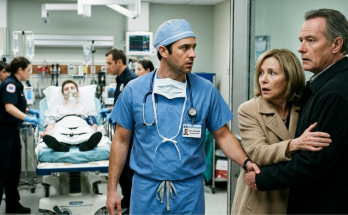
I used to think my father was a fair man.
That belief was difficult to let go of.
When I was growing up, I assumed his decisions came from experience.
If he sounded certain, I believed he had a reason.
If he told me something was wrong, I tried to correct it.
And when he was disappointed in me, I took it seriously.
That was why his rejection had hurt so much.
It wasn't simply an argument.
It felt like a judgment from someone whose opinion had shaped my childhood.
I had spent years carrying that judgment.
Even after becoming a doctor.
Even after marrying Clara.
Even after building a life I was proud of.
There was still a part of me that remembered my father telling me not to come back until I apologized.
I had replayed those words many times.
Sometimes I wondered whether I should have argued harder.
Sometimes I wondered whether I should have gone home and shown him the paperwork in person.
Sometimes I wondered whether I had sounded too emotional on the phone.
Looking back, those questions made me sad.
I had been caring for someone who was dying.
I had every reason to be emotional.
And I had already explained my situation.
I shouldn't have needed to defend my grief as though it were misconduct.
I thought about how my father behaved when he saw my badge.
He had looked stunned.
Then he began explaining.
Julian had told them I left medical school.
Julian had told them I was using drugs.
Julian had told them I was unstable.
Julian had told them I wasn't handling my responsibilities.
My father seemed to believe repeating those accusations explained everything.
But it didn't.
It only showed how much authority he had given my brother.
I remembered asking for proof.
He had none.
That was the moment something changed in me.
I had spent years wondering whether there was evidence I didn't know about.
Something Julian showed them.
Some misunderstanding that made my parents believe the worst.
But there was nothing.
No withdrawal notice.
No official letter.
No confirmation from the university.
My father had trusted Julian's story because he chose to.
And when I challenged that story, he refused to listen.
I thought about my mother.
She had been crying in the corridor.
She said they had worried about me.
I believed she might have been frightened by what Julian told her.
But she had still chosen not to hear me.
I had called from a hospital room.
I had explained that Sarah was seriously ill.
I had told them I was taking an approved leave.
I had offered proof.
My mother had responded with shame.
My father had responded by cutting me off.
I wondered how often they had remembered that conversation during the next five years.
Did they ever regret it?
Did they ever question Julian's account?
Did they ever wonder whether I was alive and well?
I couldn't answer those questions.
I didn't want to pretend I knew what happened inside their home.
But I knew what happened in mine.
I went through medical training without them.
I completed milestones without them.
I married Clara without them.
I kept trying to reach them.
And eventually I stopped expecting a reply.
That was the part of the story I understood completely.
I had lived it.
I thought about the messages I showed my parents.
The one before Sarah died.
The one about completing the first stage of my program.
The one about residency.
The one from my wedding morning.
I remembered my father's expression as he read.
He looked stunned.
As though he had never considered the possibility that I was telling the truth.
I wondered whether seeing those messages had forced him to reconsider the image of me he had carried for years.
I wasn't the irresponsible son Julian described.
I wasn't someone who had abandoned medical school.
I wasn't living in the way my parents had imagined.
I was standing in front of them wearing a surgeon's coat.
But I didn't want my success to become the only reason they changed their minds.
That would have hurt in a different way.
If I had failed to finish medical school, would I have deserved their love?
If I had struggled financially, would they have been justified in refusing to hear me?
If I had chosen another career, would that have made Julian's accusations acceptable?
Of course not.
I wanted my parents to understand that.
The problem wasn't that they underestimated my eventual success.
The problem was that they stopped treating me as someone worth listening to when they believed I was struggling.
I had needed them most when I seemed least impressive.
When I was exhausted.
When Sarah was dying.
When money was tight.
When my future was uncertain.
They had turned away.
Now they wanted to speak because the truth had arrived in a form they couldn't dismiss.
A badge.
An operating room.
A hospital full of people who knew me as a physician.
I didn't want to be cruel about that.
I knew they were frightened for Julian.
I knew seeing him injured had been terrible for them.
I understood the fear of losing someone.
But I couldn't allow that fear to erase their responsibility.
They had two sons.
Both mattered.
And for five years, they had treated one son's account as more important than the other's life.
I thought about my father's statement to Margaret Ellis.
That bothered me as much as the original accusation.
He had told the attorney I withdrew from medical school.
He had said I didn't want anything from Grandfather's estate.
He had spoken as though he knew my wishes.
But he hadn't spoken to me in years.
How could he possibly know what I wanted?
I had never authorized him to make that declaration.
I hadn't rejected my grandfather's gift.
I hadn't even known the medical trust existed.
Yet my father had attempted to explain my position to the person responsible for the estate.
I thought about how ordinary that might have seemed to him.
Perhaps he believed parents could speak for their children.
Perhaps he believed I had forfeited the right to be consulted because he thought I'd disappointed the family.
Perhaps he simply trusted Julian.
Whatever his reasoning, the effect was the same.
My own wishes had been replaced by someone else's assumption.
That was something I wasn't willing to accept again.
I had grown up.
I had made difficult decisions.
I had continued my education.
I had cared for Sarah.
I had built a marriage.
I had become responsible for patients whose lives depended on my judgment.
And I was still being treated as though someone else could decide what I believed.
I thought about the confrontation in Julian's ICU room.
My father had entered while Julian was trying to explain the safe.
Then he told him not to mention the inheritance.
I remembered turning toward him.
I had been stunned.
He had spent years refusing to listen to my explanations.
Now he was trying to control the information reaching me.
It was another version of the same behavior.
Deciding what I needed to know.
Deciding when I was allowed to know it.
Deciding which parts of the truth were acceptable to discuss.
I couldn't live with that anymore.
I wanted facts.
Not permission.
I wanted to know what Grandfather had left.
I wanted to know why Julian was managing the trust.
I wanted to know where the money went.
And I wanted to know what my father told the attorney.
Those were reasonable questions.
I didn't need to feel ashamed of asking them.
I thought about my father's tears.
He had cried when I described the wedding.
That memory remained difficult.
I wasn't used to seeing him vulnerable.
For a moment, I had felt an urge to reassure him.
To tell him I understood.
To say we could move forward.
I didn't act on it.
Not because I wanted him to suffer.
But because I knew how easily I could fall back into making myself responsible for his feelings.
My father was allowed to grieve what he had missed.
My mother was allowed to cry.
Julian was allowed to regret his actions.
But I didn't have to make those emotions disappear.
They weren't proof that I had been unkind.
They were consequences of what happened.
I thought about the empty chairs at my wedding.
I couldn't remember them without feeling something tighten in my chest.
Clara and I had been happy.
We were surrounded by the life we had chosen.
But there had been a place in my imagination where my family should have been.
I had wanted my father there.
I had wanted my mother there.
I had wanted Julian beside me.
Not because a wedding required those people to be meaningful.
But because I loved them.
Even after everything.
I had wanted to share that day with them.
They didn't come.
And now, five years after the beginning of our separation, they were finally learning Clara existed.
I thought about the message I sent that morning.
It was simple.
I told them I was getting married.
I told them her name.
I said she was wonderful.
I hoped we could someday be a family again.
That last sentence had been difficult to write.
I had worried it sounded desperate.
But I meant it.
I still wanted a family.
I just didn't understand then how much honesty would be necessary before we could have one again.
I thought about what reconciliation might require.
Not as a plan.
I wasn't ready for that.
But as a question.
Could I trust my father if he continued explaining everything through Julian?
Could I trust my mother if she was unwilling to acknowledge how she treated me?
Could I trust Julian if he said he was sorry but wouldn't fully account for the trust?
I didn't know.
And I didn't need to answer immediately.
For years, I had felt pressure to solve the situation.
To find the perfect message.
To choose the right words.
To become successful enough that my parents would reconsider.
Now I understood that repairing the relationship couldn't depend entirely on me.
They had to take responsibility too.
I could listen.
I could consider what they said.
I could decide what I was comfortable with.
But I couldn't manufacture trust where it had been broken.
I thought about Clara's advice.
She had said I didn't need to forgive simply because my family had found me.
That sentence stayed with me.
It wasn't an instruction to reject them forever.
It was permission not to rush.
And I needed that.
Because my family had already taken so much time from me.
I didn't want to lose more of my life trying to make decisions before I understood what had happened.
I thought about Grandfather.
He had wanted me to be a good person.
But he had also warned me against sacrificing everything to earn love.
I had spent years trying to prove I deserved my parents' approval.
I didn't want to spend the next five doing the same thing under a different name.
I could forgive someday.
Perhaps.
I could have a relationship with my parents again.
Possibly.
I could learn to speak with Julian without feeling betrayed.
I didn't know.
Those possibilities belonged to the future.
They weren't promises I owed anyone.
I looked at the evidence I already had.
The screenshots.
The confession.
The trust agreement Margaret described.
The transaction records she said were available.
And the letter addressed to me.
Each piece mattered.
But none of them required me to make an immediate emotional decision.
I was allowed to take time.
That seemed like such an ordinary idea.
Yet it felt unfamiliar.
I had been rushing for years.
Rushing to complete medical school.
Rushing to prove I hadn't failed.
Rushing to become someone my family might respect.
Even after saving Julian, I felt an urge to rush toward some kind of conclusion.
But I couldn't undo five years in a single conversation.
I couldn't rebuild trust because my mother cried.
I couldn't excuse the missing money because Julian was injured.
I couldn't pretend my father had been powerless when he chose to believe an accusation without proof.
I needed to let those facts remain.
I thought again about the moment I showed my parents the messages.
My mother had reached for my phone.
I pulled it away.
It was a small movement.
But I remembered why I did it.
Those messages belonged to me.
They were part of my history.
I had kept them through years of doubt.
I wasn't ready to hand them over simply because my parents finally wanted to examine the past.
I could show them the truth.
I didn't have to surrender control of it.
That distinction mattered.
I was beginning to understand that boundaries didn't need to be dramatic.
Sometimes they were simple.
A refusal to sign something without reading it.
A decision not to discuss family conflict during medical treatment.
A willingness to say I wasn't ready to forgive.
A choice to keep my own documents.
Small actions.
But necessary ones.
I looked at my father's last request in the hospital.
He had asked me not to make decisions that night.
At the time, I was angry.
I thought he wanted to delay responsibility.
Perhaps he did.
I couldn't know.
But I had eventually decided not to rush.
Not because my father asked.
Because I needed time.
That was an important difference.
For once, the decision belonged to me.
I wasn't waiting for his permission.
I wasn't looking for his approval.
I was choosing what I needed.
I thought about the meeting with Margaret.
The financial questions would be examined separately.
I would listen to what the documents showed.
I would ask the questions I needed answered.
And I wouldn't allow my family's feelings to replace the facts.
That was the decision I could make.
The rest would remain uncertain.
I had spent so long trying to be the son my parents wanted.
Now I was learning to be the man I already was.
I didn't need my father's agreement to know I had acted responsibly when Sarah was sick.
I didn't need my mother's approval to know my marriage mattered.
I didn't need Julian's admiration to know I had earned my profession.
And I didn't need anyone's permission to ask about the money my grandfather left for me.
Those things belonged to my life.
They were true before my parents saw my badge.
They remained true afterward.
I wished my father could understand that.
But I couldn't understand it for him.
Click here to continue reading: PART 12: I Had Saved My Brother’s Life and Learned Why He Destroyed Mine, but I Refused to Let His Confession Decide My Future
I Had Just Saved My Brother’s Life When My Parents Finally Realized the Son They Rejected Had Become a Surgeon
Part 11 of 15