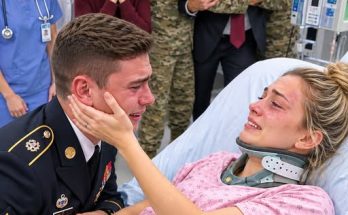
I had always believed that the people I loved were safer when I stayed away from them.
That was the lie I had been telling myself for twelve years.
My name was Elias Thorne.
I was a captain in the United States military, and most of my adult life had been spent in places I was not allowed to discuss.
I had learned how to sleep through gunfire.
I had learned how to recognize danger before another man even noticed something was wrong.
I had learned how to make decisions that would stay with me long after the mission ended.
But nobody had taught me what to do when the person in danger was my wife.
And I was thousands of miles away.
I was standing inside a C-130 Hercules when everything changed.
The aircraft shook beneath my boots.
Its engines filled the cabin with a steady roar that made ordinary conversation almost impossible.
Men sat along the walls, checking equipment or resting with their heads against the metal.
I had a photograph in my hand.
It was the same photograph I had been carrying since the day I left home.
My wife, Tessa, stood near a window with one hand resting over her stomach.
She was six months pregnant.
Her smile was small, but I knew it better than I knew my own reflection.
I remembered taking that photograph.
She had told me not to make her laugh because she was tired of having her picture taken.
Then she laughed anyway.
I kept that moment with me.
Not because I thought something terrible would happen.
Because it reminded me that there was a life waiting for me beyond the uniform.
Tessa was that life.
She had been patient with things most people would never have tolerated.
The missed dinners.
The unexplained departures.
The telephone calls that ended too quickly.
There were times when I could not tell her where I was going.
There were times when I could not tell her when I would return.
She never pretended those things were easy.
But she had never asked me to become somebody else.
I loved her for that.
And I loved the child we were waiting to meet.
Before Tessa, I had never imagined myself as a father.
I knew how to lead soldiers.
I knew how to keep people alive under terrible circumstances.
But the thought of holding a newborn made me nervous in a way combat never had.
Tessa found that amusing.
She had once watched me studying a small piece of baby furniture as though it were complicated military equipment.
"You look worried," she had said.
"I don't want to put it together wrong."
"It's a crib, Elias."
"That's exactly why I don't want to get it wrong."
She had smiled and placed my hand against her stomach.
For a moment, everything in my world had felt simple.
I was going to be a husband who came home.
I was going to be a father who stayed.
I believed I had time to learn.
That was another mistake.
The photograph moved slightly between my fingers as the aircraft shifted.
I looked at the edge of her wedding ring.
Then I thought about her family.
The Sterlings.
Even now, I could remember the first time Tessa brought me into their world.
The house had been larger than some government buildings I had entered.
Everything inside it seemed designed to remind visitors how wealthy the family was.
The floors shone.
The furniture looked expensive enough that nobody dared sit comfortably.
There were portraits on the walls, polished silver on the tables, and people who spoke quietly because they expected everyone to listen.
I had grown up in a different world.
That had never bothered me.
It bothered them.
Tessa's father, Silas Sterling, came from an old Boston family that treated its name like something sacred.
He measured people by what they owned.
He listened to introductions more carefully when they included a company, an estate, or a financial title.
A military rank meant very little to him.
Unless, of course, he needed somebody with one.
He had eight sons.
All eight had inherited his confidence.
And most had inherited his contempt for anyone outside their circle.
Caleb was the eldest.
He was the one who seemed most eager to prove that he deserved his father's approval.
He spoke over people.
He smiled when someone else was embarrassed.
He had a habit of looking at Tessa whenever Silas spoke, as though he expected her to agree with everything their father said.
She rarely did.
That made her different from the rest of them.
It also made her vulnerable in a way I did not fully understand until much later.
At our wedding rehearsal dinner, Silas had pulled me away from the other guests.
We stood near a quiet corner of the country club.
I remembered the smell of cigars.
I remembered the polished wooden walls.
And I remembered the way he studied my uniform.
He looked at it as though I had arrived wearing dirty work clothes.
"You should understand something before tomorrow," he told me.
I waited.
"Tessa was raised for a certain kind of life."
"I know that."
"Knowing it and belonging to it are different things."
He glanced toward the room where his family was gathered.
"My daughter can marry you. That doesn't make you one of us."
I looked at him for a moment.
"That's fine with me."
He seemed disappointed that I had not argued.
"Men like you usually think the uniform changes everything."
"I never said that."
"No. But you should remember your place."
I could have told him what I thought.
I could have explained that I had met men with nothing who possessed more integrity than anyone in that room.
I could have pointed out that the uniform he disliked represented responsibilities he had never been asked to carry.
But I did not.
Tessa was waiting for me.
And I had no interest in spending our wedding weekend arguing with her father.
So I walked away.
Looking back, I wish I had paid closer attention to what Silas was telling me.
He was not simply insulting me.
He was explaining the rules by which his family lived.
People belonged to them.
People obeyed them.
And anyone who refused was treated like an enemy.
Tessa had refused long before she married me.
I knew that much.
She had told me stories about growing up under Silas's control.
Most were told quietly.
Sometimes she stopped halfway through and changed the subject.
I had never pushed her.
I thought I was respecting her privacy.
There are things I regret about that now.
Not because I could have predicted every terrible thing that followed.
But because there were moments when her silence deserved more attention than I gave it.
After our wedding, I tried to keep my dealings with the Sterlings limited.
I was polite when politeness was necessary.
I attended the family gatherings Tessa wanted me to attend.
I ignored the comments about my salary and the long absences required by my work.
Sometimes Caleb would ask whether the military still provided housing for men who could not afford their own.
Sometimes one of his brothers would make a joke about government pay.
Silas usually smiled.
I rarely answered.
That seemed to irritate them more than an argument would have.
Tessa knew when I was angry.
She would touch my arm beneath the dinner table.
It was her way of telling me that we could leave whenever I wanted.
Most of the time, we did.
But pregnancy had complicated things.
Tessa wanted our child to know where she came from without being trapped by it.
She wanted to believe that becoming grandparents might soften her father.
I never shared that hope.
Still, I did not tell her what to believe.
She was my wife.
Not somebody I intended to control.
And I knew better than most that love and control were not the same thing.
That afternoon aboard the aircraft, I kept looking at the photograph.
I thought about the nursery.
I thought about the equipment I had installed there before leaving.
Three months earlier, I had fitted a discreet camera with a separate backup system.
It was not connected to the ordinary security arrangement used inside the Sterling estate.
I had done it because something about the family had always troubled me.
Their money could buy sophisticated security.
Their influence could make people reluctant to ask questions.
But I wanted one small part of Tessa's world protected by something they did not control.
I had told myself it was simply a precaution.
At the time, I did not imagine I would ever need the recordings.
Then the satellite phone attached to my vest began vibrating.
I glanced down.
It was an encrypted device used for communications that could not be handled through ordinary channels.
The incoming number appeared through a restricted routing system.
But I recognized enough of it.
Massachusetts General Hospital.
My first thought was that Tessa had gone into labor early.
I told myself there might be a complication.
Something the doctors could manage.
Something frightening but temporary.
I answered.
"Captain Thorne?"
A woman was speaking.
She sounded like a nurse who had delivered difficult news before.
"Yes."
"I'm calling about your wife."
I stood straighter.
"What happened?"
There was a short pause.
"She's still alive."
Those words stopped me.
Not because they answered my question.
Because they told me how close I was to hearing something worse.
"Tell me what's going on."
"She's in critical condition. The surgical team is working on her now."
I looked down at Tessa's photograph.
"What kind of injuries?"
"She suffered significant physical trauma."
My fingers tightened around the phone.
"Was there an accident?"
"I can't confirm the circumstances."
"Is the baby all right?"
The nurse did not answer immediately.
I heard movement behind her.
A voice.
The faint sound of hospital equipment.
Then she spoke again.
"Captain, you need to get here as soon as you can."
I had spent years learning how to keep my voice steady.
That training was all I had left at that moment.
"Please tell the doctors I'm coming."
"We'll let them know."
I ended the call.
The aircraft was still shaking.
The engines were still roaring.
Men were still sitting against the walls.
Nothing around me had changed.
But I could no longer feel the photograph in my hand.
I looked at it again.
Tessa's palm rested over the place where our child was growing.
I tried to remember the sound of her voice from our last conversation.
I remembered her asking whether I was eating properly.
I remembered telling her not to worry.
I remembered promising to come home.
I had made promises before going into dangerous places.
Some had been difficult to keep.
This one suddenly felt impossible.
I stood there for several seconds before I could move.
Then I began arranging my return.
I did not explain everything to the men around me.
I did not have to.
They had served beside me long enough to recognize the difference between urgency and panic.
What I felt was both.
I wanted answers.
I wanted to know who had been with Tessa.
I wanted to know why a hospital nurse had sounded relieved simply to tell me she was alive.
Most of all, I wanted to hear my wife speak.
The next fourteen hours passed slowly.
I sat aboard the flight carrying the photograph in both hands.
I could not sleep.
I could not eat.
Every time I closed my eyes, I saw Tessa standing by that window.
Then I imagined her on an operating table.
I had seen terrible injuries during my service.
I knew what the words physical trauma could mean.
That knowledge did not help.
It made the silence worse.
There was no call explaining that the surgery had gone well.
No reassuring message from Tessa.
No word from her father.
I found myself thinking about Silas.
About Caleb.
About the way they had watched me whenever I entered their home.
I had no proof that they were involved.
I understood that.
But I also knew Tessa had never been comfortable when she was alone with them.
I should have asked more questions.
That thought returned again and again.
I should have asked.
I should have stayed.
I should have noticed.
There was nothing useful I could do with those thoughts.
Not yet.
When the aircraft finally reached Andrews Air Force Base, I was already standing before it came to a complete stop.
I wanted to get to Boston.
I wanted to see the doctors myself.
I wanted one clear answer that did not leave me imagining the worst.
Then my phone sounded.
This time, it was not the hospital.
The message came from an unidentified sender.
Its routing information showed that it had passed through several servers before reaching me.
There was no explanation.
Only an image.
I opened it.
The picture appeared to have been taken from a hospital security camera.
I recognized the cafeteria.
I recognized the tables.
And I recognized the nine men sitting together.
Silas Sterling.
Caleb.
And Tessa's seven other brothers.
They were drinking coffee.
Several were leaning back in their chairs.
One of the brothers appeared to be laughing.
Silas looked relaxed.
Not worried.
Not exhausted.
Not like a man whose daughter was fighting for her life.
I stared at the picture.
I zoomed in on Caleb.
His mouth was open in a smile.
I could not hear what he was saying.
I could not know what had happened before the image was captured.
But I knew what I was looking at.
My wife's father and brothers were together in the hospital.
And not one of them appeared troubled by her condition.
I saved the image.
Then I put the phone away.
Until that moment, I had been afraid of what I would find when I reached Boston.
Now I was afraid of something else.
That I might already know.
Click here to continue reading: PART 2: I Walked Into My Wife’s Hospital Room Expecting an Accident, but Her Injuries and Her Family’s Behavior Told a Different Story
I Was Thousands of Miles From Home When a Hospital Nurse Called and Told Me My Pregnant Wife Was Fighting for Her Life
Part 1 of 15