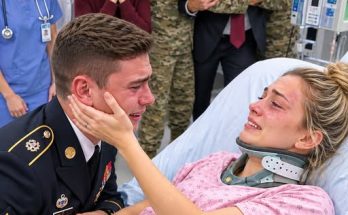
The letter stayed beside Tessa's bed.
Not inside the envelope.
Not hidden in a drawer.
She wanted it where she could see it.
Sometimes she asked me to read it again.
Sometimes she simply touched the folded paper.
I never asked why.
I understood enough.
For years, her mother had existed mostly in memories.
Small pieces of childhood.
A voice she struggled to remember.
The feeling of being held.
A few stories that came from people Tessa no longer trusted.
Now she had something written by her mother's own hand.
Words that had survived twenty-two years.
I watched her read them slowly.
She was getting stronger.
Not quickly.
But steadily.
Her voice was clearer.
Her eyes remained open longer.
She could speak with the doctors without becoming exhausted quite so easily.
There were still difficult days.
Sometimes pain interrupted her rest.
Sometimes she woke frightened.
Sometimes she cried without wanting to explain.
I had stopped asking her to make every feeling understandable.
She did not owe me that.
I was her husband.
My job was to stay.
One afternoon, she held the letter against the blanket and looked toward me.
"Do you think she knew what would happen?"
I moved my chair closer.
"Your mother?"
She nodded.
I considered the question.
"I think she knew your father was dangerous."
Tessa looked at the paper.
"But did she know he'd hurt me?"
I felt my jaw tighten.
"I don't know."
She stared at the handwriting.
"I remember being afraid when he raised his voice."
I waited.
She continued.
"I thought every family was like that."
I looked at her.
She gave a tired smile.
"Not exactly every family. But I thought it was normal to be careful all the time."
I remembered the estate.
The polished floors.
The expensive furniture.
The way everyone changed when Silas entered a room.
I had noticed it.
But I had not understood how deeply those habits were rooted.
Tessa looked at me.
"He could make everyone feel small."
I nodded.
"I saw that."
She lowered her eyes.
"My brothers learned from him."
I thought about Caleb.
His smile in the hospital corridor.
The bruises on his hand.
The way he had pointed at Silas when the recording was played.
"Yes," I said.
She was quiet.
Then she whispered, "I used to think one of them would stand up for me."
My chest tightened.
I did not interrupt.
She looked toward the window.
"Even after I married you."
I remembered family dinners.
Caleb speaking over her.
Silas making remarks about our marriage.
The other brothers laughing when they should have been ashamed.
I had been angry during those evenings.
But Tessa had been living with that behavior since childhood.
She had carried a different kind of disappointment.
I reached for her hand.
"You didn't deserve any of it."
She nodded faintly.
"I know."
Then she looked down.
"I'm trying to know."
I understood the difference.
It was easy to say something.
Harder to believe it after years of being taught the opposite.
I did not ask her to hurry.
We sat quietly.
The letter remained in her lap.
After a while, she looked at me.
"What happens to them now?"
I knew who she meant.
Silas.
Caleb.
The other seven brothers.
I had received another update from Reaper that morning.
The investigation was moving through the courts.
The evidence was extensive.
The family remained in federal custody.
Their financial position had continued collapsing.
I gave Tessa the simple version.
"They're still being held."
She watched me.
"All of them?"
"Yes."
"And the company?"
"Suspended from trading. The assets are being dealt with by the authorities."
She looked away.
I could see that the information affected her.
Not because she wanted the family protected.
But because the Sterling name had been part of her life since birth.
The estate.
The family business.
The expectations.
The rules.
They had all seemed permanent.
Now they were disappearing.
I wondered whether she felt relief.
Or grief.
Or both.
I did not ask her to choose.
After a while, she said, "I don't want to go back."
I looked at her.
"To the estate?"
She nodded.
"I don't want to see it."
I held her hand.
"Then we won't."
Her eyes filled.
"Can we really do that?"
The question made me sad.
She was an adult woman.
My wife.
A woman who had built a life with me.
And still, part of her needed permission to stay away from the place that had hurt her.
I leaned closer.
"Tessa, we can live wherever we choose."
She looked at me.
"Not there?"
"Never again, if that's what you want."
She closed her eyes.
Then she nodded.
"That's what I want."
I felt something settle inside me.
I had been thinking about leaving the military.
About building a different life.
Now the direction was becoming clearer.
We needed distance.
Not just from the Sterling estate.
From the world that had allowed Silas to control everything around him.
I wanted Tessa to wake up somewhere that did not remind her of her father.
Somewhere she could open a door without worrying who might be standing behind it.
Somewhere she could walk outside without seeing the family name on a building.
I thought about forests.
Quiet roads.
A place far from Boston.
The Pacific Northwest came to mind.
I had always liked the idea of living among trees.
A simple house.
Cool mornings.
Space.
Nothing grand.
Nothing intended to impress guests.
I did not tell Tessa every thought immediately.
She was still in the hospital.
She had more important things to manage than choosing a house.
But the idea stayed with me.
That evening, Reaper came to see us.
Tessa was awake when he entered.
He stopped near the door.
"How are you feeling?"
She looked at him.
"Tired."
He nodded.
"Fair enough."
A faint smile appeared on her face.
He looked relieved.
I noticed it.
Reaper was a man who rarely showed much emotion.
But he had been worried about her.
All of them had.
Tessa looked past him.
"Where's Viper?"
"Outside."
She nodded.
"Tell him thank you."
Reaper looked at her.
"For what?"
She glanced at me.
"For coming."
Reaper was quiet for a moment.
Then he nodded.
"We weren't going to leave Elias alone."
Her eyes filled.
"I know."
He stayed only a few minutes.
After he left, Tessa looked at me.
"They're good men."
I nodded.
"The best."
She studied my face.
"You're going to miss them."
I knew what she meant.
I had not spoken much about leaving the military since our first conversation.
But she had not forgotten.
I looked toward the door.
"Yes."
She waited.
I continued.
"More than I can explain."
She reached for my hand.
"Then are you sure?"
I looked at her.
"I've been thinking about it every day."
"And?"
I took a breath.
"I think it's time."
She was quiet.
I watched her expression.
I knew she was trying to understand what the decision meant.
For our marriage.
For my life.
For the men who had served beside me.
I had spent twelve years building a career around service and danger.
Leaving was not something I could do lightly.
But every time I imagined returning to that life, I pictured Tessa alone in another hospital room.
I knew that fear could not be the only reason.
I had to decide what I wanted.
Not simply what I wanted to avoid.
And the answer was becoming clear.
I wanted to stay with my wife.
I wanted to help her recover.
I wanted a home where her father's power had no place.
I wanted to learn how to live without constantly preparing for the next deployment.
Tessa looked at me.
"You don't have to stop protecting people."
I almost smiled.
"What do you mean?"
She looked toward the door.
"You've always cared about people who couldn't defend themselves."
I thought about my work.
About the missions.
About the people we had tried to bring home.
I nodded.
"That's true."
She continued.
"Maybe that part of you doesn't have to end."
I looked at her for a long moment.
I had been treating the decision as though there were only two choices.
Remain a soldier.
Or stop being the man I had become.
Tessa was suggesting something different.
That the uniform was not the source of everything I valued.
It had given me training.
Discipline.
Experience.
But the desire to protect people had existed before I wore it.
I looked at her.
"Maybe you're right."
She gave a tired smile.
"That happens."
I laughed quietly.
It surprised me.
The sound felt strange.
But good.
For a moment, we were simply husband and wife again.
Not a captain and a patient.
Not survivors of a family tragedy.
Just Elias and Tessa.
I held on to that moment.
Several days later, I began the formal process of leaving the service.
I made the necessary contacts.
I spoke with the people who needed to know.
I understood that my responsibilities could not be abandoned without arrangements.
There were procedures.
Decisions.
Conversations I had expected to have much later in life.
I approached them carefully.
But I no longer felt uncertain about the direction.
The hardest conversation was with Reaper and Viper.
We spoke privately near the hospital.
Neither man seemed surprised.
I looked at them.
"I'm going to resign."
Reaper nodded slowly.
Viper remained quiet.
I continued.
"I've spent a lot of time thinking about it."
Reaper looked toward the hospital.
"Because of Tessa?"
"Partly."
I looked at both men.
"But also because I know I can't keep living as though there's always going to be another chance to come home."
Viper lowered his eyes.
He understood.
We had lost enough people to know that tomorrow was never guaranteed.
Reaper looked at me.
"You've earned the right to choose."
I swallowed.
I had not expected that sentence to affect me.
For years, I had carried responsibility for men who trusted my judgment.
Now one of those men was telling me that leaving did not erase what we had shared.
I looked down.
"I don't want you thinking I'm walking away from you."
Reaper shook his head.
"We know better."
Viper stepped closer.
"You're still one of us."
I looked at him.
He nodded once.
That was enough.
We did not need a long speech.
We had spent years proving what we meant to one another.
Words were useful.
But they were not the foundation.
I returned to Tessa's room that evening.
She was sitting slightly more upright.
The doctors had been pleased with her progress.
She looked toward me.
"How did it go?"
I sat beside her.
"They understand."
She studied my face.
"Are you okay?"
I thought about the question.
For once, I did not answer automatically.
"I'm sad."
She nodded.
"I know."
"But I'm sure."
She reached for my hand.
I took it.
We sat quietly.
After a while, she looked toward the photograph.
Then toward her mother's letter.
Both rested on the table.
One represented the future we had lost.
The other represented a past she was only beginning to understand.
I looked at them too.
For years, Silas had tried to decide what kind of life Tessa deserved.
He had believed his family name gave him that right.
Now she was making her own decisions.
She was choosing not to return.
Choosing to keep her mother's words.
Choosing to face recovery at her own pace.
And I was choosing to remain beside her.
There was still grief.
There would always be grief.
But something else had begun appearing alongside it.
The possibility of a future.
Not the future we had planned.
Not the one represented by the photograph.
A different one.
One we would have to build carefully.
I looked at Tessa.
"When you're ready, I'd like us to find somewhere quiet."
She watched me.
"How quiet?"
I smiled faintly.
"Trees. A small house. Nobody dropping in without asking."
She thought about that.
Then she nodded.
"That sounds nice."
I held her hand.
"We don't have to rush."
"I know."
She looked toward the window.
"Somewhere far away?"
"Far enough."
She closed her eyes.
For a moment, I thought she had fallen asleep.
Then she whispered, "I'd like that."
I sat beside her until the evening light faded.
The military had shaped twelve years of my life.
The Sterling family had taken something from us that could never be restored.
But neither would decide every year that followed.
That was the choice I had finally made.
Click here to continue reading: PART 12: Six Months After the Hospital Call, We Found a Quiet Home Among Pacific Northwest Pines and Built a Memorial for the Child We Never Held
I Was Thousands of Miles From Home When a Hospital Nurse Called and Told Me My Pregnant Wife Was Fighting for Her Life
Part 11 of 15