I sat with Walt's letter resting beneath my hands.
Robert Ellis had finished explaining the most important documents.
The original deed.
The water survey.
The conservation agreement.
And the questionable authorization submitted by Greenfield Holdings.
I understood more than I had when I first entered his office.
But understanding the papers did not make my heart feel any lighter.
I had spent most of my life believing that family was the place where a person could feel safe.
Now I was afraid of what my own daughter might have done.
That was difficult to admit.
Even to myself.
I looked at the envelope Walt had left.
For eight years, it had remained unopened in the bottom drawer of our wooden cabinet.
I had believed there was nothing inside that I urgently needed.
I had been wrong.
And I wondered how many other things I had misunderstood simply because I trusted the people around me.
Robert moved the original deed closer.
I recognized the signatures.
Mine.
And Walt's.
There was comfort in seeing them together.
Those names represented a decision we had made as husband and wife.
We wanted a farm.
We wanted a home.
We wanted somewhere to raise our family.
Neither of us had imagined that our land would one day stand in the middle of a proposed commercial development.
We certainly hadn't imagined that our daughter might become involved in an effort to obtain it without my consent.
I ran a finger along the edge of the document.
“Walt would have hated this.”
Robert looked at me.
“He cared deeply about that property.”
“He cared about Amanda too.”
My voice became quieter.
“That's the part I can't stop thinking about.”
Robert waited.
I appreciated that he didn't rush to offer an explanation.
There wasn't one.
Not an easy one.
I remembered Amanda as a little girl running between the farmhouse and the barn.
She had always been curious.
She wanted to know what Walt was repairing.
She wanted to know why the creek rose after heavy rain.
She wanted to help me in the kitchen.
Sometimes her help made more work.
I never minded.
I liked having her beside me.
When I baked apple pies, she always appeared before they were ready.
She would ask whether she could have a piece.
I would tell her to wait.
Then she would ask again.
Walt used to laugh when he heard us.
He said she had inherited his impatience.
I thought about that now.
Amanda had always wanted things quickly.
But there was a difference between wanting something and believing another person had no right to refuse it.
Somewhere along the way, she had stopped seeing that difference.
I looked at Robert.
“She knew I didn't want to sell.”
He nodded.
“She admitted it herself.”
I paused.
“And she went ahead anyway.”
I remembered our midnight telephone conversation.
Amanda had been crying.
She told me Daniel was furious.
She said he believed I had damaged everything they had worked toward.
At first, I wondered whether I had misunderstood her.
Then she admitted that she had known about the document bearing my signature.
She knew I hadn't agreed to sell.
She knew Daniel was using her position in acquisitions to support Greenfield Holdings.
Those admissions had changed everything.
Before that call, I had still been searching for an innocent explanation.
A mistake.
A misunderstanding.
A badly entered record.
But Amanda had known what I wanted.
She simply believed that what she and Daniel wanted was more important.
I looked down.
For a moment, I felt angry with myself.
I had allowed her to speak for me for years.
Not about the farm at first.
About small things.
What I should wear.
What I should discuss.
How I should behave around her friends.
Whether my stories about farming were interesting enough.
I had treated those moments as unimportant.
I told myself she was trying to succeed professionally.
I didn't want to make her uncomfortable.
I didn't want to become the mother who embarrassed her daughter.
So I stayed quiet.
At family dinners, when she corrected a word I had used, I smiled.
When she suggested I avoid talking about livestock or the fields, I changed the subject.
When she introduced me as someone who lived out in the country, I pretended not to hear the difference in her tone.
I had become skilled at pretending.
That realization ashamed me.
Not because I was responsible for her later choices.
I wasn't.
But because I had spent years making myself smaller to keep her comfortable.
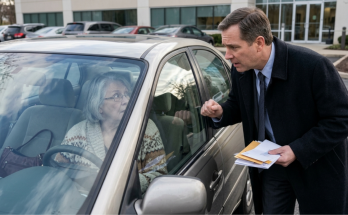
I thought about the parking lot.
Forty minutes.
My daughter had told me that her boss disliked older people.
I believed her.
I sat inside the car because I didn't want to cause trouble.
I remember looking at the glass doors.
People were entering freely.
They belonged there.
I believed I did not.
Then Tom Harlan recognized me.
And suddenly I was invited upstairs.
The receptionist stood when we entered.
Tom arranged a conference room.
He asked whether I wanted coffee or water.
He made it clear that I had a right to participate in the discussion.
I wasn't being treated as an inconvenience anymore.
The contrast still hurt.
I looked at Robert.
“I think Amanda was afraid I'd speak for myself.”
I stopped.
That was my interpretation.
I couldn't know every thought inside her head.
But I knew the effect of my presence.
Once I entered that building, the company's records began to unravel.
Tom asked why I hadn't accepted an offer.
I told him I had no intention of selling.
The system said something different.
It said I had agreed to two million dollars.
I hadn't.
The file said three meetings had been completed.
They hadn't.
The notes suggested Amanda could negotiate for me.
She couldn't.
And another document appeared in an application submitted by her husband's company.
A document that supposedly carried my authorization.
I had never knowingly given it.
I remembered the silence in that room.
Amanda had looked at the table.
She adjusted her coffee-stained blouse.
She tried to explain the entries.
But every explanation raised another question.
I wasn't pleased to see her frightened.
I was her mother.
Part of me wanted to reach across the table and comfort her.
That instinct was still there.
Even after everything.
But another part of me understood that comforting Amanda could not mean agreeing with what she had done.
I looked toward the conservation agreement.
Walt had made a difficult decision years earlier.
He had refused to sell the water rights.
He understood how valuable the aquifer might become.
He also understood that industrial development could damage it.
He chose protection over immediate profit.
And he arranged for that choice to remain important after his death.
I thought about what Amanda had chosen.
She wanted money.
Daniel wanted his investment to succeed.
They wanted to retire early.
They wanted relief from their financial worries.
I could understand wanting those things.
Walt and I had worried about money too.
There were years when every expense mattered.
We had worked additional hours.
We had postponed purchases.
We had sold our old pickup to help pay Amanda's university costs.
We knew what financial pressure felt like.
But we had never believed those pressures gave us the right to take what belonged to someone else.
I looked at my husband's signature.
He had taught Amanda that lesson.
Or at least he had tried.
I remembered him repairing equipment for neighboring farmers so she could have an expensive car at seventeen.
He worked three extra months.
He never complained.
He wanted to help her.
But he earned the money.
He didn't take it from someone else.
That difference seemed painfully important now.
I looked at Robert.
“Daniel promised investors the land would become available.”
Robert listened.
“That's what Amanda told me.”
I shook my head.
“He didn't own it.”
I waited.
“He couldn't promise it.”
There was nothing complicated about that.
The legal documents were complicated.
The groundwater restrictions were complicated.
The proposed development was complicated.
But ownership was not.
The farm belonged to me.
I had not agreed to sell.
And neither my daughter nor her husband had authority to change that fact simply by making promises.
I thought about the five-million-dollar offer.
For a moment in Tom's conference room, the amount had nearly taken my breath away.
I had never expected to see a number like that attached to our farm.
I understood what it could provide.
Security.
Comfort.
Medical care.
A different kind of future.
But I also understood what accepting an outright sale might take away.
The farmhouse.
The apple trees.
The barn.
The bridge Walt built in 1982.
The creek he had spent years protecting.
I wasn't prepared to trade those things for money.
Not because the money was unimportant.
Because it wasn't the life I wanted.
Amanda had called that emotional.
Maybe it was.
I didn't care anymore.
A home was supposed to mean something.
I looked at the map of the aquifer.
The water beneath our land reached beyond our boundaries.
The recharge area was especially important.
Robert had explained how rainfall and surface water filtered into the underground system.
He had shown me the restrictions Walt helped establish.
And he had explained that the conservation organization could seek enforcement if activities threatened the protected resource.
That changed how I understood our property.
Walt had not been protecting only our memories.
He had been protecting water that could matter to other people too.
I wondered what he would have thought about Tom's partnership proposal.
He might have considered it.
Tom had suggested redesigning part of the project.
Keeping the farmhouse.
Maintaining access to the old road.
Protecting the creek.
Possibly preserving the barn after an engineering assessment.
Those were ideas worth examining.
But they were not agreements.
And they were not guarantees.
I had learned to be careful with that distinction.
Amanda had treated a possible future sale as a certainty.
Daniel had apparently done the same.
I refused to let another possibility become a promise I never made.
I looked at Robert.
“If Tom sends plans, I want them reviewed.”
He nodded.
“I don't want anyone assuming that means I've agreed.”
“I understand.”
“And I want the conservation agreement respected.”
He agreed.
I looked down at Walt's letter.
My husband had wanted me to speak to Robert before signing anything.
He had wanted the water rights understood.
He had also directed Robert to contact Edward Mercer if anyone tried to obtain the farm through deception.
I was grateful for those instructions.
But I still felt sad that he had needed to leave them.
Walt must have understood how valuable the land might become.
He must have recognized the pressure that could follow.
I wished he had told me everything while he was alive.
Then I reminded myself that he had left me the means to learn.
That mattered.
I didn't need to know every answer immediately.
I needed to ask the right questions.
I needed to preserve the records.
I needed to refuse unauthorized transactions.
And I needed to stop allowing Amanda's opinion of my abilities to become my own.
I looked at the disputed signature.
It still frightened me.
Robert had identified differences.
But a qualified examiner would be needed to establish what those differences meant.
We also needed to determine whether I had signed anything at Amanda's house under a false explanation.
Those were matters for evidence.
Not guesses.
I had spent years trusting family without asking questions.
Now I was learning to ask questions without feeling guilty.
I looked at Robert.
“I don't want to hurt Amanda.”
My voice shook.
“But I won't let her decisions take away my home.”
He listened quietly.
I felt tears gathering.
I didn't wipe them away immediately.
For once, I wasn't embarrassed to let someone see that I was upset.
I was a mother who loved her daughter.
I was also a widow protecting the life she had built with her husband.
Those two truths existed together.
I did not have to abandon one to honor the other.
I looked at Walt's letter again.
He had trusted me to protect what mattered.
I had spent too long believing that protecting Amanda meant giving her whatever she wanted.
Now I understood that sometimes love required a refusal.
A clear one.
Without excuses.
Without apologies for having a life of my own.
I folded the letter carefully.
I had not stopped loving my daughter.
But I had stopped allowing that love to serve as permission.
Click here to continue reading: PART 14: The Water Beneath Our Farm Was Worth More Than I Had Imagined, but It Was Not the Most Important Thing Walt Left Me
My Daughter Wanted Me Out of Sight at Her Office, but the Man Who Ran the Company Had Other Ideas
Part 13 of 15