I had spent most of my life trying to keep our family together.
When Walt was alive, that seemed simple enough.
We worked.
We raised Amanda.
We worried about ordinary things.
Money.
Repairs.
School.
The weather.
We had disagreements, but there was always a home to return to.
After he died, I tried to keep that home open.
I wanted Amanda and Daniel to know they were welcome.
I wanted the kitchen table to remain a place where our family could sit together.
I wanted the farm to feel like part of their lives.
Instead, I learned that they had been making plans involving the property without my permission.
That realization changed how I understood our relationship.
It didn't erase my love.
I wished it had been that simple.
Love remained.
So did disappointment.
And the disappointment was heavier than I expected.
I sat across from Robert Ellis with Walt's letter in front of me.
The morning had been full of explanations.
The aquifer.
The conservation agreement.
The original deed.
The document submitted by Greenfield Holdings.
The historical records held by Edward Mercer.
I had learned enough to understand that the situation was serious.
But there were still facts that needed to be established.
I knew that.
I wasn't looking for Robert to promise an easy ending.
I wanted an honest one.
I looked at the disputed signature.
It was almost like mine.
Not quite.
That small difference had frightened me from the first moment I saw it.
I remembered standing in Tom Harlan's conference room.
My purse was in my hand.
I had been preparing to leave.
Then Tom called me back.
He explained that Greenfield Holdings had submitted a document apparently containing my authorization.
I walked back to the table.
I looked at the signature.
And I saw the date.
Three months earlier.
The same period when I had been recovering from my fall.
I remembered staying at Amanda's house.
I remembered Daniel bringing papers.
I remembered trusting him.
That memory was still painful.
Not because I had been careless about money.
Because I had been careless with trust.
I had assumed that my daughter's husband would never put something harmful in front of me.
I had assumed that being family meant I was safe.
Now I knew that assumption had to be questioned.
I looked at Robert.
“I still don't understand how someone could do this to a person who trusted them.”
He didn't offer an explanation for Daniel's behavior.
He couldn't.
We had not established every fact.
We knew Daniel managed Greenfield Holdings.
We knew the company had submitted an application involving my property.
We knew the document bore a suspicious signature.
And we knew Amanda had admitted being aware of the situation.
But we did not yet know exactly how the disputed signature had been produced.
Robert had been clear about that.
A qualified examiner was needed.
The circumstances surrounding the paperwork had to be examined.
The company's claims needed to be compared with the authority I had actually granted.
I understood why those steps mattered.
I wanted the truth.
Not a story that simply made me feel better.
I looked toward the original deed.
Walt's name was beside mine.
Our signatures had been placed there willingly.
We understood what the document meant.
We were buying the land that would become our home.
I remembered how proud Walt had been.
He didn't make a grand speech.
That wasn't his way.
He talked about the work ahead.
The fences.
The barn.
The fields.
He was already thinking about what needed doing.
I smiled at the memory.
I had spent fifty years beside that man.
I knew his habits.
His worries.
His stubbornness.
His quiet kindness.
He was not perfect.
Neither was I.
But he understood the difference between making a promise and merely hoping something would happen.
If Walt gave his word, he worked to keep it.
That was why the Greenfield Holdings application upset me so much.
Daniel had promised investors that the farm would become available.
According to Amanda, he had borrowed money and invested heavily.
He had made plans based on a property he didn't own.
And my daughter had helped him while working on the acquisition for Tom's company.
I wondered how they had convinced themselves that this was acceptable.
Perhaps they thought I would eventually agree.
Amanda said as much.
Perhaps they believed the money would change my mind.
Perhaps they thought I was too old to understand what was happening.
I couldn't know every reason.
But I knew the result.
They had tried to move forward without my consent.
I looked at Robert.
“Whatever Daniel promised those investors, I didn't promise it.”
He nodded.
“And whatever Amanda told her company, I didn't authorize her to negotiate for me.”
I paused.
“I want that understood.”
The words were simple.
But saying them helped.
I was not responsible for the promises they made.
I was not responsible for the financial risks Daniel chose to take.
And I was not obligated to give up my home to rescue their plans.
I thought about Amanda's midnight telephone call.
Her voice had been shaking.
She said Daniel was angry.
He believed I had embarrassed him.
I remembered how strange that sounded.
He had apparently placed his financial future on a transaction that depended on my agreement.
Yet when the truth began to emerge, he was angry with me.
I had not created that problem.
I had merely refused to cooperate.
I looked down at my hands.
For years, I would have worried about how to make Amanda feel better.
I would have asked what she needed.
I would have looked for a way to help.
I might have told myself that family came first.
But I finally understood that helping someone did not require accepting responsibility for their dishonesty.
I could love Amanda.
I could be sad for her.
I could hope she made better decisions.
But I could not agree to a sale simply because she and Daniel wanted one.
That was a boundary I had never needed to state so clearly before.
Now I did.
I thought about the five-million-dollar offer.
Tom had placed the proposal in front of me.
Amanda could hardly believe I refused.
She treated the amount as though it should settle every question.
But money couldn't replace the farmhouse.
It couldn't replace the years Walt spent building the barn.
It couldn't replace the apple trees.
It couldn't replace the bridge he built in 1982.
It couldn't replace the sound of the creek outside our home.
Those things belonged to a life I had chosen.
I wasn't willing to abandon that life simply because someone else believed I should.
Robert had also explained that the underground water rights might be more valuable than the land itself.
That information mattered.
It meant the five-million-dollar offer did not necessarily represent everything of financial importance.
But the water's value was not the main reason I wanted to protect it.
Walt had understood its importance long before the development company became interested.
He had attended county meetings in 1998.
He had learned about the aquifer.
He had refused to sell the water rights.
And he had helped establish conservation protections.
I looked at the map again.
The protected recharge area was beneath our farm.
The underground water system extended into neighboring properties.
The creek and natural drainage were connected to it.
I had walked above that water for decades without understanding what lay beneath.
Walt had known.
And he had acted.
I thought about his old arguments with the county.
At the time, I sometimes wished he would leave the matter alone.
He came home tired.
He worried about drainage.
He talked about industrial contamination.
He spent money repairing the creek bank.
I thought he was being stubborn.
Now I understood that he had been looking beyond our immediate needs.
He wanted to protect something that could matter long after we were both gone.
I felt proud of him.
And sad that I had not understood sooner.
I looked at Robert.
“The conservation agreement still matters, even if someone purchases nearby land?”
He confirmed that the recorded protections would need to be respected.
The organization could seek enforcement if activities threatened the protected resource or violated the agreement.
That did not guarantee that no development would ever occur.
It meant any proposed development had to account for the restrictions.
I understood.
I wasn't asking Robert to tell me that the entire county would remain unchanged.
I knew better.
The highway had already changed the area.
Businesses were expanding.
People wanted new places to work and shop.
But change did not have to mean ignoring legal protections.
And it did not have to mean taking my home.
I thought about Tom's alternative proposal.
A partnership.
He had suggested redesigning part of the development.
Preserving the farmhouse.
Maintaining access to the old road.
Protecting the creek.
Possibly keeping the barn after an engineering assessment.
Those ideas were worth examining.
They were not promises.
They were not completed plans.
And I had not accepted them.
I wanted that distinction to remain clear.
I looked at Robert.
“If Tom's company presents a proper plan, I may be willing to review it.”
He listened.
“But only with legal advice.”
I paused.
“And only if the water protections are respected.”
That was my position.
I wasn't agreeing to sell.
I wasn't agreeing to transfer development rights.
I wasn't agreeing to a partnership.
I was simply willing to examine a proposal that recognized what mattered to me.
I thought that was reasonable.
More importantly, it was my decision.
Not Amanda's.
Not Daniel's.
Not Tom's.
Mine.
I looked at Walt's letter.
He had left instructions that seemed almost impossible to ignore now.
He warned me that someone might try to obtain the farm.
He directed me to Robert.
He told me to ask about the water rights.
And he reminded me that growing older did not make me powerless.
I had spent the previous two days learning how much truth there was in those words.
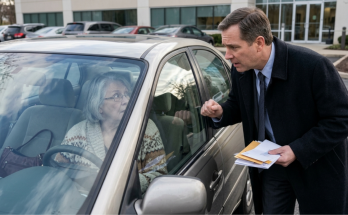
Amanda made me sit in the car because she claimed her employer didn't want elderly people around.
She tried to explain my presence when Tom recognized me.
She suggested that my age made business decisions difficult.
But none of those things changed my rights.
I still owned the farm.
I still had the right to refuse an offer.
I still had the right to choose legal representation.
And I still had the right to demand that questionable documents be examined.
I looked at Robert.
“I want to make sure I'm not overlooking anything important.”
He understood.
We had already identified the major issues.
The disputed signature required professional examination.
The Greenfield Holdings application needed careful review.
The unauthorized entries in the acquisition file had to be accounted for.
And Walt's recorded conservation protections needed to be understood before any development proposal could be considered.
Those matters were not finished.
I knew that.
I wasn't going to pretend they were.
I wanted certainty.
But I had learned that pretending to have an answer could be more dangerous than admitting there were still questions.
Amanda had made that mistake.
She treated my possible agreement as though it had already happened.
Daniel had made promises based on a sale he did not control.
I would not repeat their errors by pretending the investigation was complete.
I looked at the original deed again.
Our farm was still the property I had come to Robert to protect.
No document we had examined established that I had knowingly agreed to the sale Amanda wanted.
The Greenfield Holdings filing raised serious questions, but filing a document did not automatically mean a valid transfer had occurred.
Those facts gave me some comfort.
Not complete comfort.
The legal questions remained.
And my relationship with Amanda had changed.
I couldn't deny either truth.
I thought about calling her.
Part of me wanted to hear her voice.
I wanted to ask whether she had eaten.
Whether she had slept.
Whether she was frightened.
Those were ordinary questions a mother asks.
I had asked them for years.
But I didn't reach for the telephone.
We had already spoken.
She had admitted what she knew.
She had apologized.
And I had told her to obtain legal advice.
There was nothing more I could responsibly promise her.
I couldn't make Daniel's debts disappear.
I couldn't undo the company records.
I couldn't give her reassurance that everything would be all right.
I didn't know that it would.
I looked at Walt's photograph in my memory.
The one on our mantel.
I could picture his face clearly.
He had a way of looking at me when he knew I was worrying too much.
He would listen.
Then he would ask what actually needed to be done.
I had spent eight years missing that question.
Now I could ask it myself.
What needed to be done?
The records needed to be preserved.
The disputed document needed examination.
The conservation agreement needed to be respected.
Any future proposal needed proper review.
And I needed to keep making decisions for myself.
Those were things I could understand.
They were things I could insist upon.
I didn't need a dramatic speech.
I didn't need to shout at Amanda.
I didn't need to threaten anyone.
I only needed to stop giving my consent where it had not been earned.
I thought again about the wooden cabinet.
Walt had built it to hold our important papers.
For years, it had seemed like an ordinary piece of furniture.
Now I understood why he valued records so much.
A memory could be questioned.
A conversation could be misrepresented.
A promise could be denied.
But a properly preserved document could show what had actually been agreed.
The deed showed our ownership.
The conservation agreement showed the protections Walt arranged.
The company's records showed the statements made about me.
And the disputed signature showed why the facts needed investigation.
Those papers did not answer every question.
But they gave us a way to ask the right ones.
I looked at Robert.
“I don't want anyone to think I'm making this decision because I'm angry.”
He listened.
“I am angry.”
I paused.
“But that's not the reason I'm refusing to sell.”
I looked at the map.
“I wanted to keep the farm before I knew about Greenfield Holdings.”
That mattered.
My wishes had not changed because I discovered my daughter's deception.
I had always wanted to remain at home.
I had always wanted the creek protected.
I had always wanted to keep the place Walt and I built.
I was not refusing a sale as punishment.
I was refusing because the land was not something I wanted to give up.
And I could not agree to a partnership without understanding its terms.
I looked at the signature on the original deed.
I remembered how hopeful we had been when we bought the farm.
We had no idea what the next fifty years would bring.
There were difficult times.
There were good times.
There were years when money was scarce.
There were years when the harvest was better.
We raised Amanda.
We grew older.
And then Walt died.
Through all of it, the farm remained part of our lives.
I had not expected to spend my later years defending it from decisions made by my own family.
But I could not choose the circumstances.
I could choose my response.
I had been hurt.
I had been frightened.
I had learned things about Amanda and Daniel that I wished were not true.
Those discoveries had consequences for our trust.
I couldn't pretend otherwise.
But I had also learned things about Walt.
I discovered how carefully he protected the aquifer.
I discovered the lasting importance of the 1999 agreement.
I discovered why he wanted Robert Ellis involved.
And I learned that Edward Mercer still held historical records connected to the county survey.
I had once thought Walt's envelope was simply another sentimental precaution.
Now I knew it contained information I needed.
I looked down at his handwriting.
For a moment, I wanted to cry again.
Not because of Amanda.
Because I missed him.
I missed the man who believed the barn would outlast us.
I missed the man who spent his own money repairing the creek bank.
I missed the man who knew that a home could be worth protecting even when someone offered more money than we had ever imagined.
I folded the letter carefully.
I didn't know whether Amanda and I would ever return to the closeness we once had.
I didn't know what would happen to Daniel's investment.
I didn't know how the questions about the disputed signature would ultimately be resolved.
And I didn't know whether Tom's company could design a project that respected the restrictions and allowed me to remain at home.
Those questions were still open.
I would not manufacture answers just to make the situation seem finished.
But the decision I had come to make was settled.
I would not sell my eighty acres simply because someone else needed them.
I would not accept an unauthorized agreement as my own.
I would not allow my daughter or her husband to speak for me without permission.
And I would not abandon the protections Walt had spent so many years establishing.
I looked at Robert one final time.
“I want the farm protected, and I want every document examined properly.”
He understood.
I gathered Walt's papers.
The old deed.
The survey map.
The letter.
The instructions that had brought me there.
For the first time, I didn't feel ashamed that I needed help understanding some of them.
Walt had needed attorneys too.
He had needed surveyors.
He had needed people who understood the underground water system.
Asking for help had not made him powerless.
And it did not make me powerless.
I thought about the woman I had been in the parking lot.
She had stayed in the car because her daughter told her to.
She had been afraid of embarrassing someone.
She had believed her age made her less welcome.
I wished I could speak to that woman now.
I would tell her that the glass doors were not the problem.
The problem was believing she needed permission to walk through them.
Tom Harlan had recognized me because my land mattered to his company.
But I did not need five million dollars or eighty acres to deserve respect.
I had deserved it before he knew who I was.
I had deserved it while I sat in the car.
And I deserved it now.
I looked at Walt's name one last time.
He had left me a farm.
He had left me records.
He had left me the means to defend what we had built.
But the most important thing he had left was a reminder that I still had a voice.
I was old enough to know what I loved.
Old enough to understand what I wanted.
And old enough to recognize when someone was trying to make a decision that belonged to me.
I loved Amanda.
That had not changed.
But I was no longer willing to confuse loving my daughter with surrendering my home.
The farm was still mine.
The water still needed protection.
And my answer to an outright sale was still no.
For the first time since my daughter made me wait outside her office, I felt no need to apologize for that answer.
The End
Read more original stories on readdramaus.
My Daughter Wanted Me Out of Sight at Her Office, but the Man Who Ran the Company Had Other Ideas
Part 15 of 15