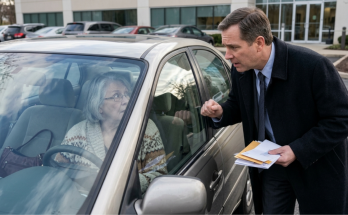
I thought about the aquifer all the way through the conversation with Robert.
It was strange to discover something so important about land I had lived on for fifty years.
The water had always been there.
Beneath the fields.
Beneath the soil.
Connected to the creek that ran through our property.
Walt had known.
I had not.
For a while, that made me feel foolish.
Then I remembered that my husband hadn't known everything when we first started farming either.
He learned.
He listened.
He attended meetings.
He asked questions.
And when the county began studying underground water supplies in 1998, he paid attention.
I could do the same.
I looked at the map again.
The aquifer extended beneath several neighboring properties.
But the most important protected recharge area was beneath our farm.
That explained why the location mattered.
It also explained why the eighty acres could not simply be treated like an empty piece of ground beside a highway.
I traced the edge of the shaded section with my eyes.
I knew those fields.
I knew where the creek ran.
I knew the old road.
I knew where Walt had spent hours repairing a damaged bank after a flood.
But I had never looked at those places as parts of a water system.
Now they seemed connected in a way I couldn't ignore.
I looked at Robert.
“Walt was worried about what people might build over the water.”
He nodded.
“That was an important part of his concern.”
I thought about the county meetings.
He had come home angry so many evenings.
I remembered him standing in the kitchen with muddy boots.
He would talk about drainage.
About what the county wanted.
About the way officials discussed the land.
Sometimes I listened carefully.
Sometimes I was preparing supper and thinking about the next day's work.
I had not understood how much was at stake.
I regretted that now.
But I couldn't change the past.
I could only understand the records he left.
I looked toward the agreement dated 1999.
The document had three parties.
Walt.
The county.
And a local conservation organization.
My husband had donated a narrow strip of land along the creek.
The strip included the banks, mature trees, and an access path.
He had also arranged protections that could be enforced if activity threatened the water.
That was the part I kept returning to.
Walt had understood that his own refusal might not be enough forever.
One day he would be gone.
Someone else might own the property.
The county might grow.
Businesses might want the land.
So he helped establish protections that would continue after him.
I wished he could know how grateful I was.
I looked at Robert.
“Could this agreement really make a difference if a company wanted to build there?”
He explained that its restrictions mattered.
A development that violated them could be challenged.
But the existence of the agreement did not mean every possible project was prohibited.
That distinction was important.
I had no desire to turn the farm into a battleground simply because other people wanted to build nearby.
I understood that towns changed.
Roads expanded.
Businesses opened.
People needed work.
But development had to respect the protections already recorded.
And any arrangement involving my property had to respect my rights as its owner.
I looked at the map.
There was no reason those two principles had to contradict each other.
A responsible project could be examined.
An unsuitable project could be refused.
That was what Tom's partnership suggestion had made me consider.
I had not expected him to offer another possibility after I rejected five million dollars.
I expected him to be frustrated.
Perhaps angry.
Instead, he spoke about redesigning the eastern section of the development.
He mentioned preserving the farmhouse.
Keeping the old road accessible.
Creating protected green space near the creek.
And examining whether the barn could remain.
I remembered how I leaned forward when he mentioned the possibility.
For the first time that morning, someone was discussing a future that did not require me to leave my home.
I wasn't ready to agree.
But I was willing to look at plans.
I thought about how different that was from Amanda's approach.
She had begun with the assumption that I should sell.
When I refused, she called me emotional.
When the company records were questioned, she tried to explain the unauthorized entries.
And when Greenfield Holdings appeared, she admitted that she and Daniel had kept the situation from me because they knew I would reject it.
I sat quietly.
The contrast was painful.
A company president who wanted my land had been willing to listen to my refusal.
My daughter had not.
I didn't mistake Tom's politeness for a guarantee.
He still had a substantial financial interest in the project.
His company had invested more than seventy million dollars in surrounding properties, planning, and infrastructure.
They needed my eighty acres for their original design.
He had good reasons to keep talking.
I understood that.
But I also understood that honest negotiation required recognizing the other person's right to say no.
Tom had done that during the meeting.
Amanda had tried to remove that right from the discussion.
I looked at Robert.
“I don't want to refuse every conversation just because I'm frightened.”
He listened.
“But I'm not going to agree to anything without knowing what it means.”
“That is a sensible distinction.”
I nodded.
I was beginning to trust my own judgment again.
Not because I suddenly understood every legal term.
I didn't.
But because I knew what questions mattered.
Would the creek remain protected?
Would the recharge area be affected?
What restrictions applied to the land?
Could the farmhouse remain?
What would happen to the barn?
Would the old road still provide access?
And what rights, if any, would I be asked to transfer?
Those were questions I could ask.
I didn't need Amanda to ask them for me.
I thought about the five-million-dollar proposal again.
It had been a remarkable offer.
More money than Walt and I had ever imagined.
But Robert had explained that the water rights could be worth considerably more than the land itself to certain buyers.
That changed the context.
It did not automatically establish a precise value.
Robert had been careful about that.
He had said the value would require analysis.
But the aquifer made the property more complicated than a simple acreage calculation.
I appreciated that he hadn't tried to replace one enormous number with another.
I had already seen what happened when people became too focused on money.
Daniel had borrowed.
He had promised investors the land would become available.
Amanda had helped him while working for another company.
And now their plans were threatened because I had refused to cooperate.
I didn't want to become another person who let a large number make every decision.
I wanted to think about what the farm was.
And what it meant.
I remembered our first years there.
Walt and I were young enough to believe we could work forever.
We made plans.
We changed them when money was tight.
We repaired things instead of replacing them.
We learned what the land needed.
There were difficult seasons.
There were disappointments.
But the farm remained our home.
When Amanda was born, it became the place where we raised her.
I remembered her running through the kitchen.
I remembered the bicycle.
I remembered Walt jumping into the pond to pull her out.
I remembered her standing near the apple trees.
There had been a time when the farm was her favorite place.
I wondered whether she remembered that.
I wondered whether she thought about the pond when she entered the false acquisition records.
Or whether she remembered her father teaching Daniel about the old tractor.
I couldn't know.
Perhaps she had convinced herself that selling the land would be good for everyone.
Perhaps Daniel had convinced her that their financial future depended on it.
I had heard her explanation.
They needed money.
They wanted to retire early.
Daniel had made commitments to investors.
But those reasons didn't make the records truthful.
They didn't turn an unauthorized statement into permission.
And they didn't make the disputed signature valid.
I looked at the Greenfield Holdings application.
It still lay among the documents Robert had reviewed.
My name appeared on it.
The date corresponded to the period after my fall.
I remembered Daniel placing papers before me.
I remembered him describing them as medical and insurance documents.
I remembered signing where he indicated.
But I had never knowingly authorized a transfer of development rights.
That was the truth I could state.
I didn't need to add anything to it.
Robert had explained the need for a qualified document examination.
The signature looked suspicious.
There were inconsistencies in the letter formation.
The writing pressure appeared different.
But we needed evidence before drawing a final conclusion.
I respected that.
I wanted the facts established properly.
I did not want anyone able to dismiss my concerns because I had made accusations I couldn't support.
I looked at Robert.
“I want to be careful about what I say.”
He nodded.
“I know what I agreed to. And I know what I didn't.”
I paused.
“But I don't know exactly how that signature got there.”
That was the honest position.
It was enough to justify asking questions.
It was enough to justify reviewing the document.
And it was enough to refuse any claim that I had authorized Greenfield Holdings to proceed.
I thought about the original deed.
Walt and I had signed it together.
We understood what we were doing.
We wanted the farm.
We intended to live there.
We intended to work the land.
That signature represented a choice.
The Greenfield Holdings document did not represent a choice I remembered making.
The difference mattered to me.
I looked at Walt's letter.
His instructions had been clear.
Speak to Robert.
Ask about the water rights.
Do not sign anything without understanding what was happening.
And do not allow age to become a reason for surrendering control.
I had followed those instructions as soon as I discovered the envelope.
I wished I had opened it earlier.
But I was grateful that I had opened it when I did.
It had changed the way I understood the entire situation.
Before, I thought the dispute concerned a valuable piece of land.
Now I knew it involved a protected underground water resource.
Before, I thought Amanda was simply pressuring me to accept an offer.
Now I knew she had made unauthorized statements in company records.
Before, I believed Daniel was uninvolved in the acquisition.
Now I knew he was the registered managing director of Greenfield Holdings.
Before, I thought my age made me an embarrassment to Amanda at work.
Now I understood that my presence exposed information her employer had not been receiving directly from me.
Those were painful discoveries.
But they were necessary.
I looked at Robert.
“I want Edward Mercer's records considered.”
He agreed that the historic county documents were relevant.
I thought about the retired attorney.
He had represented the county during the survey.
He knew something about the original arrangements.
And Walt had specifically wanted him involved if the land became the subject of deceptive efforts.
I did not know what additional details his copies contained.
I wasn't going to imagine an answer.
I had learned the importance of staying with what the records actually showed.
I looked at the conservation agreement.
It showed Walt had taken steps to protect the creek and underground water.
It showed another organization had rights concerning activities that threatened the protected resource.
It showed that the farm could not be treated as an unrestricted parcel simply because someone wanted to purchase it.
Those were significant facts.
They gave me a clearer understanding of my position.
They also gave me a responsibility.
I could not ignore the water protections simply because someone offered more money.
I thought about the possibility of a partnership.
If the actual plans respected those protections, I could consider them.
If they did not, I had no reason to accept.
That was a decision I could make without guilt.
I looked at Robert.
“Walt didn't keep those records because he wanted somebody to pay him more.”
Robert listened.
“He kept them because he cared what happened to the water.”
I looked down at the map.
“And I think I finally understand that.”
For years, I believed the most important thing Walt left me was the farmhouse.
Then I thought it was the farm itself.
Now I understood that he had left something else.
A way to protect what mattered.
A record of his decisions.
And an example of how to stand firm without needing to shout.
I folded his letter.
I wasn't ready to sell.
I wasn't ready to agree to a partnership.
And I wasn't ready to accept Amanda's apology as an explanation for everything she had done.
But I was ready to examine the truth without looking away.
For the first time since the parking lot, that felt like progress.
Click here to continue reading: PART 15: I Could Not Undo My Daughter’s Betrayal, but Walt’s Final Instructions Helped Me Decide What Would Happen to Our Farm
My Daughter Wanted Me Out of Sight at Her Office, but the Man Who Ran the Company Had Other Ideas
Part 14 of 15