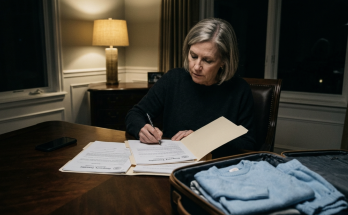
Thomas Cole had been dead six years.
That was the first fact Martin gave us.
He remained seated in the sealed conference room, staring at the old photograph as though someone had removed the floor beneath him.
“My brother died in a boating accident,” he said.
Judge Ortega did not answer immediately.
Martin looked up.
“Didn’t he?”
Ortega closed the file.
“I don’t know.”
The words sounded worse than an accusation.
Martin’s attorney placed a hand on his arm.
“Do not speculate.”
“I’m not speculating.” Martin looked at Ortega. “You put a photograph of my dead brother beside Victor Harrow and Richard Sloan. I want to know why.”
“So do federal investigators.”
“You knew Thomas?”
“Yes.”
“How?”
“Through the Harrow warrant proceedings.”
Martin stood.
His attorney whispered, “Sit down.”
He did not.
“My brother was a tax attorney.”
“He also represented one of the shell companies used by Harrow’s network.”
Martin stared at him.
“No.”
Ortega’s expression remained steady.
“Yes.”
“Thomas never practiced criminal law.”
“He did not need to. The company retained him for tax structuring.”
Martin looked toward me.
I had no help to offer.
This was the point every family reaches when secrets outlive the people who kept them.
Arthur.
Sloan.
Thomas Cole.
Each dead.
Each carrying part of the same story.
Judge Ortega continued.
“Eight years ago, before the Harrow case became public, federal investigators identified several companies moving procurement proceeds through private accounts. Arthur Vance discovered one of those channels intersected with property he intended to purchase.”
“AV-17,” I said.
“Yes.”
“Arthur created it?”
“With Sloan’s knowledge.”
“Pierce said that too.”
Ortega nodded.
“The purpose was to isolate a transfer and identify who came to recover it.”
“But no one did.”
“No.”
“Why?”
Ortega looked at Martin.
“Because Thomas Cole warned them.”
Martin sat down.
His face emptied.
“My brother?”
“We believed so.”
“Believed?”
“There was never enough admissible evidence to charge him.”
Martin shook his head.
“You’re saying Thomas leaked a federal operation to Harrow?”
“I’m saying the recovery attempt stopped immediately after Thomas learned his client’s accounts were under scrutiny.”
“That proves nothing.”
“No.”
“Then why is he in the photograph?”
“Because Arthur confronted him.”
Martin stared.
“What happened?”
“I don’t know exactly.”
“Convenient.”
His attorney warned him quietly.
Martin ignored it.
“Thomas died six years ago. If you knew any of this, why did no one tell me?”
“Because there was no charge.”
“He was my brother.”
“That does not create a right to sealed investigative information.”
Martin pushed back from the table.
I understood his anger.
It did not matter that Ortega was legally correct.
There are facts people cannot hear as procedure.
Sarah asked, “How does this connect to the letter Arthur intended for Claire?”
Ortega looked toward me.
“Arthur became convinced Sloan was corrupt.”
“Pierce said the same.”
“Yes.”
“What made Arthur suspect him?”
“Money moved from AV-17 without authorization.”
“To Sloan?”
“Indirectly.”
“How?”
Ortega shook his head.
“That portion came from Arthur, not from evidence I could independently verify.”
“Tell me anyway.”
He hesitated.
“Arthur said Sloan demanded that he keep the account open after Harrow’s arrest.”
“For what purpose?”
“He believed Sloan was using the account to receive payments from someone connected to Harrow.”
“Thomas?”
“Possibly.”
“Judge Victor?”
Ortega’s face tightened.
Sarah looked at me.
I continued.
“Pierce says JV in the ledger meant Judge Victor.”
Martin looked confused.
Ortega looked almost tired.
“It did.”
I felt my shoulders tense.
“You?”
“No.”
“Then who?”
“A man named Victor James.”
Silence.
I exhaled slowly.
Pierce had given us a nickname and attached it to the wrong person.
“Who was Victor James?”
“A procurement judge advocate assigned to contract review.”
Military.
That explained why Arthur thought I might eventually become involved.
“Was he investigated?”
“Yes.”
“Charged?”
“No.”
“Why?”
“He disappeared.”
“When?”
“Two weeks after Harrow was sentenced.”
“Alive?”
“Unknown.”
Grant had not told me that.
Probably because he did not yet know.
Or because this segment sat under another agency’s jurisdiction.
“What was James suspected of doing?”
“Selling internal information.”
“To Harrow?”
“Yes.”
“And Sloan?”
“Possibly.”
Martin asked, “Thomas?”
Ortega looked at him.
“Possibly.”
Martin sat back.
For a moment, grief altered his face more than fear.
I realized something uncomfortable.
Martin had entered Evelyn’s case aggressively because he believed he was handling an ordinary family dispute.
Lang’s referral had come through Harrow.
Harrow had used Martin’s firm.
Perhaps because Martin was Thomas Cole’s brother.
Perhaps because someone expected Martin’s name to open doors Thomas once used.
Or perhaps because someone wanted Martin implicated if the scheme surfaced.
“Why did you intercept Arthur’s letter?” I asked.
Ortega folded his hands.
“Because Sloan brought it to me.”
That surprised everyone.
“Sloan told you Arthur wanted me to have it.”
“Yes.”
“And you took it.”
“Yes.”
“Why?”
“Because three days earlier, Victor James disappeared.”
The room remained still.
“At the time,” Ortega continued, “we believed someone was removing anyone connected to the leak.”
“Removing?”
“Intimidating. Bribing. Possibly worse.”
“Was Thomas already dead?”
“No.”
“When did he die?”
“Eleven months later.”
Martin looked toward the photograph again.
Ortega continued.
“Arthur’s letter named Sloan and James. It also named someone inside Vance Maritime who had preserved records.”
“Pierce.”
“Yes.”
“If the letter had reached me…”
“You would have been required to report it.”
“I would have.”
“And that would have created new records showing Arthur, Pierce, and you were connected.”
“You thought that put me at risk.”
“Yes.”
“You made that decision for me.”
“Yes.”
Anger came slowly.
Cleanly.
“You had no right.”
“No.”
The answer stopped me.
Ortega did not defend himself.
“I believed I was protecting an active prosecutor,” he said. “But I also protected an investigation that later died because evidence disappeared. I have spent years wondering whether those were the same decision.”
I looked at him.
“Where is the letter?”
His expression shifted.
“I gave it back to Sloan.”
Sarah exhaled.
“Who is now dead.”
“Yes.”
“Did you copy it?”
“No.”
“Did you record its contents?”
“Only in sealed notes.”
“Where?”
He looked toward his file.
“Those notes were removed from the archive five years ago.”
The same archive Lang had tried to access.
Everything connected.
Not cleanly.
But enough.
“Who could remove them?” I asked.
“Someone with judicial archive credentials or administrative access.”
“Victor James?”
“He had military credentials, not court credentials.”
“Sloan?”
“Possibly.”
“Thomas Cole?”
“No.”
“Harrow?”
“No.”
“Then who?”
Ortega’s expression hardened.
“That is the question I should have forced seven years ago.”
The sealed conference ended with his formal recusal.
The case would be reassigned.
Evelyn’s remaining property claim would continue under a different judge unless she dismissed it.
Outside the courthouse, Martin stood alone near the steps.
His attorney had gone to retrieve the car.
I would have walked past him.
He spoke first.
“Colonel.”
I stopped.
“I owe you something.”
“If you mean an apology, save it until this is over.”
His mouth tightened.
“Fair.”
He looked toward the street.
“I hired Lang.”
“Yes.”
“I believed his work because some of it seemed to confirm what Mrs. Vance told me.”
“Yes.”
“I did not scrutinize his referral because it came through a corporate contact who invoked my brother’s name.”
“Harrow.”
“Yes.”
“That should concern you.”
“It does.”
He turned toward me.
“I spent six years believing Thomas died because he drank too much on a boat.”
“What do investigators think?”
“I don’t know yet.”
“Then don’t replace one certainty with another.”
He gave a bitter laugh.
“You really are a prosecutor.”
“I was trained not to fall in love with theories.”
“Useful skill.”
“It would have been useful to you before filing forged evidence.”
He nodded once.
“I deserved that.”
My phone rang.
Grant.
I answered.
“We found something,” he said.
“Where?”
“Sloan’s house.”
“What?”
“A safe-deposit key.”
I stepped away from Martin.
“Bank?”
“Yes.”
“Have you opened it?”
“Warrant just cleared.”
“What did you find?”
“Arthur’s letter.”
My pulse stopped for half a beat.
“Intact?”
“Yes.”
“To me?”
“Your full name is on the envelope.”
I closed my eyes.
Seven years.
A letter written for me had passed through Sloan, Ortega, and back into Sloan’s possession, then sat hidden while Harrow went to prison, Arthur died, Thomas Cole died, and Julian bought Vance Maritime.
“What does it say?”
“Come read it yourself.”
An hour later, I sat inside the federal office with the original envelope beneath clear protective film.
The handwriting was angular.
Old-fashioned.
CLAIRE BENNETT.
No rank.
No title.
Just my name.
Grant opened the scanned copy on a monitor.
The letter was only two pages.
Arthur began without greeting.
He wrote that if I was reading it, then either the Harrow prosecution had ended or the people who compromised it had failed to stop him.
He described AV-17.
He named Sloan.
Victor James.
Thomas Cole.
He wrote that Donald Pierce had preserved the financial originals.
Then came the paragraph that made every other line secondary.
I read it twice.
Grant watched me.
“What?”
I pointed.
Arthur claimed the person who first alerted him to the fraud was not Sloan.
It was someone inside Harrow’s network.
Someone who later asked Arthur to create AV-17.
Someone Arthur described only by initials.
E.V.
I stared at those letters.
Sarah leaned closer.
“No.”
Grant said nothing.
I kept reading.
Arthur had written:
E.V. believed Harrow would destroy her son if she refused to cooperate.
Her son.
My throat tightened.
There was only one E.V. in this family whose son connected directly to Arthur’s world.
Evelyn Vance.
I read the next paragraph.
Arthur claimed Evelyn had known about Harrow’s network seven years earlier.
She had secretly warned Arthur.
Then begged him never to tell Julian.
I looked at Grant.
“Evelyn knew.”
He nodded.
“Looks that way.”
“No.”
I shook my head.
“She didn’t recognize Harrow’s name in court.”
“Maybe she lied.”
“Or Arthur did.”
“Possible.”
I read the final lines.
Arthur wrote that Evelyn was not involved in the fraud.
She had been trying to protect Julian from someone who wanted access to the Vance family companies.
Then one final sentence:
If Evelyn denies any of this, ask her what happened at the Harbor House on March 14.
I knew the Harbor House.
A private restaurant near the marina.
Julian’s parents used to dine there.
March 14.
Seven years earlier.
I took out my phone.
Sarah stopped me.
“Claire.”
“I’m not calling.”
“Good.”
I searched my old calendar.
March 14.
Seven years earlier.
I had been in court on the Harrow case that morning.
That evening, my calendar showed one personal entry.
DINNER—JULIAN + EVELYN—HARBOR HOUSE, 7:30.
I stared at it.
I had been there.
Not just Evelyn.
Not just Julian.
Me.
And I remembered nothing unusual.
Then slowly, one detail returned.
A man had approached our table near the end of dinner.
Evelyn had gone pale.
She introduced him as an old family acquaintance.
He shook Julian’s hand.
Ignored me.
And before leaving, he leaned down beside Evelyn and said something too softly for the rest of us to hear.
I had forgotten his face.
But I remembered his name.
Victor.
Click here to continue reading: PART 9: The Harbor House Memory Returned in Pieces, and Evelyn Finally Admitted Why Victor James Terrified Her That Night
The Lawsuit Arrived at Breakfast, and My Mother-in-Law Was Certain I Would Be Too Frightened to Fight Her
Part 8 of 18