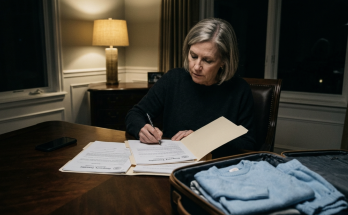
Evelyn came to my house without calling.
At 6:40 the next evening, headlights swept across the living-room wall, followed by three firm knocks.
I checked the camera before opening the door.
She stood alone.
No Julian.
No lawyer.
No pearl earrings.
That last detail struck me as strangely significant.
Evelyn always wore pearls when she expected confrontation.
I opened the door but did not invite her in immediately.
“We need to talk.”
“That sentence has not gone well for either of us lately.”
“Please.”
The word sounded unfamiliar in her voice.
I stepped aside.
She walked into the living room and remained standing until I pointed toward a chair.
Even then, she perched on the edge.
“What did Julian tell you?”
“Ask Julian.”
“I did.”
“And?”
“He told me I misunderstood.”
“That sounds like him.”
Her eyes sharpened, but only briefly.
“He said he gave me the documents because he was scared you knew something about Arthur’s company.”
“Yes.”
Evelyn stared at the floor.
“I thought he was protecting the family.”
“He was protecting himself.”
“I know that now.”
I studied her.
It would have been easy to enjoy the moment.
For years, Evelyn had treated me as the person complicating her son’s life.
Now she had discovered he had manipulated her.
But vindication is rarely as satisfying when the person across from you looks genuinely wounded.
“He told me there was missing money,” she said.
“There was money connected to Arthur.”
“He said you had taken it.”
“I didn’t.”
“I know.”
That made me pause.
“You know?”
“Martin showed me the bank records.”
“When?”
“This morning.”
“And?”
“The money I accused you of taking came from accounts you funded.”
“Yes.”
Her mouth tightened.
“I was wrong.”
Not sorry.
Not yet.
But wrong.
From Evelyn, it was a beginning.
She clasped her hands.
“Did Arthur do something criminal?”
“I don’t know.”
“You prosecuted that Harrow man.”
“Yes.”
“And Arthur received money from him?”
“Arthur controlled a company that received funds tied to the fraud.”
“Does that mean he knew?”
“No.”
“Could he have known?”
“Yes.”
She flinched.
Arthur had been a difficult man, but Evelyn had respected him.
Not affectionately.
Dynastically.
Arthur represented the part of the Vance name she considered permanent.
“What about Julian?”
“Ask his lawyer.”
Her eyes lifted.
“I’m asking you as his wife.”
“We are divorcing.”
“You are still his wife.”
“Legally.”
“Does that mean nothing?”
“It means exactly what it means.”
She looked away.
The room remained quiet.
I thought of all the times she had told Julian to choose family.
Now she had arrived at my house because the family had chosen against her.
“Why did you sue me?” I asked.
She stiffened.
“You know why.”
“No. I know what you claimed. I want to know why you believed it.”
She stood and walked toward the window.
For a long time, she said nothing.
Then she spoke without turning.
“Because Julian came to me looking terrified.”
“When?”
“About two months ago.”
“Before the filing.”
“Yes.”
“What did he say?”
“That during the divorce you would take everything.”
“I never said that.”
“I know.”
“He said I had hidden assets?”
“He said you controlled all the records.”
“That part was true.”
“You always controlled the records.”
“Because he hated paperwork.”
“I know.”
Her shoulders lowered.
“He said Arthur had left irregular accounts. He said your name appeared in one. Then he showed me copies from your office.”
“So you decided I was stealing from you.”
“I decided you had known things you never told us.”
“There is a difference.”
“Yes.”
She turned.
“I did not understand that difference then.”
That was closer to an apology than I had ever heard from her.
“Why hire Martin?”
“I knew his sister.”
“Why Peter Lang?”
“I didn’t.”
“I believe you.”
She breathed out.
“Martin said Lang was a researcher.”
“Yes.”
“He said Lang came recommended.”
“By someone connected to Harrow.”
Her face tightened.
“So the lawsuit…”
“May have been useful to someone.”
“To get your records.”
“Possibly.”
She sat again.
“What happens now?”
“That depends on what investigators find.”
“No. I mean to us.”
I almost asked what she meant.
Then I understood.
She was not talking about the investigation.
She meant the lawsuit.
The divorce.
The family.
“You filed fraud allegations against me.”
“I know.”
“You called me dishonest.”
“I know.”
“You tried to freeze my accounts.”
“I know.”
“Those actions don’t disappear because Julian misled you.”
“I know.”
Her voice broke on the last word.
Very slightly.
I looked away to give her the dignity of pretending it had not.
“Withdraw the false claims,” I said.
“I told Martin to.”
“All of them?”
“Yes.”
“And the property?”
She hesitated.
There was Evelyn.
Still bargaining.
“The Charleston house belonged to Arthur’s family.”
“No.”
“He loved that property.”
“That does not make it yours.”
“He meant for Julian—”
“Evelyn.”
She stopped.
“Either you believe documents matter, or you don’t.”
Her mouth tightened.
“He sold it.”
“Yes.”
“To us.”
“Yes.”
“With a recorded deed.”
“Yes.”
“And we paid fair value.”
She did not answer.
“That claim goes too.”
“I’ll talk to Martin.”
“Then we have nothing else to discuss tonight.”
She stood.
At the door, she paused.
“Claire.”
I waited.
“Did you really tell Julian you were a colonel?”
“Yes.”
“When?”
“The day I was promoted.”
“What did he say?”
I remembered.
We had been eating takeout from cardboard containers because I returned home late.
I told him I had been selected.
He had looked up from his phone and said, That’s great, babe.
Then he asked whether I had paid the property tax.
“He congratulated me.”
Evelyn closed her eyes briefly.
“I see.”
“No,” I said. “You’re beginning to.”
She left.
At 11:06, Grant called.
They had found Donald Pierce.
Alive.
He had checked into a roadside motel under his middle name seventy miles from home.
“Why?” I asked.
“He says someone frightened him.”
“Harrow?”
“He won’t say over the phone.”
“When are you interviewing him?”
“Tomorrow.”
“Do I need to be there?”
A pause.
“He asked for you.”
That bothered me.
“Why?”
“He says the originals concern your prosecution.”
The next morning, I drove to a federal building outside Raleigh with Sarah and Grant.
Pierce waited in a conference room.
He was seventy-one, pale, thin, with nicotine-yellowed fingers and an oxygen concentrator beside his chair.
He looked older than the public photographs I remembered.
But alert.
When I entered, he stared at me for several seconds.
“Colonel Bennett.”
“Mr. Pierce.”
“I wondered if you’d ever come.”
“You could have contacted me.”
“I almost did.”
“When?”
“Seven years ago.”
I sat across from him.
“Why didn’t you?”
“Arthur stopped me.”
Grant turned on the recorder.
Pierce looked toward it.
“Fine.”
He rested both hands on the table.
“Harrow’s people used Vance Maritime before Arthur bought the company.”
“I know.”
“No. You know the company received money.”
“Yes.”
“You don’t know why.”
“That’s why I’m here.”
Pierce coughed.
“Arthur was helping the government.”
I stared at him.
“What government?”
“Yours.”
“That is a large category.”
“The investigators on Harrow.”
“That’s impossible.”
“No.”
“I prosecuted Harrow. Arthur Vance was never listed as a cooperating witness.”
“Because he wasn’t.”
“Then what was he?”
“A source.”
The room changed.
Grant leaned forward.
Pierce continued.
“Arthur discovered shipments were being routed through a warehouse he was trying to buy. He suspected theft. He reported it through a friend who knew someone in federal contracting enforcement.”
“Name.”
“Richard Sloan.”
I knew Sloan.
Former Defense Criminal Investigative Service.
Retired now.
“He worked the Harrow matter.”
“Yes.”
“Why wasn’t Arthur in the prosecution file?”
Pierce smiled without humor.
“Because Sloan kept him outside the formal case until he could prove where the money was going.”
“What money?”
“AV-17.”
I looked at Grant.
Pierce continued.
“Harrow’s network sent three hundred eighty thousand dollars into a controlled account Arthur created.”
“A controlled account?”
“He was supposed to hold it so investigators could trace the next contact.”
“Who was the next contact?”
Pierce looked at me.
“That’s the problem.”
“What?”
“No one came for it.”
“Then why wasn’t it returned?”
“Because Sloan disappeared from the investigation.”
“He retired.”
“No.”
Pierce shook his head.
“He was removed.”
“For what reason?”
“I don’t know.”
“And Arthur?”
“Got scared.”
“Of Harrow?”
“Of someone inside the investigation.”
The words settled heavily.
Grant’s expression became unreadable.
“Did Arthur think there was a leak?” he asked.
“Yes.”
Pierce pointed toward me.
“And later, after she convicted Harrow, Arthur thought she might be the only person clean enough to tell.”
I stared at him.
“Arthur never contacted me.”
“He tried.”
“No.”
“He wrote you.”
“When?”
“After the sentencing.”
“I never received anything.”
Pierce nodded as though that confirmed something.
“Then he was right.”
A chill moved across my shoulders.
“What did he write?”
“I don’t know. He sealed it.”
“Who delivered it?”
“Sloan.”
Grant and I looked at each other.
Richard Sloan.
“Arthur trusted Sloan after thinking the investigation was compromised?” I asked.
“At first.”
“What changed?”
“He learned Sloan was the compromise.”
Silence.
Sarah stopped writing.
“Explain,” Grant said.
Pierce swallowed.
“Arthur discovered AV-17 wasn’t just being monitored.”
“What does that mean?”
“Sloan had redirected the money.”
“To where?”
“That’s what the originals show.”
“What originals?”
Pierce reached for a canvas bag near his feet.
Grant immediately stood.
“Don’t.”
Pierce froze.
An agent checked the bag before placing it on the table.
Inside were three old ledgers, photocopies of bank records, and a small metal flash drive.
Pierce touched the top ledger.
“These.”
Grant put on gloves.
I leaned closer.
The first page contained transactions from seven years earlier.
AV-17 appeared repeatedly.
Beside several entries were initials.
RS.
Richard Sloan.
Another set appeared twice.
VH.
Victor Harrow.
And one I did not recognize.
JV.
My stomach tightened.
“JV,” Sarah said.
No one answered.
It could mean anyone.
But there was one person in my life with those initials.
Julian Vance.
I looked at Pierce.
“Was Julian involved seven years ago?”
“No.”
“Then why are his initials here?”
Pierce shook his head.
“Those aren’t Julian’s.”
“Whose?”
Before he could answer, Grant’s phone rang.
He stepped away.
His expression changed while listening.
“What happened?” I asked when he ended the call.
He looked directly at me.
“Richard Sloan was found dead this morning.”
No one moved.
“How?”
“Gunshot.”
“Suicide?”
“Not clear.”
Pierce closed his eyes.
Grant looked at the ledgers.
Then back at Pierce.
“You were about to tell us who JV is.”
Pierce opened his eyes.
“Yes.”
“Who?”
He looked at me.
“Judge Victor.”
I frowned.
“That’s not a name.”
“It was a nickname.”
“For whom?”
Pierce’s answer came almost too softly to hear.
“For the federal judge who signed the original Harrow warrants.”
I felt the blood drain from my face.
There had been only one judge attached to the earliest warrant proceedings.
A magistrate at the time.
Samuel Ortega.
Click here to continue reading: PART 7: Pierce Named Judge Ortega in the Old Ledger, Forcing Me to Question the One Man Who Had Just Protected My Records
The Lawsuit Arrived at Breakfast, and My Mother-in-Law Was Certain I Would Be Too Frightened to Fight Her
Part 6 of 18