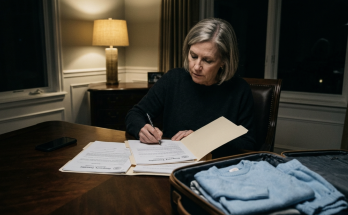
Evelyn refused to believe Margaret Keane was inside the Charleston house.
“That is ridiculous.”
We were in Sarah’s office when Grant called.
I had put him on speaker.
Evelyn sat across from me with Rebecca Shaw beside her.
Julian had joined remotely with Daniel.
The legal geometry had become absurd.
Every member of the family now had separate counsel.
“Mrs. Vance,” Grant said, “when were you last at the property?”
“Two weeks ago.”
“Who has keys?”
“I do. Julian used to. Claire has one because of the deed.”
“Anyone else?”
“The caretaker.”
“Name?”
“Robert Mills.”
“We spoke to him.”
“And?”
“He says a woman matching Keane’s description has been staying there intermittently.”
Evelyn shook her head.
“No.”
“He says you approved it.”
“I did not.”
Grant’s tone remained even.
“He showed us text messages.”
Evelyn’s face changed.
“What messages?”
“From a number saved under your name.”
Rebecca leaned toward her.
“Do not guess.”
“I’m not guessing. I never gave anyone permission.”
I asked, “Was your number spoofed?”
Grant said, “Possibly.”
“Or someone had access to her phone.”
Evelyn looked toward me.
“Who?”
Julian’s voice came through the laptop.
“Mom, did you ever give Arthur your old phone?”
She frowned.
“What?”
“After he broke his.”
“That was years ago.”
“When?”
“I don’t know.”
“Before he died?”
“Yes.”
“Did you erase it?”
She stared at the laptop.
“No.”
I closed my eyes.
Of course.
Old devices.
Old passwords.
Old family habits.
People feared sophisticated hacking while leaving entire lives unlocked in drawers.
Grant said, “We’re executing a warrant now. Stay where you are.”
The call ended.
Evelyn looked at me.
“This is my house.”
“No.”
Her eyes narrowed automatically.
Then she stopped.
For the first time, she corrected herself.
“Fine. The house.”
That tiny surrender would have been amusing under different circumstances.
The Charleston property had become the last surviving piece of her lawsuit.
Arthur had sold it to Julian and me four years before his death.
The payment was documented.
The deed clean.
Evelyn’s claim rested almost entirely on her belief that Arthur intended it to remain a Vance family property.
Now Margaret Keane had apparently been using it.
That meant Arthur’s intent might have mattered after all.
Just not in the way Evelyn imagined.
“What rooms did Arthur use?” I asked.
Evelyn looked at me.
“All of them.”
“Private rooms.”
“The upstairs study.”
“Locked?”
“Yes.”
“When we bought it?”
“He kept access for a year.”
I stared at her.
“You never told me that.”
“I assumed Julian did.”
Julian said, “I didn’t know.”
Evelyn frowned.
“Arthur had a key.”
“To a house he sold us.”
“He said there were personal papers he needed time to remove.”
“How long?”
“A year.”
“When did he stop going?”
“About six months before he died.”
Sarah asked, “Did anyone inspect the study after?”
Evelyn shook her head.
“Claire renovated that floor.”
I remembered.
New flooring.
Paint.
Electrical work.
The study had been almost empty when contractors entered.
One built-in bookcase.
One old desk.
Nothing else.
Except—
I sat upright.
“What?” Sarah asked.
“The wall.”
“What wall?”
“In the study.”
Evelyn looked confused.
I turned toward her.
“Arthur made us keep the north wall.”
“Yes.”
“Why?”
“He liked the wood paneling.”
That had been the explanation.
I had hated the dark walnut.
Arthur insisted it was original to the house.
When we bought the property, a clause in the sale documents required preservation of “certain architectural features” for five years.
At the time, I thought it eccentric.
Now I knew better.
“Grant needs to check behind the paneling.”
Sarah called.
He answered on the first ring.
Twenty minutes later, he called back.
“You were right.”
My skin went cold.
“What did they find?”
“A concealed compartment.”
Evelyn stood.
“What?”
“Behind the north wall.”
“What’s inside?” I asked.
“File boxes.”
“How many?”
“Six.”
I closed my eyes.
“And Margaret?”
“Gone.”
“She was there?”
“Evidence suggests she left recently.”
“How recently?”
“Coffee still warm.”
Julian swore through the laptop.
Grant continued.
“There’s something else.”
“Of course there is.”
“One box is labeled BENNETT.”
No one spoke.
I looked toward Evelyn.
Her face had gone white.
“Arthur kept a box about me.”
“Yes,” Grant said.
“Do not open it without logging everything.”
A beat.
“Already done.”
I heard myself becoming a prosecutor again.
Grant almost sounded amused.
“We know how evidence works.”
“Sorry.”
“No, you’re not.”
He was right.
It took four hours for the first inventory to reach us.
By then, federal agents had located Margaret Keane’s rental car abandoned near a bus terminal.
No sign of her.
The six boxes behind the wall contained copies of the Harrow procurement records, Arthur’s handwritten notes, correspondence with Sloan, bank records, judicial documents, and photographs.
The BENNETT box contained material on me.
Not personal surveillance.
Professional records.
Copies of motions.
Trial transcripts.
Public promotion notices.
Newspaper articles.
Arthur had followed my career for years.
Evelyn stared at the inventory.
“He knew more about you than we did.”
The sentence hurt in a way I did not expect.
A near-stranger had paid attention.
My husband had not.
I did not look toward the laptop.
Julian spoke anyway.
“I know.”
I kept reading.
At the bottom of the BENNETT box was a sealed envelope labeled:
IF THEY USE HER NAME.
That one had been written for an unknown future reader.
Grant read it to us over secure video after agents processed it.
Arthur explained that Sloan first suggested using my identity as a fallback target after Mercer refused to participate in the diversion.
Arthur objected.
Sloan told him it did not matter whether I was guilty.
Only whether investigators could believe I might be.
Arthur then wrote something that silenced the room.
Colonel Bennett prosecuted Harrow without taking the settlement approach Sloan wanted.
I frowned.
“What settlement approach?”
Grant checked another document.
“Harrow was offered an early cooperation agreement.”
“I know.”
“You recommended withdrawing it.”
“Yes. He lied during debrief.”
“Sloan apparently wanted it preserved.”
“That was not Sloan’s decision.”
“No.”
But it explained Mercer’s daughter’s phrase.
The woman who never took the deal.
Not Mercer.
Me.
I had refused to support Harrow’s cooperation agreement after he lied.
That decision lengthened the prosecution.
Made Harrow angry.
Disrupted whatever arrangement Sloan expected.
Arthur had noticed.
That was why he believed I was clean.
Not instinct.
Evidence.
Evelyn looked at me.
“You never told us any of this.”
“It was a criminal case.”
“I know.”
For once, she did not sound accusatory.
Grant continued reading Arthur’s letter.
Sloan needed the cooperation agreement because it would have limited exposure to certain financial counts and reduced scrutiny of downstream transfers.
When I rejected it, the case expanded.
That threatened AV-17.
It threatened Victor James.
It threatened Thomas Cole.
It threatened Sloan himself.
So they prepared a second strategy.
If the diverted money surfaced, records would suggest I had taken it.
My career would make the allegation dramatic.
My access would make it plausible.
My silence about confidential work would make me look evasive.
Years later, Evelyn had unknowingly repeated their script.
You never told us what you really did.
You hid things.
You controlled the records.
The realization moved across her face.
“They used me.”
I answered quietly.
“They used what you were already willing to believe.”
She looked at me.
That landed.
Good.
Some truths should.
Grant turned to the final page.
Arthur wrote that the complete unaltered archive had been split into three parts.
Pierce held financial originals.
Mercer held prosecutorial alterations.
Arthur held correspondence and judicial copies.
Together they could prove the frame.
“We have all three now?” Sarah asked.
Grant shook his head.
“Almost.”
“What’s missing?”
“One judicial attachment.”
“Which?”
“A sealed warrant supplement identifying the person who authorized Sloan to continue using AV-17 after Harrow’s arrest.”
“Ortega?”
“No.”
“Margaret Keane?”
“Possibly.”
“Victor James?”
“Possibly.”
“Who had authority?”
Grant looked at the page.
“According to Arthur, only one signature mattered.”
He turned the scanned document toward the camera.
The name had been torn away from Arthur’s copy.
Not blacked out.
Physically removed.
Julian leaned closer to his screen.
“Can it be reconstructed?”
“Maybe.”
Evelyn whispered, “Margaret has it.”
Everyone looked at her.
“How do you know?” I asked.
She stood.
“I don’t know.”
“You said it like you did.”
She began pacing.
“When my husband died, Arthur gave Margaret an envelope.”
“What?”
“At the funeral.”
“You knew Margaret Keane?”
“I knew her as Margaret Keane.”
“Did you know she was Harrow’s sister?”
“No.”
“What did Arthur say?”
“That she was holding something for the family.”
“What family?”
“I assumed ours.”
Grant’s voice sharpened.
“When was this?”
“Nine years ago.”
Before Harrow’s prosecution concluded.
Before Arthur’s hidden wall.
Before Mercer died.
“Did Margaret ever contact you?”
“No.”
“Never?”
Evelyn stopped pacing.
“Once.”
“When?”
“Last year.”
My chest tightened.
“What did she want?”
“She asked whether Arthur ever told me where Claire kept her military papers.”
Every person in the room went silent.
“What did you say?” I asked.
“That I had no idea.”
“Did you tell Julian?”
“No.”
“Why?”
“Because by then you were separating, and I thought Margaret was asking about the divorce.”
I stared at her.
“You thought a retired court administrator calling about my military papers was a divorce question.”
“I didn’t know who she really was.”
Sarah closed her eyes briefly.
Grant asked, “What number did she call from?”
“I may still have it.”
She searched her phone.
Found the old entry.
Grant copied it.
Ten minutes later, he called back.
“That number was used yesterday.”
“Where?”
“Charleston.”
“By Margaret?”
“We don’t know.”
“To whom?”
Grant looked directly at me through the screen.
“Victor Harrow.”
The room became perfectly still.
Harrow and Margaret had spoken the day before agents found the hidden archive.
Not enemies.
Not necessarily.
Perhaps partners.
Or negotiators.
Or two people racing for the same missing document.
Then Julian spoke.
“Wait.”
His voice sounded strange.
“Mom.”
“What?”
“The Harbor House.”
Evelyn frowned.
“What about it?”
“That night Victor James came to the table.”
“Yes.”
“Who was sitting at the bar?”
“I don’t remember.”
“I do.”
I looked at Julian.
He had gone pale.
“There was a woman alone near the window.”
“Lots of people were there.”
“No. This one kept looking at Mom.”
He looked toward me on the laptop.
“You noticed her too.”
Memory moved.
A woman with short dark hair.
A wineglass she barely touched.
She left just after Evelyn.
At the time, I thought nothing of it.
Now I saw the face from courthouse hallways years later.
Older.
Blonder.
But the same.
“Margaret Keane,” I said.
Julian nodded.
Evelyn sat down hard.
Grant immediately called the field team.
I looked again at Arthur’s missing warrant attachment.
Victor James at our table.
Margaret watching from across the room.
Evelyn warned.
Me unknowingly present.
Julian talking business.
Seven years later, every line converging.
Then Grant’s phone rang again.
He listened.
His expression hardened.
“What?”
He looked toward us.
“Margaret has been located.”
“Where?”
“At Charleston Harbor.”
“Alive?”
“Yes.”
Relief barely began before he continued.
“She’s with Victor Harrow.”
My stomach tightened.
“Are they in custody?”
“Not yet.”
“Why not?”
Grant’s jaw set.
“Because they’re holding someone.”
“Who?”
He looked toward Evelyn.
“Donald Pierce.”
No one moved.
Then he added the detail that turned the entire case again.
“And Pierce is telling agents not to intervene.”
Click here to continue reading: PART 13: Donald Pierce Refused Rescue at the Harbor Because the Man Beside Harrow Was the Witness Everyone Thought Had Vanished
The Lawsuit Arrived at Breakfast, and My Mother-in-Law Was Certain I Would Be Too Frightened to Fight Her
Part 12 of 18