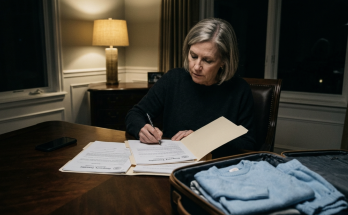
Evelyn’s house looked untouched from the street.
That was the first disturbing thing about it.
No broken front window.
No splintered door.
No alarm lights.
Nothing that announced intrusion.
Yet inside, one cabinet had been opened, one shelf disturbed, and one object removed.
The Bible.
Grant kept me outside until the scene team finished.
Evelyn stood beside me beneath the covered porch with Rebecca and a uniformed officer.
She looked furious.
Good.
Fear made Evelyn defensive.
Anger made her observant.
“Who knew about that Bible?” I asked.
“Everyone.”
“That is not helpful.”
“It sat in my living room for years.”
“Who knew Arthur gave it to you?”
“Family.”
“Martin?”
“Probably.”
“Margaret?”
“I don’t know.”
“Victor?”
Her face tightened.
“He saw it once.”
“When?”
“Harbor House week.”
I stared at her.
“What?”
“He came to my house before the dinner.”
“You did not tell Grant that.”
“I forgot.”
“You forgot Victor James was inside your house?”
“I forgot the Bible was there.”
That distinction mattered.
“What happened?”
“He was in the sitting room. Arthur had just sent the Bible over after I complained he was clearing out family things.”
“Did Victor touch it?”
“Yes.”
My pulse changed.
“How?”
“He picked it up.”
“Opened it?”
“I think so.”
“Did he say anything?”
Evelyn frowned.
“He asked whether Arthur had marked passages.”
“And?”
“I said Arthur did not read Scripture.”
Pierce had been right.
Arthur’s line about truth in Scripture was code.
Victor had known enough to check.
“Did he take anything?”
“No.”
“You’re sure?”
“I was standing there.”
Grant came outside.
“Scene is clear.”
“What did they find?”
“Entry was likely with a key or copied key.”
“Nothing forced.”
“No.”
“Fingerprints?”
“Plenty. Most old.”
Evelyn crossed her arms.
“Then someone I know.”
“Or someone with access.”
“What was left?”
Grant looked at me.
“A page.”
“From the Bible?”
“Yes.”
He handed me a photograph.
The torn page was from the Book of Judges.
That was almost too neat.
But Arthur liked layered jokes.
One verse had been underlined decades earlier in faded ink.
The handwriting beside it was Arthur’s.
D.G.C. — NOT A NAME. A DATE.
I stared.
“Deputy General Counsel.”
Grant nodded.
“D.G.C.”
“But he says not a name.”
“A date.”
Evelyn looked over my shoulder.
“What date?”
Below Arthur’s note was a string of numbers.
11-4-09.
Sarah joined us.
“November fourth, 2009?”
“Or April eleventh.”
I looked at Evelyn.
“What happened November fourth, 2009?”
She frowned.
“I don’t know.”
“Julian?”
“He was in college.”
“Arthur?”
“No idea.”
“Your husband?”
Her face shifted.
“My husband had surgery that fall.”
“What date?”
“I don’t remember.”
Grant said, “We’ll check.”
The underlined verse itself referred to judgment delivered through a hidden act.
Arthur had chosen it deliberately.
“What if the date is an appointment?” Sarah asked.
“Government position date.”
I looked at Grant.
“Who became Deputy General Counsel on November fourth, 2009?”
“We’re checking.”
Evelyn leaned against the railing.
“Would Arthur expect me to understand that?”
“No.”
“Then why give me the Bible?”
“So you wouldn’t.”
She looked offended.
I continued.
“He needed you to possess it, not decode it.”
“That sounds like Arthur.”
Yes.
It did.
Grant’s phone rang.
He stepped away.
When he returned, his face had changed.
“What?”
“November fourth, 2009 was the confirmation date for a senior Defense Department attorney.”
“Name?”
Grant looked toward Evelyn first.
Then me.
“Malcolm Reed.”
I knew it.
Not personally.
Everyone in senior military law knew the name.
Reed had served as Deputy General Counsel for procurement matters before becoming a private defense contractor adviser.
Powerful.
Connected.
Retired.
Still influential.
And very much alive.
“He is the Deputy,” I said.
“Likely.”
“Dying?”
Grant nodded.
“Pancreatic cancer. Not public, but confirmed.”
Pierce’s statement suddenly aligned.
Victor had moved because Reed was dying.
Once Reed died, old loyalties might dissolve.
Old payments might surface.
Old protections vanish.
Evelyn stared at us.
“Who is Malcolm Reed?”
I looked at her.
“A man who had authority over procurement legal policy when Harrow’s network was operating.”
“Did Arthur know him?”
Grant answered.
“Records show they attended the same defense-industry advisory meetings.”
“When?”
“Multiple years.”
Evelyn’s face went blank.
“I met him.”
My stomach tightened.
“When?”
“At Arthur’s house.”
“Before or after Harbor House?”
“Before.”
“How long?”
“Years.”
“What do you remember?”
“Nothing important.”
“Evelyn.”
She snapped.
“I am trying.”
I let the silence work.
She closed her eyes.
“He was charming.”
That was not the word I expected.
“Toward you?”
“Toward everyone.”
“What did he want?”
“I thought business.”
“What kind?”
“Arthur’s warehouses. Military logistics.”
“Julian?”
Her eyes opened.
“He asked about Julian constantly.”
Sarah and I exchanged a glance.
“Why?”
“He said young men with ambition needed opportunities.”
Julian.
Borrowed ladders.
Every rung could break.
Victor’s threat suddenly sounded less abstract.
Maybe Julian had been cultivated long before he realized anyone cared about him.
“When did Reed first meet Julian?” I asked.
“Julian was maybe twenty-two.”
“What happened afterward?”
“He got an internship.”
“With whom?”
Evelyn’s face changed.
“Defense logistics contractor.”
“Name?”
“Bannister Group.”
I knew Bannister.
A Harrow subcontractor.
My pulse slowed.
“Was Bannister part of the fraud case?”
“Yes.”
Evelyn gripped the porch railing.
“No.”
“Yes.”
She looked genuinely ill.
“Julian didn’t know.”
“I believe that.”
But someone had put him near the network deliberately.
Maybe as leverage against Arthur.
Maybe Evelyn.
Maybe both.
Grant returned inside to coordinate warrants.
I stayed with Evelyn.
She stared toward the street.
“I thought Arthur was paranoid.”
“He was.”
“That doesn’t mean he was wrong.”
“No.”
She gave me a tired look.
“You really enjoy distinctions.”
“They keep people out of prison.”
“Or put them in.”
“That too.”
She looked down.
“Did Reed know who you were?”
“Probably.”
“Before Julian married you?”
That question stopped me.
Julian and I had met after I joined JAG but before Harrow.
“Why?”
“Because when Julian brought you home the first time, Arthur asked your full name twice.”
I remembered.
I thought he was hard of hearing.
“What did he do after?”
“He left the room and made a call.”
My stomach tightened.
“Did you hear anything?”
“No.”
“Who?”
“I don’t know.”
“What did he say when he came back?”
Evelyn thought.
Then her expression shifted.
“He asked whether you planned to stay in military law.”
I remembered that too.
I had answered yes.
Arthur stared at me for a long moment, then said:
That can become dangerous if you’re too good.
At the time, I thought it was an old man’s joke.
It was not.
“Arthur knew the network might intersect my career.”
“Yes.”
“Maybe before Harrow.”
Evelyn looked at me.
“Did he choose you?”
The question was absurd.
Then it wasn’t.
“Julian chose me.”
“Did he?”
I stared at her.
She shook her head quickly.
“No. I don’t mean Arthur arranged your marriage.”
“Good.”
“I mean maybe Arthur encouraged Julian not to ruin it.”
That was possible.
Arthur had been strangely approving of me when most of the family remained cool.
“He liked that you were disciplined,” Evelyn said. “He told Julian you were the first serious decision he had made.”
I looked away.
That sounded painfully like Arthur.
It also sounded painfully like Julian.
Grant returned.
“We have a warrant for Reed’s communications and financial records.”
“Travel?”
“Being checked.”
“Victor?”
“Still missing.”
“Harrow?”
“Missing.”
“Margaret?”
“Missing.”
“Michael Keane?”
“Still not located.”
Too many moving parts.
“What about the Bible?”
“Forensics is examining the remaining page fibers. Whoever tore out the relevant section left the Judges page intentionally or accidentally.”
“Could be a message.”
“Yes.”
“To whom?”
“Possibly us.”
“From Victor?”
“Or Margaret.”
I frowned.
“If Margaret was helping Reed and Victor, why leave us anything?”
Grant looked at me.
“Maybe she isn’t helping.”
Pierce had said Margaret acted under threat to her son.
If she had stolen the Bible—or been forced to—she might have torn out one page to preserve the clue.
“How many pages are missing?”
“Three.”
“Which books?”
“Judges. Samuel. Kings.”
Arthur’s sense of humor was getting obnoxious.
“Initials hidden in margin notes?”
“Possibly.”
“Scan all handwritten markings.”
“Already happening.”
Evelyn went inside with Rebecca.
I stayed on the porch.
Julian called.
This time I answered immediately.
“Are you safe?” he asked.
“Yes.”
“Mom?”
“Yes.”
“They searched my apartment.”
“Who?”
“Federal agents.”
“Warrant?”
“Yes.”
“What did they take?”
“Old laptops.”
“Anything else?”
“Arthur’s company files.”
“Expected.”
He paused.
“Claire.”
“What?”
“I remembered Malcolm Reed.”
My grip tightened.
“How?”
“Mom sent his name.”
“You met him.”
“Yes.”
“When?”
“College.”
“Bannister internship?”
Silence.
“How did you know?”
“Your mother remembered.”
Julian breathed out.
“Reed arranged it.”
I closed my eyes.
“Did he ask you to do anything unusual?”
“At the time, no.”
“And later?”
He hesitated.
“Julian.”
“After I graduated, he asked me to introduce him to Arthur.”
“Why?”
“He said Arthur was blocking a logistics transaction.”
“Did you?”
“Yes.”
“What happened?”
“Arthur threw him out.”
My pulse changed.
“Were you there?”
“Yes.”
“What did Arthur say?”
“I didn’t understand it then.”
“What?”
Julian’s voice lowered.
“He said, ‘You don’t get to use the boy because you lost the father.’”
I stopped breathing for a moment.
“Lost the father?”
“My dad.”
Evelyn’s late husband.
Not just an investor.
Maybe another person Reed had cultivated.
“What did Reed say?”
“That Arthur was becoming sentimental.”
“And?”
“Arthur said, ‘You got enough from him.’”
The world narrowed.
“Julian, what exactly did your father invest in before he died?”
“I don’t know.”
“Find out.”
“Claire.”
“What?”
“My father killed himself.”
I went still.
Evelyn had always told me he died from complications after surgery.
“What?”
Julian’s voice cracked.
“Mom lied about it.”
The porch seemed to tilt.
“When did you learn?”
“Just now.”
“From whom?”
“Federal agents found the death certificate.”
I closed my eyes.
Cause of death.
Gunshot.
Self-inflicted.
Evelyn had rewritten an entire death.
“Why would she lie to you?”
“I don’t know.”
But I did not believe that.
Not anymore.
I turned toward the house.
Evelyn stood beyond the front window.
She was watching me.
She knew from my face.
I opened the door.
“Julian knows.”
She closed her eyes.
Rebecca stood.
“Knows what?”
Evelyn sat slowly.
I held the phone away from my ear.
“Tell him.”
She shook her head.
“Evelyn.”
Her hands trembled.
“Tell him why his father died.”
Julian’s voice came faintly through the phone.
“Mom?”
Evelyn stared at me.
Then at the phone.
Finally she whispered:
“Because Malcolm Reed told him the government was going to arrest him.”
The room became silent.
Julian did not speak.
Neither did I.
Evelyn continued.
“Your father believed him.”
Her voice broke.
“And Malcolm Reed knew it was a lie.”
Click here to continue reading: PART 15: Evelyn’s Biggest Lie Was Not About Me, but About the Death That Had Controlled Julian’s Life Since He Was Twenty
The Lawsuit Arrived at Breakfast, and My Mother-in-Law Was Certain I Would Be Too Frightened to Fight Her
Part 14 of 18