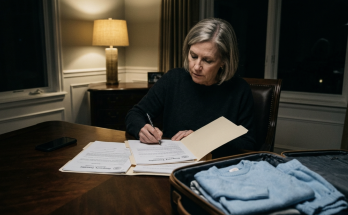
The Army keeps records long after people stop remembering why they mattered.
Sometimes that is bureaucracy.
Sometimes it is mercy.
By the next afternoon, Grant had obtained authorization to review Andrew Mercer’s archived personnel and legal correspondence relating to the Harrow matter.
Because I had known Mercer professionally, I remained outside the formal search.
I hated that.
I also knew it was correct.
Sarah found me in the cafeteria of the federal building staring at soup I had not touched.
“You are doing the thing again.”
“What thing?”
“Trying to control an investigation by mentally pacing beside it.”
“I’m eating.”
She looked at the soup.
“That object has not changed position in fifteen minutes.”
I pushed it away.
“You sound like my mother.”
“Your mother would tell you to add salt.”
That made me smile despite myself.
Then her expression softened.
“How are you doing with Evelyn?”
“I haven’t decided.”
“You don’t have to.”
“She spent years believing I might be corrupt.”
“She also spent years being wrong.”
“She was afraid.”
“So?”
I looked at her.
Sarah rarely softened conclusions just because motives were complicated.
“So nothing,” I said.
“Good.”
“She still weaponized Julian’s fear.”
“Yes.”
“She still filed false claims.”
“Yes.”
“She also warned Arthur seven years ago.”
“Yes.”
I rubbed my forehead.
“People are inconvenient.”
“Occupational hazard.”
Grant appeared in the doorway.
His face told me the search had produced something.
We went upstairs.
On the conference table sat a scanned personnel file, three sealed investigative memoranda, and a printed email chain.
Grant remained standing.
“Mercer died on September twenty-third, four years ago.”
“I remember his retirement being earlier.”
“He retired five months before his death.”
“Reason?”
“Medical hardship.”
“Legitimate?”
“Yes. His wife was undergoing cancer treatment.”
That part had been true.
“What did you find?”
Grant pointed to the email chain.
“Two days before his death, Mercer emailed an old military address belonging to you.”
I stared at him.
“I never received anything.”
“The account had already been migrated.”
“When?”
“Six months earlier.”
“So it bounced.”
“Yes.”
“Was there a second attempt?”
“He sent the same message to your old office fax.”
I laughed once in disbelief.
“That office had been closed.”
“Correct.”
Mercer had tried to reach me using outdated information.
Not unusual for someone retired from the system.
“What did he say?”
Grant slid the page across.
The message was short.
CLAIRE—
I SHOULD HAVE SPOKEN SOONER.
THE HARROW FILE WAS ALTERED BEFORE TRIAL.
I HAVE THE UNCHANGED COPY.
DO NOT CONTACT SLOAN.
—A.M.
I read it twice.
Then a third time.
“The unchanged copy.”
Grant nodded.
“Likely the same copy Victor referenced.”
“Where is it?”
“We don’t know.”
“What was altered?”
“We don’t know.”
“What happened between this message and Mercer’s death?”
“That is where it gets interesting.”
Sarah sat forward.
Grant opened another folder.
“Mercer made three phone calls after sending this.”
“To whom?”
“First, his daughter.”
“Normal.”
“Second, Richard Sloan.”
My jaw tightened.
“He specifically told me not to contact Sloan, then called him himself.”
“Yes.”
“How long?”
“Eleven minutes.”
“And the third?”
Grant looked at me.
“Judge Ortega.”
That surprised me.
“Duration?”
“Thirty-eight seconds.”
Sarah asked, “Did Ortega disclose that?”
“We haven’t asked him yet.”
“Why not?”
“We’re doing that today.”
I stood.
Grant shook his head.
“You’re not attending.”
“I know.”
I hated that too.
“What about the crash?”
Grant opened a photograph.
Mercer’s sedan had left a rural highway on a gradual curve and struck a tree.
Dry road.
Daylight.
No other vehicle officially involved.
“Mechanical?” I asked.
“At the time, investigators found nothing.”
“At the time.”
“We had the car-storage records reviewed.”
“And?”
“The vehicle was destroyed two years after the case closed.”
“So nothing remains.”
“Physically, no.”
He handed me the accident report.
One witness claimed a dark SUV had been behind Mercer moments before the crash.
The statement had been marked uncorroborated.
I looked up.
“Harrow?”
“Could be.”
“Sloan?”
“Could be.”
“Anyone.”
“Yes.”
The report included one more detail.
Mercer’s briefcase was missing.
His wallet remained.
His phone remained.
His watch remained.
No briefcase.
“What did his daughter say?”
“We’re meeting her tomorrow.”
“I want—”
“No.”
I stopped.
Grant’s expression softened slightly.
“You are connected to too many of these people.”
“That is why I can ask better questions.”
“That is why every answer risks becoming about you.”
He was right.
Again.
It was becoming irritating.
That evening, I met Julian and Daniel Price at Sarah’s office.
Julian had asked to speak because agents had questioned him again about Vance Maritime.
He looked worse than the previous meeting.
“You know about Mercer?” he asked.
That startled me.
“How?”
“Agents asked if Arthur ever mentioned him.”
“What did you say?”
“No.”
“Was that true?”
“At the time.”
I waited.
Julian looked toward Daniel.
His lawyer nodded once.
“After they left,” Julian said, “I remembered a name on one of Arthur’s old invoices.”
“Mercer?”
“No. AM Consulting.”
My pulse changed.
“What was it?”
“A payment.”
“How much?”
“Fifty thousand.”
“When?”
“About four years ago.”
Near Mercer’s death.
“From Vance Maritime?”
“Yes.”
“To AM Consulting?”
“Yes.”
“Did you verify the company?”
“No.”
“Of course not.”
He flinched.
I regretted the tone immediately, but not enough to apologize.
“What did Arthur say about it?”
“He called it advisory work.”
“Did you know Andrew Mercer?”
“No.”
“Did Arthur?”
“I don’t know.”
Sarah asked, “Do you have the invoice?”
“Federal agents took the files.”
“Did the invoice contain an address?”
“A post office box.”
“Where?”
“Virginia.”
Mercer had lived in Virginia.
That was not proof.
But it narrowed coincidence.
Julian continued.
“There’s more.”
There always was now.
“Arthur asked me once whether I knew how to retrieve deleted email.”
“When?”
“Maybe a month before he died.”
“What did you say?”
“That I didn’t.”
“Did he explain?”
“No.”
“Why didn’t you mention this before?”
“Because I didn’t remember until the agents asked about Mercer.”
His answer sounded honest.
The problem was that Julian’s honesty had become a sequence of doors he opened only after someone else found the hallway.
“Did you ever access Arthur’s email?”
“Yes.”
“When?”
“After he died.”
“Why?”
“Estate records.”
“Did you delete anything?”
“No.”
“Did someone else?”
“His accountant had access.”
“Name?”
“Leonard Price.”
Daniel looked up.
“Not related.”
Julian almost smiled.
No one else did.
I wrote the name.
“Alive?”
“Yes.”
“Where?”
“Savannah, last I knew.”
Sarah glanced toward me.
“I assume Grant already has him.”
“He will in five minutes.”
I sent the name.
Grant replied almost immediately.
ALREADY LOOKING.
An hour later, the answer came.
Leonard Price had died eighteen months earlier.
Stroke.
Natural.
Probably.
That word had begun following every death.
The next morning, Grant interviewed Mercer’s daughter, Emily.
I was not in the room.
But three hours later, he called me to the building.
He looked unsettled.
“What did she say?”
“She remembers the briefcase.”
“What about it?”
“Her father called her the night before he died. Said he had finally decided to deliver something himself.”
“To me?”
“He didn’t say.”
“Did he describe it?”
“A paper case file and a disk.”
“Disk?”
“Her word.”
“Could mean flash drive.”
“Possibly.”
“Anything else?”
Grant nodded.
“He told her if anything happened, she should find ‘the woman who never took the deal.’”
I stared at him.
“What deal?”
“She doesn’t know.”
“Could he have meant me?”
“That is what she thinks.”
“Why?”
“Because after his funeral, a man came to her house asking whether Mercer had left anything for Colonel Bennett.”
I stood.
“Who?”
“She didn’t know his name.”
“Description?”
Grant turned a laptop toward me.
An old security-camera still.
A man stood on Mercer’s front porch.
Older now than at Harbor House.
But unmistakable.
Victor James.
My stomach tightened.
“He was alive after Mercer died.”
“Yes.”
“Did Emily give him anything?”
“No.”
“What happened?”
“He left.”
“Then what?”
“Nothing for four years.”
Sarah, seated across the room, asked, “Until Lang started digging.”
Grant nodded.
I looked at Victor’s face.
“He thought Mercer had given me the copy.”
“Seems likely.”
“That is why Lang searched my case history.”
“Yes.”
“And Harrow’s network photographed me.”
“Possibly.”
“They thought I had what Mercer took.”
“Or knew where it was.”
But I didn’t.
I never had.
That should have been reassuring.
It wasn’t.
If Mercer had not delivered the file to me, then someone else had received it.
Or it was still hidden.
I looked again at his failed email.
I HAVE THE UNCHANGED COPY.
DO NOT CONTACT SLOAN.
“What deal did Mercer refuse?” Sarah asked.
I shook my head.
“I don’t know.”
Grant opened one more scanned memorandum.
“This might help.”
It was from the original Harrow investigation.
A financial analysis worksheet.
Several lines had been blacked out in the trial copy.
But this scan came from Mercer’s personal archive.
The unredacted line showed a proposed transfer from Harrow’s network.
Recipient designation:
C.B.
My initials.
Sarah stared.
“That’s why Arthur wrote Claire’s name.”
“No,” I said slowly.
The amount beside C.B. was $125,000.
Date: eight years ago.
Before I had ever met most of these people professionally.
Then I saw the narrative column.
C.B. did not stand for Claire Bennett.
It stood for Contracting Branch.
I almost laughed from relief.
Then stopped.
Below it was a handwritten note in Mercer’s margin:
SLOAN CHANGED THIS TO BENNETT IN WORKING COPY.
My relief vanished.
“Why would Sloan change a branch code into my name?”
Grant did not answer.
Sarah did.
“To make it look like you were the recipient.”
A false trail.
Prepared before Harrow’s trial.
Before Evelyn sued me.
Before Julian found C.B. in Arthur’s folder.
Someone had planted my initials years earlier.
Not because of the divorce.
Not because of Evelyn.
Because if the hidden copy ever surfaced, I was supposed to look compromised.
I stared at the handwriting.
“Mercer found the alteration.”
“Yes,” Grant said.
“And kept proof.”
“Yes.”
“Then he tried to contact me.”
“Yes.”
“And died two days later.”
Grant did not answer.
He did not need to.
The pattern was no longer subtle enough for any of us to ignore.
Click here to continue reading: PART 11: The Altered Harrow File Made Me Look Corrupt on Purpose, and Julian Discovered Arthur Had Prepared for That Betrayal Years Ago
The Lawsuit Arrived at Breakfast, and My Mother-in-Law Was Certain I Would Be Too Frightened to Fight Her
Part 10 of 18