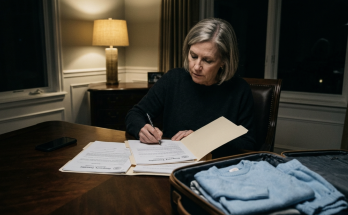
I did not sleep well.
At 3:08 in the morning, I was still sitting at my kitchen table with a legal pad divided into names.
VICTOR JAMES.
RICHARD SLOAN.
ANDREW MERCER.
THOMAS COLE.
VICTOR HARROW.
ARTHUR VANCE.
DONALD PIERCE.
EVELYN.
JULIAN.
Then, reluctantly, I wrote my own name.
CLAIRE BENNETT.
Every arrow eventually touched it.
Not because I had been involved in the fraud.
Because someone had wanted future investigators to believe I was.
The C.B. alteration was not random.
Sloan knew who I was.
I had prosecuted Harrow.
If a hidden financial record surfaced later showing money designated to “C.B.,” suspicion would naturally move toward me.
The forged evidence in Evelyn’s lawsuit had followed the same logic.
Fake signature.
Fake email.
Real benefits records.
Build enough authentic material around a lie and people stop asking which piece poisoned the rest.
At 5:12, I gave up on sleep.
At 7:03, Julian called.
I almost let it go to voicemail.
Then answered.
“I found something.”
His voice was urgent.
“Where?”
“Arthur’s storage unit.”
I stood.
“You went there?”
“With Daniel.”
That was slightly better.
“What did you find?”
“A box labeled PIERCE.”
My heart kicked.
“Do not open anything else.”
“Too late.”
“Julian.”
“Claire, listen.”
I grabbed my keys.
“Where are you?”
“At Daniel’s office.”
“Stay there.”
“I already called Grant.”
Good.
Maybe Julian was learning.
By the time I arrived, federal agents had secured the box.
Daniel looked annoyed but resigned.
Julian sat near the conference table with a photocopy agents had allowed him to retain because it was addressed personally to him.
He handed it to me.
Arthur’s handwriting.
JULIAN—
IF YOU FOUND THIS, THEN YOU FINALLY LOOKED WHERE I TOLD YOU NOT TO.
That sounded like him.
The letter continued.
Arthur explained that Vance Maritime had been offered to Julian cheaply for one reason: he wanted the company transferred away from himself before people connected to Harrow realized he had preserved financial records.
I stopped reading.
“You were cover.”
Julian stared at the table.
“Yes.”
“Arthur used you to hide the company.”
“Yes.”
“Did you know?”
“No.”
“Do you believe him?”
“I don’t know what to believe anymore.”
I continued.
Arthur claimed he had cleaned the operating business and removed the suspect money before selling.
He warned Julian that old files might someday become dangerous.
Then one line made my stomach tighten.
IF CLAIRE ASKS, TELL HER THE MONEY WAS NEVER HERS AND NEVER MINE. SHE WAS CHOSEN AS A NAME BECAUSE SHE WOULD BE BELIEVABLE.
Julian looked at me.
“I’m sorry.”
I kept reading.
Arthur had known.
He knew someone altered records to implicate me.
He knew I might eventually discover it.
But he still never contacted me directly after the failed letter.
Why?
The answer appeared three paragraphs later.
SLOAN SAID BENNETT COULD NOT BE TRUSTED AFTER MERCER REFUSED THE ARRANGEMENT. I DID NOT BELIEVE HIM, BUT I COULD NOT PROVE WHICH OF THEM WAS LYING.
I looked up.
“Mercer refused an arrangement.”
“The deal,” Julian said.
The phrase from Mercer’s daughter.
The woman who never took the deal.
Maybe Mercer had not been referring to me.
Maybe he was referring to himself indirectly.
“What arrangement?” I asked.
Julian shook his head.
“The next page.”
I turned it.
Arthur wrote that Richard Sloan had proposed a plan after Harrow’s arrest.
The missing funds would be assigned to a “cooperating recovery operation.”
That operation would justify transfers through government-controlled channels.
But instead of returning all the funds, a portion would disappear into private accounts.
Arthur refused.
Mercer refused.
Victor James, apparently, did not.
Thomas Cole had prepared some of the corporate structures.
Whether knowingly or not, Arthur was unsure.
Sloan then needed someone to blame if the diversion surfaced.
A prosecutor with access.
A prosecutor with a strong enough career to plausibly influence records.
Me.
I read the line again.
Julian’s voice came quietly.
“They picked you because you were good.”
“No.”
He frowned.
“They picked me because I was visible.”
“That’s what I mean.”
“It isn’t.”
I set the paper down.
“They needed a name investigators would recognize later. Someone connected to Harrow who could plausibly have touched sensitive evidence.”
“You.”
“Yes.”
Julian leaned back.
“For years I thought you hid your career because you were embarrassed by us.”
That surprised me.
“What?”
“You never brought us around your work people.”
“You hated those events.”
“I hated feeling stupid.”
I stared at him.
That was new.
“You never said that.”
“You never asked.”
The hypocrisy would have been funny in another life.
“You are using my line.”
“I know.”
He looked down.
“Turns out it works.”
We sat in silence for a moment.
Then he said, “I really did think Mom was wrong about you at first.”
“About the lawsuit?”
“Yes.”
“What changed?”
“The C.B. note.”
“You thought it meant Claire Bennett.”
“Yes.”
“So did whoever planted it.”
His face tightened.
“I’m sorry.”
“You already said that.”
“I know.”
“Apologies are not invoices, Julian. You don’t keep submitting the same one until the balance disappears.”
He looked as though I had struck him.
I regretted it.
Not enough to take it back.
Grant entered carrying Arthur’s storage inventory.
“There’s more.”
That phrase had become a threat.
“What?”
“The box contains copies of Sloan’s communications.”
“Copies from where?”
“Arthur appears to have photographed documents during meetings.”
“Smart.”
“Paranoid.”
“Same skill set under different lighting.”
Grant almost smiled.
Then he laid down three images.
The first showed Sloan’s handwritten instructions for AV-17.
The second showed Victor James’s initials beside a routing number.
The third showed a list of names.
Thomas Cole.
Andrew Mercer.
Arthur Vance.
Claire Bennett.
Next to each was a single word.
PRESSURE.
PRESSURE.
WATCH.
FRAME.
No one spoke.
Julian finally said, “Frame?”
I looked at him.
“Yes.”
Arthur had photographed a plan to frame me.
Eight years earlier.
Grant said, “This changes the case.”
“Enough to reopen Harrow?”
“Possibly.”
“Enough to investigate Sloan’s death?”
“Already happening.”
“What about Mercer?”
“Reopened this morning.”
“Thomas Cole?”
“His accident file is being reviewed.”
Julian looked sick.
“My mother knew none of this.”
“No.”
“Arthur did.”
“Yes.”
“And sold me the company anyway.”
“Yes.”
Anger entered his face slowly.
For once, I did not try to soften it.
He had spent years worshipping Arthur’s judgment.
Arthur had used him as camouflage.
Maybe love had been part of it.
Maybe protection.
Still use.
“Why didn’t Arthur go public?” Julian asked.
Grant answered.
“Because the original evidence was compromised, and the people controlling access included Sloan.”
“What about Ortega?”
“Still being reviewed.”
I looked at Grant.
“Did Ortega explain Mercer’s call?”
His expression changed slightly.
“Yes.”
“And?”
“Mercer called to say he had proof Sloan altered records.”
“Why only thirty-eight seconds?”
“Ortega told him to contact internal investigators immediately.”
“Did he?”
“No record.”
“Did Ortega know Mercer died two days later?”
“Yes.”
“Did he connect it?”
“He says he suspected.”
“Why did he do nothing?”
Grant’s voice became careful.
“He did something.”
“What?”
“He wrote a sealed memorandum requesting review of Sloan’s activities.”
My pulse slowed.
“And?”
“The memorandum vanished.”
The removed archive notes.
Lang’s attempted access.
Everything kept circling the same missing records.
“Who had authority to remove a sealed judicial memorandum?”
Grant looked at me.
“At the time? Very few people.”
“Names.”
“One was Sloan through investigative liaison access.”
“Others?”
“Court administrator.”
“Who?”
He hesitated.
“Margaret Harrow.”
The surname entered the room like a dropped glass.
Julian looked up.
“Related?”
Grant nodded.
“Victor Harrow’s sister.”
I stared at him.
“She worked for the court?”
“For nineteen years.”
“During the prosecution?”
“Yes.”
“Why did no one flag that?”
“She used her married name professionally.”
“What name?”
“Margaret Keane.”
I knew that name.
Everyone who appeared regularly in that courthouse knew it.
Margaret Keane had been one of the most trusted senior administrators in the district.
She had retired five years ago.
One year after Mercer’s death.
“Where is she now?”
“Florida.”
“Have you contacted her?”
“We’re locating her.”
I stood.
Grant said, “Claire.”
“What?”
“Sit.”
“I’m fine.”
“You look like you want to prosecute the furniture.”
I sat.
Sarah looked at the list again.
PRESSURE.
PRESSURE.
WATCH.
FRAME.
“Why watch Arthur instead of pressure him?” she asked.
“Because he controlled the money,” I said.
“Why not kill the account?”
“He may have had copies.”
“And Mercer?”
“Pressure him into participating.”
“He refused.”
“Yes.”
“And Claire?”
I looked at the word beside my name.
“Frame me if the money trail surfaced.”
Julian leaned forward.
“Then what was the endgame?”
That was the right question.
Not what happened.
Why build a false trail unless someone expected discovery eventually?
Grant stared at Arthur’s documents.
“Insurance.”
“Against prosecution?”
“Yes.”
“If anyone reopened the money transfers,” Sarah said, “they could point to Claire.”
“Exactly.”
Julian’s face changed.
“Then Harrow went to prison thinking she had the evidence.”
I looked at him.
“Maybe.”
“And when he got out…”
“He wanted to know whether Mercer’s unchanged copy reached me.”
Grant nodded.
“That explains Lang.”
“So Harrow believed the frame was still necessary.”
“Yes.”
A thought struck me.
“What if he was not trying to frame me now?”
Grant looked over.
“What if Harrow was trying to find proof that someone else framed me?”
Silence.
Julian frowned.
“Why would he help you?”
“Not help me.”
I looked at Arthur’s list.
“Harrow served five years. Sloan stayed free. Victor James vanished. If Harrow discovered after prison that Sloan had taken money from his network and left him holding the entire criminal case…”
Sarah finished the thought.
“He might want the unchanged file for revenge.”
Grant’s expression tightened.
“That is possible.”
“Then Lang was not looking for evidence to hurt me.”
“He may have been looking for the same evidence we are.”
“Through illegal access.”
“Yes.”
“Harrow could still be dangerous.”
“Absolutely.”
But his motive had shifted.
Not exoneration.
Not innocence.
Retaliation.
And if he believed Margaret Keane had helped Sloan bury judicial records, then she was no longer just a former administrator.
She was a target.
Grant’s phone rang.
He answered.
Listened.
Then stood so quickly his chair rolled backward.
“What happened?” I asked.
He covered the receiver.
“They found Margaret Keane.”
“Where?”
“Not Florida.”
“Where?”
He looked at me.
“Charleston.”
My chest tightened.
The one property Evelyn still refused to release.
“What address?”
Grant’s eyes held mine.
“The house Evelyn claims Arthur meant to keep in the family.”
Click here to continue reading: PART 12: The Charleston House Was Never About Inheritance, and Evelyn’s Last Property Claim Led Us Straight to the Missing Archive
The Lawsuit Arrived at Breakfast, and My Mother-in-Law Was Certain I Would Be Too Frightened to Fight Her
Part 11 of 18