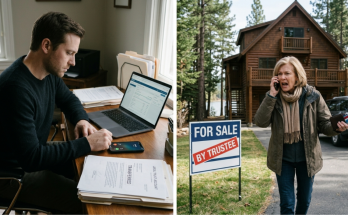
Clare had a thick folder waiting when I arrived.
I noticed it before I sat down.
It lay in the middle of her desk, with several papers placed neatly beside it.
She usually greeted me with a smile.
That morning, she looked serious.
I set my bag beside the chair.
“Is it bad?”
She didn't answer with a simple yes or no.
Instead, she explained that we needed to examine exactly what had been submitted.
We also needed to determine who had provided the documents and whether anyone had attempted to act on them.
Her careful language frightened me more than anger would have.
I sat down.
She turned the folder toward me.
The first page contained the cabin's address.
I recognized it immediately.
I had written that address on countless documents.
Insurance forms.
Maintenance agreements.
Payment records.
There was nothing unfamiliar about it.
I turned the page.
My father's name appeared in the section concerning property management.
I stared at it.
He had represented himself as someone acting for the family.
I kept reading.
The language suggested an authority I did not remember granting.
I looked at Clare.
“I never approved this arrangement.”
She nodded.
“Keep going.”
I turned another page.
There was a signature.
My signature.
Or something that had been designed to look like it.
I stopped breathing for a moment.
The first letter looked almost right.
The middle of the name was familiar.
But the end was wrong.
The final stroke extended farther than mine ever did.
It was such a small detail.
And yet I could see it immediately.
I knew my own handwriting.
I had signed contracts for years.
I had signed the purchase documents for the cabin.
I had signed the paperwork for the renovations.
I had signed more financial documents than I cared to remember.
The name on that page wasn't written by me.
I leaned closer.
“That's supposed to be my signature?”
Clare watched my face.
“Yes.”
I touched the edge of the paper.
“I didn't write it.”
She asked me to look carefully and make certain.
I examined it again.
The letters were close.
Close enough to be disturbing.
But the rhythm of the handwriting was wrong.
The last line was wrong.
Even the spacing looked forced.
I shook my head.
“No. Somebody else signed my name.”
Clare made a note.
She told me that the disputed signature would need proper examination.
We couldn't determine everything simply by looking at a copy.
We needed the submission records.
We needed to know where the document had come from.
And we needed to know whether it had been relied upon for any transaction.
I understood what she was saying.
But I couldn't stop looking at the page.
Somebody had apparently tried to make it appear that I had agreed to something.
Something involving my father.
Something involving the cabin.
My chest felt tight.
I thought about my mother standing outside the cabin during the anniversary celebration.
I thought about her treating me like somebody who had arrived uninvited.
And I thought about my father's confidence whenever he discussed the property.
I had believed they were simply too comfortable using what belonged to me.
Now I was looking at a document that went much further.
Clare turned another page.
“This is the part I wanted you to see.”
There was a proposed loan.
The cabin was identified in the paperwork.
The intended purpose was described in broad terms involving improvements to the family property and future financial arrangements.
Then I saw the amount.
$325,000.
I read it once.
Then again.
Three hundred and twenty-five thousand dollars.
I had been worried about the attempt to move $86,000 from the trust.
Now I was looking at a proposed loan for almost four times that amount.
I leaned back.
For a moment, I couldn't speak.
Clare allowed the silence.
I looked at the document again.
The amount was still there.
Nothing about it had changed.
“Is this money they wanted to borrow against my cabin?”
“That is what the proposal indicates.”
I felt sick.
I thought about the work I had done on the property.
The repairs.
The savings.
The extra consulting contracts.
The weekends I had spent making sure everything was finished properly.
I had done all that so I could have a peaceful place to call my own.
And now someone had apparently been preparing to put that property behind a loan I had never requested.
I asked Clare whether the loan had been approved.
She explained that we still needed to confirm the complete status through the appropriate records.
The paperwork itself did not establish that money had been released.
That mattered.
I understood that.
But it didn't make the document harmless.
I looked at the amount again.
“Why would they need that much for renovations?”
Clare didn't speculate.
She said we needed to find out what had been represented to the financial institution.
I remembered my father's group message.
He had mentioned the trust paying for improvements.
At the time, I had been angry because he had discussed it without asking me.
Now that message sounded different.
He had already been talking about financial arrangements.
He had already described the property as though it belonged to the family.
And he had apparently been telling people he could speak on behalf of everyone.
I told Clare about the message again.
She had already saved it.
She said the timing could be important.
Then she directed my attention to a section near the end of the loan proposal.
There were names listed as intended recipients.
I moved my eyes down the page.
The first was my father.
The second was my mother.
The third was Mark.
I read those names slowly.
I had expected to find my father's name somewhere.
I had begun suspecting he was involved in more than ordinary property management.
But seeing my mother listed made my stomach turn.
And Mark.
My cousin.
The same person who treated the cabin like a place he could reserve for friends.
The same person who expected me to accommodate his plans.
All three names were there.
I looked at Clare.
“They were supposed to receive the money?”
“The proposal identifies them in that capacity.”
I pressed my hands together.
I didn't know which question to ask first.
Why had my mother been included?
What had Mark been told?
Did either of them know about the disputed signature?
Had my father been planning this alone?
Or had all three believed they could use the cabin without ever asking me?
I wanted answers.
But I knew the paper did not answer all those questions.
Clare reminded me of that.
She said the document established what had been proposed.
It did not, by itself, prove exactly who had prepared each page or what each person understood.
We needed the records.
We needed to determine who submitted the paperwork.
And we needed to establish whether anyone had tried to use the disputed authorization.
I listened carefully.
I didn't want my anger to make me careless.
But I also refused to pretend that what I was seeing was ordinary.
My family had been given permission to enjoy the cabin.
That was all.
They had not been given permission to treat it as collateral.
They had not been given authority to borrow against it.
And they certainly had not been given permission to imitate my signature.
I asked Clare whether anyone could legally create that kind of debt without authorization from the proper owner.
She explained that valid authority would be required.
The disputed paperwork was precisely why the matter needed immediate attention.
I nodded.
Then I looked at the signature again.
There was something humiliating about it.
Someone had apparently assumed that a piece of paper bearing my name would be enough.
Not my actual consent.
Not a conversation.
Not my understanding of what was being proposed.
Just a name that resembled mine.
I wondered how many times I had allowed my family to make decisions because confronting them felt exhausting.
I wondered whether my silence had encouraged them.
I had allowed weekend visits.
Then longer visits.
Then family gatherings.
Then other people's plans.
I had tolerated relatives discussing improvements without including me.
I had let them call the cabin a family place because arguing over those words seemed petty.
And somewhere along the way, my generosity had become an expectation that I would never object.
I felt ashamed.
Not because I had caused what was happening.
I hadn't.
But because I had spent so much time convincing myself that the warning signs were harmless.
Clare closed the folder for a moment.
She asked me how I was feeling.
I told her I didn't know.
That was the truth.
I was angry.
I was frightened.
And beneath both of those feelings was a sadness I couldn't quite explain.
These were my parents.
The people whose approval I had wanted since I was a child.
The people I had invited into my cabin because I wanted them to feel loved.
Now I was sitting in a professional office looking at paperwork that apparently sought to give them financial benefits from my property.
Without my permission.
I thought about calling my mother.
I wanted to ask her whether she knew her name was on the proposal.
I wanted to hear her reaction.
But then I remembered our last conversation.
She had insisted that the trust money belonged to the family.
She had not been interested in explaining who had contributed what.
She had only wanted access restored.
I looked at Clare.
“Should I call them?”
She shook her head.
Not yet.
We needed to preserve the records and allow the proper process to establish what had happened.
She advised me against confronting anyone with specific accusations.
I agreed.
I didn't like it.
But I agreed.
Then I asked about the cabin.
The question had been sitting in my mind since I arrived.
“Can I still sell it?”
Clare considered me carefully.
She said we needed to review the deed, the trust arrangements, and any outstanding obligations before taking the next steps.
She wanted to make sure the disputed paperwork was properly addressed.
I understood.
But my decision had become clearer while sitting in that office.
The cabin no longer felt like the peaceful place I had worked so hard to create.
I didn't like thinking that.
I remembered the lake.
The porch.
The rebuilt dock.
I remembered standing by the windows after the heating system had been installed.
I remembered feeling proud when the repairs were finished.
Those memories mattered.
I didn't want to pretend they didn't.
But the cabin had also become a place where I was expected to give endlessly.
A place where everyone else's plans came before mine.
A place where my own mother could make me feel unwanted.
And now it was connected to a financial proposal I had never approved.
I realized I didn't want to spend the next several years fighting over access.
I didn't want to keep explaining ownership.
I didn't want another family celebration where I was treated like a visitor.
I wanted the property sold.
I wanted the trust secured.
And I wanted whatever had happened with those documents examined properly.
I told Clare.
“I don't want to keep the cabin.”
She waited.
I continued.
“I want to proceed with the sale, as long as we can do it correctly.”
She asked whether I had considered what that would mean for my family.
I nodded.
I had considered them for years.
That was part of the problem.
Every decision seemed to begin with what my parents wanted.
Every arrangement had to account for Mark's plans.
Every disagreement became a question of whether Daniel could persuade me to compromise.
I was tired of making everyone comfortable while ignoring what the situation was doing to me.
“I know they'll be angry,” I said.
Clare nodded.
“They probably will.”
“But I can't keep living this way.”
She opened her notes.
Then she explained what needed to happen next.
The bank had to be informed that I disputed the authorization.
We needed the original submission information.
The date.
The method used to send the paperwork.
The supporting records.
And any details showing who had represented themselves as having authority over my property.
Clare had already begun contacting the appropriate legal department.
She would request the records needed to establish what had occurred.
I listened.
For the first time that morning, I felt able to concentrate.
There were practical steps.
There were documents to examine.
There were people who could review the facts.
I didn't have to solve everything through an argument with my father.
That was a relief.
I asked what would happen if the bank confirmed that the signature was not mine.
She explained that the appropriate legal process would determine how the matter was handled.
It wasn't something we could settle by accusing someone across a kitchen table.
I understood.
I also understood that whatever the outcome, my family would not be given back the same unrestricted access.
I had made that decision.
Before leaving, I looked at the proposed loan one last time.
$325,000.
My father.
My mother.
Mark.
And a signature that was not mine.
I had entered Clare's office thinking my father might have exceeded his authority with the trust.
I was leaving with evidence of a far more serious attempt to use the property.
I gathered my bag.
Clare told me to send her any new communication from the bank or my relatives.
She also reminded me not to reveal what we had found.
I promised I wouldn't.
Then I walked out to my car.
For a while, I sat behind the steering wheel without starting the engine.
I thought about the anniversary celebration.
My suitcase in one hand.
The bottle of wine in the other.
My mother looking at me as though my arrival had spoiled something.
I had wanted to belong.
That was the part I found hardest to admit.
Even after buying the cabin.
Even after paying for every major improvement.
Even after allowing everyone to enjoy it.
I had still wanted my parents to make me feel welcome.
And they hadn't.
I looked at the office building through the windshield.
I could not change what had happened.
I could not make my parents appreciate the years of work.
I could not force Mark to understand that access was a privilege.
And I could not make Daniel take my concerns seriously.
But I could decide what happened to my property next.
I started the car.
The real estate agent was still waiting for my response about the interested buyers.
I would speak with Clare about the offer when it arrived.
I would follow the legal advice.
I would keep the records.
And I would let the investigation establish exactly what my family had attempted.
I was not going to argue them into respecting me.
I had tried that for too long.
The cabin was going to be sold.
And the people who had treated it as their own would have to accept that the decision was no longer theirs.
Click here to continue reading: PART 5: The Bank Confirmed My Father Had Submitted Documents Without My Permission, and Then an Offer Arrived That Could Finally End the Cabin Dispute
I Thought My Family Had Only Taken Advantage of My Cabin Until a Bank Employee Mentioned a Transfer I Never Approved
Part 4 of 15