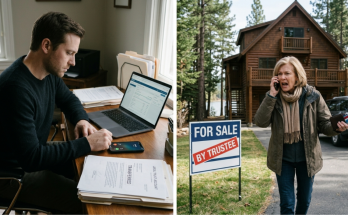
I left Clare's office knowing I could never look at my father quite the same way again.
I had wanted an explanation.
Instead, I had seen a signature that someone had tried to make look like mine.
And beside it was a loan proposal for $325,000.
I kept thinking about those pages during the drive home.
The number itself was frightening.
But what disturbed me most was how casually the paperwork appeared to give other people control over something I had spent years building.
My father.
My mother.
Mark.
Their names had been listed together.
Mine appeared only where someone needed my supposed permission.
I pulled into the parking area outside my apartment and remained in the car.
My hands were resting on the steering wheel.
I didn't feel ready to go inside.
For years, my father had spoken as though he knew what was best for everyone.
He made plans.
He offered opinions.
He expected people to listen.
I had grown accustomed to that behavior.
Sometimes I disagreed with him.
Usually, I kept my disagreement to myself.
But this was different.
He had apparently submitted documents claiming authority over my property.
And somebody had attached a signature that I knew was not mine.
I looked toward my apartment building.
I wanted to call him.
I wanted to ask whether he understood what he had done.
Then I remembered Clare's instructions.
No accusations.
No angry messages.
No revealing what evidence we possessed.
I took my phone out and put it back into my bag.
For once, I was going to follow the advice of someone who wasn't trying to make me feel guilty.
When I finally went upstairs, I placed the folder on my desk.
I did not open it immediately.
Instead, I made coffee and stood by the kitchen counter.
I could remember the first payment I had made toward the cabin.
I could remember wondering whether buying it was a mistake.
My divorce had left me uncertain about almost everything.
The cabin had given me something practical to concentrate on.
I could repair a railing.
I could replace a window.
I could pay a contractor.
Those were problems with solutions.
Family relationships were harder.
I had thought that purchasing a place of my own would give me some distance from the arguments and disappointments I had lived through.
Instead, I had invited those same problems into the property.
And I had paid for the privilege.
I set down my coffee.
Then I opened the folder.
The proposed loan was near the front.
I looked at the amount again.
Three hundred and twenty-five thousand dollars.
My family had talked about improvements for years.
Sometimes my father wanted changes to the deck.
Sometimes my mother thought the rooms needed updating.
Mark always seemed to have an opinion about what would make the place more convenient for guests.
But nobody had discussed improvements requiring anything close to that amount.
I thought about Daniel saying he had heard something concerning repairs.
He had sounded uncomfortable when I asked for details.
Now I understood why that conversation bothered me.
There was a difference between replacing a damaged section of railing and borrowing hundreds of thousands of dollars against a property.
One was ordinary maintenance.
The other could put the property at financial risk.
And I had authorized neither the proposed borrowing nor the disputed document.
That afternoon, Clare contacted me again.
She had begun arranging the formal review.
The financial institution had been notified that I disputed the management authorization.
She was also seeking the original records connected to the submission.
I asked whether the bank could simply reject the paperwork and forget about it.
She explained that rejecting a document was not the same as understanding how it had been submitted.
We needed the dates.
We needed the supporting materials.
We needed to know what representations had been made about my consent.
And we needed to establish whether the paperwork had been used for any additional requests.
I listened carefully.
I had expected the problem to become simpler once I identified the false signature.
It hadn't.
It had become more serious.
Clare reminded me that the bank's examination would take time.
She also told me to continue keeping any messages from my family.
I promised I would.
Before ending the call, I asked her something that had been troubling me.
“Do you think my father believed I would never find out?”
She paused.
“I can't tell you what he believed.”
“I know.”
“What matters is what the documents show and what the records confirm.”
I looked at the folder.
She was right.
I had spent years trying to understand why my family behaved the way it did.
Why Mom could say something cruel and then expect me to forget it.
Why Dad treated my property like a family resource.
Why Mark assumed his plans were more important than my permission.
I had searched for explanations.
Maybe they were stressed.
Maybe they didn't realize how much the cabin cost.
Maybe they thought I didn't mind.
But their reasons no longer changed the facts.
The property belonged to me.
The trust had rules.
And I had never signed that authorization.
A few days passed.
I continued working.
I answered ordinary messages.
I paid my bills.
From the outside, my life looked much the same.
But every time my phone rang, I checked the screen before answering.
I had become nervous about hearing another demand from my relatives.
I disliked that feeling.
My apartment had always been the place where I could shut the door and enjoy some privacy.
Now my family's arguments followed me there through calls and messages.
One afternoon, Clare called with an update.
The bank had confirmed that the proposed loan had not been approved.
I sat down immediately.
“Nothing was paid out?”
“Not through that proposal.”
I closed my eyes.
Relief.
Real relief.
For several seconds, I concentrated on the fact that the cabin had not been burdened with that loan.
Then Clare continued.
The records showed that the disputed authorization had been submitted through an email address associated with my father's business.
I opened my eyes.
“His business address?”
“Yes. That's what the submission information indicates.”
I thought about how confidently he had spoken about dealing with the bank.
He hadn't sounded uncertain.
He hadn't acted like someone who needed to ask permission.
He had discussed financial arrangements as though he already possessed the authority to make them.
I asked whether the records established that he had personally written the signature.
Clare said they did not yet establish that.
The signature required further examination.
And we still needed to distinguish between the person associated with the submission address and whoever had prepared each document.
I appreciated her caution.
It would have been easier to hear her say that everything was obvious.
But easy answers were what had allowed my family to avoid difficult questions for years.
This time, I wanted accuracy.
I wanted every relevant fact documented.
I wanted the proper process followed.
When we ended the call, I wrote the update in my notes.
Loan not approved.
Submission connected to father's business email.
Signature still disputed.
I stared at those three lines.
The first made me feel safer.
The other two made me feel deeply disappointed.
I had not wanted to find evidence pointing toward my father.
Even after the bank warned me about the $86,000 transfer attempt, part of me had hoped there would be an innocent explanation.
Now that hope was getting harder to maintain.
I walked into the living room.
The old photograph of the cabin remained on my desk.
I picked it up.
The porch had looked terrible when I bought the property.
The wood was weathered.
The railing was damaged.
The driveway was full of weeds.
I remembered showing the photograph to my parents after the purchase.
They had seemed pleased that I had found something to work on after my divorce.
At the time, I had wanted their approval.
I had wanted them to see that I could rebuild my life.
I had not imagined that one day they would speak about the place as if my work and money had somehow made it theirs.
I returned the photograph to the desk.
That evening, the real estate agent contacted me.
There was an offer.
I opened the message slowly.
It came from the couple who had expressed interest in using the cabin as a vacation home.
They had considered the property carefully.
Then they had increased their bid.
The figure was $615,000.
I read it twice.
Six hundred and fifteen thousand dollars.
It was more than I had expected when I decided to sell.
I sat back in my chair.
For the first time in days, I was looking at a number that did not represent something my family wanted to take.
It represented an opportunity to move forward.
The cabin had cost me considerably less when I purchased it.
But the purchase price was only part of what I had spent.
There had been years of improvements.
The roof.
The windows.
The heating.
The dock.
Insurance.
Taxes.
Maintenance.
And the countless weekends I had given up to keep everything working.
I thought about the money.
Then I thought about the memories.
The first morning I had coffee on the repaired porch.
The first evening the new heating system worked properly.
The day the dock was finished.
I remembered standing beside the lake and feeling proud.
Selling the cabin would mean giving up those experiences.
I wasn't pretending otherwise.
I loved parts of that place.
I had loved what it represented when I bought it.
But I no longer loved what it had become.
The agent asked whether I wanted to proceed.
I requested twenty-four hours.
I didn't want to accept a major offer while I was still emotional.
And I didn't want to sign anything without Clare reviewing the arrangement.
The agent agreed.
I forwarded the documents.
Then I called Clare.
She already knew the property had attracted interest.
When I told her the amount, she asked me to send the complete offer.
I had done that.
She said she wanted to check the deed, the trust structure, the costs, and any obligations connected to the transaction.
I asked whether the disputed loan paperwork could prevent the sale.
She said we needed to make sure the transaction proceeded properly and that the relevant records were preserved.
Nothing about the sale should create confusion regarding the investigation.
I agreed.
Then she asked a more personal question.
“Are you comfortable letting the cabin go?”
I looked toward the window.
Outside, evening traffic moved along the street.
I had imagined retiring there someday.
I had imagined spending quiet weekends reading near the fireplace.
I had imagined inviting people who wanted to be there with me.
Those plans had once felt important.
But they were plans for a life I no longer wanted to build around that property.
“Yes,” I said.
She waited.
I took another breath.
“I don't think I could relax there anymore.”
That was the simplest way to explain it.
Even if I changed the locks, even if I limited access, even if my relatives stopped visiting, the cabin would still remind me of the arguments.
I would remember my mother's words.
I would remember the attempted transfer.
I would remember the signature.
I didn't want every peaceful weekend to begin with wondering whether another relative would demand a key.
Clare understood.
She said the offer appeared financially reasonable, subject to the necessary review.
Then she reminded me that accepting it would be a permanent decision.
I told her I knew.
After the call, I opened the agent's message again.
The buyers wanted a quiet place near the lake.
That detail stayed with me.
A quiet place.
It was exactly what I had wanted when I first found the cabin.
I wondered whether they would stand on the dock and feel the same excitement I once had.
I hoped they would.
That night, I made a list of the practical things that needed to be completed.
Documents to review.
Expenses to confirm.
Questions for Clare.
Arrangements for the sale.
I did not write a list of family members to consult.
That felt strange.
Almost selfish.
Then I reminded myself that selling my own property was not something that required a vote.
I was responsible for the decision.
I would also be responsible for living with it.
My family had already demonstrated what happened when I allowed their expectations to direct my choices.
I wasn't going to repeat that mistake.
The following morning, I spoke with Clare again.
We reviewed the important details.
She wanted the transaction carefully documented.
The trust arrangements had to be respected.
The funds and any outstanding expenses needed proper handling.
I listened.
I asked questions.
And when the discussion ended, I knew what I wanted to do.
I contacted the agent.
I accepted the $615,000 offer.
The next step would be arranging the closing.
I felt nervous after sending my response.
Not because I doubted the decision.
Because I knew how my family would react when they learned I was serious.
My mother would accuse me of cruelty.
My father would demand that I reconsider.
Mark would complain about his plans.
Daniel would probably suggest another conversation.
I could already hear their voices.
But this time, they were not going to decide what happened.
I looked at the framed photograph one last time that afternoon.
I had bought a damaged cabin and turned it into something beautiful.
That achievement would remain mine.
I didn't need to keep the building to prove it.
The buyer's offer was accepted.
The closing would move forward under Clare's guidance.
And I had made the first major financial decision in years without asking whether my family would forgive me for it.
Click here to continue reading: PART 6: My Father Came to My Apartment Carrying a New Family Agreement, but One Question About the Bank Changed His Face
I Thought My Family Had Only Taken Advantage of My Cabin Until a Bank Employee Mentioned a Transfer I Never Approved
Part 5 of 15