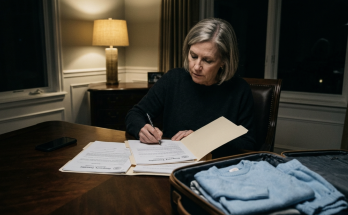
My sister’s house had never felt small until five of us arrived carrying overnight bags, plastic grocery sacks, school backpacks, and the silence of people who did not know whether they were guests or refugees. She had prepared the spare room for me and spread blankets across the living-room sofa for the children. Nothing matched. Nothing was organized. It was the safest place I had slept in years.
That first evening, nobody knew what to do with the quiet. At home, quiet had always meant somebody was angry. My children kept looking toward the hallway whenever a cabinet closed. My youngest flinched when my sister dropped a spoon into the sink. I watched each reaction and felt something inside me crack a little further.
My sister pretended not to notice. She made pasta, burned the garlic bread, complained about the smoke alarm, and asked the children ridiculous questions about whether burnt edges counted as seasoning. Slowly, almost reluctantly, they laughed. The sound startled me. I had not realized how little laughter remained in our house until I heard it somewhere else.
After dinner, my oldest asked whether we were staying there permanently.
“I don’t know yet,” I said.
The answer disappointed her.
I could see it immediately.
“I know that sounds uncertain,” I added. “But I do know we are not going back tonight.”
“Or tomorrow?” my youngest asked.
“Not tomorrow.”
“Next week?”
I looked at my sister.
She did not rescue me.
That was another kind of kindness.
“No,” I said. “Not next week either.”
The room changed.
My children exchanged glances.
It was the sort of silent communication siblings develop when they have lived with the same unpredictable adult. I had seen those looks before and assumed they were about chores, homework, secrets between them. Now I wondered how many had actually been warnings.
My son spoke first.
“What if Dad says sorry?”
The question went directly to the weakest part of me.
My husband had apologized many times. Sometimes with flowers. Sometimes with long messages. Sometimes with tears that seemed genuine enough to make me doubt my own memory. He knew exactly how to sound ashamed when consequences appeared.
“I don’t think sorry fixes what happened,” I said.
My son looked down at his plate.
“He always says sorry.”
The words were quiet.
My sister sat very still.
I asked, “What do you mean?”
My son shrugged.
“That’s what happens.”
“What happens?”
Nobody answered.
My youngest stared at the table.
My oldest finally said, “He gets mad. Then something happens. Then the next day he buys food or acts normal.”
The ease with which she described the pattern made me feel physically sick.
They had mapped the cycle more clearly than I had.
I had spent years distinguishing between bad incidents and good stretches. To them, the good stretches were simply part of the incident.
I forced myself not to react too strongly.
“What kinds of things happened?”
My oldest looked at me.
“You know.”
The answer carried no accusation, which somehow made it worse.
“I know some things,” I said. “Maybe not everything.”
My children went quiet again.
My sister stood. “I’m going to make tea.”
It was an unnecessary task, and we all knew it. She was giving them room to speak without another adult watching.
My youngest pulled her knees against her chest.
“Sometimes Dad would come into our rooms after you went to sleep.”
Every muscle in my body tightened.
“What did he do?”
“He’d ask what we told you.”
“About what?”
“About him.”
My son interrupted.
“He thought we were making you mad at him.”
I stared at them.
“What did he ask you?”
My oldest answered slowly.
“Whether we told you when he yelled at us.”
My son added, “Or when he grabbed us.”
My breath stopped.
“What?”
He looked away.
“It wasn’t like what he did to you.”
The sentence landed like a blow.
I moved closer.
“When did he grab you?”
My son rubbed his upper arm.
“When he thought I was lying.”
“How hard?”
He shrugged again.
I hated that shrug. It was the same one I used whenever someone asked about a bruise.
“Show me,” I said softly.
He hesitated.
Then he pulled up his sleeve.
There was no fresh injury, but he pointed to a spot near his shoulder.
“He’d squeeze here.”
My mouth went dry.
My oldest spoke next.
“He shoved me once.”
“When?”
“Last winter.”
“Why didn’t you tell me?”
She looked at me with genuine confusion.
“You were there.”
I felt as if the room had shifted under my feet.
I tried to remember winter.
There had been an argument in the hallway. My husband accusing her of rolling her eyes. Her door slamming. Him saying she had stumbled.
I had accepted that explanation because accepting it allowed the evening to continue.
“I didn’t see him push you,” I whispered.
“You saw me afterward.”
She was not angry.
She was simply telling the truth.
I pressed my fingers against my lips.
My sister returned with tea but did not interrupt.
My youngest leaned toward me.
“Mom, are you mad?”
“No.”
“At us?”
“Never.”
She seemed relieved enough that I wanted to cry.
“What else happened?” I asked.
This time the children spoke slowly, sometimes correcting one another, sometimes disagreeing over dates.
They described insults I had heard but dismissed as discipline.
They described punishments designed to keep them isolated.
They described my husband standing outside bedroom doors, demanding phones and passwords.
They described him telling them that if our marriage ended, it would be because they had encouraged me to disrespect him.
My youngest began crying before she finished.
“He said if you left, we’d lose the house.”
I reached for her.
“He said you couldn’t take care of us without him.”
My sister inhaled sharply.
I held my daughter against my chest.
“He was wrong.”
“Are you sure?”
The fear in her voice exposed the full reach of what he had built.
He had not only frightened them.
He had made himself seem necessary.
“Yes,” I said. “I’m sure.”
It was the strongest promise I had made since leaving the hospital, though I did not yet know how I would fulfill it.
My husband controlled most of our finances.
The house was in both our names, but he managed the mortgage.
The utilities.
The insurance.
The accounts.
Even my phone plan.
Whenever I had asked to become more involved, he joked that numbers made me anxious and told me he was saving me the stress.
Sitting in my sister’s living room, I understood the arrangement differently.
Control did not always announce itself with a fist.
Sometimes it arrived disguised as convenience.
That night, after the children were asleep, my sister found me at the kitchen table with a notebook.
I had written every financial account I could remember.
Bank.
Mortgage.
Credit card.
Insurance.
Retirement.
School expenses.
My sister pulled out the chair opposite me.
“You’re making a list.”
“I don’t know what we have.”
Her expression tightened.
“I know roughly.”
“Roughly isn’t enough anymore.”
She nodded.
“What do you need?”
“I need to know whether he can empty everything.”
My sister looked toward the dark hallway.
“We should call someone in the morning.”
“A lawyer?”
“Yes.”
The word felt enormous.
I had never spoken to one about my marriage.
“I don’t want this to turn ugly,” I said.
My sister stared at me.
“It already is ugly.”
I looked down.
“I know.”
“No,” she said gently. “You know it hurt. That’s different.”
I understood what she meant.
I was still treating legal action as an escalation rather than a response.
As though applying for protection might somehow be more aggressive than being tied to a beam.
The next morning, I called an attorney recommended by the hospital social worker.
Her office fit me in quickly.
She listened while I described the shed, the recording, the police response, the hospital, and my concerns about the children.
Then she asked a question that made my stomach tighten.
“Has he ever threatened to take them from you?”
“Yes.”
“How often?”
“A lot.”
“What does he say?”
“That he has the money. That he can afford better lawyers. That nobody will believe I’m stable if I leave.”
The attorney wrote something.
“Has he ever called you unstable in messages?”
I thought of the hospital.
“Yes.”
“Keep every one.”
Then she explained that what I had been experiencing involved overlapping forms of abuse: physical violence, coercive control, financial control, intimidation, and threats involving the children.
Hearing those categories spoken aloud made my marriage sound like a case study.
I hated that.
I also needed it.
Before I left her office, we began discussing emergency protective measures and temporary arrangements for the children.
The attorney warned me that once formal steps began, my husband might become more cooperative, more threatening, or alternate between the two.
“He may suddenly sound reasonable,” she said. “That doesn’t mean the risk has passed.”
I nodded.
My phone vibrated before I reached the parking lot.
A message from my husband.
I almost did not open it.
Then I remembered the attorney’s instruction to preserve everything.
I tapped the screen.
His message was calm.
No insults.
No threats.
I’m sorry things went too far. I love you. The children need both of us. Let’s sit down alone and talk before lawyers ruin our family.
I stared at the words.
For years, that tone had worked.
Then another message appeared.
Mom is willing to forgive what you said about her.
I actually laughed.
The sound surprised me.
My sister, waiting beside the car, raised an eyebrow.
“What?”
I showed her the screen.
She read it twice.
Then she looked at me.
“His mother is willing to forgive you?”
“That’s apparently the emergency.”
We both laughed.
It was not happiness.
It was the strange release that comes when manipulation becomes visible enough to seem absurd.
Then my phone rang.
My husband.
I declined it.
He called again.
I declined again.
A voicemail arrived.
I did not listen immediately.
We drove back to my sister’s house.
The children were at school.
The living room was empty.
I put the phone on the table and played the message on speaker.
At first, his voice was soft.
He said he loved me.
He said the shed had been a terrible mistake.
He said his mother was upset and confused.
Then his tone changed.
He told me I needed to stop talking to police.
He told me my sister was poisoning me against him.
He told me that if I forced him into a custody fight, he would make sure the court learned what kind of mother I really was.
The voicemail ended.
My sister reached for the phone.
“There.”
“What?”
“The shift.”
I looked at her.
“He couldn’t even finish one voicemail without threatening you.”
I replayed it.
She was right.
The tenderness and the threat occupied less than two minutes.
That evening, my attorney asked me to forward the message.
I did.
Twenty minutes later, she called back.
“We’re filing.”
I stood beside my sister’s kitchen window, looking at the dark yard.
“Today?”
“Yes.”
My heart began pounding.
For years, every attempt to protect myself had ended before it became visible.
A hidden savings envelope.
An unsent email.
A bag packed and unpacked.
A phone call canceled halfway through dialing.
This was different.
Once the papers were filed, he would know.
There would be no pretending we were simply taking space.
I closed my eyes.
“Do it.”
When I hung up, my youngest appeared in the doorway wearing pajamas.
“Mom?”
“Yes?”
“Are we staying here tonight?”
I looked at her.
“Yes.”
She nodded and went back down the hallway.
Such a small question.
Such a small answer.
But for the first time in years, I had given my child certainty before I had it myself.
Click here to continue reading: PART 6: My Husband Tried to Turn the Children Against Me, but One Message Revealed How Far His Control Really Reached
The Night My Husband Ordered Me Into the Shed, My Daughter Quietly Reached for Her Phone
Part 5 of 16