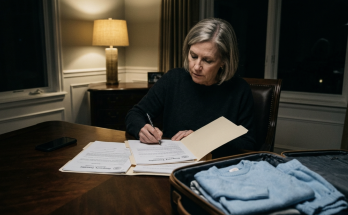
The divorce filing itself felt strangely anticlimactic.
After the shed, the hospital, courtrooms, recordings, hidden accounts and revelations from my mother-in-law, I expected signing the documents to produce something dramatic.
It did not.
My attorney placed several pages in front of me.
She explained each section.
I read them carefully.
Then I signed my name.
The pen made a soft scratching sound.
That was all.
Years of marriage reduced to ink.
I sat back and stared at the signature.
“Are you okay?” my attorney asked.
“I don’t know.”
“That’s allowed.”
I almost smiled.
I had become familiar with that phrase.
Allowed.
So many ordinary feelings had needed permission inside my marriage.
Anger.
Confusion.
Privacy.
Uncertainty.
Now people kept reminding me I was permitted to have them.
My husband had already indicated through counsel that he would contest portions involving finances and parenting.
No surprise.
He opposed language describing coercive control.
He disputed certain financial characterizations.
He wanted expanded contact.
He wanted less supervision.
Some disputes would resolve.
Others would take time.
I no longer interpreted delay as failure.
That was new.
During the marriage, I needed conflicts to end quickly because prolonged tension made the house dangerous.
Now a disagreement could remain unresolved while lawyers handled it.
Nobody needed to surrender before dinner.
The children continued therapy.
Supervised visits with their father happened cautiously.
The reports were mixed.
Sometimes he behaved appropriately.
He asked about school.
He played games.
He listened.
Those sessions left the children confused.
My son returned one afternoon almost cheerful.
“Dad was normal.”
I heard relief in his voice.
“That sounds nice.”
He looked at me as though expecting suspicion.
“It was.”
“You’re allowed to enjoy seeing him.”
He nodded.
Then his smile disappeared.
“Does that mean you were wrong?”
There it was.
The trap abuse creates for children.
If a harmful parent behaves lovingly, perhaps the harm was imaginary.
I chose my words carefully.
“No.”
“But if he can be nice—”
“He can.”
“Then why can’t we just live together?”
I sat beside him.
“Because being nice sometimes doesn’t make the unsafe times acceptable.”
He frowned.
“What if there aren’t any more?”
“I hope there aren’t.”
“So?”
“So he can learn to be safer without us living in the same house.”
My son considered that.
The possibility seemed new.
Change without reunion.
Improvement without reward.
My husband had always linked the two.
If he apologized, I was expected to return emotionally.
If he behaved well, the previous incident disappeared.
Now his good behavior could simply be good behavior.
It did not buy access to the old life.
My youngest struggled more.
She sometimes refused visits.
Other times she went but spoke very little.
After one session, she came home carrying a folded piece of paper.
“What’s that?”
“Dad gave it to me.”
My stomach tightened.
“What did the supervisor say?”
“He said Dad could give us drawings.”
“Can I see?”
She hesitated.
Then handed it over.
It was not a drawing.
It was a handwritten letter.
My heart sank.
The supervisor had apparently seen only the outside and assumed it was harmless.
The first lines were affectionate.
I miss you every day.
I think about our family constantly.
Then:
Sometimes adults make choices when they are scared, and later they regret them.
I read more slowly.
Your mother has been very afraid, and fear can make people remember things differently.
My pulse began pounding.
The next sentence was worse.
I hope someday you are old enough to understand that I was trying to keep our family together.
I stopped.
My daughter watched my face.
“Is it bad?”
I wanted to tear the page.
Instead, I folded it carefully.
“It’s something the adults need to talk about.”
“What did he mean?”
I looked at her.
“What do you think he meant?”
She picked at her sleeve.
“That maybe you remember the shed wrong.”
I breathed in.
“What do you remember?”
Her face changed immediately.
“I saw it.”
“Yes.”
“He tied you.”
“Yes.”
“Grandma was there.”
“Yes.”
“Then why did Dad write that?”
Because he needed reality to become flexible again.
Because losing control of the public story had not ended his need to influence the private one.
Because our daughter’s memory was now another territory.
“I think Dad is having trouble accepting that other people remember what happened differently from how he wants to describe it.”
My daughter looked angry.
“He knows I recorded it.”
“I know.”
“Then how can he say memory?”
I had no answer that would satisfy.
Some denial survived evidence because denial was not really about facts.
It was about identity.
My husband could admit he made a mistake.
He could admit he lost control.
He could admit I was frightened.
What he resisted was the idea that the incident belonged to a pattern.
A pattern required reinterpreting himself.
The letter went immediately to my attorney and the professionals managing contact.
The supervisor documented what happened.
Future materials were screened more carefully.
My husband complained that everyone was policing normal communication.
Then, a week later, he tried another route.
My oldest came home from a visit with a question.
“Dad says there might not be enough money for college now.”
I stopped chopping vegetables.
“What?”
“He said lawyers cost a lot.”
My jaw tightened.
“What else?”
“He said selling the house might be necessary because you want half of everything.”
I put down the knife.
My daughter watched me.
“I told him not to talk about money.”
“What did he say?”
“That I’m old enough to understand consequences.”
Consequences.
Another familiar word.
In our old home, consequences flowed toward everybody except the person causing harm.
His anger had consequences.
My questioning had consequences.
My leaving had consequences.
My legal action had consequences.
The violence itself somehow became background.
“You are not responsible for our finances,” I told her.
“I know.”
“Your father and I will handle it.”
“He said you might make us move.”
“We may move.”
Her face tightened.
“I thought you said we wouldn’t lose everything.”
“We won’t.”
“But the house?”
I looked at her.
The house.
For years, that building had represented continuity.
Now it was becoming a bargaining object.
Mortgage.
Equity.
Possession.
I decided not to lie.
“We might not keep the house.”
She looked down.
My heart hurt.
“But losing that house is not the same as losing our family.”
She did not answer.
Later that night, I found her crying.
“I wanted my room back.”
I sat beside her.
“I know.”
“My wall still has the marks where we measured height.”
“I know.”
“My books are there.”
“We can get your books.”
“That’s not the same.”
“No.”
I did not try to turn the loss into inspiration.
Some things simply hurt.
Leaving saved us.
It also cost us.
Both could be true.
Eventually, arrangements were made for me to retrieve more belongings under controlled conditions.
I had not returned to the house since the shed.
The idea made me physically ill.
My sister offered to go in my place.
I considered it.
Then decided I wanted to see the house once while it could no longer hold me.
We arrived with proper arrangements and another person present.
My husband was not there.
That mattered.
The front door opened.
The smell hit first.
Laundry detergent.
Old wood.
The faint vanilla scent from a candle I used to burn.
Home.
My body reacted before my mind.
I almost stepped backward.
My sister touched my shoulder.
“You want to leave?”
“No.”
We went inside.
Everything looked smaller.
The kitchen where I had turned off the faucet.
The hallway where my oldest had been shoved.
The stairs my children learned to climb quietly when their father was angry.
Ordinary spaces carrying invisible history.
I walked into my bedroom.
My side of the closet remained partly full.
Clothes hung where I left them.
A pair of shoes sat beneath a chair.
On the dresser was a photograph from our anniversary.
My husband had not removed it.
I picked it up.
We looked happy.
Maybe we had been.
That was another truth I had stopped fighting.
There were happy moments.
Real ones.
They did not cancel the harm.
Neither did the harm need every good memory to become fake.
I placed the photograph facedown.
My sister packed clothes.
I collected documents.
The children had given lists of items they wanted.
Books.
A stuffed animal.
A jewelry box.
A baseball glove.
Normal objects.
We moved through the rooms methodically.
Then I reached the backyard.
The shed stood at the far end.
My feet stopped.
My sister saw.
“No reason to go out there.”
“I know.”
I stared through the glass.
The shed door was closed.
The yard looked harmless.
Sunlight on wet grass.
A plastic chair.
A forgotten soccer ball near the fence.
The place where my daughter had hidden with her phone.
I opened the back door.
Cold air entered.
My sister said my name.
“I’m not going inside.”
I stepped onto the patio.
The yard seemed longer than I remembered.
I crossed halfway.
Then stopped.
That was enough.
I did not need to touch the beam.
I did not need to prove courage by entering the scene.
I simply needed to stand there because I chose to.
I turned back.
On the patio, I noticed something taped inside the window.
A piece of paper.
My husband’s handwriting.
Please come home.
My stomach tightened.
The message might have been there for days.
Weeks.
Perhaps he expected me eventually to return for belongings.
I removed it.
My sister watched.
“You keeping that?”
“Yes.”
“For evidence?”
I looked at the paper.
“No.”
“Then why?”
I tore it in half.
Then again.
“I’m tired of every message from him becoming sacred.”
I dropped the pieces into the trash.
It was a small act.
Pointless legally.
Important personally.
Not everything needed archiving.
Some things could simply end.
The children unpacked their belongings that evening.
My youngest hugged a stuffed rabbit against her chest.
My oldest placed books along the spare-room shelf.
My son found an old photograph from a family camping trip.
He looked at it for a long time.
“Can I keep this?”
“Of course.”
“Even though Dad’s in it?”
“Yes.”
He looked surprised.
“You don’t have to erase him.”
The words were for all of us.
The next supervised visit passed without incident.
Then another.
My husband began following the rules more consistently.
Reports said he was calmer.
More focused on the children.
Less argumentative.
I was glad.
Not hopeful about us.
Glad for them.
That distinction became easier.
One afternoon, my attorney called.
“We may be close to resolving major portions of the divorce.”
I sat down.
“What changed?”
“Reality.”
I almost laughed.
She explained that the financial evidence, testimony and court rulings had narrowed his options.
He was still disputing things.
Still negotiating.
But the fantasy that I would retract everything had weakened.
There would be no restoration of the old story.
No statement saying the shed was merely panic.
No agreement requiring silence.
My husband was beginning to negotiate from the world that existed rather than the one he demanded.
That evening, my youngest sat beside me on the sofa.
“Are you divorcing Dad?”
“Yes.”
She had known.
Still, hearing it made her eyes fill.
“Forever?”
“Yes.”
She leaned against me.
“Okay.”
Not relief.
Not devastation.
Just acceptance arriving slowly.
After a while she asked, “Are we still a family?”
I thought of my mother-in-law’s old warning.
If you leave, you might not be a real family.
I kissed my daughter’s hair.
“Yes.”
“Even if Dad lives somewhere else?”
“Yes.”
“Even if you don’t forgive him?”
“Yes.”
She was silent.
Then:
“That makes more sense.”
I smiled.
So did I.
Click here to continue reading: PART 15: The Final Agreement Could Not Give Us Back the Years We Lost, but One Choice Proved My Children No Longer Feared Him
The Night My Husband Ordered Me Into the Shed, My Daughter Quietly Reached for Her Phone
Part 14 of 16