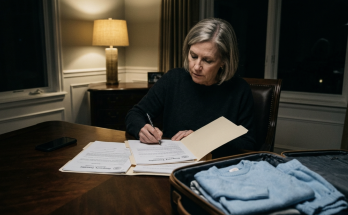
The mediation proposal arrived the following week.
My attorney warned me before sending the document.
“Read it when you’re somewhere calm.”
I almost laughed.
Calm had become a place other people seemed to live.
Still, I waited until the children were at school and my sister was home before opening the file.
The first page used language so polite that I had to read it twice.
Mutual resolution.
Best interests of the children.
Constructive co-parenting.
Privacy.
Stability.
If someone had seen only the proposal and nothing else, they might have thought we were two reasonable adults ending an unfortunate marriage.
Then I reached the conditions.
My husband would agree to temporary financial support.
He would participate in counseling.
He would accept supervised contact initially.
In return, I would agree not to characterize the shed incident as part of an ongoing pattern of abuse.
I sat back.
There it was.
He was willing to negotiate everything except the story.
My sister read over my shoulder.
“He wants you to say it was isolated.”
“Yes.”
“He has years of notes proving he knew there were problems.”
“Yes.”
“And he still wants you to help clean it up.”
“Yes.”
The next condition was worse.
Both parties would avoid making disparaging statements about the other parent to the children.
That sounded reasonable.
I agreed with it completely.
But attached language defined certain statements as disparaging.
Including telling the children their father was dangerous.
My stomach turned.
“How am I supposed to explain why they can’t be alone with him?”
My attorney had anticipated the question.
“You don’t accept that wording.”
I kept reading.
Another condition requested that certain recordings involving my husband and mother-in-law remain confidential beyond what was legally necessary.
My sister laughed without humor.
“Of course.”
The recording frightened them more than the bruises.
Bruises faded.
Sound traveled.
A bruise required explanation.
A recording carried voices.
My husband knew that.
He had built much of his control around privacy.
Family business.
Don’t tell people.
Nobody outside needs to know.
Now he wanted the same principle written into an agreement.
I closed the file.
“I’m not agreeing.”
My sister nodded.
My attorney called an hour later.
“I assumed you’d have concerns.”
“It’s not mediation. It’s reputation management.”
A pause.
“That’s a fair description.”
“Can I refuse?”
“Of course.”
“Will that make me look unreasonable?”
“No, not if we respond appropriately.”
There it was again.
The old fear.
Not what is safe?
Not what is true?
What will people think?
My husband had trained me to imagine an invisible jury in every room.
Neighbors.
Teachers.
Doctors.
Relatives.
Friends.
Now there was an actual legal process, and I still worried more about appearing difficult than about being protected.
“I want a reasonable agreement,” I said.
“We can propose one.”
“But I’m not lying.”
“You don’t need to.”
“I’m not calling the shed an isolated mistake.”
“You don’t need to.”
“And I’m not promising never to tell the children something is unsafe.”
“You shouldn’t.”
My breathing slowed.
I was still learning that negotiation did not require surrendering reality.
Our response proposed boundaries.
Supervised contact subject to professional guidance.
Financial disclosures.
Communication through approved channels.
No direct or indirect attempts to obtain our location.
No pressure on the children to carry messages.
No interference with therapy.
No requirement that I minimize past conduct.
We sent it.
My husband rejected most of it.
His lawyer’s reply emphasized that he had parental rights.
I understood that.
The phrase still frightened me.
Rights had been one of my husband’s favorite words when discussing marriage.
His right to know where I was.
His right to see my phone.
His right to make financial decisions because he earned more.
His right to discipline the children.
I had learned to hear the word as a threat.
My attorney reminded me that legal rights came with rules, oversight and responsibilities.
They were not the same thing as ownership.
That distinction mattered.
Around the same time, the financial review deepened.
The hidden accounts were not the only issue.
Several transfers from our shared savings had been made during periods when my husband told me we could not afford basic repairs.
Some money went into the separate account.
Some was used for the storage unit.
Some went toward legal consultations.
I stared at that last category.
“He talked to lawyers before I left?”
My attorney nodded.
“Several times, apparently.”
“How long ago?”
“The earliest we can document is a little over three years ago.”
I remembered that year.
Our anniversary dinner.
A family vacation.
Christmas photos.
He had been consulting attorneys while posing beside me with his arm around my waist.
“What was he asking them?”
“We don’t know everything. Privilege may limit what we can access.”
I understood.
Still, the fact itself rearranged memories.
My husband had always accused my sister of putting divorce ideas in my head.
He had claimed lawyers destroy families.
Yet he had quietly researched the same process.
One afternoon, a package arrived at my sister’s house.
No return address.
My heart began pounding before I touched it.
My sister told me not to open it.
We contacted my attorney.
The package was documented first.
Inside were photographs.
Family photographs.
The children as babies.
Our wedding.
Vacations.
Birthdays.
On top lay a note.
I thought you might want these since you are determined to erase me.
I stared at the handwriting.
There was no explicit threat.
That almost made it worse.
The package had reached an address my husband was not supposed to use to contact me directly.
My sister’s address was not a secret to him historically, but he had been warned against indirect contact.
My attorney documented it.
My husband later claimed he had only wanted me to have sentimental belongings.
Maybe that was true.
Maybe it was partly true.
Intent became another trap.
For years, I had allowed good intent to excuse harmful behavior.
Now I focused on effect and boundaries.
He had been told not to contact me outside approved channels.
He had done it anyway.
My therapist asked how the package made me feel.
“Watched.”
“Because he knows the address?”
“He always knew the address.”
“Then what changed?”
I thought about it.
“He wanted me to know he still knew where I was.”
The sentence came out before I could soften it.
That was exactly how it felt.
She asked whether there had been prior incidents involving monitoring.
I told her about the photographs from the storage unit.
Her expression remained calm, but she asked careful questions.
Did I remember unfamiliar cars?
Did my husband ever appear somewhere unexpectedly?
Did he know conversations I had not told him about?
I began remembering things.
A coffee meeting with a friend.
He had asked afterward whether I enjoyed complaining about him.
I assumed someone had seen us.
A trip to my sister’s house.
He knew what time I arrived though I never told him.
A pharmacy visit.
He later asked why I needed medication before I mentioned going.
Each memory had an innocent explanation if viewed alone.
Together, I no longer knew.
I told my attorney.
She advised caution.
“We document what you remember. We don’t assume more than we can support.”
Again, facts.
Not fear.
I clung to that.
Then something happened with my son.
He came home from school unusually quiet.
At dinner, he barely ate.
When I asked what was wrong, he said nothing.
Later, he came to my room.
“Dad sent someone.”
I sat upright.
“What do you mean?”
“A man talked to me outside school.”
My whole body went cold.
“What man?”
“He said he knew Dad.”
“What did he want?”
My son looked frightened.
“He asked if I missed him.”
“Did he give you a name?”
“No.”
“What else?”
“He said Dad wanted me to know none of this was my fault.”
I held very still.
“And?”
“He said grown-ups get confused and sometimes one parent makes the other look bad.”
My jaw tightened.
“Did he ask you anything?”
My son nodded.
“Whether you were talking about moving.”
I stood.
“Anything else?”
“Whether Auntie was still taking us to school.”
My hands began shaking.
My son saw.
“Am I in trouble?”
The question broke through my fear.
“No.”
I crouched in front of him.
“Absolutely not.”
“I answered some things.”
“That is not your fault.”
“I didn’t know.”
“I know.”
He started crying.
I pulled him against me.
He kept apologizing.
I realized he had inherited my reflex.
Something frightening happens.
Find the part that might be your fault.
Apologize before anyone asks.
I held him tighter.
“You did nothing wrong.”
This time, the sentence needed to be said.
Not stored.
Not assumed.
Repeated.
My attorney contacted the school and authorities.
Security footage helped identify the man.
He was someone connected socially to my husband.
When questioned, he characterized the conversation as casual concern.
My husband denied sending him.
We could not immediately prove otherwise.
That frustrated me so badly I barely slept.
My sister found me in the kitchen at two in the morning.
“You’re doing the thing.”
“What thing?”
“Trying to solve everything before sunrise.”
I looked at the stack of papers.
“I need to know whether he sent him.”
“Why?”
“Because if he did—”
“What changes?”
I stopped.
“If he did, he violated boundaries.”
“And if he didn’t?”
“Then some idiot decided to involve himself.”
“Either way, your son was approached. You reported it. The school knows.”
I stared at her.
“You’re very irritating at night.”
“I’m versatile.”
I almost smiled.
The incident altered the temporary arrangements again.
School staff became stricter about who could approach the children.
The children were reminded not to engage with adults who claimed to carry messages.
I hated teaching them that.
But I hated the alternative more.
My husband’s next move was softer.
A letter through the attorneys.
Not a legal proposal.
A personal letter.
He wrote that he finally understood how frightened I had been in the shed.
He wrote that he hated himself for causing that fear.
He said he was beginning therapy.
He said he had spent nights replaying his choices.
Then came a sentence that caught me.
I know you believe this was about control, but I was terrified of losing my family.
I read it several times.
It sounded true.
That was the dangerous part.
I believed he had been terrified.
I believed fear had driven some of his behavior.
But fear did not explain away rope.
Hidden accounts.
Monitoring.
Threats.
Children used as messengers.
The letter continued.
I was wrong, but I was not a monster.
I put it down.
That sentence lingered.
For years, I had needed him to be either good or monstrous.
If he loved the children, then perhaps he could not be abusive.
If he cried after hurting me, perhaps the harm was not who he really was.
If he had good qualities, perhaps leaving was unfair.
My therapist had challenged that thinking.
People did not need to be monsters to be dangerous.
They could be funny.
Generous.
Hardworking.
Afraid.
Loving in some moments.
And still unsafe.
I finished the letter.
At the end, my husband asked for one conversation.
Not alone.
Not in person.
A supervised video session with a mediator.
My attorney said it could be arranged if I wanted.
This time, I did not answer immediately.
I thought about what I needed.
Not what would calm him.
Not what would make me look cooperative.
What I needed.
“I’ll do it,” I said.
My sister looked surprised.
“Why?”
“Because I want to hear what he says when he can’t corner me.”
The video meeting happened three days later.
My husband appeared on screen wearing a plain shirt.
No suit.
No tie.
He looked tired.
For several seconds, neither of us spoke.
Then he said my name.
I felt the old pull.
Familiarity.
History.
The life we had built.
“I’m sorry.”
I nodded once.
He continued.
“I know that’s not enough.”
“No.”
His eyes dropped.
“I’m getting help.”
“I hope you do.”
He looked back up.
“I want my family.”
There it was.
Not malicious.
Not shouted.
Still the same phrase.
My family.
I answered carefully.
“The children are not something you get back because you’re sorry.”
His jaw tightened.
Only slightly.
“I’m their father.”
“Yes.”
“You can’t cut me out forever.”
“I’m not deciding forever today.”
He leaned closer to the camera.
“This is exactly what your sister wants.”
The mediator interrupted.
My husband apologized.
Then he tried again.
“I just want us to stop fighting.”
“We stopped living together.”
His face hardened.
“That’s not the same thing.”
For me, it was.
The fight had changed shape.
Then he said something I had heard countless times.
“Can’t we keep this between us?”
I looked at him.
“No.”
Silence.
His expression shifted.
Something like disbelief passed through it.
The answer was small.
One syllable.
But it destroyed the central rule of our marriage.
No more keeping it between us.
When the call ended, my hands were shaking.
But I had not apologized.
I had not comforted him.
I had not promised anything.
For the first time, we had spoken while witnesses remained present from beginning to end.
And for the first time, his sadness did not become my assignment.
Click here to continue reading: PART 11: My Daughter Finally Asked the Question I Feared Most, and My Answer Forced Me to Confront What Staying Had Taught Them
The Night My Husband Ordered Me Into the Shed, My Daughter Quietly Reached for Her Phone
Part 10 of 16