By the time the final settlement conference arrived, almost a year had passed since the night in the shed.
I measured the year in strange milestones.
The first night nobody checked the doors twice.
The first week my youngest slept until morning.
The first school event where I attended without scanning the parking lot.
The first time my son disagreed with me loudly and then froze, waiting for punishment that never came.
The first time my oldest slammed her bedroom door and reopened it immediately to apologize.
I told her doors survived.
So did mothers.
She stared at me.
Then laughed.
Recovery was full of moments like that.
Small behaviors revealing old fear.
Small responses building new rules.
The legal process moved more slowly than healing in some places and faster in others.
Financial disputes narrowed.
The hidden accounts were accounted for.
Property would be divided.
Neither side got everything requested.
The house would be sold.
That decision hurt the children most.
We discussed keeping it.
Financially, it made little sense.
Emotionally, I did not want it.
My youngest surprised me.
“I thought I wanted it.”
“What changed?”
She shrugged.
“I don’t like the backyard anymore.”
I knew what she meant.
We found a rental house near the children’s schools.
Smaller.
Older.
The kitchen cabinets were an ugly brown.
The living room carpet needed replacing.
The first time we toured it, my son complained there was no garage.
My oldest said her room was too small.
My youngest walked through every room.
Then asked, “Does Dad have a key?”
The property manager looked confused.
“No,” I said.
My daughter smiled.
“I like it.”
We moved in two months later.
My sister helped us paint.
The children chose colors.
My oldest picked something so dark I warned the room would look like a cave.
She said that was the point.
I let her.
My son put posters everywhere.
My youngest placed her desk near the window.
Not facing it.
That detail mattered.
At my sister’s house, she had positioned herself where she could see the street.
In our new home, she wanted sunlight.
The custody and contact arrangements evolved carefully.
My husband completed required programs.
He attended therapy.
He followed supervision rules more consistently.
Professionals recommended gradual changes in contact.
I did not oppose every step.
That surprised people.
Some relatives expected me to want him erased.
I did not.
I wanted the children safe.
If he could become a safer father within structured boundaries, I wanted that for them.
But I no longer confused their relationship with him and my relationship with him.
He could be their father.
He would not be my husband.
Those two truths could coexist.
My mother-in-law’s contact remained limited.
She continued counseling on her own.
She wrote letters to the children, screened appropriately.
At first, my youngest refused to read them.
Then one day she asked.
I handed her the latest.
My mother-in-law did not ask for forgiveness.
She wrote about school.
A recipe.
A flower she had planted.
At the end she said:
I am learning that saying I love you is not the same as making you feel safe.
My daughter read that line twice.
“She finally gets it.”
“Maybe.”
“Do you believe her?”
“I believe she’s trying to understand.”
“That’s not yes.”
“No.”
My daughter smiled faintly.
She had learned nuance.
That was not a lesson I ever wanted fear to teach her.
Still, I was proud of how carefully she thought.
The final settlement conference took place in separate rooms.
I was grateful.
I no longer needed to sit across from my husband to prove anything.
Attorneys moved between spaces.
Numbers changed.
Language was revised.
Parenting provisions were negotiated.
The process lasted hours.
My attorney returned with one issue repeatedly.
My husband wanted a clause emphasizing joint parental respect.
I did not object.
Then he wanted language stating that neither parent would discuss the legal proceedings with the children.
Too broad.
The children already knew what happened.
Pretending otherwise would recreate secrecy.
We proposed age-appropriate boundaries instead.
No using the children as messengers.
No sharing litigation strategy.
No blaming.
No pressure to take sides.
Truthful responses to their questions allowed.
My husband resisted.
Then accepted.
That mattered more than it might have looked.
The children would not be required to participate in denial.
Another issue involved family photographs and belongings.
I agreed to divide them.
Wedding photos.
Baby albums.
Holiday videos.
My husband wanted originals.
So did I.
We arranged copies.
For once, history did not need one owner.
Near the end of the day, my attorney returned carrying a revised draft.
“This may be it.”
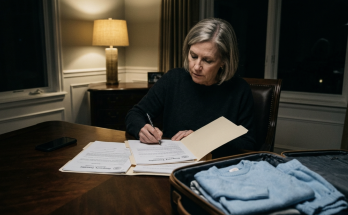
I read every page.
Finances.
Property.
Support.
Parenting.
Contact.
Communication.
Therapeutic recommendations.
No document could guarantee behavior.
But it established boundaries outside his control.
I reached the last page.
There was space for my signature.
My hand trembled slightly.
Not fear.
Something closer to grief.
The marriage had once been more than evidence.
More than legal language.
There had been the day we met.
His ridiculous joke on our first date.
The apartment with the leaking radiator.
Babies.
Christmas mornings.
Arguments over paint colors.
Road trips.
Private jokes.
Then slowly, fear.
I did not want to lie in either direction.
Leaving did not require me to declare every year meaningless.
It required me to accept that good memories could not obligate me to continue a dangerous future.
I signed.
My attorney looked at me.
“That’s your part.”
“What happens now?”
“His side signs, then final processing.”
I nodded.
No fireworks.
Again.
Just ink.
My husband signed later that day.
The final legal completion would follow formal procedure.
I drove home.
The children were waiting.
My sister had brought pizza.
Nobody asked for a speech.
I preferred that.
My oldest looked at me.
“Did you do it?”
“Yes.”
She hugged me.
My son joined.
Then my youngest.
We stood in the kitchen beside a stack of unopened moving boxes, all four of us holding on to each other.
My sister cleared her throat.
“This is very emotional, but the cheese is getting cold.”
We laughed.
It was the first family milestone that belonged entirely to us.
Weeks later, something happened that showed me the children had moved further than I realized.
My son had a school event.
My husband was permitted to attend under the existing arrangements.
I knew beforehand.
So did the children.
The old me would have spent the entire day imagining disaster.
Instead, we discussed logistics.
Where everyone would sit.
Who would drive.
What to do if anyone felt uncomfortable.
At the event, my husband arrived alone.
He looked older.
Maybe I did too.
He saw me across the auditorium.
For a second, our eyes met.
Then he looked away.
No confrontation.
No demand.
The program began.
Our son stood onstage with his class.
Halfway through, he spotted both of us.
His face changed.
Not fear.
Embarrassment.
He had forgotten a line.
He glanced toward me.
Then toward his father.
My husband smiled.
So did I.
Our son recovered.
Afterward, he ran toward us.
He stopped halfway.
I saw the old calculation appear.
Which parent first?
Whose feelings need protecting?
My chest tightened.
Then my son did something simple.
He walked to his father.
Hugged him.
Then came to me.
No apology.
No checking whether I was upset.
He assumed I could survive his love for his father.
I almost cried.
That was freedom too.
My husband spoke briefly.
“He did well.”
“Yes.”
A pause.
Then he said, “Thank you for bringing him.”
The old wording might have irritated me.
Bringing him.
As though permission belonged somewhere.
But I did not take the bait my own mind offered.
“He wanted us both here.”
My husband nodded.
There was sadness in his face.
Maybe regret.
Maybe loss.
It was no longer my job to identify it.
He left without argument.
In the car, my son looked at me.
“You’re not mad?”
“For what?”
“Hugging Dad first.”
“No.”
He stared.
“Really?”
“Really.”
He leaned back.
“Cool.”
The word nearly broke my heart.
Something so ordinary had once felt dangerous to him.
Later, my youngest asked whether Dad was getting better.
“I think he’s working on some things.”
“Will he ever be normal?”
I smiled faintly.
“Normal is a difficult word.”
“Will he ever not scare us?”
“I hope so.”
She looked at me.
“But we don’t have to wait for that?”
“No.”
That answer was the entire difference between my old life and the new one.
We did not have to remain close enough to be harmed while waiting for somebody else to change.
My final divorce decree arrived several weeks later.
The envelope sat on the kitchen counter for an hour before I opened it.
I expected emotion.
Instead, I read the document quietly.
Names.
Dates.
Legal language.
Marriage dissolved.
I touched the final page.
That was it.
My oldest came into the kitchen.
“Is it official?”
“Yes.”
“How do you feel?”
I thought about it.
“Lighter.”
“Sad?”
“Yes.”
“Happy?”
“A little.”
She smiled.
“You can be both.”
I looked at her.
“Yes.”
She had learned that from somewhere.
Maybe therapy.
Maybe watching me.
Maybe surviving.
That evening, we ordered takeout.
No celebration cake.
No dramatic toast.
The divorce was not a victory over my husband.
It was the legal recognition of a decision I had already made.
We would no longer organize our household around fear.
That was the victory.
Click here to continue reading: PART 16: A Year After the Shed, My Daughter Deleted the Video—and Showed Me That the Truth No Longer Needed to Control Us
The Night My Husband Ordered Me Into the Shed, My Daughter Quietly Reached for Her Phone
Part 15 of 16