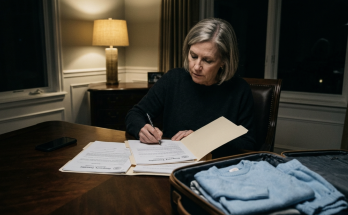
The anniversary came without warning.
I knew the date.
Of course I did.
But I had spent the week thinking about school schedules, work, groceries and whether the plumber would finally fix the dripping bathroom faucet.
Then I opened my calendar.
There it was.
One year.
For several seconds, I stood in the kitchen holding my phone.
The house around me was noisy.
My son was arguing with his sister about cereal.
My oldest was searching for a missing shoe.
My youngest had left a backpack directly in the hallway despite being told not to.
Normal chaos.
I almost laughed.
A year earlier, noise had meant danger.
Now it meant children running late.
I did not tell them the date immediately.
I did not want to turn it into a family holiday.
Trauma had already occupied too much space in their lives.
I went to work.
Answered emails.
Bought groceries.
Came home.
That evening, my youngest found me folding laundry.
“Mom?”
“Yes?”
“Do you know what today is?”
I looked at her.
“Yes.”
She nodded.
Neither of us said shed.
We did not need to.
She sat on the bed.
“I watched the video.”
My hands stopped.
“When?”
“Yesterday.”
I felt a surge of worry.
“Why?”
“I don’t know.”
She looked embarrassed.
“I wanted to see if it was how I remembered.”
My chest tightened.
Of course.
Even the person who recorded the truth had learned to question herself.
“What did you think?”
“It was worse.”
I sat beside her.
She stared at her hands.
“I forgot how Grandma sounded.”
I waited.
“I forgot Dad said you deserved to learn.”
Her voice became quieter.
“I remembered the rope.”
She looked at me.
“But I forgot his face.”
The recording had captured only fragments of him visually.
Still enough.
My daughter rubbed her palms together.
“I don’t want it on my phone anymore.”
I understood immediately.
“Okay.”
“But what if we need it?”
“The original evidence has already been preserved where it needs to be.”
“Are you sure?”
“Yes.”
She looked relieved.
Then uncertain.
“If I delete my copy, am I pretending it didn’t happen?”
The question hurt.
“No.”
“What if someday I forget parts?”
“You probably will.”
Her eyes widened.
“That’s okay?”
“Yes.”
I took her hand.
“Forgetting details is not the same as lying.”
She thought about that.
The video had become almost sacred in our family.
It had saved something essential.
Proof.
Not because I needed proof of my own pain.
Because the outside world sometimes needed facts.
The recording prevented my husband and mother-in-law from completely rewriting what happened.
It helped police.
Lawyers.
Courts.
Most of all, it broke the private rule that protected him.
But my daughter had started treating the video as though she needed to guard it forever.
She did not.
“Do you want me there when you delete it?”
She nodded.
We sat together.
She opened the file.
The thumbnail showed darkness, wood, part of the shed wall.
My stomach clenched.
She did not press play.
Her finger hovered.
“Mom?”
“Yes?”
“Were you really going to stay with Dad before that?”
The question surprised me.
“I don’t know.”
“You were planning to?”
“I wasn’t planning to leave that night.”
“So if he hadn’t done that…”
She let the sentence fade.
I understood.
The shed had been the point of no return.
But the marriage was already dangerous before it.
“I might have stayed longer.”
She looked sad.
“Then I’m glad I recorded it.”
I squeezed her hand.
“I’m glad you called for help.”
“That’s not the same.”
“No.”
She looked at the screen.
“I hate that it had to happen.”
“So do I.”
“But if it didn’t…”
“We don’t know.”
I interrupted gently.
“We don’t have to make what happened good just because something important came after it.”
She looked at me.
That idea seemed to settle somewhere.
The violence had not been a gift.
The recording had not made the suffering worthwhile.
We had simply done something with the truth afterward.
My daughter deleted the file from her phone.
Then she emptied the deleted folder.
The screen returned to her photos.
School pictures.
A ridiculous image of our cat.
A sunset.
A birthday cake.
Her life.
She exhaled.
“That felt weird.”
“Regret it?”
“No.”
She leaned against me.
“I just don’t want that to be the most important thing I ever did.”
I closed my eyes.
“It isn’t.”
“What is?”
“You haven’t done it yet.”
She smiled.
That was what I wanted for her.
A future larger than the bravest thing she did as a frightened child.
My own life had grown too.
I found work that gave me more control over my schedule.
I learned the finances.
Not perfectly.
I paid a bill late once and panicked.
Then discovered the world did not end.
I made a budget.
I made mistakes.
I corrected them.
Every ordinary financial decision disproved one of my husband’s oldest claims.
You can’t manage without me.
I could.
Not effortlessly.
Not without help.
But competence had never required isolation.
My sister still helped.
Friends helped.
Professionals helped.
I stopped confusing independence with never needing anyone.
The children continued their relationships with their father under structured arrangements.
Over time, supervision requirements changed according to professional guidance and court decisions.
Progress came unevenly.
There were good visits.
Difficult conversations.
Occasional attempts from him to return to old language.
When that happened, boundaries followed.
No drama.
No bargaining.
Action.
That consistency mattered.
My husband apologized to the children more directly over time.
Not perfectly.
At first, he still softened.
I was stressed.
I lost control.
I was afraid your mother would leave.
Eventually, according to the children, he managed simpler sentences.
I scared you.
I was wrong.
You did not cause it.
I did not hear those apologies myself.
I did not need to.
They belonged to the children.
My mother-in-law saw them occasionally after rebuilding contact slowly.
The first meeting with my youngest happened in a therapist’s office.
My daughter told me afterward that Grandma cried.
“Did that bother you?”
“No.”
“What did she say?”
“That she should’ve helped you.”
“How did that feel?”
My daughter shrugged.
“True.”
There was no dramatic reconciliation.
No embrace that erased history.
Trust returned in teaspoons.
A birthday card answered.
A supervised lunch.
A short phone call.
My mother-in-law had to live with the fact that remorse did not restore access instantly.
To her credit, she began accepting that.
I did not become close to her again.
Perhaps I never would.
Forgiveness, if it came, would not recreate the previous relationship.
I was no longer interested in rebuilding things exactly as they had been.
Some structures deserved replacement.
My ex-husband and I communicated mostly through a parenting application.
Messages remained practical.
Pickup times.
School events.
Medical appointments.
At first, every notification made my pulse spike.
Over time, it became simply a notification.
That change felt miraculous.
He still occasionally wrote something that carried the old edge.
Why wasn’t I told earlier?
You always make simple things difficult.
The difference was that I no longer answered the emotion hidden inside the logistics.
I responded only to what mattered.
Appointment is Tuesday at 3.
Pickup remains 5:30.
The school sent the notice to both parents.
Nothing more.
No defense.
No apology.
No attempt to convince him I was reasonable.
His opinion of me had stopped functioning as an emergency.
One afternoon, months after the divorce became final, we met briefly at a school event.
He approached after the children went inside.
For a second, my body stiffened.
Then he stopped several feet away.
“Can I ask you something?”
I considered saying no.
“What?”
“Did you ever think we’d end up here?”
I almost laughed.
The question was too large.
“No.”
He looked toward the school doors.
“I didn’t either.”
Silence.
Then he said, “I know you probably don’t believe I’m sorry.”
I waited.
Old instinct told me to rescue him from the discomfort.
I did not.
He continued.
“I blamed you for everything.”
“Yes.”
He looked at me.
No argument.
“I blamed my mother too.”
“Yes.”
“I still get angry.”
I almost smiled at the honesty.
“I know.”
He rubbed his hands together.
“But I know being angry doesn’t mean somebody has to fix it.”
The sentence startled me.
It was something a therapist might have taught him.
Maybe he finally understood.
Maybe he understood only in theory.
Either way, it was not mine to test.
“I hope you keep working on that.”
He nodded.
Then something unexpected happened.
He said, “I’m sorry about the shed.”
Not:
I’m sorry things went too far.
Not:
I’m sorry you were frightened.
Not:
I’m sorry we both made mistakes.
“I tied you up because I wanted to scare you into listening to me.”
My breath caught.
He looked at the ground.
“There wasn’t another reason.”
For one second, everything around us seemed quieter.
I had waited so long for him to say the truth plainly.
Now that he did, I discovered I did not need it as much as I once imagined.
“I know.”
He nodded.
“I know you know.”
We stood there.
Then he asked, “Can you forgive me?”
A year earlier, the question would have trapped me.
If I said no, was I bitter?
If I said yes, did that minimize what happened?
Now I understood forgiveness did not need to solve anything.
“I don’t know what forgiveness will mean for me.”
He looked disappointed.
I continued.
“But I don’t spend every day hating you.”
He seemed surprised.
“That’s the answer I have.”
He nodded.
“Okay.”
No demand.
No argument.
He walked away.
I watched him go.
I did not feel love.
I did not feel hatred.
I felt distance.
Safe distance.
That evening, I told my therapist about the conversation.
She asked whether his apology changed anything.
“No.”
Then I reconsidered.
“Maybe one thing.”
“What?”
“I realized I didn’t need him to say it anymore.”
She smiled slightly.
“That sounds significant.”
It was.
For years, I thought healing would arrive when the people who hurt me finally agreed with my version.
My husband.
His mother.
Relatives.
Courts.
But evidence had proved the facts long before everybody emotionally accepted them.
Healing came later.
In quieter forms.
My daughter sleeping.
My son disagreeing without flinching.
My oldest loving both parents without apologizing.
Me opening a bank statement without panic.
A locked door I controlled.
A home where anger did not determine the rules.
On the anniversary weekend, we went to my sister’s house for dinner.
She had become too important to call merely my sister anymore.
She was part emergency contact, part accountant, part taxi driver, part unwanted philosopher.
The children adored teasing her.
Halfway through dinner, my youngest lifted her glass of soda.
“I want to make a toast.”
My sister groaned.
“She gets this from you.”
“I do not make toasts.”
“You would if people let you.”
My daughter rolled her eyes.
“Can I talk?”
We quieted.
She looked around the table.
“To not living in the shed house.”
My breath caught.
My sister smiled.
My son lifted his glass.
“To Mom’s ugly brown cabinets.”
“They came with the house.”
My oldest added, “To doors we’re allowed to slam.”
“You are absolutely not encouraged to slam doors.”
“Allowed is different.”
She grinned.
I raised my glass.
“To allowed being different.”
We laughed.
That was the closest we came to commemorating the anniversary.
No speech about survival.
No declaration that pain made us stronger.
I did not want to romanticize what happened.
We were stronger in some ways.
More fragile in others.
The children carried things they should never have had to learn.
So did I.
But our lives were ours again.
Before bed that night, my youngest came into my room.
“Do you ever think about the video?”
“Sometimes.”
“Do you wish I didn’t delete it?”
“No.”
She nodded.
“I’m glad.”
She started toward the door.
Then stopped.
“Mom?”
“Yes?”
“If something bad happens again, would people believe us without a video?”
The question showed how deeply the past remained.
I thought carefully.
“Sometimes evidence helps.”
She waited.
“But you never need permission from a recording to tell the truth.”
She looked at me.
“And if somebody doesn’t believe me?”
“You keep telling someone safe until somebody listens.”
She nodded.
“Okay.”
She left.
I sat alone for a while.
A year earlier, I had been tied to a beam believing survival meant enduring five more minutes.
My daughter had been outside holding a phone with shaking hands.
My husband believed the family secret would remain inside the yard because it always had.
He was wrong.
But the deepest change was not that the secret got out.
It was that we no longer lived according to it.
The shed became evidence.
Then history.
It was not our identity.
My daughter was not the child with the video.
My son was not the boy who feared his father’s grip.
My oldest was not the girl I failed to protect quickly enough.
I was not the woman tied to a beam.
Those things happened to us.
They mattered.
They changed us.
But they were not the end of the sentence.
One Sunday afternoon, months later, we drove past the old neighborhood.
Not intentionally.
A road closure diverted traffic.
The children recognized it before I did.
My youngest went quiet.
The old house appeared at the end of the block.
A different car stood in the driveway.
The house had been sold.
Someone else lived there now.
The backyard fence had been repainted.
From the street, I could see the top of the shed.
My hands tightened briefly around the steering wheel.
“Want me to turn?” I asked.
My oldest looked toward the house.
“No.”
My son said nothing.
My youngest stared longest.
Then she leaned back.
“It looks smaller.”
I knew exactly what she meant.
We drove past.
Nobody asked to stop.
At the next intersection, my son began complaining about hunger.
My oldest changed the music.
My youngest laughed at something on her phone.
The house disappeared behind us.
I did not look in the mirror.
For years, I believed leaving would destroy our family.
What destroyed us slowly was fear.
Leaving gave us the chance to become something else.
Not the family we had pretended to be.
The family we actually were.
Complicated.
Changed.
Still healing.
Still connected.
Alive inside our own choices.
And finally, no longer silent.
The End
Read more original stories on Feel Every Story.
The Night My Husband Ordered Me Into the Shed, My Daughter Quietly Reached for Her Phone
Part 16 of 16