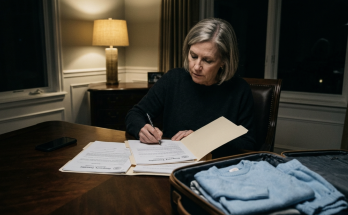
The morning of the hearing, I woke before the alarm and lay still in my sister’s spare room, staring at the ceiling while the house remained dark.
For once, nobody had woken me.
No footsteps in a hallway.
No phone vibrating.
No child checking the window.
Just my own body anticipating something it could not control.
Three days earlier, my mother-in-law had formally changed parts of her statement.
My attorney warned me not to build hope around it.
“She may narrow what she says.”
“She may panic.”
“Yes.”
“She may protect him again.”
“Yes.”
I nodded.
The old version of me would have spent the next three days trying to predict which woman would appear in court.
The one who had admitted the truth in the conference room.
Or the one who had spent years defending her son.
This time, I refused to make my stability depend on her courage.
Her testimony mattered.
But my safety no longer rested on it.
By the time we reached the courthouse, my oldest daughter had already texted me twice.
Good luck.
Then:
You don’t have to be scared of him.
I read the second message several times.
It was sweet.
It was also backward.
Children should not have to remind their mothers they are allowed to be safe.
Still, I kept the message open as I walked through security.
My husband was waiting near the courtroom.
He looked different.
Not dramatically.
Nobody else might have noticed.
But I knew the signs.
His shoulders were too rigid.
His lips were pressed together.
He kept checking his phone even though there was nothing on the screen.
He had lost some of the smoothness he carried at the first hearing.
Then his mother arrived.
She came alone.
My husband saw her.
His entire body changed.
He stood.
She stopped several yards away.
For a second, neither moved.
The hallway was busy with attorneys, clerks and families, yet that strip of space between them seemed strangely empty.
My husband spoke first.
“Mom.”
She did not answer.
His attorney immediately approached and said something I could not hear.
My mother-in-law shook her head.
Then my husband took one step toward her.
“You talked to them?”
My attorney touched my arm.
“Don’t engage.”
I had no intention of it.
My mother-in-law looked at her son.
“I told them what I remembered.”
His face went pale.
“You lied.”
The word came softly.
That was the voice I feared most.
Not the shouting.
The quiet one.
His mother took a step backward.
His attorney intervened.
My husband turned away.
But before he did, I saw the expression on his face.
Not heartbreak.
Betrayal.
He believed truth belonged to him until somebody else used it.
Inside the courtroom, the early testimony dealt with finances.
The hidden accounts.
The storage unit.
The transfers.
His lawyer argued that many of the accounts were legitimate personal savings and that I had benefited from his careful financial management.
My attorney did not need to prove every dollar had been concealed for a sinister purpose.
She established something simpler.
I had not known.
My husband admitted that.
He said I did not enjoy managing money.
My attorney asked whether I had ever requested more access.
“I don’t remember.”
She produced messages.
One from me three years earlier.
Can you please give me the login? I hate not knowing what’s going on with our savings.
His reply:
Stop worrying. I have it handled.
He shifted in his chair.
Another message.
I want to understand the bills too.
His answer:
Why are you suddenly acting like you don’t trust me?
I had forgotten both exchanges.
Seeing them projected into the courtroom brought back the emotions immediately.
The guilt.
The retreat.
The apology I sent afterward.
Sorry. I’m stressed.
My husband had taught me to apologize for requesting information about our own finances.
Then came the notebook from the storage unit.
The entry was read aloud.
She tried to leave. Got her calm. Need to secure things before next time.
My husband’s attorney argued that the note could refer to practical planning.
My attorney asked what “secure things” meant.
My husband said finances.
“Why?”
“Because my wife had threatened to leave unexpectedly with our children.”
I stared at him.
There it was again.
My fear becoming his justification.
My attorney asked whether I had ever threatened to prevent him from seeing the children permanently.
“No.”
Whether I had ever hidden them.
“No.”
Whether I had ever emptied joint accounts.
“No.”
Whether I had ever filed a false report against him.
“No.”
“So what specifically did you need to secure against?”
His jaw tightened.
“My family being taken away.”
The judge looked toward him.
My attorney paused.
“You considered your wife leaving a threat against you?”
He corrected himself immediately.
“I considered her taking the children without discussing it a threat.”
It was polished.
But the first answer remained.
My family being taken away.
Ownership again.
Then the hearing moved to the photographs.
My husband admitted hiring the private investigator.
He said he had been worried I might leave town with the children.
My attorney asked whether I had ever said I intended to leave town.
“No.”
Whether I had relatives in another state I planned to stay with.
“No.”
Whether I had bought tickets.
“No.”
Whether I had researched relocation.
“Not that I knew.”
“So what evidence supported your concern?”
He looked toward his lawyer.
“My wife was unpredictable.”
That word again.
Unpredictable.
Unstable.
Emotional.
Words broad enough to make any resistance sound dangerous.
My attorney asked whether I had been photographed buying groceries.
He looked irritated.
“I didn’t control what the investigator photographed.”
“Did you stop the surveillance when you saw she was continuing normal daily activities?”
“No.”
“How long did it continue?”
“Several weeks.”
I felt sick despite already knowing.
Several weeks of school drop-offs.
Pharmacy trips.
Visits to my sister.
All watched.
Then my mother-in-law was called.
She walked slowly to the witness stand.
My husband did not look at her.
She swore to tell the truth.
My attorney began carefully.
“Were you present on the night of the shed incident?”
“Yes.”
“Did you previously testify about that night?”
“Yes.”
“Was everything you said previously accurate?”
A pause.
“No.”
My husband looked up.
The movement was sharp enough that several people noticed.
My mother-in-law continued.
“I left things out.”
“What did you leave out?”
She stared at her hands.
“That I knew there had been problems before.”
My attorney asked what kind.
My mother-in-law hesitated.
“His temper.”
“Had you ever seen him become physically aggressive toward his wife before the shed?”
My husband’s lawyer objected.
The court addressed the scope.
The question was permitted in a limited form.
My mother-in-law swallowed.
“Yes.”
The word entered the room quietly.
My husband’s face changed.
She described the garage.
Not perfectly.
She did not remember every detail.
She did remember returning for her purse.
She remembered seeing her son with me pressed against the car.
She remembered that I looked afraid.
She remembered leaving.
My attorney asked why.
“I was scared.”
“For whom?”
My mother-in-law looked toward me.
“At first, myself.”
I appreciated the answer precisely because it was ugly.
No polishing.
No attempt to seem brave.
She had left because she was afraid.
Then my attorney asked whether she called anyone.
“No.”
Police?
“No.”
My family?
“No.”
A doctor?
“No.”
“What did you do?”
“I called her later.”
“And when she said she was fine?”
“I let myself believe her.”
My husband shifted.
His mother noticed.
She looked at him.
For one second, they were no longer witness and respondent.
They were mother and son.
He mouthed something.
I could not hear.
She could.
Her face tightened.
My attorney continued.
“Did you see injuries at other times?”
“Yes.”
“Did you ask your son about them?”
“Sometimes.”
“What did he say?”
“That she bruised easily. That they argued. That she exaggerated.”
“And did you accept those explanations?”
“Yes.”
“Why?”
My mother-in-law took several seconds.
“Because believing him meant I didn’t have to do anything.”
My throat tightened.
That sentence contained more accountability than all the apologies she had offered before.
My husband stopped looking at her.
The cross-examination began.
His attorney emphasized uncertainty.
Had she personally seen every injury occur?
No.
Had she ever seen me strike my husband?
No.
Had she sometimes heard me raise my voice?
Yes.
Had I complained about the marriage?
Yes.
Had she recently been upset because her son blamed her for the recording?
“Yes.”
“Could that resentment be affecting your testimony?”
My mother-in-law looked toward my husband again.
“I’m angry with him.”
His attorney paused.
“Then yes?”
“No.”
She sat straighter.
“I’m angry because he did what he did.”
The answer changed the room.
His attorney tried another direction.
Was she hoping to repair her relationship with me and regain access to the grandchildren?
“Yes.”
“Then you have a reason to tell her what she wants to hear.”
My mother-in-law nodded.
“I do want to see them.”
My stomach tightened.
“But lying is how I lost them.”
The attorney stopped.
My mother-in-law continued before anyone asked.
“I spent years telling myself keeping quiet was protecting my family.”
Her voice shook.
“It wasn’t.”
My husband whispered something to his lawyer.
The lawyer touched his arm.
He pulled it away.
I knew that motion.
It meant control was slipping.
The court took a short recess.
We moved into the hallway.
My attorney told me to stay close.
My husband came out several minutes later.
His mother was farther down the corridor speaking with her own counsel.
He saw her.
“Are you happy now?”
The voice carried.
His attorney immediately told him to stop.
His mother turned.
He kept going.
“You think they’re going to let you see the kids because you stabbed me in the back?”
Security moved closer.
His mother froze.
“I told the truth.”
“You told her version.”
My husband pointed in my direction.
My heart started pounding.
“You always hated my marriage.”
His mother stared at him.
“That’s not true.”
“You ruined this.”
Then something happened I had never seen before.
My mother-in-law did not soothe him.
She did not lower her voice.
She did not tell everyone he was stressed.
She said, “No.”
He stopped.
“You did.”
The words hung between them.
My husband’s face twisted.
“You’re my mother.”
“Yes.”
“You’re supposed to stand by me.”
She began crying.
“I did.”
She wiped her face.
“For too long.”
My husband stepped toward her.
Security intercepted him immediately.
He did not touch her.
He did not need to.
The transformation was visible.
The calm man from the witness stand disappeared.
His voice rose.
“This is all because of her.”
He pointed toward me again.
“Everything was fine until she started poisoning everybody.”
My body reacted.
I could feel the old instinct ordering me to disappear.
Do not look at him.
Do not make him angrier.
Do not answer.
My attorney moved slightly in front of me.
My sister took my hand.
Security instructed him to step back.
He argued.
His lawyer urged him to stop.
He shouted that nobody understood what I had done to his family.
People in the hallway turned.
A court officer approached.
And then I realized something.
He was doing exactly what he had always feared.
Humiliating himself in public.
Nobody had forced him.
No recording had tricked him.
No wife had provoked him.
His mother had told a truth he disliked, and his response appeared in front of everyone.
The anger.
The blame.
The entitlement.
The immediate need to identify a person responsible for his feelings.
Eventually he was taken to a separate area until proceedings resumed.
My knees began shaking only after he disappeared.
My sister led me to a bench.
“You okay?”
“No.”
“But?”
I breathed slowly.
“But he didn’t get near me.”
“No.”
“He couldn’t make everyone leave.”
“No.”
“He couldn’t change what happened.”
“No.”
I looked toward the door through which he had been escorted.
For years, I had believed his rage could alter reality.
If he became angry enough, eventually someone apologized.
Someone backed down.
Someone changed the story.
Today, he had become angry in a building structured around rules he did not control.
The hearing resumed.
The judge addressed the hallway incident only as appropriate to the proceedings.
The final temporary orders became more restrictive.
Supervised contact continued.
Communication remained controlled.
Financial protections were strengthened.
Further evaluation and proceedings were scheduled.
Nothing was permanently resolved yet.
But another layer of uncertainty had fallen away.
Outside the courthouse, my mother-in-law stood alone.
She saw me.
I stopped several yards from her.
My sister remained beside me.
My mother-in-law did not approach.
“I’m sorry,” she said.
I nodded.
She waited.
Maybe for forgiveness.
Maybe for something warmer.
I had nothing to give.
Not yet.
“Thank you for telling the truth.”
Her face folded slightly.
Then she nodded.
It was enough.
That evening, my youngest asked whether Grandma had helped.
“She told the truth.”
“Everything?”
“I don’t know if anybody tells everything all at once.”
My daughter considered that.
“Did Dad get mad?”
I hesitated.
“Yes.”
She looked worried.
“Did he hurt anyone?”
“No.”
“Why not?”
The question was simple.
I answered it just as simply.
“Because there were people there who stopped him from doing whatever he wanted.”
She stared at me.
Then nodded.
That night, I understood why the answer mattered.
Safety was not the absence of anger.
My husband might remain angry for years.
Safety was no longer organizing our lives around appeasing it.
Click here to continue reading: PART 14: As the Marriage Finally Ended on Paper, My Husband Made One Last Attempt to Rewrite the Past Through Our Children
The Night My Husband Ordered Me Into the Shed, My Daughter Quietly Reached for Her Phone
Part 13 of 16