After the hearing, my husband stopped contacting the children directly.
For four days.
The silence felt unnatural.
My children became restless rather than calm.
My youngest checked her phone repeatedly.
My son asked whether Dad was angry.
My oldest said very little.
We had lived so long expecting disruption that quiet itself became suspicious.
On the fifth morning, the disruption came from an unexpected direction.
My attorney called.
“We need to talk about the finances.”
I was packing school lunches.
The knife in my hand stopped over a loaf of bread.
“What happened?”
“We received preliminary disclosures.”
I put the knife down.
“And?”
A pause.
“There are accounts you didn’t know about.”
I sat.
My sister, across the kitchen, noticed immediately.
“How many?”
“Several.”
I closed my eyes.
My husband had always told me our finances were simple.
One checking account.
One savings account.
Retirement.
Mortgage.
Normal household debt.
He complained constantly that money was tight.
Vacations were too expensive.
Repairs had to wait.
The children’s activities needed to be considered carefully.
Whenever I bought something unnecessary, even something small, he reminded me that one income could not carry irresponsible spending.
“What kind of accounts?” I asked.
“Investment accounts. Another savings account. There may be more.”
My pulse began pounding.
“How much?”
“We’re still verifying.”
“Give me a number.”
She hesitated.
Then she did.
I stared at the table.
My sister mouthed, What?
I shook my head.
The amount was not enough to make us wealthy.
It was enough to change years of memories.
Every time he had said we could not afford something.
Every argument over school costs.
Every month I had worried whether buying new shoes for the children would upset the budget.
All while he had money I did not know existed.
“How long?”
“Some accounts go back several years.”
I felt something colder than anger.
Calculation.
Violence could be impulsive.
This was not.
This required planning.
Statements.
Transfers.
Passwords.
Repeated decisions to keep me uninformed.
My attorney continued.
“There are also transfers we want explained.”
“To where?”
“We don’t know yet.”
I stood and began pacing.
“Can he move the money?”
“There are restrictions we can request. We’re working on that.”
“What if he already did?”
“We’ll trace what we can.”
Trace.
Another word that made my marriage sound like an investigation.
After we hung up, my sister asked what was wrong.
I told her.
She leaned back against the counter.
“You knew he controlled the money.”
“Not like this.”
I remembered asking him once why our savings grew so slowly.
He had snapped that I had no idea what it cost to support a family.
Then he spent two days barely speaking to me.
I had apologized.
Not because I had done anything wrong.
Because the silence had become unbearable.
Now I wondered whether the punishment had served another purpose.
Questions about money were dangerous because money contained evidence.
My sister poured coffee into a mug and slid it toward me.
“You okay?”
“No.”
It was becoming easier to say.
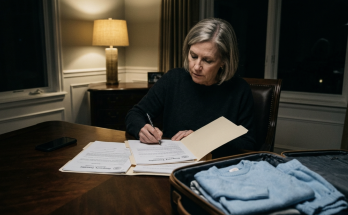
At the attorney’s office later that week, I saw statements printed across a long conference table.
Dates.
Balances.
Transfers.
Numbers I should have known years earlier.
My attorney pointed to one account.
“This was opened solely in his name.”
“When?”
She told me.
The date meant something.
I stared at it.
“That was after I tried to leave the first time.”
My attorney looked up.
“You tried to leave before?”
I had mentioned threats.
I had not described that night in detail.
“It was about four years ago.”
“What happened?”
“I packed bags.”
“For yourself?”
“For me and the kids.”
“And?”
“He found them.”
My attorney waited.
“He cried.”
I almost laughed at how absurdly small the sentence sounded.
“He said his father abandoned the family when he was young. He said I was doing the same thing. He promised counseling.”
“Did you go?”
“Twice.”
“What happened after that?”
“He said the counselor was biased.”
My attorney tapped the date on the statement.
“And soon afterward, he opened this account.”
I looked at the paper.
The timing was too clean.
“What are you thinking?” she asked.
“That he believed I might leave again.”
My attorney nodded.
“And wanted resources you couldn’t access.”
The room went quiet.
I had interpreted the period after my attempted departure as reconciliation.
He had interpreted it as risk management.
The difference sickened me.
There were other transfers.
Smaller ones.
Regular ones.
Money moved away from shared accounts into places I never saw.
At the same time, he increased his scrutiny over my spending.
He required explanations for grocery totals.
He questioned fuel costs.
Once, he accused me of being careless because I bought our daughter a winter coat without waiting for a sale.
I remembered standing in the kitchen defending a forty-dollar purchase while he had thousands hidden elsewhere.
My attorney watched me study the statements.
“Financial control often works by creating dependency.”
I hated the phrase because it fit too well.
“He told me I couldn’t survive without him.”
“Did you believe him?”
“Yes.”
“Do you still?”
I looked at the numbers.
“No.”
But belief did not disappear simply because evidence arrived.
Part of me still heard his voice when I thought about rent, school costs, insurance, legal fees.
You have no idea how the world works.
You can’t handle money.
You need me.
The next discovery came from my own credit report.
There was a card I did not recognize.
Opened years earlier.
My name was attached.
I stared at the document.
“I never opened this.”
My attorney’s expression changed.
“Are you sure?”
“Yes.”
She asked whether I might have signed paperwork without remembering.
“No.”
Then I remembered something.
A folder.
Insurance papers.
My husband placing tabs beside signature lines.
He had told me they were routine.
I had signed because the children were late for school.
My stomach turned.
“Could he have put something in front of me?”
“Possibly.”
I pressed my fingertips against my forehead.
I had thought financial control meant not giving me enough information.
Now I understood how easily ignorance could be turned into consent.
The legal process around the account became another thread.
Documents were requested.
Records preserved.
Questions sent through attorneys.
My husband responded angrily.
He said the accounts were private because they came from his earnings.
He said I was using the court process to punish him.
He said the credit card had been for family expenses.
Every explanation followed the same pattern.
He had acted.
I was unreasonable for objecting.
My attorney asked whether I wanted to pursue a more complete forensic review.
I looked at the cost estimate.
My immediate instinct was panic.
“We can’t afford this.”
Then I stopped.
We.
There was no we.
Not in the old sense.
I corrected myself.
“I don’t know if I can afford it.”
My attorney explained the options.
My sister later offered to help with part of the initial cost.
I resisted.
She looked annoyed.
“You’re allowed to accept help.”
“I already live in your house.”
“So?”
“The kids are here.”
“So?”
“You’re doing everything.”
“So?”
I almost smiled.
She folded her arms.
“You spent years being taught that needing anything made you a burden.”
I looked at her.
“You’re very annoying.”
“I know.”
I accepted the help.
The financial review uncovered another detail.
Payments to a storage facility.
Regular.
Monthly.
For nearly three years.
I had never known my husband rented storage.
My attorney asked whether I recognized the company.
“No.”
“Could it be work-related?”
“Maybe.”
But something bothered me.
My husband kept everything.
Old tools.
Documents.
Boxes from appliances we no longer owned.
If he had rented storage, he would have complained about the cost.
Unless he did not want me to know.
My attorney requested information through the proper channels.
The answer took time.
Meanwhile, my husband’s approach shifted again.
Through his attorney, he proposed mediation.
He offered to release some funds for household expenses.
He wanted structured contact with the children.
He said he was willing to attend an intervention program.
The proposal looked reasonable on paper.
That made it more dangerous emotionally.
Part of me wanted to believe it.
What if the court had frightened him into changing?
What if losing access to the children had finally forced him to understand?
What if the shed truly became the worst thing he ever did because he never did anything like it again?
I hated those questions.
Not because they were foolish.
Because they sounded exactly like the questions that had kept me inside the marriage.
My therapist—the first one I had seen alone—asked me something simple.
“If he changes, does that obligate you to return?”
I stared at her.
“No.”
“Then you don’t need to determine today whether he is changing.”
The idea was liberating.
I had spent years believing his future improvement determined my obligations.
Now, perhaps, his improvement could belong to him.
Whether he changed or not, I could still leave.
At home that evening, my oldest found me reviewing financial papers.
“What’s all that?”
“Money stuff.”
“Dad stuff?”
I nodded.
She sat across from me.
“Are we poor?”
The question hurt.
“No.”
“Dad always said we almost were.”
“I know.”
“Were we?”
I looked at the statements.
“No.”
Her eyes narrowed.
“So he lied?”
“About some things.”
She stared at the papers.
“Why?”
I wanted to protect her from adult complexity.
But I also did not want to repeat the old family rule: conceal anything uncomfortable.
“I think he wanted me to believe I couldn’t leave.”
She was quiet.
Then she said, “That’s weird.”
I almost laughed.
“Yes.”
“We would’ve stayed even if we were poor.”
I looked at her.
“What?”
“With you.”
She shrugged.
“We don’t care about the house.”
I could not speak for several seconds.
The house had been one of my strongest chains.
The children’s rooms.
Their schools.
The backyard.
The routines.
I had treated all of those things as proof that staying protected stability.
My daughter had just told me the structure mattered less than the person inside it.
Three days later, my attorney called again.
“We got information on the storage unit.”
I stood near the window.
“And?”
“It’s in his name.”
“What’s inside?”
“We don’t know yet.”
“Then why are you calling?”
“Because of when he rented it.”
She gave me the date.
I stopped breathing.
It was the week after I had packed those bags four years earlier.
The same period when he opened the hidden account.
Two preparations.
Money I could not reach.
A place I did not know existed.
My attorney spoke carefully.
“We should not assume what it means until we know more.”
“I know.”
But the pattern had already become impossible to ignore.
The first time I tried to leave, my husband had not only persuaded me to stay.
He had quietly prepared for the possibility that one day persuasion might fail.
Click here to continue reading: PART 9: The Storage Unit Contained More Than Hidden Property, and One Envelope Showed How Long My Husband Had Been Preparing Against Me
The Night My Husband Ordered Me Into the Shed, My Daughter Quietly Reached for Her Phone
Part 8 of 16