Daniel stood near the living room doorway.
He looked around.
Then he glanced at me.
“You moved some things.”
I nodded.
“I changed the furniture a little.”
He looked toward the chairs.
“It looks good.”
“Thank you.”
It was an ordinary exchange.
Nothing important.
Yet I noticed how different it felt.
Six months earlier, he had spoken to me as though he had a right to decide how I used my own home.
Now he was simply a guest noticing that something had changed.
I liked that difference.
Oliver was still asking about the garden.
He wanted to know whether the roses had grown taller.
He wanted to know whether the flowers he had helped water were still blooming.
I told him we would go outside after dinner.
He accepted that.
Then he looked around the room.
“Grandma, where did the chair go?”
I smiled.
“I moved it.”
He seemed satisfied.
Children had a way of noticing the smallest changes.
Things adults stopped seeing.
Marissa remained near the doorway for a moment.
I could tell she was uncomfortable.
I understood.
The last time she had been in the house, she was carrying Oliver's backpack while the movers loaded their belongings.
She had been angry with me.
She had accused me of refusing to help.
Now she was standing in the same hallway as a visitor.
I wondered how that felt to her.
But I did not ask.
She could decide what she wanted to say.
I did not need to make the conversation easy for everyone.
Daniel put the paper bag on the kitchen counter.
“Where should I leave this?”
“Right there is fine.”
He nodded.
Then he looked toward the dining room.
I noticed his eyes settle on the table.
For a moment, he became quiet.
I wondered whether he was remembering the same evening I was.
The argument.
The expense sheet.
The photograph of the loan agreement.
I did not mention any of it.
Not yet.
I wanted Oliver to enjoy dinner.
The food was almost ready.
I checked the chicken.
The potatoes were warm.
The green beans were finished.
The apple pie waited on the counter.
I had not made anything complicated.
I had not prepared enough food for twice as many people.
I had not worn myself out trying to prove that I was a good mother.
I had cooked a meal.
That was all.
And for once, I felt no need to apologize for keeping it simple.
Oliver came into the kitchen.
“Can I help?”
I smiled.
“You can help put a few things on the table.”
He looked pleased.
I gave him a small task.
He carried what I handed him carefully.
I watched him move toward the dining room.
He looked happy to be useful.
Not because anyone had demanded it.
Because he wanted to help.
I thought about Daniel when he was young.
My husband had tried to teach him that same lesson.
Look after what you use.
Finish what you begin.
Help because you are part of the household.
Somewhere along the way, Daniel had forgotten that responsibility.
I hoped Oliver would not.
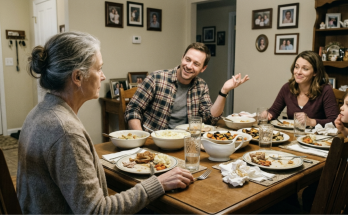
We sat down to dinner.
The four of us occupied the same places we had used before.
I noticed that immediately.
Daniel sat where he had sat on the night of the argument.
Marissa was beside him.
Oliver sat near me.
I looked at the plates.
Roasted chicken.
Mashed potatoes.
Green beans.
Nothing unusual.
For a moment, the ordinary appearance of the meal made me uneasy.
It looked so much like the dinners we had shared when they lived with me.
I wondered whether we would fall into the same habits.
Would Daniel start complaining?
Would Marissa make a remark about the food?
Would I begin watching everyone's expression, hoping they approved?
Then Oliver began talking.
He told me about school.
He spoke quickly.
Sometimes I had to ask him to slow down.
He laughed and started again.
I listened.
Daniel smiled occasionally.
Marissa asked Oliver a question.
The conversation stayed on ordinary things.
For several minutes, it was pleasant.
I found myself relaxing.
Marissa mentioned a project at work.
I asked how it was going.
She explained a little.
I listened without offering advice.
Daniel mentioned his second job.
He looked tired when he spoke about it.
I could imagine how difficult it was to work extra hours while trying to repay serious debts.
But I did not offer to take any financial burden away from him.
That was something I had learned.
I could acknowledge that his life was difficult without making it my job to rescue him.
He was thirty-six.
He had a wife and son.
He needed to learn how to support his household without depending on my savings.
I hoped the second job would help him do that.
Oliver asked for more potatoes.
I served him.
Then he asked about the garden again.
I laughed softly.
“The roses aren't going anywhere before dinner is finished.”
He smiled.
“I know.”
I watched him return to his food.
For a few minutes, the room felt comfortable.
No accusations.
No demands.
No discussion of money.
I began to believe we might get through the evening without revisiting the argument.
Then Daniel put down his fork.
He looked at me.
“Mom, there's something I want to say.”
I felt my shoulders tighten.
I looked at him.
“All right.”
He glanced toward Marissa.
She lowered her eyes.
Then he looked back at me.
“I've been thinking about what happened here.”
I knew what he meant.
I looked at the chair beneath him.
The same chair.
The same table.
Six months earlier, he had spoken with such confidence.
Now he looked uncertain.
He took a breath.
“I was sitting in this house, eating food you paid for, and I treated you like you were the one taking advantage.”
I remained quiet.
He looked down.
“I was using your vehicle. I wasn't paying rent. You were covering bills that should have been ours.”
Marissa did not interrupt.
Oliver continued eating.
Daniel looked at me again.
“And I called you a freeloader.”
The word seemed heavier now than it had when he first said it.
I remembered how it had made me feel.
Small.
Ashamed.
As though everything I had done meant nothing.
I kept my hands on the table.
Daniel swallowed.
“I don't have an excuse for that.”
I waited.
He continued.
“I don't know why I thought I could speak to you that way.”
I looked at him.
I had asked myself the same question many times.
How had my son reached a point where he believed my home was his to control?
How had he become comfortable taking so much without feeling grateful?
I knew it had not happened in one day.
I knew I had helped create the arrangement by refusing to set limits.
But the choices he made afterward belonged to him.
I took a breath.
“Daniel, people don't begin treating others that way all at once.”
He watched me.
“It happens gradually.”
He nodded.
I continued.
“You accept one favor and stop noticing it. Then you expect the next one. After a while, you begin acting as though someone owes you what they've been giving.”
He looked down.
I thought about how often I had paid for things without asking questions.
How often he had accepted.
How rarely he had considered what it cost me.
“That was what happened here.”
He nodded again.
“I know.”
I looked toward Oliver.
He was carefully cutting his chicken into small pieces.
I did not want to turn dinner into a long discussion of debts and wrongdoing.
But Daniel had begun the conversation.
And I wanted him to understand what he was apologizing for.
I looked back at him.
“I wasn't asking you to be perfect. I was asking you to respect me.”
His eyes filled.
“I didn't.”
“No.”
He rubbed his hands together.
“I've had a lot of time to think.”
I could see that.
He looked different from the man who had stood in my hallway demanding twenty thousand dollars.
He no longer seemed to believe that an explanation would automatically make everything acceptable.
He looked ashamed.
But I wanted that shame to lead somewhere useful.
Not toward another promise he would forget.
Toward different behavior.
Daniel reached into his pocket.
I watched him.
For a moment, I felt nervous.
The last time he had placed an envelope on my table, it contained a five-hundred-dollar check.
I had returned it because I wanted any repayment handled properly.
Now he took out another envelope.
He placed it beside my plate.
I looked at it.
“What's this?”
He kept his hand near it.
“Proof of another payment.”
I glanced at him.
“Toward what you owe me?”
He nodded.
“Yes.”
I opened the envelope.
Inside was a repayment receipt.
I examined it.
It showed another payment under the arrangement we had agreed upon.
It was not a large amount compared with everything he owed.
But it was real.
A payment made.
A record kept.
Not a promise about money he hoped to have someday.
I looked at the paper for a moment.
Then I looked at my son.
“Thank you.”
He nodded.
“I know it isn't enough.”
“It is part of what you're supposed to do.”
He looked at me carefully.
I continued.
“And I appreciate that you've done it.”
His expression softened.
For months, I had wondered whether Daniel understood that rebuilding trust required ordinary, repeated actions.
Keeping a job.
Following a budget.
Making payments.
Telling the truth.
He seemed to be trying.
I could acknowledge that without forgetting the past.
I placed the receipt back inside the envelope.
Then Daniel spoke again.
“There's something else.”
I waited.
He glanced toward Oliver.
Then he looked at me.
“I shouldn't have put him in the middle of our argument.”
My throat tightened.
I remembered Oliver standing beside me after Daniel told him that Grandma was angry.
I remembered Marissa threatening to keep him away.
I remembered his little drawing.
The house.
The watering can.
MY FAMILY.
Daniel continued.
“I was upset with you, and I made it sound like you didn't want us around anymore.”
I nodded slowly.
“That hurt him.”
“I know.”
He looked at Oliver.
Our grandson was busy with his dinner.
He did not seem to understand that we were talking about the fear he had carried months earlier.
Daniel looked back at me.
“He should never have had to worry about whether you loved him.”
I felt tears rising.
I had wanted Daniel to understand that more than almost anything.
The money mattered.
The loan mattered.
The stolen transfers mattered.
But Oliver had done nothing wrong.
He should never have been used to pressure me into changing my decision.
I looked at Daniel.
“I'm glad you can see that now.”
He nodded.
“I am sorry.”
I believed he meant it.
But I also remembered what I had told him at the coffee shop.
An apology was a beginning.
Not the end of the work.
I looked toward Marissa.
She had been quiet for most of the conversation.
Her fork rested beside her plate.
She was looking down.
I did not ask her to speak.
I had spent too many years trying to pull the right words out of other people.
If she had something to say, she could say it herself.
For several seconds, nobody spoke.
Then Marissa lifted her head.
“Clara?”
I looked at her.
“Yes?”
She seemed uncomfortable.
I could see she was choosing her words.
“I need to apologize too.”
I sat still.
She looked toward Daniel.
Then back at me.
“I was angry when you told us we had to move.”
I nodded.
“I know.”
She continued.
“I thought you were making things harder for us when we were already struggling.”
I listened.
She looked at the table.
“I kept thinking about what we needed. I didn't think enough about what we were expecting from you.”
Those words surprised me.
I had heard Marissa complain many times.
I had heard her accuse me of caring more about money than family.
I had heard her threaten to keep Oliver away.
Now she was acknowledging something different.
She took a breath.
“We treated your house like it was ours to use however we wanted.”
I looked at her.
She continued.
“And I spoke to you badly when you asked us to leave.”
Her voice was quiet.
“I shouldn't have done that.”
I waited.
She did not try to make another excuse.
She did not blame the apartment.
She did not blame my decision.
She simply looked at me.
“I'm sorry.”
I nodded.
“Thank you, Marissa.”
That was all I said.
I did not rush around the table to hug her.
I did not tell her that everything was forgotten.
I did not promise that our relationship would return to what it had been before.
I appreciated her apology.
But I needed time.
So did she.
I looked at Daniel.
He looked relieved.
I wondered whether he had expected me to say more.
Perhaps he had hoped I would tell them that we could forget the entire situation.
But I could not.
The investigations had not disappeared.
The repayments were still necessary.
Their debts remained their responsibility.
The apologies did not change those facts.
They changed something else.
For the first time, Daniel and Marissa were acknowledging that they had treated me unfairly.
Without demanding that I make them feel better afterward.
That was important.
I looked toward Oliver.
He had finished his chicken.
He was now looking at the remaining potatoes.
I smiled.
“Would you like a little more?”
He nodded eagerly.
I served him.
The conversation moved on.
Daniel asked about my garden.
Marissa mentioned how Oliver was doing in school.
Oliver began telling us something that had happened during the week.
I listened.
The room felt different.
Not perfect.
Not repaired.
But quieter.
The kind of quiet that came when nobody was trying to win an argument.
After dinner, Oliver reminded me about the roses.
I laughed.
“I haven't forgotten.”
He stood quickly.
I told him to slow down.
He smiled and waited.
We went toward the garden.
Daniel and Marissa followed.
I opened the door.
The evening air was pleasant.
Oliver hurried toward the flowers.
I watched him look around.
He seemed delighted that everything was still there.
The roses.
The path.
The watering can.
I stood beside him.
He pointed toward one plant.
“That one's bigger.”
I smiled.
“You're right.”
He looked pleased.
I handed him the watering can.
He began working carefully.
I watched the water fall onto the soil.
Behind me, Daniel and Marissa stood quietly.
For the first time in months, we were together in the garden without anyone arguing.
I did not know what our family would look like a year from then.
I did not know whether Daniel would continue making his payments.
I did not know whether Marissa and I would ever feel completely comfortable around each other.
But that evening, they had come as visitors.
They had brought dessert.
They had apologized.
And they had respected the fact that the house was mine.
When I looked toward the maple tree, I thought about my husband.
I wished he could have seen his son beginning to accept responsibility.
I wished he could have heard Daniel admit what he had done.
But I knew he would have wanted more than words.
He would have wanted Daniel to keep going.
So did I.
I turned back toward Oliver.
He was still watering the flowers.
He looked up and smiled.
For that moment, I let myself enjoy being his grandmother.
Nothing more was required of me.
Click here to continue reading: PART 11: A Year After My Son Moved Out, His Payments Continued, but My Grandson Asked Whether I Would Ever Let His Father Come Home
My Son Called Me a Freeloader at My Own Dinner Table, and My Grandson’s Question Made Everything Harder to Ignore
Part 10 of 15