After Margaret left that afternoon, I stayed in the garden a little longer.
The roses were blooming.
The wooden bench beneath the maple tree was warm from the afternoon sun.
I sat there thinking about the question my sister had asked.
Did I regret making Daniel leave?
I had answered no.
And I meant it.
But that did not mean I had stopped feeling sad about everything that happened.
I still remembered the way Daniel looked when I confronted him about the money.
I still remembered how he cried.
I still remembered the frightened expression on Oliver's face when he learned that his parents were moving.
Those memories had not disappeared.
I did not expect them to.
They were part of what had happened to our family.
I had simply learned that feeling sad about a decision did not automatically make it wrong.
For most of my life, I had struggled to understand that.
When Daniel was little, I wanted to make his world comfortable.
If he was disappointed, I tried to cheer him up.
If he was frightened, I reassured him.
If he needed help, I gave it.
There was nothing unusual about that.
I was his mother.
I wanted him to feel safe.
But somewhere along the way, I had forgotten that my role was supposed to change as he grew older.
Daniel was no longer a little boy who needed me to solve every problem.
He was thirty-six.
He had a wife.
He had a son.
And he needed to learn that being responsible for a family meant more than finding someone who would pay the bills.
I had spent years making that lesson easier for him to avoid.
It was painful to admit.
I had not meant to do it.
I had thought I was being generous.
I had thought I was protecting my family.
But protecting Daniel from every financial difficulty had allowed him to keep making decisions without fully facing their cost.
I could see that now.
When he first called about losing his apartment, I did not ask enough questions.
He was crying.
He said his business had gone badly.
He asked for three months.
I opened my home.
I did not establish clear expectations.
I did not insist on a written plan.
I assumed that because Daniel loved me, he would never take advantage of my generosity.
Looking back, that assumption makes me uncomfortable.
Love did not remove the need for honesty.
And trust did not mean I should stop paying attention.
I thought about the expense sheet.
Forty-seven thousand, eight hundred and sixty dollars.
Even after a year, the number remained difficult to accept.
It represented electricity.
Water.
Groceries.
Insurance.
Household expenses.
Personal bills that Daniel and Marissa should have handled themselves.
It represented two years of saying yes.
Two years of believing that the next month might be different.
Two years of treating their needs as more urgent than my own.
And that was before I discovered the money Daniel had taken without permission.
The $8,500.
The three transfers.
I could still remember the bank representative showing me the entries.
One transfer for $4,800.
Another for $2,200.
A third for $1,500.
At first, I had hoped there was an explanation I had forgotten.
Perhaps I had authorized something and misplaced the paperwork.
Perhaps the transactions belonged to an expense I no longer remembered.
But Daniel had admitted the truth.
He had taken the money.
He had expected to replace it.
And he had never asked me.
I looked down at my hands.
I had worked for that money.
I had saved it.
At sixty-seven, I could not simply replace large amounts whenever someone needed help.
My income was fixed.
My future depended on the decisions I made with what I had.
That had been true even while Daniel lived with me.
But I had acted as though my savings were available whenever his finances became difficult.
He had eventually begun acting the same way.
I understood my part in that pattern.
But I also understood where my responsibility ended.
I had been too generous.
Daniel had chosen to take money without permission.
Those were not the same mistake.
I needed to remember that.
For a long time, whenever I thought about what Daniel had done, I began searching for ways to blame myself.
Perhaps I had raised him incorrectly.
Perhaps I had been too soft.
Perhaps I should have asked more questions when his business began struggling.
Some of those questions were worth considering.
But they did not change the fact that he was an adult when he made those choices.
He knew the money belonged to me.
He knew he had not received permission.
He knew I had never agreed to guarantee a thirty-eight-thousand-dollar loan.
And he had gone ahead anyway.
I could acknowledge my mistakes without taking responsibility for his.
That was one of the hardest lessons I had learned.
I looked toward the house.
The curtains moved slightly near the kitchen window.
Everything was still.
I remembered the evening I stood in my bedroom searching for the missing financial folder.
I had looked through the safe.
Then the drawers.
Then the study.
I had wanted to find it so badly.
Not because the documents were irreplaceable.
Because finding the folder would have allowed me to believe Daniel had never touched anything without asking.
I had not wanted to suspect him.
Even after discovering the loan agreement, part of me continued searching for an explanation that would make everything less painful.
But the truth had become impossible to avoid.
I could no longer give Daniel unrestricted trust simply because he was my son.
I had to consider his actions.
Not only his intentions.
That was something Robert Hayes had helped me understand.
During the financial investigations, I had learned to separate facts from assumptions.
I knew the loan carried a signature I had not written.
I knew the lender had identified serious irregularities.
I knew the matter had been referred to the appropriate authorities.
I knew Daniel had admitted taking money from my account.
There were still details I could not personally explain.
But I did not need to invent answers.
I only needed to remain honest.
That had become my approach to the entire situation.
When I spoke with Robert, I told him what I knew.
When the lender requested information, I provided it.
When the bank reviewed the unauthorized transfers, I cooperated.
I did not protect Daniel by hiding the truth.
And I did not try to hurt him by exaggerating it.
That balance mattered to me.
He was my son.
I wanted him to have a future.
But I no longer believed his future depended on my willingness to absorb every consequence of his mistakes.
In fact, I had begun to believe the opposite.
Daniel needed to learn that responsibility continued even when someone loved him.
He needed to repay money he had taken.
He needed to work through his debts.
He needed to understand how his decisions affected Marissa and Oliver.
And he needed to do those things without expecting his mother to rescue him whenever he became uncomfortable.
I thought about our meeting at the coffee shop.
Daniel had looked different that afternoon.
Tired.
Less confident.
More willing to listen.
He told me about his second job.
He admitted that he could not keep blaming Marissa for everything.
He asked whether he could ever make things right.
I remembered how much I wanted to say yes.
I wanted to promise him that time would fix everything.
But I had learned not to make promises just to relieve someone else's discomfort.
So I told him I did not know.
Trust would return only if his actions supported it.
I could not give him a date.
I could not give him a shortcut.
And I could not do the work for him.
He had seemed disappointed.
I understood why.
For years, I had made difficult things easier.
Now I was asking him to live with uncertainty.
To keep doing the right thing without knowing exactly when he would be forgiven.
I hoped he understood that this was part of becoming responsible.
Sometimes there was no immediate reward.
Sometimes the only thing to do was continue.
Make another payment.
Tell the truth again.
Keep another promise.
Repeat those choices until they became habits.
That was what I needed to see from him.
And I had begun seeing some of it.
The repayments continued.
Daniel and Marissa were learning to budget.
They lived in an apartment they could afford.
They were making decisions without assuming I would pay the difference.
That was progress.
I was glad.
But I did not need to reward that progress by giving him back the financial access he had misused.
My bank passwords remained private.
My cards remained in my possession.
My important documents stayed secured.
The SUV keys hung beside the garage door.
I had stopped treating those boundaries as something shameful.
They were ordinary precautions.
The kind I should have taken long before the argument.
I rose from the bench and walked toward the house.
Inside, I put the kettle on.
Then I stood beside the counter while the water heated.
I thought about how different my days had become.
I no longer woke wondering what Daniel needed.
I no longer checked whether Marissa had used my groceries without replacing them.
I no longer listened for arguments about bills.
I could decide when to cook.
I could leave the house without explaining where I was going.
I could attend book club.
I could have dinner with Margaret.
And I could spend an afternoon in the garden without feeling guilty about ignoring someone else's problem.
These were ordinary freedoms.
I had not realized how much I missed them.
I poured my tea.
Then I sat at the kitchen table.
The same table where Daniel had once accused me of taking advantage.
I looked at his old chair.
I no longer felt the need to avoid it.
It was simply a chair.
A place where my son had made a hurtful accusation.
A place where we had later shared a different conversation.
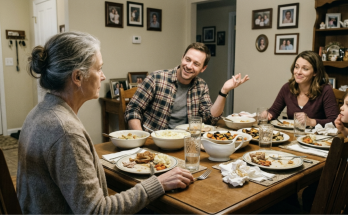
I remembered the Sunday dinner six months after they moved out.
Oliver had brought flowers.
Daniel had brought dessert.
Marissa had arrived looking uncomfortable.
We had eaten together.
Then Daniel apologized.
He acknowledged that I had paid for the food, the house, and the expenses he had taken for granted.
He admitted that he had no right to call me a freeloader.
I remembered the relief I felt hearing those words.
Not because an apology erased everything.
Because he finally seemed to understand what he had done.
Then he showed me proof of another repayment.
That mattered more than a long speech.
It was evidence of action.
Marissa had apologized too.
She admitted that she and Daniel had behaved as though my home belonged to them.
I appreciated hearing that.
For months, I had wondered whether she would ever recognize how unfairly she had treated me.
I did not suddenly feel close to her.
But I no longer felt that every conversation had to become a fight.
We could be polite.
We could share a meal.
We could focus on Oliver.
That was enough for the time being.
I did not need every damaged relationship to return immediately to what it had once been.
Some things required patience.
Other things required distance.
And I was learning to accept both.
I looked toward the garden again.
Oliver had helped water the flowers during his last visit.
He had asked whether I enjoyed living alone.
Then he asked if Daniel would ever live with me again.
I remembered kneeling beside him.
I had told him I loved his father.
I had also told him that Daniel needed to take care of his own home.
Oliver accepted my answer.
Then he returned to watering the flowers.
I had worried for months that he would think I had stopped loving his family.
But he was beginning to understand that love did not require everyone to live together.
He still visited.
We still baked.
We still laughed.
He still called me Grandma with the same excitement.
I had not lost him because I set boundaries with his parents.
That meant more to me than I could easily explain.
I took another sip of tea.
I thought about the day Daniel moved out.
He had offered me a check for five hundred dollars.
I had returned it because I wanted repayment handled properly.
At the time, I saw disappointment on his face.
Perhaps he thought I was rejecting his attempt to make things right.
But I had needed him to understand that money could not be offered casually one day and forgotten the next.
There needed to be a plan.
He had eventually agreed to one.
And now he was making payments.
I was glad I had insisted.
That decision had been another small boundary.
Another moment when I chose something difficult over something comfortable.
The more I thought about the past year, the more I realized that none of the important changes had been dramatic.
The argument had been dramatic.
The discovery of the loan had been frightening.
The moving truck had been painful.
But the changes afterward were quiet.
A password changed.
A document secured.
A repayment recorded.
A difficult conversation held without shouting.
A dinner invitation accepted without giving up control of my home.
Those were the things that had helped me rebuild my life.
I looked at my reflection in the kitchen window.
I was still sixty-seven.
I still missed my husband.
I still worried about Daniel.
I still loved Oliver more than I could explain.
But I was no longer willing to measure my worth by how much I could give away.
I had spent enough years doing that.
I thought about the promise I had once made to myself when Daniel was a baby.
I wanted him to know he would always be loved.
That promise had not changed.
What had changed was my understanding of what love required.
I could offer guidance.
I could listen.
I could encourage him when he made responsible choices.
I could welcome him for dinner.
But I could not take over his debts.
I could not forgive financial wrongdoing by pretending it never happened.
And I could not place my retirement at risk because my son was afraid of admitting he had failed.
I stood and carried my cup to the sink.
Outside, the garden looked peaceful.
I knew there would still be difficult conversations.
Daniel had more repayments to make.
The effects of his decisions had not disappeared.
Trust was still being rebuilt.
But I no longer woke each morning expecting to solve everything.
My son had his responsibilities.
I had mine.
And for the first time in years, I was allowing those responsibilities to remain where they belonged.
Click here to continue reading: PART 14: My Son Was Still Rebuilding His Life, but I Had Finally Stopped Confusing a Mother’s Love With the Obligation to Rescue Him
My Son Called Me a Freeloader at My Own Dinner Table, and My Grandson’s Question Made Everything Harder to Ignore
Part 13 of 15